OTTOMAN QUR'AN COPIED IN BULGARIABiblio.com
1 101 résultats
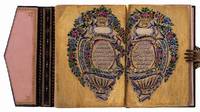
63854Ottoman Empire dated 1266 AH/1849-50 AD. Arabic manuscript on paper 308 leaves plus 4 fly-leaves 15 lines to the page written in naskh in black ink verses separated by gold and polychrome illuminated rosettes within gold and black rules hizb sajda and juz' marked by illuminated floral marginal devices surah headings in white thuluth on gold and polychrome illuminated panels f.1b and 2a illuminated in gold and polychrome with rococo floral decoration against a gold ground pin-pricked with cintamani motifs the colophon within similarly illuminated panels in Ottoman gilt dark brown leather binding with flap with fitted box. Text panel: 8 by 5.1cm. Leaf: 12.5 by 8.2cm. Isma'il Najib is recorded as a pupil of Ahmed Zarifi and teacher to Tentene-zade Seyyid Hasan Vehbi Stanley 2009 p.248. Further Qur'ans by the scribe have sold in Christie's London 26 April 2018 lot 177; 26 October 2017 lot 229 and 12 October 1978 lot 7 and another was sold at Sotheby's London 21 November 1985 lot 390. The latter example is illuminated in a very similar manner to the present lot in a fully Rococo style unlike the typical Shumen style of illumination. In the 19th century one of the most important places of Ottoman manuscript production was Shumen a strategically-important fortress in what is today Bulgaria. Tim Stanley and Süheyl Ünver have independently worked on the corpus of manuscripts there identifying more than fifty Qur'anic scribes from the town apparently divisble into three groups according to their original teacher: Seyyid Mehmed Nuri Ahmed Zarifi and Ahmed Nazifi Tim Stanley The Decorated Word volume II. Oxford 2009 p.226. By the 1850s Qur'ans from Shumen had come to be remarkably homogenous: all observe the principle of ayet ber kenar in which every page ends with a completed Qur'anic verse; all are written with 15 lines of text to a page; all have between 300 and 310 pages. The dimensions of these manuscripts are also fairly constant. Although these manuscripts were produced in quantities to make them available to many relatively prosperous subjects of the Ottoman Empire Shumen Qur'ans were presented by Ottoman sultans to important figures including Ali Rif'at Pasha the Khedive of Egypt and al-Husayn Sharif of Mecca. The production of Qur'ans in Shumen came under increasing pressure with the rise of lithographic printing and came to a complete stop with Bulgarian indepedence in 1878. For a fuller discussion of the Shumen school of calligraphy see Tim Stanley "The Shumen Phenomenon" The Decorated Word volume II. Oxford 2009 pp.222-51. The illumination of Shumen manuscripts - though united by a Baroque idiom and a bright pastel colour palette - exhibits some variety suggesting that there were several different schools of illumination in the city alongside the numerous calligraphers. Ottoman Empire, dated 1266 AH/1849-50 AD. hardcover
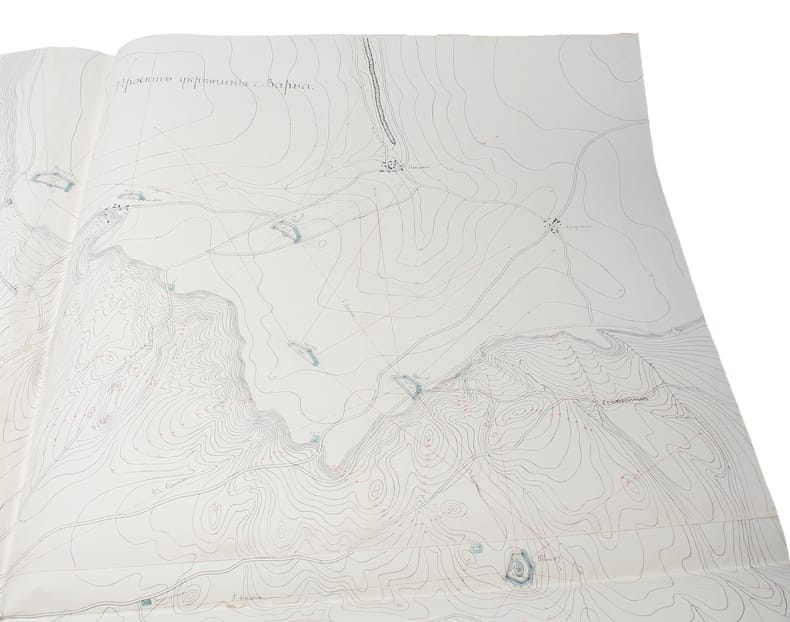
59218Varna 1888-89. 131 x 126 cm. joined by 4 sheets. Large manuscript surveying map of the fortress of Varna and its vicinity of with contour lines and defensive fortresses, including the fortified lines along the Black Sea coast. Depicting in all 19 defensive installations in all directions from Varna. Surveyed by the Russian captain, Kapitan Scrodel'uikov. Pen and ink with watercolour. With scale. On good thick paper. With 4 small punched holes (stars).
59218Varna 1888-89. 131 x 126 cm. joined by 4 sheets. Large manuscript surveying map of the fortress of Varna and its vicinity of with contour lines and defensive fortresses including the fortified lines along the Black Sea coast. Depicting in all 19 defensive installations in all directions from Varna. Surveyed by the Russian captain Kapitan Scrodel'uikov. Pen and ink with watercolour. With scale. On good thick paper. With 4 small punched holes stars. unknown
3241Paris, Guillermun LE BRET (Jean Petit), 1542 (1er texte) et 1543 (2ème). In folio (29 cm), 8 + 199 folios (1er texte) et 9 + 269 folios. Pages de titre à encadrement. Gravure sur bois pleine page au verso de la deuxième page de titre (représentation de l'
in-4. 16, 100. leg. piena pelle con piccoli restauri.greek bulgaria bulgarian Typographia regia first edition theophylacti editio princeps byzantine instuction politics archivio b
Good Turkish, Ottoman (1500-1928) Original wrappers. Roy. 8vo. (23 x 16 cm). In Ottoman script (Old Turkish with Arabic letters. 120 p., several tables of zones and routes. Slight foxing on cover, fading on pages, chippings on extremities of cover and some pages, repaired spine. Otherwise a good copy. First and only Turkish edition of this rare description of the Black Sea, including the historical geography of the western shores of the region, written in a travelogue style, by Bulgarian admiral Ivanov when he was the head of the Naval School in Varna (1928-1931) where he lectured on meteorology, oceanography and naval aviation for officers and conducted the seamanship course for the civil navy. Ivanov was a Bulgarian officer and admiral and a freemason, who was a member of the "Black Sea Friends" Lodge. He is a descendant of Kolyo Ficheto. In 1910, he graduated from the Military School in Sofia, and in 1914, he also completed a naval cadet course in St. Petersburg. From 1912 to 1913 he served in the Port Company of the Navy. During the period March 30, 1913 - September 1, 1913, he was the chief of the ship "Druzki". In the same year, he also served on the ship "Nadezhda". From 1914 he was adjutant of the Mobile Defense and flag officer of the destroyer detachment. He participated in World War I. Özege 10186.; Six copies can be traced in OCLC: 977483558.; 949487717.; 67339656.; 1030754762.
Milano, Arti Grafiche Milanesi, 1927-1934, 3 annate complete + 44 fasc. (3 doppi, uno quadruplo) complessivi, raccolti in voll. 19, copp. fittizie (ma conservate le br. edit. dei fasc.), pp. da 96 a 380 ciascuno. Con ill. in b.n. e pubblicità. Asportate le pp. 1-20 dei nn. 2, 8 1927. Alcune adesioni. Grandi opere, politica sociale, economia corporativa, commercio estero e coloniale, emigrazione, turismo, viabilità, mostre e fiere, ecc. Testi di A.G. Bragaglia, E. Susmel, G. Provenzal, V. Gorresio, G. Rasi, D. Grandi, E. Bravetta, V. Ducrot, ecc. Segnaliamo articolo in due parti di R. Sacchetti sulla V Triennale, coordinata da: Sironi, Carrà, Funi, De Chirico, Severini Depero; architettura moderna, sia d'interni (Portaluppi, Fontana, Ulrich, Langer) che in istallazioni esterne: Scoccimarro, Zanini, Midena per la Casa dell'Aviatore, Portaluppi per la Casa del Sabato, la Villa per un artista di Pollini & Figini; la stazione per Aeroporto Civile di Prampolini con mobili di Colombo, decorazione murale di: Prampolini, Depero, Dottori; mostre sulle arti decorative in stile moderno; il tutto corredato da numerose ill. Inoltre un intero numero dedicato alla Bulgaria, un'altro alla Svizzera; articoli d'interesse su: gli Stabilimenti cinematografici Cines-Pittaluga, l'Istituto Poligrafico dello Stato, la IV Mostra Naz. della Radio, produzione e pubblicità (Nizzoli, Cappiello)...
Milano, Arti Grafiche Milanesi, 1927-1934, 3 annate complete + fasc. 44 (3 doppi, uno quadruplo) complessivi, raccolti in voll. 19, copp. fittizie (ma conservate le br. edit. dei fasc.), pp. da 96 a 380 ciascuno. Con ill. in b.n. e pubblicità. Asportate le pp. 1-20 dei nn. 2, 8 1927. Alcune adesioni.
In 12°; 125, (9) pp. e 120 pp. Legatura coeva in piena pelle con cornice a doppio filetto a secco ai piatti. Filetti e autori e titolo in oro al dorso. Testi in greco e latino a fronte. Seconde rare edizioni, quanto le prime, pubblicate per la prima volta a Roma l'anno precedente, di due opere dell'antichità classica andate a lungo perdute. La prima opera è uno scritto del filosofo neoplatonico Sallustio che visse a Roma nel IV secolo. Amico personale dell'imperatore romano Giuliano condividendone il programma di restaurazione dell'antica religione romana. Persona dalla profonda saggezza fu apprezzato anche da almeno altri tre imperatori che successero a Giuliano che gli confermarono la carica di prefetto del pretorio d'Oriente. Libanio lo lodò come funzionario incorruttibile, Imerio gli indirizzò un'orazione in cui lo definiva un vero servitore e rappresentante dello stato: Gli stessi cristiani, che subirono le persecuzioni di Giuliano, anche su suggerimento dello stesso Sallustio, ne lodarono, nonostante tutto l'equilibrio. Fu persona dalla notevole erudizione. Pur mutuando numerose tesi da diversi neoplatonici, Sallustio seppe elaborare alcune teorie del tutto originali come ad esempio, quella sull'origine del “male”. Sallustio scrisse il trattato qui presentato, dedicato all'importanza degli dei e del loro culto, presumibilmente, come parte degli sforzi dell'imperatore Giuliano per rafforzare l'antica religione pagana contro il cristianesimo che si stava affermando. Il testo rimase sconosciuto per numerosi secoli, fino a quando il noto studioso e teologo, Leone Allacci (Chio, Chios in greco, 1586 circa – Roma, 19 gennaio 1669) lo rinvenne fra i manoscritti conservati della Biblioteca Vaticana. L'opera fu curata e tradotta in latino, dal filologo di Amburgo Lukas Holste (1596-1661), segretario e bibliotecario del cardinale Francesco Barberini prima ed in seguito, bibliotecario del Vaticano. La seconda opera raccoglie le sentenze morali pitagoriche del filosofo Pseudo-Demofilo. Anche questa è una seconda edizione dopo la prima edizione romana dell'anno precedente. Testo greco con a fronte traduzione latina a cura di Lucas Holstenius. Infine, alle pagine 104-109, ci sono versi del bibliotecario bulgaro Johannes Pediasimus sugli orrori o le gioie della cattiva o buona moglie: Desiderium. De muliere mala - de muliere bona. Rif. Bibl.: Per la prima opera: Goldschnitt Hoffmann III, 528; Schweiger I, 284; Houzeau/Lancaster I, 1027. Per la seconda opera: Schweiger I, 86; Hoffmann II, 10 (sotto Demophilus).
Very Good French Original wrappers. 4to. (27 x 19 cm). In French. 235 p. A fine copy. First and only edition of this protocol text of the 1878 Treaty of San Stefano (Peace treaty of San-Stefano) signed between the Russian and Ottoman empires at the conclusion of the Russo-Turkish War of 1877-1878. It was signed at San Stefano, then a village west of Constantinople (present-day Istanbul), on 3 March [O.S. 19 February] 1878 by Count Nicholas Pavlovich Ignatiev and Aleksandr Nelidov on behalf of the Russian Empire and by Foreign Minister Saffet Pasha and Ambassador to Germany Sadullah Bey on behalf of the Ottoman Empire. Starting with the documents "Bases d'Armistice, signees an Andrinople le 19/31 Janvier 1878, entre la Russia et la Turquie" [i.e. Armistice bases, signed in Adrianople on January 19/31, 1878, between Russia and Turkey] and "Preliminaires de Paix conclus a San-Stefano, le 19 Fevrier / 3 MArs 1878" [i.e. Preliminaries of Peace concluded at San-Stefano, February 19 / March 3, 1878], with the treaty protocol text containing 50 articles in its entirety, provided for the establishment of an autonomous Principality of Bulgaria following almost 500 years of Ottoman rule in the Bulgarian lands. Bulgarians celebrate the day the treaty was signed, 3 March [O.S. 19 February] 1878, as Liberation Day. OCLC: 320195160, 962446088.
Profusely illustrated with wonderful black and white photos and illustrations. Features: Hunting the Opium Smugglers - Author attempts to capture Chinaman who was causing much trouble by smuggling opium into a South Sea Island; Photograph from Hong Kong of a "Punishment Chair" upon which a bound criminal sat upon eleven knives and was then carried through the streets as a lesson to others; With "Lizzie" to the Edge of Beyond - An old Ford car takes four passengers and a heavy load seven hundred miles through Central Africa; The Faithful Burglar - a story involving psychic phenomena from Ray Bell's Tie-Camp at Shabaqua, Ontario - with photo; Through Savage Europe - Part II - Richard Carline continues to describe his painting tour through Serbia, Bosnia, and Montenegro; The Devil Panther - Two British hunters pursue a feared killer panther in India; What Happened to Hubbard? - Sequel to "Where the Gold Went" in which Charles A. Siringo described how Schell and Hubbard stole a quantity of gold from the famous Treadwell Mine in Alaska - describes how Hubbard went on to success in Dawson City; Roaming the Wild South Seas - Part IV (conclusion) - Jack McLaren describes the romance and adventure of the South Sea Islands - article with photos; A Run for Money - Author attempts to smuggle a ranch payroll through a Mexican rebel zone; Photo of Filipino "Tom Thumb", Panglima Diki-Diki; The "Human Bomb" - Update on a 1913 story about Carl Warr who walked into the Los Angeles Police Headquarters with enough dynamite to blow it up; Across the Great Sahara - Part III - A journey by camel across the Sahara from bottom to top - article with many excellent photos; The Sheep-Shearer - A sailor's amusing story about a machine invented by his second engineer; At Grips With a Python - Nighmare experience for a South African farmer; The Ghost of Ardtrea - An odd story from County Tyrone, Ireland describing events in an old rectory; A Week End in Bulgaria - Quaint glimpses of Bulgarian manners and customs by traveller Ralph Michaelis. 88 pages. plus 16 pages of nostalgic ads. Nibbling to backstrip has left the back cover barely holding, otherwise clean and unmarked with light wear. A quality vintage copy. Book
Very Good Turkish, Ottoman (1500-1928) Paperback. Roy. 8vo. (23 x 16 cm). In Ottoman script. 185 p. Some stains on cover and interior. Pages are very clean. Faded on margins slightly. Otherwise a good and clean copy in its original wrappers. The work, which could not be published due to the war despite the necessary permission to be published while its author was alive, was admired by those who read it before it was published, and some copies were sent to well-known authors and intellectuals of the period such as Nâmik Kemal and Recâizâde Ekrem and were appreciated by them. Completed by Râci Efendi in 1897 and published by Necmi Râci who was his son artillery major after Raci Efendi's death as a posthumous edition, the work consists of three sections under the titles "History-i Vak'a-i Zagra" [i.e. History of the events in Stara Zagora], "Hercümerc-i Kit'a-i Rumeli" [i.e. Chaos in the Rumelia Army] and "Hicretnâme" [i.e. The book of migration]. The first part, with a short introduction by Necmi Râci and the author at the beginning, was written in a style of "memoirs" and begins with the entry of the Russians into the Ottoman lands by crossing the Danube River on 21 June 1877; The news of the invasion reaching the Old Zagra, the anxious waiting here, the persecution of the Bulgarians during the Russian invasion, the rescue of the town by the Ottoman army under the rule of Süleyman Pasha, and it ends with the depiction of the immigration and the disasters that took place with a short account of Stara Zagora and environs. The first part of the second chapter summarizes the military operation on the Rumelia front during the Ninety-Three War [i.e. '93 Harbi - Russko-Turetskaya voyna 1877-1878 - Russo-Turco War 1877-78], and the mistakes made during this time and what they cost are explained. The events that took place since the beginning of January 1878, when the Russians occupied Zagra and the surrounding towns for the second time, the situation of the Muslims and the sad scenes of the second migration are described, and parts of the articles of foreign journalists who saw this disaster are also quoted. Huseyin Râci Efendi was a müfti (clergyman) in Stara Zagora during the Russo-Turkish War of 1877-1878. (Source: Islam Ansiklopedisi). This war was a conflict between the Ottoman Empire and the Eastern Orthodox coalition led by the Russian Empire and composed of Bulgaria, Romania, Serbia, and Montenegro. Fought in the Balkans and in the Caucasus, it originated in emerging 19th-century Balkan nationalism. Additional factors included Russian goals of recovering territorial losses endured during the Crimean War of 1853-56, re-establishing itself in the Black Sea, and supporting the political movement attempting to free Balkan nations from the Ottoman Empire. The Russian-led coalition won the war, pushing the Turks back all the way to the gates of Constantinople but for the timely intervention of the western European great powers. (Wikipedia). Roumi 1326 = Gregorian 1910. Özege 19975. Extremely rare.
Good Turkish, Ottoman (1500-1928) Original wrappers. Tear on the upper left side of front cover, chippings on extremities. A good copy. Roy. 8vo. (24 x 17 cm). In Bulgarian. 107 p. First and only edition of this scarce early book in Bulgarian, printed in Constantinople (Macedonian Printing House) on the history of the Archbishopric of Ohrid, also known as the Bulgarian Archbishopric of Ohrid, which was an autocephalous Eastern Orthodox Church established following the Byzantine conquest of Bulgaria in 1018 by lowering the rank of the autocephalous Bulgarian Patriarchate due to its subjugation to the Byzantines. In 1767, the Archbishopric's autocephaly was abolished, and the Archbishopric was placed under the tutelage of the Patriarchate of Constantinople. 13 copies in OCLC: 793578483, 48911077.
Very Good Turkish, Ottoman (1500-1928) In full leaher bdg. Cr. 8vo. (19 x 13 cm). In Ottoman script. 91 p., b/w ills. According to the Zâtî's work, Between the Balkan States which constructed regular army system newly Bulgaria had the most powerful army. Moreover, as in the case of Montenegro, with the encouragement of national feeling a country with a small army can achieve a historic victory. The defeat of the Ottoman Empire in the First Balkan War, to which Ottomans began at a superior level compared to enemies, proves this defeat was due to political reasons. Zâtî's work has some details of Balkan geography and its demographic structure and idea of Turkish / Ottoman nationalism. One copy in OCLC in Leiden University Library: 777192829.; Özege 2644.; TBTK 6872. First and Only Edition. Extremely rare.
2020DBS-9781774072004ARCLER PRESS 2020. 1st. Hardcover. New. ARCLER PRESS hardcover
2020DBS-9781774072004ARCLER PRESS 2020. 1st. Hardcover. New. ARCLER PRESS hardcover
2021DBS-9781774077719ARCLER PRESS 2021. 1st. Hardcover. New. ARCLER PRESS hardcover
2021DBS-9781774077719ARCLER PRESS 2021. 1st. Hardcover. New. ARCLER PRESS hardcover
2021DBS-9781774077726ARCLER PRESS 2021. 1ST. Hardcover. New. ARCLER PRESS hardcover
2021DBS-9781774077726ARCLER PRESS 2021. 1ST. Hardcover. New. ARCLER PRESS hardcover
2021DBS-9781774077702ARCLER PRESS 2021. 1ST. Hardcover. New. ARCLER PRESS hardcover
2021DBS-9781774077702ARCLER PRESS 2021. 1ST. Hardcover. New. ARCLER PRESS hardcover
1862PHO-915Paris, Didier et Cie., 1862. relié demi-percale , dos à nerfs avec auteur et titre ,IV, 556 pp., quelques rousseurs et un cahier bruni sinon bon exemplaire dans une reliure solide.
1862R77746Petit-Montrouge, J.-P. Migne 1862 Complete in 2 volumes: 1384 + 1296 columns, text printed in 2 numbered columns, 28cm., hardback (bound in nice cart. covers, marbled plates, spine in cloth with gilt lettering), original 18-edition, in the series "Patrologiae Cursus Completus Series Graeca. Patrologiae Graecae, latine tantum editae" Tomi LXIII-LXIV (63-64), some occasional foxing, stamp on titlepage, Text in Latin, Good condition, [continuation of title: "... praecedit J.F. Bern. Mariae DE RUBEIS Dissertatio de Theophylacti gestis, scriptis et doctrina"], R77746
Complete in 2 volumes: 1384 + 1296 columns, text printed in 2 numbered columns, 28cm., hardback (bound in nice cart. covers, marbled plates, spine in cloth with gilt lettering), original 18-edition, in the series "Patrologiae Cursus Completus… Series Graeca. Patrologiae Graecae, latine tantum editae" Tomi LXIII-LXIV (63-64), some occasional foxing, stamp on titlepage, Text in Latin, Good condition, [continuation of title: "... praecedit J.F. Bern. Mariae DE RUBEIS Dissertatio de Theophylacti gestis, scriptis et doctrina"], R77746