18 204 résultats
Corners are lightly bumped. ; 98 pages
Lucy Flecker, a widow and grandmother, sets her family into disarray when it is unexpectedly revealed that she has been left a beautiful house in Greece, by famous archaeologist Oliver Lussom, who it is alleged, has been her lover. Her family assumes that she will sell her legacy, but against their wishes the sixty-three-year-old woman decides to return to Greece and, in the process, irrevocably changes her life. Book
Covers period up to 1976. "Modern Greece tells the story of Greece and its people, from the founding of Constantinople to the eclipse of socialism in the late twentieth century. C. M. Woodhouse is uniquely qualified to write the history of Greece, having served there in the Allied military and the British embassy during and after World War II before writing several books on Greece. In this classic work, which Woodhouse has updated five times to create a truly comprehensive history, the depth of his knowledge and understanding of the country and its citizens comes through clearly in every chapter, as he ranges from the ascendancy and eventual fall of the Byzantine Empire through the emergence for the first time of a unified Greek kingdom in the 1800s to the political turmoil of twentieth-century politics. This is a book for readers and travelers who wish to understand the history and culture behind the beauty that is eternal Greece." 352p. bibliography.index Book
Covers period up to 1985. 352p. bibliography.index "Modern Greece tells the story of Greece and its people, from the founding of Constantinople to the eclipse of socialism in the late twentieth century. C. M. Woodhouse is uniquely qualified to write the history of Greece, having served there in the Allied military and the British embassy during and after World War II before writing several books on Greece. In this classic work, which Woodhouse has updated five times to create a truly comprehensive history, the depth of his knowledge and understanding of the country and its citizens comes through clearly in every chapter, as he ranges from the ascendancy and eventual fall of the Byzantine Empire through the emergence for the first time of a unified Greek kingdom in the 1800s to the political turmoil of twentieth-century politics. This is a book for readers and travelers who wish to understand the history and culture behind the beauty that is eternal Greece. Book
192 p. plates bibliography. index Book
"The efforts of the British philhellenes in the Greek War of Independence have never been forgotten by the Greeks. The British themselves, however, have been slow to honour their fellow-countrymen who fought for the first of the new nation states to achieve independence in the nineteenth century. In this account of the movement at home and in the field, Mr. Woodhouse shows that it did not consist merely of Byron plus an entourage of eccentrics, ruffian, and romantics, though there were plenty of all three. They were part of an international movement of protest in which nationalism, religion, radicalism and commercial greed all played a part, as well as sentiment and pure heroism. This is an attempt to widen the context." 264p. bibliography. index Book
(New - will be sent to you direct from the publisher in Greece) Rhigas of Velestino (1757-1798), popularly known as Rhigas Pheraios, is one of the greatest national heroes of modern Greece for it was he who some thirty years before the outbreak of the Greek War of Independence in 1821 first conceived the possibility of a full-scale national revolution to free Greece from the domination of its Ottoman overlords. His aim was not simply an armed rebellion but a regeneration of his people, through education, literature and social and political awareness. To this end he wrote patriotic stories, poems, scientific lectures, he published maps and translations, and drafted a constitution, and he was the first Greek to insist that the popular language, or demotic Greek, should become the country's official language. But he was not to witness the realisation of his vision. On his way up to stir up the Greeks of the Mani he was betrayed, arrested in Trieste by the Austrian police, extradited to the Turkish authorities and executed, with seven colleagues, at Belgrade. This book is the first comprehensive study of Rhigas's life and ideas in English, and includes 14 black and white illustrations. Book
19788234Ams Press. 1978. Hardcover. Good in No Dust Jacket dust jacket. Ex-library copy with usual stamps call numbers and pocket. Shelfwear.; English translation of Thucydides' De bello peloponnesiaco book V chapters 61-75 followed by the author's interpretation of the events therein described. Reprint of 1933 edition.; 161 pages . 0404153577 . Ams Press hardcover
19789609Ams Press. 1978. Hardcover. Near Fine in No Dust Jacket dust jacket. Very light shelfwear. Else fine.; English translation of Thucydides' De bello peloponnesiaco book V chapters 61-75 followed by the author's interpretation of the events therein described. Reprint of 1933 edition.; 161 pages . 0404153577 . Ams Press hardcover
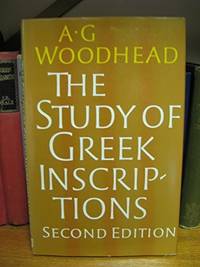
198140293Cambridge University Press. 1981. Second Revised Edition. Hardcover. Good in Good dust jacket. Ex-library copy with usual stamps call numbers and pocket. Tape stains to boards. A few tears to DJ.; 150 pages; Contents: Signs and symbols; the origin and development of the greek alphabet; boustrophedon and stoichedon; classification of inscriptions; dating of inscriptions; restoration of inscriptions; squeezes and photographs; inscriptions in the history of greek art; epigrahic publications; some miscellaneous information. . 0521231884 . Cambridge University Press hardcover
2004EEzz8004Cambridge Univ. Press (2004). 163 S., 3 w. Bl., mit 141, tls. farb. Abb., flex., farb. ill. OKart., Vorderdeckel etw. aufgebogen.
(Cambridge Introduction to World History Series) Introduction to the Archiecture and art of the Parthenon.48p. illus diagrams glossary, Contents complete, Library stamps and label Ex-Library
a "fascinating and scholarly overview " of the world in the 6th.C. BC. " .the time of Xenophanes, Cyrus, Solon the Lawmaker, Sappho,The Buddha ,Aeschylus,Pythagoras, Confucius, Lao-Tzu, and Nebuchadnezzar." 260p. bibliography.index Bookplate inside front cover. else fine Book
272 p., illus. Based on the BBC TV series. Hardcover Very good condition good
For thousands of years, and in many different cultures, cities, and states, individuals have consulted oracles in time of need. In this fascinating exploration of the history and enduring popularity of oracles, Michael Wood examines how they are interpreted and why.The inherent ambiguity of many oracular pronouncements and the ingenuity and tendentiousness of many readings of them form the basis for Woods analyses of oracles, both real and imagined. Using examples from actual oracles at Delphi, Dodona, and in pre-Hispanic America to fictional-but influential-oracles in literature from Oedipus to Macbeth, Wood combines storytelling and commentary to provide an entertaining and concise account of humanitys persistent faith in signs. He also looks at later instances of oracles, arguing that consultations have evolved in many ways over the years, and that echoes and survivals of old practices in modern literature and popular culture.continue to exert an important influence over human civilization. Lively, engaging, and remarkably revealing, The Road to Delphi shows an ancient art at work in many times and places, and invites us to think again about the ways in which we deal with our longing for the certainties we know we cant have.271p. bibliography. index Book
The controversial thesis at the center of this study is that, despite the importance of slavery in Athenian society, the most distinctive characteristic of Athenian democracy was the unprecedented prominence it gave to free labor. Wood argues that the emergence of the peasant as citizen, juridically and politically independent, accounts for much that is remarkable in Athenian political institutions and om a survey of historical writings of the eighteenth and nineteenth centuries, the focus of which distorted later debates, Wood goes on to take issue with recent arguments, such as those of G.E.M. de Ste Croix, about the importance of slavery in agricultural production. The social, political and cultural influence of the peasant-citizen is explored in a way which questions some of the most cherished conventions of Marxist and non-Marxist historiography.210.index Shabby reading copy, but text complete. Ex-Library
8°, pp. 294, numerose illustrazioni in bianco e nero e fotografie a colori anche a piena pagina, rilegatura editoriale, titolo al dorso, sovracoperta editoriale illustrata con piegatura, ex libris applicato al frontespizio, esemplare molto buono
8vo, For thousands of years, and in many different cultures, cities, and states, individuals have consulted oracles in time of need. In this fascinating exploration of the history and enduring popularity of oracles, Michael Wood examines how they are interpreted and why. The inherent ambiguity of many oracular pronouncements and the ingenuity and tendentiousness of many readings of them form the basis for Wood?s analyses of oracles, both real and imagined. Using examples from actual oracles at Delphi, Dodona, and in pre-Hispanic America to fictional?but influential?oracles in literature from Oedipus to Macbeth, Wood combines storytelling and commentary to provide an entertaining and concise account of humanity?s persistent faith in signs. He also looks at later instances of oracles, arguing that consultations have evolved in many ways over the years, and that echoes and survivals of old practices in modern literature and popular culture?in the works of Kafka and in the film The Matrix, as well as in astrology columns?continue to exert an important influence over human civilization.
20017041The Johns Hopkins University Press. 2001. Hardcover. Fine in Near Fine dust jacket. Very minor shelfwear to DJ.; 208 pages; In 404 BCE the Peloponnesian War finally came to an end when the Athenians starved into submission were forced to accept Sparta's terms of surrender. Shortly afterwards a group of thirty conspirators with Spartan backing "the Thirty" overthrew the democracy and established a narrow oligarchy. Although the oligarchs were in power for only thirteen months they killed more than 5 percent of the citizenry and terrorized the rest by confiscating the property of some and banishing many others. Despite this brutality members of the democratic resistance movement that regained control of Athens came to terms with the oligarchs and agreed to an amnesty that protected collaborators from prosecution for all but the most severe crimes. The war and subsequent reconciliation of Athenian society has been a rich field for historians of ancient Greece. From a rhetorical and ideological standpoint this period is unique because of the extraordinary lengths to which the Athenians went to maintain peace. In Remembering Defeat Andrew Wolpert claims that the peace was "negotiated and constructed in civic discourse" and not imposed upon the populace. Rather than explaining why the reconciliation was successful as a way of shedding light on changes in Athenian ideology Wolpert uses public speeches of the early fourth century to consider how the Athenians confronted the troubling memories of defeat and civil war and how they explained to themselves an agreement that allowed the conspirators and their collaborators to go unpunished. Encompassing rhetorical analysis trauma studies and recent scholarship on identity memory and law Wolpert's study sheds new light on a pivotal period in Athens' history. . 0801867908 . The Johns Hopkins University Press hardcover
1985306AMSTERDAM. GRUNER. 1985. 3 TOMES IN-8 DE 2 FEUILLETS + XIII + 241 PAGES, 1 FEUILLET + IV + 74 PAGES ET 1 FEUILLET + IX ET 149 PAGES, RELIURE DE L' EDITEUR PLEINE PERCALINE BLEUE, TITRE DORE SUR DOS LISSE ET SUR LE PLAT SUPERIEUR , SOUS JAQUETTE ILLUSTREE. ILLUSTRE DE 78 PLANCHES HORS-TEXTE. (REIMPRESSION DE L' EDITON 1975-1984). BON EXEMPLAIRE.
SIGNED BY AUTHOR with dedication. RARE dissertation on rhetorical devices in Josephus Flavuis' "Jewish Wars". 220x150mm. 95 pages. Cover and spine missing. Binding somewhat loose. Author's dedication on title page upper edge. Title page slightly dirty and somewhat worn. Title page edges worn. Title page bottom part detached from from binding. Title and last pages slightly age-stained. Some pages corner slightly creased. Pages yellowing. [SUMMARY]: This extremely rare dissertation has sustained loss of cover, but is internally in good condition. PLEASE NOTE: This book's cover is very worn, loose or missing. If you'd like, we can send this book to be rebound for an extra charge.
Berlin, Verlag die Runde, 1936, in-8, tela edit. nera, titolo rosso, tagli scuri, pp. 339, (1). Numerose tavv. in b.n. Blande gore marginali a tutte le carte, che diventano però più visibili ai margini bianchi delle tavole.
22,8x14,8 cm; 5, (1) pp. Brossura editoriale, qualche segno del tempo e uno strappetto al margine interno, ininflunete, ma nel complesso buon esemplare. L'opera ucì nel volume "In memoria di Oddone da Ravenna". PRIMA EDIZIONE con dedica autografa dell'autore. Prima edizione in volume singolo. Angelo Wolff, noto pubblicista padovano di idee liberali progressiste, fu apprezzato grecista e latinista oltre che autore di vari componimenti poetici. Fu insegnante del grande economista Umberto Meoli. Questo componimento nacque durante un soggiorno di Wolff a Noto di Siracusa. Due soli esemplari censiti in ICCU. PRIMA EDIZIONE.
In folio (34,5x23 cm); (8) pp. Brossura editoriale con titolo in rossa al piattio anteriore. esempalre con qualche leggero segno del tempo ma nel complesso in buone condizioni di conservazione e ancora in barbe. Stampato su carta di ottima qualità. Prima edizione con dedica autografa dell'autore alla prima carta bianca. Angelo Wolff, noto pubblicista padovano di idee liberali progressiste, fu apprezzato grecista e latinista oltre che autore di vari componimenti poetici. Fu insegnante del grande economista Umberto Meoli. Questo componimento nacque durante un soggiorno di Wolff a Selinunte (all'ultima pagina è presente una breve storia della colonia). PRIMA EDIZIONE ASSAI RARA, un solo esemplare censito in ICCU.