7 résultats
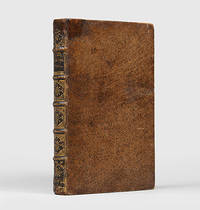
1577ALDR0726Lipsiae (Leipzig), (Johannes Steinman 1577). Kl.4°. 789(1) S., 268 S. (es fehlen die Ss.7-10), 8 Bll. (Index), 191(1) S. Titelbll. in Pag. mit je e. Holzschnitt-Druckermarke (dav. e. montiert). Halblederband (19. Jhdt.) m. Deckelbezug aus Kibitzpapier u. goldgepr. Rü.tit. u. Streicheisenlinien sowie Vorsätzen aus gemust. Kleisterpapier. Einband m. stärkeren Gebrauchsspuren, Fehlstellen an beiden Kapitalen, Ecken u. Kanten bestoßen u. abgewetzt, Text gebräunt, im Text vereinzelt m. Marginalien v. alter Hand. VD16 N 394; BM, German Books 646 (unter Neander); Adams P 2311 (unter Pythagoras). - Griechisch-lateinische Parallelausgabe mit umfangreichen Kommentaren, im wesentlichen eine Neuausgabe der erstmals 1559 in Basel erschienenen Neander-Edition. - Michael Neander (1525-1595), ein deutscher Pädagoge, Theologe und Rektor der Klosterschule Ilfeld, gab diese Schulschrift als Lectüre für die reiferen Schüler heraus. Das Werk enthält u.a. Gedichte des Pythagoras und Phokylides, Sentenzen aus Theognis, Kapitel aus den Dichtungen des Märthrerbischofs Nilus und das Gedicht von Tryphiodor über den Fall von Troja.
1547WB16188Venice 1547. First Edition thus. Hardcover. Very Good. Small 8vo. pp. 163 8. Contemporary vellum gilt. The first Italian translation; text contains Xenophons writings about Socrates and the Laws of Athens. A very nice copy. <br/><br/> hardcover
1547WB16188Venice 1547. First Edition thus. Hardcover. Very Good. Small 8vo. pp. 163 8. Contemporary vellum gilt. The first Italian translation; text contains Xenophons writings about Socrates and the Laws of Athens. A very nice copy. <br/><br/> hardcover books
1524GR915Vinegia, Gregorio de Gregori, small in-8vo, 14,3 x 9 cm, 156 leaves, full calf XIX c. binding, guilt back with 5 raised bands, morocco title slightly worn. Some later manuscript initials, coloured edges. Jacopo Poggio Bracciolini (Firenze 1441 - 1478) translated in italian his father's Giac.Fr. Pogio History of Florence, participated in the Pazzi conspiration against the Medici and was therefore hanged. Second rare italian translation of Cyropaedia. Adams X 39, not in Brunet.
1581ST20964Geneva: Excudebat Henrius Stephanus 1581. Second Estienne Edition. 320 x 212 mm. 12 1/2 x 8 1/2". 6 p.l. 584 76 pp.Edited and with annotations by Henri Estienne. <br/> FINE 17TH CENTURY SPRINKLED CALF PRIZE BINDING covers gilt with French fillet border oblique fleur-de-lys at corners SUPRA LIBROS OF CARDINAL MAZARIN AT CENTER raised bands spine compartments with fleurs-de lys at center and corners edges gilt over marbling old repair to head of spine. Printer's device Schreiber 18 on title. WITH 1692 COLLÈGE MAZARIN PRIZE PRESENTATION to Laurence Thibault for Greek oratory signed by the head of College P. J. Le Chapelier with seal of the college attached tipped onto title page. Main text in Greek dedication to James VI of Scotland and Estienne's annotations in Latin. Renouard 149.6; Hoffmann III 577; Dibdin II 567; USTC 450908. Lower corner of back board somewhat bumped leather slightly marked other very modest exterior wear but the stately binding in nearly fine condition. First five quires with two tiny wormholes to tail margin final signature with a little creasing other insignifcant imperfections but AN ESPECIALLY FRESH CLEAN AND BRIGHT COPY INTERNALLY the leaves crackling when you turn them.<br/> <br/> This copy of what Renouard calls the "far superior" Estienne Xenophon is offered in a very attractive binding that was used as a prize for a student at the Collège Mazarin near the close of the 17th century. Best known to his contemporaries as an historian and general as well as an opponent of Athenian democracy Xenophon ca. 430-354 B.C. was a student of Socrates and aside from Plato's his works contain the only surviving examples of Socratic dialogues. Although born in Athens Xenophon greatly admired Sparta and its political structure and he eventually went to war for Sparta against the Athenians this earned him land in Sparta but unsurprising exile from Athens. Xenophon's philosophical writings found popularity in the Renaissance and some scholars have suggested that Machiavelli was particularly influenced by Xenophon's more "practical" i.e. ruthless approach to politics. The present 1581 printing is among the most highly regarded Renaissance editions of Xenophon's works. The printer and scholar Henri Estienne II 1528-98 was a brilliant classicist best known for producing "Thesaurus Graecae Linguae" 1572 a standard reference for 300 years. He produced his first Xenophon in 1561 but fully revised the text for the present edition. Dibdin tells us that "the edition of 1581 has more intrinsic value than the preceding one" and Renouard notes that it is "not as pretty as the 1561 edition but far superior." Our copy fittingly was presented as a prize for Greek oratory to a student at the Collège Mazarin founded by a bequest from the former first minister of France Jules Cardinal Mazarin 1602-61. Mazarin was not just a prince of the Church and an advisor to the Sun King but one of the greatest bibliophiles of his day with a library of 40000 volumes that became the foundation of the Bibliothèque Mazarine. Our book is bound in a style appropriate to that famed collection with Mazarin's personal supralibros at the center of each board. The partly printed award certificate bound in at the front indicates that Laurence Thibault had won second prize for Greek oration in the college's "solemn games" honoring the royal recognition of the college. It is signed by the head of the college Pierre-Jean Le Chapelier de Mauron who held a doctorate from the Sorbonne and simultaneously served as abbot of the Abbey of Ste Marie-de-Boquen in Brittany. Excudebat Henrius Stephanus unknown
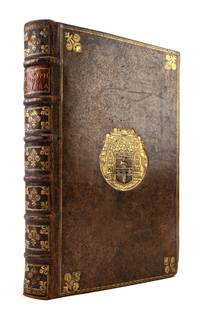
1573127728London: John Allde 1573. Sixth edition in English of Xenophon's Oeconomicus first published by Thomas Berthelet in 1532 this edition the first to be published by John Allde at his busy establishment at the Long Shop next to St Mildred Poultry London. The text is a Socratic dialogue principally about household management and agriculture one of the earliest works on economics in its original sense of household management. It is also one of the very few contemporary writings to discuss the position of both women and slaves in antiquity. The text was rendered into English by Gentian Hervet 1499-1584 the French humanist who spent some of his early career in the 1520s and 1530s in England and was tutored at Oxford by Thomas Lupset. Octavo 135 x 87 mm 64 leaves. Woodcut decorative border to title woodcut initials printed in blackletter. Twentieth-century ribbed blue cloth spine lettered gilt. Ownership stamp of Rothamsted Experimental Station Harpenden Herts. to front pastedown; pale dampmark; a very good copy. ESTC gives three locations only: British Library Bodleian and Huntington. hardcover
1525133029Venice: Heirs of Aldus Manutius and Andrea Torresano 1525. The Aldine Xenophon First Aldine edition of the collected works of Xenophon including the Anabasis recounting his leadership of the Ten Thousand against the Persian Empire and the Cyropaedia his partly fictionalized biography of Cyrus the Great which became a model for medieval writers of the mirror-for-princes genre. The edition is almost complete with the only absent Xenophon text being the Apology. The edition marks the first printing of Xenophon's De Atheniensium re publica and De vectigalibus alongside the Hellenica which the Aldine press had published in October 1503 and the Agesilao which had previously been erroneously attributed to Plutarch. The text was edited by Aldus's brother-in-law Gian Francesco d'Asola who in his preface makes disparaging comments about the 1516 Filippo Giunta edition showing the rivalry between the two great Venetian printing houses. This edition is universally recognized as superior. Provenance: library of the College of Santa Maria Coronata Pavia ownership inscription "Biblioth. Collegij S. Mariae Coronatae Papiensis" and old small stamp on title page. Folio 306 x 209 mm. Woodcut Aldine device on title and on verso of final leaf. Complete with blank leaves L8 and a1. Seventeenth-century sprinkled calf spine lettered and tooled in gilt red speckled edges. Some early annotations in margins in Greek. Spine ends and head of front joint repaired with new calf very minor insect damage to rear cover a few instances of light finger-soiling yet contents generally clean and crisp. A very good copy. Adams X4; Ahmanson-Murphy 229; Cataldi Palau 94; Renouard 100.1; STC Italian 738. unknown