144 résultats
Very Good Turkish, Ottoman (1500-1928) Original autograph letter handwritten signed by Mehmed Semseddin Pasha addressed to 'Kütahya Evkâf-i Humâyûn' [i.e. Kütahya Imperial Foundations]. It starts with 'Huve' traditionally. (29x21 cm). In Ottomsn script. Letterhead 'Nezâret-i Evkâf-i Humâyûn' [i.e. Ministry of foundations]. 1 p. including eight lines with additional annotation. Mehmed Semseddin was an Ottoman / Turkish statesman with Circassin (Adige - Shapsig) origin, descended from Tletseruk (or Tleseruk) family. Mehmed Semseddin Pasha was the son of Hacizade Osman Bey who was a Circassian chieftain. In 1864, his family emigrated to Samsun and then to Istanbul in the Great Immigration of Circassians. He was graduated from Galatasaray High School. He was also groom of Egypt Extraordinary Commissioner Circassian Rauf Pasha, a member of the Society Circassian Charity (Çerkes Teavun -Yardim- Cemiyeti), the manager and author of Guaze newspaper published in Turkey which was first published journal in Latin letters in Turkey.
191919932Genève, Fréd. Boissonnas, éditeur d'Art, Collection L'image de la Grèce, 1919. In-4 broché de [8] pages suivies des planches, couverture ornée à rabats.
Very Good French Paperback. Roy. 8vo. (24 x 17 cm). In French. [18], [xxvi], 312 p., numerous b/w plts. Thessalonique au quatorzieme siecle. Preface de Charles Diehl. Salonica city in the 14th century. First Edition. Scarce.
Very Good Turkish, Ottoman (1500-1928) Original manuscript autograph letter signed 'Ortaç' by Yusuf Ziya Ortaç to an unknown friend of him. 2 p. Full. In Ottoman script. 'Akbaba' satiric magazine's letterhead with its address in its period, Klodfarer (Claude Farer) Street, Istanbul. It's written with an interesting satiric style of Ortaç and it mentions 50's Turkey. It starts as 'Aziz kardesim, dostum, efendim'. He told that he received his friend's letter and upon this he wrote 'after I've read your letter, I felt like I've seen and heard you, it was like a "fondness feast!'". And he mentions 'Turkish nation' by criticizing as 'This nation knows only just forgiveness! They forgive superabundant; they forget fabrics, chimneys; but never forget some things!'. A rare and very collectible autograph.
Numerous black and white photographs. "...Framed with the object of producing an account of the great contest now in progress, which shall be at once popular and authoritative... An account written by men of great experience in political, military, and naval matters... Will contain a great deal of first-hand material which will be really valuable to historians of the future." - From Preface. Contents: Chapter CXXVII - The Germans in Russian Poland. Fading to periphery of front and back covers. Average wear. Unmarked. Binding intact. Sound copy. Magazine
246 pages. Text in English and French. Extensively illustrated with black and white (and some colour) archival illustrations. Clean, bright and unmarked with very light wear. Prior owner's name clipped from top corner of front free endpaper - in the process, the top corners of the half-title and title pages were accidentally clipped. Excellent copy. Book
Very Good Turkish, Ottoman (1500-1928) Original paper autograph letter handwritten signed by Pirizade Ibrahim Hayrullah Bey. 22x14 cm. In Ottoman script. Paper with the letterhead of 'Selânik Vilâyeti' [i.e. Governorship of Salonica]. AH: 1326 = AD: 1910. With its elqab, letter has 10 lines. A legible script in Turkish with Arabic letters. Letter warns interlocutors against Bulgarian atrocities. Hayrullah Bey was a statesman who held various positions in the last period of the Ottoman Empire. He was born in 1859 in the rooted Pirizade family in Istanbul. His father was the head of the State Department of Shura and Shaykh al-Islam Pirizâde Mehmed Sahip Molla (1838-1910), and his mother was Hekimbasizade Fahrünisa Hanim. There are also two sheikh al-islams among their great grandfathers. Ibrahim Hayrullah Bey, a member of the Committee of Union and Progress, rapidly rose to state administration after the declaration of the 2nd Constitutional Monarchy. In September 1909 he was appointed Governor of Thessaloniki.
New English Original bdg. HC. Roy. 8vo. (24 x 17 cm). In French. 9 volumes full set: ([4], 396 p.; [4], 290 p.; [4], 352 p.; [viii], 374 p., 2 maps; [vii], 341 p.; [viii], 366, [1] p.; [viii], 342 p.; [vi], 323 p.; [vi], 255 p.). 1- Les Juifs de Constantinople sous Byzance. Les Juifs sous la domination des Turcs Seldjoukides. Les Juifs d'Istanbul sous Mehmet le Conquerant. Histoire des Juifs d'Istanbul depuis la prise de cette ville en 1453 par Mehmet II jusqu'a nos jours (1er volume). 2- Histoire des Juifs d'Istanbul depuis la prise de cette ville en 1453 par Mehmet II jusqu'a nos jours (2me volume). Histoire des Juifs d'Anatolie (1er volume); les Juifs d'Izmir (Smyrne) (1ere partie). 3- Histoire des Juifs d'Anatolie (1er volume); les Juifs d'Izmir (Smyrne) (2eme partie). Histoire des Juifs d'Anatolie (2eme volume) (1ere partie). 4- Histoire des Juifs d'Anatolie (2eme volume) (2eme partie). Appendice a l'histoire des Juifs d'Anatolie. 5- Documents officiels Turcs concernant les Juifs de Turquie. Appendice a l'ouvrage Documents officiels Turcs concernant les Juifs de Turquie. Recueil de nouveaux documents inedits concernant l'histoire des Juifs de Turquie. 6- Nouveau recueil de nouveaux documents inedits concernant l'histoire des Juifs de Turquie. Encore un nouveau recueil de documents concernant l'histoire des Juifs de Turquie -etudes scientifiques. Quatrieme recueil de documents concernant les Juifs de Turquie proverbes Judeo-Espagnols. Cinquieme recueil de documents concernant les Juifs de Turquie -divers sujets Juifs. Sixieme recueil de documents concernant les Juifs de Turquie et divers sujets Juifs. 7- Septieme recueil de documents concernant les Juifs de Turquie et divers sujets Juifs. Histoire des Juifs de Rhode, Chio, Cos, etc. Appendice a l'histoire des Juifs de Rhode, Chio, Cos, etc. et fin tragique des communautes Juives de Rhodes et de Cos, oeuvre du brigandage Hitlerien. Turcs et Juifs, etudes historique, politique. 8- Turcs et Juifs, etudes historique, politique (suite). Appendice a l'ouvrage Turcs et Juifs, etudes historique, politique. Appendice a mes ouvrages Turcs et Juifs. Nouveaux documents sur Sabbetai Sevi organisation et us et coutumes de ses adeptes. Don Joseph Nassi d'apres de nouveaux documents. 9- Esther Kyra d'apres de nouveaux documents. Don Salomon Aben Yaeche Duc de Metelin. Hommes et choses Juifs Portugais en Orient. Medecins Juifs au service de la Turquie. Un chapitre inedit de l'histoire Juive: Marranes Iraniens. Le Juif dans le proverbe: Le conte et la chanson Orientaux. Abdul Hamid II et le sionisme. L'adoption des caracteres Latins dans la langue Hebraique signifie sa dislocation. La presse Judeo-Espagnol mondiale.
New English Original bdg. HC. [Red cloths]. Roy. 8vo. (24 x 17 cm). In French. 9 volumes full set: ([4], 396 p.; [4], 290 p.; [4], 352 p.; [viii], 374 p., 2 maps; [vii], 341 p.; [viii], 366, [1] p.; [viii], 342 p.; [vi], 323 p.; [vi], 255 p.). 1- Les Juifs de Constantinople sous Byzance. Les Juifs sous la domination des Turcs Seldjoukides. Les Juifs d'Istanbul sous Mehmet le Conquerant. Histoire des Juifs d'Istanbul depuis la prise de cette ville en 1453 par Mehmet II jusqu'a nos jours (1er volume). 2- Histoire des Juifs d'Istanbul depuis la prise de cette ville en 1453 par Mehmet II jusqu'a nos jours (2me volume). Histoire des Juifs d'Anatolie (1er volume); les Juifs d'Izmir (Smyrne) (1ere partie). 3- Histoire des Juifs d'Anatolie (1er volume); les Juifs d'Izmir (Smyrne) (2eme partie). Histoire des Juifs d'Anatolie (2eme volume) (1ere partie). 4- Histoire des Juifs d'Anatolie (2eme volume) (2eme partie). Appendice a l'histoire des Juifs d'Anatolie. 5- Documents officiels Turcs concernant les Juifs de Turquie. Appendice a l'ouvrage Documents officiels Turcs concernant les Juifs de Turquie. Recueil de nouveaux documents inedits concernant l'histoire des Juifs de Turquie. 6- Nouveau recueil de nouveaux documents inedits concernant l'histoire des Juifs de Turquie. Encore un nouveau recueil de documents concernant l'histoire des Juifs de Turquie -etudes scientifiques. Quatrieme recueil de documents concernant les Juifs de Turquie proverbes Judeo-Espagnols. Cinquieme recueil de documents concernant les Juifs de Turquie -divers sujets Juifs. Sixieme recueil de documents concernant les Juifs de Turquie et divers sujets Juifs. 7- Septieme recueil de documents concernant les Juifs de Turquie et divers sujets Juifs. Histoire des Juifs de Rhode, Chio, Cos, etc. Appendice a l'histoire des Juifs de Rhode, Chio, Cos, etc. et fin tragique des communautes Juives de Rhodes et de Cos, oeuvre du brigandage Hitlerien. Turcs et Juifs, etudes historique, politique. 8- Turcs et Juifs, etudes historique, politique (suite). Appendice a l'ouvrage Turcs et Juifs, etudes historique, politique. Appendice a mes ouvrages Turcs et Juifs. Nouveaux documents sur Sabbetai Sevi organisation et us et coutumes de ses adeptes. Don Joseph Nassi d'apres de nouveaux documents. 9- Esther Kyra d'apres de nouveaux documents. Don Salomon Aben Yaeche Duc de Metelin. Hommes et choses Juifs Portugais en Orient. Medecins Juifs au service de la Turquie. Un chapitre inedit de l'histoire Juive: Marranes Iraniens. Le Juif dans le proverbe: Le conte et la chanson Orientaux. Abdul Hamid II et le sionisme. L'adoption des caracteres Latins dans la langue Hebraique signifie sa dislocation. La presse Judeo-Espagnol mondiale.
839 pages plus author and keyword indeces. Sections include: Grain Boundaries Structure and Chemistry; Dynamical and Mechanical Properties; Heterophase Interfaces; Electrical Properties and Superconductors; Nanocrystalline Materials. Prior owner details blacked out upon half-title page else unmarked. Light wear. Clean. Tight and square. Nice copy in green card covers. Book
Large format beautifully illustrated book about the treasures of the Archaeological Museum of Thessaloniki. 378p. This extremely large [14x11x4 inches - 35x28x4cm] and heavy volume weighs. 3.5 kg.- almost 8 lbs [7 Copies found WorldCat] Book
1917054904Istanbul: Ahmed Ihsan ve Sürekasi Matbaasi. AH 1333 1917. 1st Edition . Soft cover. Good. 8vo - over 7¾ - 9¾" tall. Original wrappers. Foolscap 8vco. 17 x 11 cm. In Ottoman script Old Turkish with Arabic letters. 126 p. 11 unnumbered b/w plates 8 numerous b/w ills. tables. Slight creasing on some pages and slight stains otherwise a good copy. First and only edition of this rare photography guide in Ottoman literature prepared and published by Ipekci Brothers. This richly illustrated guide tells how to use a camera to take good and artistic photographs and introduces parts of a camera. Some good photographic examples in this book as separate plates. The Ipekçi family who had been engaged in the silk business for several generations in Thessaloniki Greece continued the silk trade for a while in Constantinople where they migrated in 1893. The brothers who first opened a store called "Hüsn-i Intihap" in Istanbul and then the Thessaloniki Bonmarche one of the biggest stores of the period turned to filmmaking with Ihsan Ipekçi's initiative after the Thessaloniki Bonmarche was demolished during the arrangement of Eminönü Square. The family which started operating the Alhambra Cinema which was opened in 1923 converted "Paten Sarayi" i.e. Skating Palace into a movie theater and opened the Melek today's Emek cinema a year later. Ahmed Ihsan was an important figure of the late 19th century and also the founder of a current in Turkish literature "Servet-i Fünûn" i.e. The Wealth of Sciences or Knowledge. He established a prominent printing house in the Ottoman Empire and he is known as the translator of the first Jules Verne translation into Turkish. Three copies in OCLC 949475400: Bogaziçi University Library and UCLA and University of California Los Angeles Southern Regional Library Facility. <br/> <br/> Ahmed Ihsan ve Sürekasi Matbaasi., [AH 1333] paperback
Very Good Turkish, Ottoman (1500-1928) Original paper autograph letter handwritten signed by Mahmud Sevket, Izzeddin Çalislar. (33x21 cm). In Ottoman script. 2 p. Repaired back side. Request of a surgical operation by 'Said bin Mehmed' (Siroz Redif Taburu Efrâdindan) and Mahmud Sevket Pasha and Izzeddin's confirmations. Signed by Mahmud Shevket Pasha as "commander of Turkish countercoup of 1909 (Hareket Army)" and by Izzeddin [Çalislar] as "Erkân-i Harb Kolagasi (Batallion commander)". The Ottoman countercoup of 1909 (13 April 1909) was an attempt to dismantle the Second Constitutional Era of the Ottoman Empire and replace it with an autocracy under Sultan/Caliph Abdul Hamid II. Unfortunately for the advocates of representative parliamentary government, mutinous demonstrations by disenfranchised regimental officers broke out which led to the collapse of the Ottoman government. Characterized as a counterrevolution, chaos reigned briefly and several people were killed in the confusion. It was instigated by some parts of the Ottoman Army in a large part by a certain Cypriot Islamic extremist. Dervish Vahdeti reigned supreme in Istanbul for 11 days. The Countercoup was put down in the 31 March Incident, on 24 April 1909 by the Army of Action (Hareket Ordusu) which was the 11th Salonika Reserve Infantry Division of to the Third Army (Ottoman Empire) commanded by Mahmud Shevket Pasha. Extremely rare.
20210Paris, L. Carteret, 1925. In-4, 228 pp., en feuilles, couverture originale illustrée, chemise et étui cartonnés de l'éditeur (étui déraîchi, petites taches à la chemise).
Very Good Turkish, Ottoman (1500-1928) Original autograph letter handwritten signed by Mahmud Sevket. (33x21 cm). In Ottoman script. 1 p. Case and its response by Mahmud Sevket when he was the governor of Kosovo. Document has 17 lines including the case of 'comitadjis' in Gjilan region of Kosovo. Report says that several comitadjis have been arrested and for them the court was expected to issue a death sentence. In his response, Mahmud Sevket Pasha has ordered that the death penalty should be converted to life rowing (hard labour). Mahmud Sevket's text: "Mabeyn-i Humayun Cenâb-i mülûkâne-i bas kitâbet celilesinden (?) celileden teblîg buyurulan telgrafane-i âlîsi sureti bilâde nakl-i (?) müebbeden kürek cezasi ile mahkûm edilerek idamlari cihetine gidilmemenin azâ-yi muhakemeye ettirilmeyeek ve muamelât-i muhakeme-i te'dib etmekte olan memuriye mucibiince dahi anlasilamayacak surette muhakeme-i fevkalâde re'isine bizzat sifâhen teblîg buyurulmus ve isbu muharebenin nezd-i âlîsinde hifz-i (?) müsarinileyhin emriyle müstesnâdir. Yevm-i muhakeme gayr-i mâlûm ise de bunun yarisinin bile icrâ olunmasi mahtumun bulunduguna göre teblîgâtin ihtiyâten teblîgi (?) baskaca beyân olunur efendim. Kosova Vâlisi Birinci Ferik Mahmud Sevket.".
Very Good Turkish, Ottoman (1500-1928) Original manuscript autograph letter signed 'Sadrazam Rifat' sent to Tophâne-i Âmire müsiri Mustafa Zeki Pasa [i.e. Grand master of Turkish artillery]. 38x24 cm. In Ottoman script. Folded. 1 p. It's an official celebration for Mustafa Zeki Pasha's achievements in the Turco-Greco War in 1897-1898. It's written in a beautiful riq'a script. Halil Rifat Pasha was an Ottoman statesman and a Grand Vizier for six years between 1895 until his death in 1901, during the reign of Abdul Hamid II. He was born in Serres (Serez) and received education in an Islamic type parish school in Salonica (Selanik), then continued to Mekteb-i Mülkiye in Constantinople. After his education years, he started to work as a mailing clerk in Vidin, then worked as secretary in the office of the Governor of Salonica. He advanced by degrees and was appointed to higher official positions by passage of time, including at Rustchuk. In 1882 he was appointed as mutasarrif of Vidin, then in 1886 he was appointed as governor of Sivas, where he started a road-building programme. He was subsequently appointed governor of Aidin (1889) and later of Monastir, where he fought brigandage units which was rife in the province. He was appointed as minister of internal affairs in 1893 . Then he was appointed as grand vizier in November 1895 . The most important events in his era as grand vizier were the riots of Sason (in 1895) and in Crete (in 1897), as well as the Greco-Turkish War of 1897 which ended with Ottoman victory. His motto in the road building campaign was "Any place where you can't go is not yours"! (Gidemedigin yer senin degildir!). Zeki Pasha was one of the most trusted Ottoman generals and statesmen of the Sultan Abdulhamid II. He served as Tophane Counselor for 18 years during the reign of Sultan Abdülhamid II. In 1899, Italian architect Alexandre Vallaury built the 'Tophane Müsiri Zeki Pasa Mansion (Yali)', one of the most valuable estates of Istanbul, on his behalf. In 1908, he fell out of favor with the declaration of the Second Constitutional Monarchy by Union and Progress Society (Ittihat ve Terakki Cemiyeti) and was deported first to Büyükada and then to Rhodes. (Source: Wikipedia). Slightly chipped. A very good manuscript paper.
Very Good Turkish, Ottoman (1500-1928) Original manuscript autograph document signed by Mehmed Said Pasha sent to Trabzon Vilayat, Ordu Kaza, Hasbamane Nahiya local manager, faziletlu 'Mehmed Ali Sevki Beyefendi'. 33,5x20 cm. Folded. 1 p. In Ottoman script. Mehmed Said Pasha was an Ottoman monarchist, senator, statesman and editor of the Turkish newspaper Jerid-i-Havadis. He supported the CUP, the political party which came to power after the Ottoman coup d'état of 1913. His origin comes from 'Sebazâde family' from Ankara. He became first secretary to Sultan Abdul Hamid II shortly after the Sultan's accession, and is said to have contributed to the realizations of his majesty's design of concentrating power in his own hands; later he became successively minister of the interior and then governor of Bursa, reaching the high post of grand vizier in 1879. He was grand vizier seven more times under Abdul Hamid II, and once under his successor, Mehmed V. He was known for his opposition to the extension of foreign influence in Turkey. n 1896, he took refuge at the British embassy in Constantinople, and, though then assured of his personal liberty and safety, remained practically a prisoner in his own house. He came into temporary prominence again during the revolution of 1908. On 22 July he succeeded Mehmed Ferid Pasha as grand vizier, but on the 6 August was replaced by the more liberal Kâmil Pasha, at the insistence of the Young Turks. Also during 1908, Mehmed Said Pasha bought the famed Istanbul arcade in the Beyoglu (Pera) district, today known as Çiçek Pasaji ("Flower Passage"). The modern name became common in the 1940s; during Mehmed Said Pasha's ownership in the 1900s and 1910s, the arcade was known as Sait Pasa Pasaji ("Said Pasha Passage"). During the Italian crisis in 1911-12, he was again called to the premiership. He was again removed from power by the Savior Officers (who backed the Freedom and Accord Party (Liberal Union) against the Committee of Union and Progress) and replaced by a new cabinet supported by the Officers and the Freedom and Accord Party. The CUP would return to power, however, the next year after the Ottoman coup d'état of 1913. (Source: Wikipedia). Seven lines on special paper with watermark 'Joynson Superfine'. Letter of request to provide teaching for some students in the region.
Very Good Turkish, Ottoman (1500-1928) Paperback. Chipped on margins. Some owner notes. Otherwise a good copy. Roy. 8vo. (24 x 18 cm). In Ottoman script. 32 p. This rare book includes the royal travel of Sultan Abdülmecid in 1262 AH [1846 AD] to Roumelia. From Edirne, Abdülmecid proceeded to Eski Zagra (Stara Zagora), Kizanlik (Kazanluk), Gabrova (Gabrovo), Tirnova (Turnovo), Rusçuk (Ruse), Silistre (Silistra), and Varna. The route of the 1846 tour followed closely, except in reverse order, Mahmud II's tour of 1837. According to witness accounts, along the way, the sultan was greeted everywhere with poetic recitations and songs of praise and prayer, both in Ottoman and Bulgarian. The pride of place among welcoming parties invariably fell on students, of all creeds, most clad in white uniforms, some in solemn church-going attire, with flowers and green branches in their hands. At every stop, ceremonial cannon salvos were fired during the day and elaborate firework illuminations were performed at night. In the town of Kizanlik, known then as now for the most fragrant roses and the best rose oil, the sultan's visit coincided, possibly by design, with the rose harvesting season. So the locals sprinkled rose water and poured rose oil before the sultan's cavalcade. According to Hristo Stambolski, in the three days of the sultan's stay in town, no rose harvesting was done so that the whole area would be exquisitely scented in his honor. For his part, the sultan had doctors vaccinate all children against smallpox in public before sending each one off with a small gift of money. Even people with rare diseases were, on occasion, summoned to the sultan's presence so his doctors could cure them. The sublime visit caused the locals, who were unaccustomed to direct contact with the center of power, quite a stir. The most detailed account, albeit from a hostile source, relates the sultan's visit to Rusçuk, which, at four days, may have also been the longest. According to Nayden Gerov, the greeting ceremonies proceeded on a communal basis, with the Jews being placed closest to the town walls, next to them the Armenians, then the Bulgarians, and finally, the Muslims, situated the farthest from town, yet being the first to see and welcome the sultan. As the sultan approached, each group of youngsters would in turn sing for him, everyone else bowing profusely. Based on Gerov's description, it seems that Abdülmecid was dressed in a slightly more luxurious fashion than during state ceremonies in Istanbul. ((Source: Sultan Abdülmecid's Tour of Rumelia and the Trope of Love by Stephanov). The sultan began to travel by the way of the gate of Yedikule in Istanbul in May 6, 1846. He followed the way of Ayastefanos, Silivri, Çorlu, Burgaz, Edirne, Zagra-i Atik, Kizanli, Trnova, Rusçuk, Silistre, Rusçuk, Shumnu, and Varna and came back to Istanbul by way of the sea on June 14, 1846. During this travel, the Sultan listened to people's problems and ordered the authorities to be solved with those problems. He received successful military and administrative authorities in settlements on the way of travel and rewarded them. He also received the governors of Serbia, Eflak and Bogdan, and the representatives of foreign states. With this travel, the Sultan aimed to strengthen the connection to the center of people and administrators in provinces. Özege 17910. First Edition.
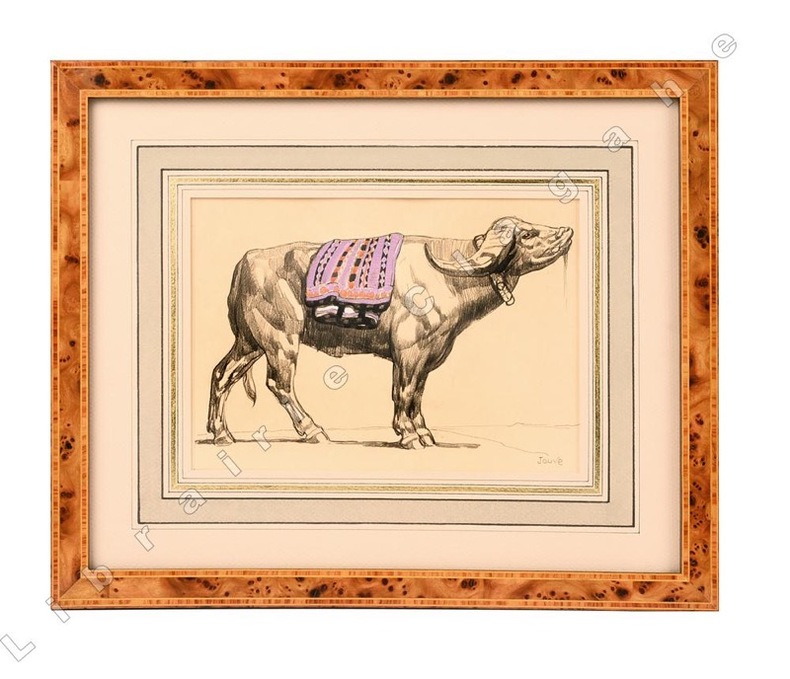
185221442Dessin original au crayon gras, gouache et aquarelle sur papier japon impérial (185 x 217 mm ; recadré 151 x 212), signé au crayon dans le coin inférieur droit ; passe-partout à large encadrement bicolore beige et vert et large filet doré, encadrement de loupe. Format total 295 x 355 mm. Au dos, partie de dessin au crayon et fusin, découpée.