144 résultats
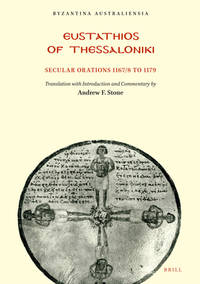
201314577Australian Association for Byzantine Studies. 2013. Softcover. Near Fine. Light wear to corners of rear wrap else fine.; This book presents translations of six speeches by Eustathios of Thessaloniki accompanied by a detailed commentary which analyses the language used in these complex pieces of oratory and explains the allusions to the historical events of the time that they contain. Ten appendices provide further details on a range of topics.; Australian Association for Byzantine Studies. Byzantina Australiensia 19.; 241 pages . 187650336X . Australian Association for Byzantine Studies paperback
201317163Australian Association for Byzantine Studies. 2013. Softcover. Fine. Book is fine.; This book presents translations of six speeches by Eustathios of Thessaloniki accompanied by a detailed commentary which analyses the language used in these complex pieces of oratory and explains the allusions to the historical events of the time that they contain. Ten appendices provide further details on a range of topics.; Australian Association for Byzantine Studies. Byzantina Australiensia 19.; 241 pages . 187650336X . Australian Association for Byzantine Studies paperback
New English Paperback. Pbo. Roy. 8vo. (23 x 16 cm). In English. 224 p., ills. "The book contains five studies on the Exchange of Populations. These are accompanied by photographs from 1950-1960. The majority of them come from the Photographic Archive at the Centre for Asia Minor Studies, and, whilst taken mainly or exclusively for documentation purposes, ultimately provide the researcher with material for social analysis. The visual and linguistic narrations in the book run independently side by side and each tells its own story. The reader is assigned the task of combining these two elements and deciding how he will interpret the whole.".
Greece, 1940. In the port city of Salonika, with its wharves and brothels, dark alleys and Turkish mansions, a tense political drama is being played out. "Spies of the Balkans" is a stunning novel about a man who risks everything to fight back against the world's evil. Set in Greece in 1940, this powerful WWII thriller from Furst (The Spies of Warsaw) focuses on Costa Zannis, a senior Salonika police official known for his honesty and ability to settle matters "before they got out of hand." As the Nazis' intentions for Europe's Jews becomes clear, Zannis goes out of his way to aid refugees seeking to escape Germany. When Mussolini's troops invade Greece, Zannis joins the army, where he meets Capt. Marko Pavlic, who as a policeman in Zagreb investigated crimes committed by the Ustashi, Croatian fascists. With their similar politics, Zannis and Pavlic soon become friends and allies. Subtle details foreshadow the coming crimes perpetrated by the Nazis in the Balkans. For example, Zannis learns from a colleague that someone has been taking photos of the contents of a synagogue so that the Germans can more easily identify what to plunder. Book
Greece, 1940. In the port city of Salonika, with its wharves and brothels, dark alleys and Turkish mansions, a tense political drama is being played out. "Spies of the Balkans" is a stunning novel about a man who risks everything to fight back against the world's evil. Set in Greece in 1940, this powerful WWII thriller focuses on Costa Zannis, a senior Salonika police official known for his honesty and ability to settle matters "before they got out of hand." As the Nazis' intentions for Europe's Jews becomes clear, Zannis goes out of his way to aid refugees seeking to escape Germany. When Mussolini's troops invade Greece, Zannis joins the army, where he meets Capt. Marko Pavlic, who as a policeman in Zagreb investigated crimes committed by the Ustashi, Croatian fascists. With their similar politics, Zannis and Pavlic soon become friends and allies. Subtle details foreshadow the coming crimes perpetrated by the Nazis in the Balkans. Book
27220PARIS, P.U.F. - Fondée en 1878 par Gabriel Monod, publiée avec le concours du CNRS et de la 6e section de l'Ecole des Hautes Etudes.- Revue historique N° 534, Avril, juin 1980 - In-8, 15,5 x24 cm - Broché - paginé 299-611 - Très frais, comme neuf - Envoi rapide et soigné
PARIS, P.U.F. - Fondée en 1878 par Gabriel Monod, publiée avec le concours du CNRS et de la 6e section de l'Ecole des Hautes Etudes.- Revue historique N° 534, Avril, juin 1980 - In-8, 15,5 x24 cm - Broché - paginé 299-611 - Très frais, comme neuf - Envoi rapide et soigné La Revue historique, est une revue d’histoire française créée en 1876 par le protestant Gabriel Monod et le catholique Gustave Fagniez. Cette nouvelle revue s'inscrit en réaction contre La Revue des Questions historiques créée dix ans plus tôt et qui traduisait la pensée d'une droite ultramontaine et légitimiste. La Revue historique ne se réclame d'aucune religion, d'aucun parti, d'aucune doctrine Éditée à Paris par les Presses universitaires de France
19342003100095xbvkBerlin, Kittler, 1934. 122 (5) Seiten, mit 2 Karten und fotografischen Abbildungen auf Kunstdrucktafeln. - Original-Leineneinband mit Deckel- und Rückentitel; 8vo.(ca. 20 x 15 cm).
19883688-AF3Federal Republic of Germany, o.A., 1988. 244 S., Lexikonformat, kartoniert. Sehr gutes Exemplar.
Fine English Paperback. Pbo. Demy 8vo. (21 x 14 cm). In Turkish. 432 p. Sabatay Sevi: Mesih mi sahte peygamber mi? Translated by Selahattin Ayaz. First Edition of Sholem's 'Mystic mesiah'.
Very Good Italian Paperback. Roy. 8vo. (24 x 17 cm). In Italian. 33-93 pp. Signed and inscribed by Saban. Saban was a Turkish mathematician of Jewish origin. He's the nephew of Saban who is the chief rabbi of Turkey. He studied on quazi asymptotic varieties, differential geometry, space curves, and openable surfaces and integrals on the sphere surfaces.
As New As New English Original bdg. Dust wrapper. 4to. (30 x 21 cm). In English. 91, [4] p., many color ills. "Non ministrari sed ministrare: The ceremony was rich in pomp and tradition. On Saturday, March 7, 2009, Dr. David G. Horner was inaugurated as the seventh president of the American College of Greece. After the procession and formal welcome, the Greek Orthodox bishop, Damaskimos of Diavlia, offered the opening invocation. The closing benediction was to be very different in style. It was given by Reverend Dr. Nancy Taylor, senior minister of Old South Church in Boston. Dr. Taylor's presence at the ceremony was a fitting one. It was her church -the United Church of Christ- that first sent missionaries overseas to found the American College.".
Large format beautifully illustrated book about the treasures of the Archaeological Museum of Thessaloniki. 378p. This extremely large [14x11x4 inches - 35x28x4cm] and heavy volume weighs. 3.5 kg.- almost 8 lbs [7 Copies found WorldCat] Book
Very Good English Paperback. Pbo. Oblong large 8vo. (22 x 22 cm). In German and Greek. B/w ills. 61, [2] p. Deutsche Schule Thessaloniki. Jahresbericht 1974 / 75.
2378PARIS, J de Gigord & Action Populaire - In-8 débroché - frontispice - 9 cartes - 545 pages
PARIS, J de Gigord & Action Populaire - In-8 débroché - frontispice - 9 cartes - 545 pages
Very Good Turkish, Ottoman (1500-1928) Original manuscript autograph letter signed 'Sadrazam Rifat' sent to Tophâne-i Âmire müsiri Mustafa Zeki Pasa [i.e. Grand master of Turkish artillery]. 38x24 cm. In Ottoman script. Folded. 1 p. It's an official celebration for Mustafa Zeki Pasha's achievements in the Turco-Greco War in 1897-1898. It's written in a beautiful riq'a script. Halil Rifat Pasha was an Ottoman statesman and a Grand Vizier for six years between 1895 until his death in 1901, during the reign of Abdul Hamid II. He was born in Serres (Serez) and received education in an Islamic type parish school in Salonica (Selanik), then continued to Mekteb-i Mülkiye in Constantinople. After his education years, he started to work as a mailing clerk in Vidin, then worked as secretary in the office of the Governor of Salonica. He advanced by degrees and was appointed to higher official positions by passage of time, including at Rustchuk. In 1882 he was appointed as mutasarrif of Vidin, then in 1886 he was appointed as governor of Sivas, where he started a road-building programme. He was subsequently appointed governor of Aidin (1889) and later of Monastir, where he fought brigandage units which was rife in the province. He was appointed as minister of internal affairs in 1893 . Then he was appointed as grand vizier in November 1895 . The most important events in his era as grand vizier were the riots of Sason (in 1895) and in Crete (in 1897), as well as the Greco-Turkish War of 1897 which ended with Ottoman victory. His motto in the road building campaign was "Any place where you can't go is not yours"! (Gidemedigin yer senin degildir!). Zeki Pasha was one of the most trusted Ottoman generals and statesmen of the Sultan Abdulhamid II. He served as Tophane Counselor for 18 years during the reign of Sultan Abdülhamid II. In 1899, Italian architect Alexandre Vallaury built the 'Tophane Müsiri Zeki Pasa Mansion (Yali)', one of the most valuable estates of Istanbul, on his behalf. In 1908, he fell out of favor with the declaration of the Second Constitutional Monarchy by Union and Progress Society (Ittihat ve Terakki Cemiyeti) and was deported first to Büyükada and then to Rhodes. (Source: Wikipedia). Slightly chipped. A very good manuscript paper.
New English Paperback. Pbo. 4to. (30 x 25 cm). In English. Ills. [x], 184 p. The intent of this study is multi fold: on the one hand it introduces and publishes a heretofore unknown annotated secere (genealogical tree), covering the Evrenosogullari (descendants of Haci Evrenos) from the beginning of the 14. through the third quarter of the 17. century, while on the other it presents a collection of seven inscriptions on stone (kitâbeler) relating to the early Ottoman March Lord (Uc Beg) Haci Evrenos, of which only one has been previously published.
New English Paperback. 4to. (30 x 25 cm). In English. Color and b/w ills. [xvi], 231 p. In this study, Heath Lowry takes the reader on a series of fascinating journeys through the former Ottoman territories which today comprise northern Greece. Part travelogue and part history of a once key part of the discovery of destroyed and/or long forgotten Ottomans monuments, in combination with a detailed examination of the current status of those which survive today. Lowry approaches his subject by following the footsteps of the early 20th century British archeologist, F. W. Hasluck, who was the first scholar to examine the manner in which one time pagan sacred spaces in Anatolia and the Balkans had first been subsumed as Christian sites, and then in turn converted into Muslim sacred spaces. The question Lowry sets out to answer is: what happened to the Muslim sacred spaces in northern Greece following the collapse of the Ottoman Empire at the end of the First World War? His account traces the manner in which a surprisingly large number of such sites were subsequently converted (or reconverted as the case may be) into Christian sacred spaces. Running the gamut from major works of Ottoman architecture, such as the previously unstudied 14th century mosque of Yildirim Bayezid in Drama, to the mosque of the Ottoman 3rd Army Headquarters in Thessaloniki (Selanik), both of which today are Orthodox Churches, he traces the fate of not only mosques, but tombs, and even subjects as varied as tree cults and totem stones. This work, which reflects the author's travels in northern Greece throughout the past five years, is a must-read companion piece to his earlier: The Shaping of the Ottoman Balkans. Together these two works, which Bahçesehir University is proud to have published as parts of its Tenth Anniversary Commemorations, mark a major contribution to our knowledge of both the long neglected Ottoman architectural legacy in Greece and to the subsequent subsumption of many Muslim sacred spaces.
New English Paperback. 4to. (30 x 25 cm). In English. Color and b/w ills. [xvi], 286 p. Contents: Chapter 1: In the footsteps of Haci Evrenos: A reinterpretation of the 14th Century Ottoman Conquest of Western Thrace.; Chapter 2: The Role of Imarets (Soup Kitchens) & Zaviyes (Dervish Lodges) in the Settlement of the Greek Lands.; Chapter 3: Selanik's (Thessaloniki's) Fortress of the Seven Towers: What it Tells Us About the Post-Conquest History of the City.; Chapter 4: The Ottoman Architectural Legacy & Economic Life in the Western Macedonian City of Siroz (Serres).; Chapter 5: Searching for Ottoman Zihne: Archeology, Tahrir Defters & Travelers as Sources for the History of Northern Greece., Chapter 6: Ibrahim Pasha & the Making of Ottoman Kavala, ca. 1478-1536.; Chapter 7: The Ottoman Bath Culture: Or Two Little Known 15th Century Ottoman Kaplicas (Hot Springs) in Macedonia.
New English Paperback. Pbo. 4to. (30 x 25 cm). In English. Color and b/w ills. [xvi], 286 p. Contents: Chapter 1: In the footsteps of Haci Evrenos: A reinterpretation of the 14th Century Ottoman Conquest of Western Thrace.; Chapter 2: The Role of Imarets (Soup Kitchens) & Zaviyes (Dervish Lodges) in the Settlement of the Greek Lands.; Chapter 3: Selanik's (Thessaloniki's) Fortress of the Seven Towers: What it Tells Us About the Post-Conquest History of the City.; Chapter 4: The Ottoman Architectural Legacy & Economic Life in the Western Macedonian City of Siroz (Serres).; Chapter 5: Searching for Ottoman Zihne: Archeology, Tahrir Defters & Travelers as Sources for the History of Northern Greece., Chapter 6: Ibrahim Pasha & the Making of Ottoman Kavala, ca. 1478-1536.; Chapter 7: The Ottoman Bath Culture: Or Two Little Known 15th Century Ottoman Kaplicas (Hot Springs) in Macedonia.
New Turkish Paperback. Demy 8vo. (21 x 14 cm). In Turkish. 204 p., ills. Yarim asirlik tutku, Türkiye ve ben. Vol. 1: Bereketli yillar.
A beautiful and epic novel that spans nearly a hundred years, The Thread is a magnificent story of a friendship and a love that endures through the catastrophes and upheavals of the twentieth century,both natural and man-made,in the turbulent city of Thessaloniki, Greece...sweeping historical events, from fire to civil war to Nazi brutality and economic collapse. Thessaloniki, Greece, 1917: As Dimitri Komninos is born, a fire sweeps through the thriving multicultural city where Christians, Jews, and Muslims live side by side. It is the first of many catastrophic events that will forever change this place and its people. Five years later, as the Turkish army pushes west through Asia Minor, young Katerina loses her mother in the crowd of refugees clambering for boats to Greece. Landing in Thessaloniki's harbor, she is at the mercy of strangers in an unknown city. For the next eighty years, the lives of Dimitri and Katerina will be entwined with each other and - through Nazi occupation, civil war, persecution, and economic collapse -with the story of their homeland. Thessaloniki, Greece, 2007: A young Anglo-Greek hears his grandparents' remarkable story for the first time and understands he has a decision to make. For decades, Dimitri and Katerina have looked after the treasures of those who have been forced from their beloved city. Should he stay and become their new custodian? See all Editorial Reviews Book
Very Good Turkish, Ottoman (1500-1928) Original manuscript autograph berat for preferment of Hüseyin Hüsnü Pasha in '93 Harbi ( Risso-Turco War, 1877-1878). 41,5x24 cm. In jali-diwani Ottoman script. Signed and sealed. Preferment of Hüseyin Hüsnü Pasha on his achievements in the Russo-Turkish War between the years of 1877-78.
Very Good Turkish, Ottoman (1500-1928) Original manuscript autograph letter signed 'Birinci Ferik Nâzim' by Hüseyin Nazim Pasa sent to 'Yanya Vali-i Sâbiki Süvâri Ferikânindan saâdetlü [Ferik -i.e. General-] Hamdi Pasha. 37x23 cm. With letterhead of 'Hassa Ordu-yi Humâyûn Dairesi'. In Ottoman Turkish. 1 p. Slightly chipped on folded margins. Otherwise a good manuscript paper. It starts as in elkâb section "Saâdetlü efendim hazretleri" and it goes on as "Hâs Ordu-yi Humâyûna mensûb Birinci Süvâri Firkasi Kumandanligi deruhde olunduk ifâ-yi vâzifeye mübâseret buyurulmasi tevci olunur efendim., Fî sene 27 Rübu'l-evvel [1]327 / ve fî sene 5 Nisan [1]325. ". [i.e. Nazim Pasha wants to take over the task of First Army Commandership]. Hegira: 1325 = Roumi: 1327 = Gregorian: 1909. This letter written in Balkan Peninsula before Balkan Wars (1912-1913). Nazim Pasha was the Minister of War of the Ottoman Empire from 8 January 1912 to 23 January 1913. His father was Circassian Ismail Pasha (Çerkes Ismail Pasa). He joined the war ['93 Harbi = 1877-78 War] as a young officer. Afterwards, he held various positions in the Ottoman armies, especially in Rumelia. He participated in military maneuvers in Russia and France and was later included in the 'Fahr-i Yaverân'. He served as the 2nd Army Command in Edirne during the Constitutional Monarchy period and was briefly appointed as the 1st Army Command in March 31 period. During this period, he was close to Ahrar Party and Prince Sabahattin. Later, the First Balkan War, in which he commanded the Ottoman army as the Commander-in-Chief, failed.
