Benoist-méchinLivre Rare Book

1 815 résultats
1961100149932Editions Albin Michel 1961 in8. 1961. Broché. Ce livre est le fruit d'un voyage à travers sept pays du Proche-Orient effectué par l'auteur. Il propose une analyse des événements du Printemps arabe début 2011 en les décryptant et en les resituant dans une perspective historique plus longue. L'ouvrage explore les mentalités la culture et les bouleversements politiques de la région contribuant à une meilleure compréhension de l'islam et des pays arabes
3510in 8 broché,couverture illustrée en couleurs de Charles MATHONAT faux-titre,frontispice,titre avec photo,160 pages, illustrations photos,Alpina éditeur 1949,bon état
32 pages. Features: The Senator Nobody Knows - William E. Borah will not play politics; Our Soldiers and Reform of Court-Martial System - Ex-Noncommissioned Officer says that in the World War American Soldiers were tried by Court-Martial System of George III; Heroes of the Air Mail - they carry on every day of the year, through rain or fog, over mountains and treacherous valleys; Lo! The Poor Indian, A Citizen Who Has Few Rights; Did High Freight Rates Occasion the Discovery of America?; Henry Ford's Page - America is a challenge to other nations to put their social foundations at the bottom instead of the top; Editorials - anti-American forces arrayed against Hon. Albert Johnson, Farmer Butte discovers dinotherium in Ohio, gunplay in Pittsburgh; Exploring Where Paul Preached - notable architectural and art treasures unearthed on the site of ancient Antioch - photo-illustrated article; The Lobster is Supreme in the village of Cape Porpoise; Can Courage be Cultivated?; Chats with Office Callers; The Strange Transient Woman - A One-Act Play; I Read In the Papers; Can You Tell Me? Soiling to front cover near spine. Unmarked with average wear. A worthy vintage copy. Book
1958AUB-8324Lausanne, la Guilde du Livre 1958. Bel exemplaire relié, reliure pleine toile ornée d'éd., fort in-4, 404 pages avec annexes.
Frost, OrcuttIn Pristine Condition. unknown
19853345Les Editions du Pacifique 1985 191 pages IN4. 1985. Reliure editeur cartonnée. 191 pages.
185847111Paris Mallet-Bachelier 1858. 4to. No wrappers. In: "Comptes Rendus Hebdomadaires des Séances de L'Academie des Sciences" Tome 47 No 6 a. No 10. Pp. 245- 279 a. pp. 393- 431 entire issues offered. Bernard's papers: pp. 245- 253 a. pp. 393 -400. <br/><br/><em>First appearance of these landmark papers in which Barnard explains his discovery of how the nerves controls the blood vessels. This is the "discovery of the vascoconstrictor and vasodilator nerves and description of their function of regulating the blood supply to the different parts of the body."Garrison & Morton No. 774."In 1858 the papers offered Bernard demonstrated the existence of vasodilator nerves by finding an increased blood flow through the submaxillary gland when the corda tympani is stimulated. He also observed that the venous blood became bright red. Since that time an enormous amount of research has been carried out on the vasomotor system."R.J.S. Mcdowall.Garrison & Morton No. 774. </em> unknown
185547110Paris Mallet-Bachelier 1855 a. 1857. 4to. No wrappers. In: "Comptes Rendus Hebdomadaires des Séances de L'Academie des Sciences" Tome 41 No 13 and Tome 44 No 12 a. No. 26. Pp. 461-500 pp. 578-640 a. pp. 1293-1363 3 entire issues offered. Bernard's papers: pp. 461-469 pp. 578-586 a. pp. 1325-1331. Some scattered brownspots to the first paper. <br/><br/><em>First printing of these two milestone-papers in physiology in which Bernard discovers and isolates glycogen from the liver shows that it is converted into blood glucose and discovers the process of gluconeogenesis. He further creates the concepts "experimental determination" and "local interieur"Bernard undertook the task of tracing out the various transformations of food stuffs within the animal organism beginning with the carbohydrates; and he not only found contrary to the accepted view that sugar was formed in the liver but he was also able to isolate a substance from the hepatic tissue which though not sugar was converted by fermentation into dextrose. He made a special study of its properties and called it "glycogen"."The culmination of Bernard's work on the glycogenic function of the liver. He invented the term "internal secretion" and can be said to have started the scientific investigation of the internal secretions although for 30 years the significance of his work was not generally realized. By his research on glycogene Bernard showed that the body not only can break down but can also build up complex chemical substances."Garrison & Morton .Claude Bernard 1813-78 was a key figure in French nineteenth-century science and one of the world's great physiologists. With good reason he has been called the ‘father of experimental medicine’.Garrison & Morton No. 1000 a. 999.1 </em> unknown
185048830Paris Bachelier1850. 4to. No wrappers. In: "Comptes Rendus Hebdomadaires des Séances de L'Academie des Sciences" Tome XXXI No. 17. With titlepage to vol. 31. Pp. 561- 592. Entire issue offered. Bernard's paper: pp. 571-574. Titlepage with a faint stamp to top and a stamp in lower margin. <br/><br/><em>First appearance of the first exposition of the glycogenic function of the liver - one of the greatest physiological discoveries of the 19th century. Bernard showed that the liver builds up complex substances including glycogen from the nutriment brought to it by the blood and that these are subsequently modified for distribution to the body.Dibner "Heralds of Science" No 131 - Horblit "One Hundred Books famous in Science" No. 11a here listing "Nouvelle Fonction du Foie" from 1853 but with the remark "The work appeared earlier in abbreviated form in the "Comptes rendus" the paper offered. - Exhibition of First Editions of Epochal Achievements in the History of Science Berkeley 1934. No 107. </em> unknown
2278notes de voyages. In 12 étroit,147 pages,illustrations photos.Ollendorff 1900 (dos doublé avec de petits manques)
90619Paris, Edition G.P./Presses de la Cité, 1973. 22 x 27, 111 pp., nombreuses illustrations en couleurs, reliure d'édition carton illustré, très bon état.
198447169London Royal Society 1984. Royal8vo. Full buckram gilt lettering to spine.In: "Proceedings of the Royal Society of London" Series A vol. 392. IV478 pp. Entire volume offered. Berry's paper: pp. 45-57. Clean and fine. <br/><br/><em>First printing of the paper in which Berry describes his discovery of the "Berry phase" a unifying concept in quantum mechanics."In 1983 Berry made the surprising discovery that a quantum system adiabatically transported round a closed circuit in the space of external parameters acquires besides the familiar dynamical phase a non-integrable phase depending only on the geometry of the circuit. This Berry phase which had been overlooked for more than half a century provides us a very deep insight on the geometric structure of quantum mechanics and gives rise to various observable effects. The concept of the Berry phase has now become a central unifying concept in quantum mechanics with applications in fields ranging from chemistry to condensed matter physics. In particular the Berry phase plays an important role in modern magnetism an allows to reach a deeper understanding of a broad range of phenomena such as the spin-orbit coupling the Aharonov-Bohm effect the quantum Hall effect the anomalous Hall effect the magnon dynamics the tunneling of magnetization in molecular magnets etc. Further in the light of the Berry phase a number of new phenomena can be predicted in ferromagnets with a textured magnetization or in semiconductors with spin-orbit coupling." Patrick Bruno. </em> hardcover
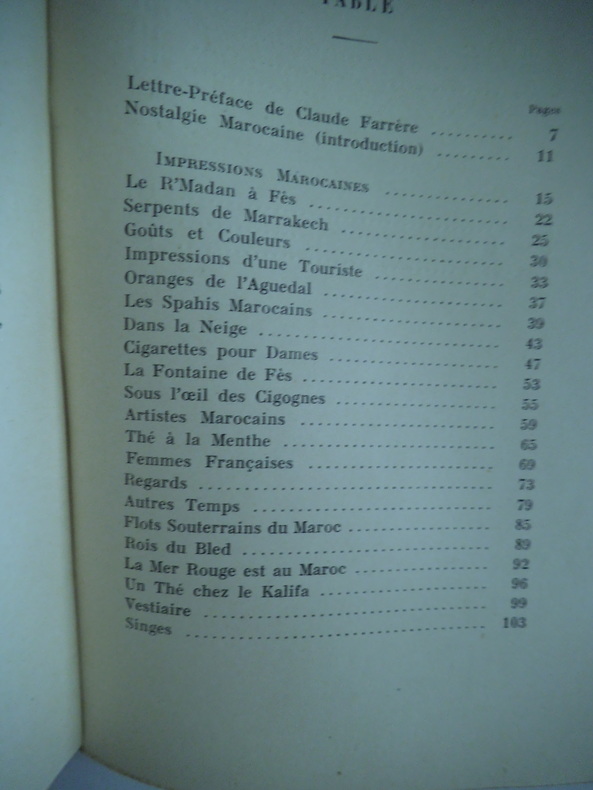
11498lettre préface de Claude FARRERE. Dessins de Jean Hée. In 12 broché, faux-titre, frontispice, titre illustré, 140 pages. Exemplaire sur alfa. Les œuvres représentatitves. 10 Août 1930
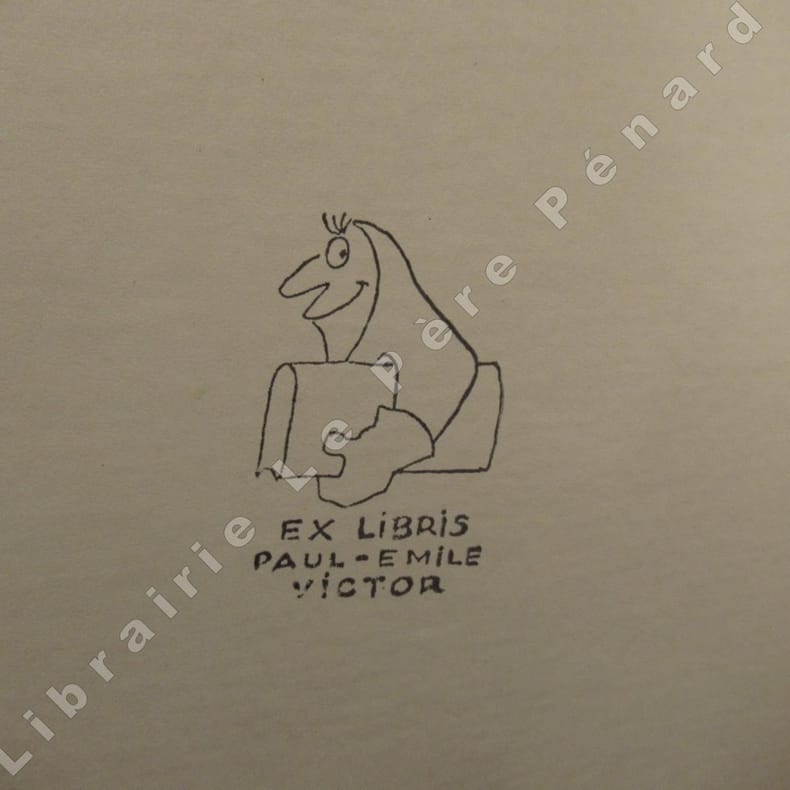
19711153171971 Editions American Geographical Society, Special Publication No. 39 - 1971 - Grand in-8, cartonnage toilé gris - Ex-libris Paul-Emile Victor au revers du 1er plat - 554 p. - Ouvrage en anglais
26759Paris, Nouvelles Editions Latines, 1958. 14 x 20, 272 pp., plusieurs illustrations, broché non coupé, bon état (couverture légèrement défraîchie).
182949248Leipzig Johann Ambrosius Barth 1829. Without wrappers as issued in "Annalen der Physik und Chemie. Hrsg.von Poggendorff" Bd. 16 Siebentes Stück. 2 pp. 1 folded engraved plate. Entire issue offered with titlepage to volume 16. Berzelius's paper: pp. 387-415. Clean and fine. <br/><br/><em>First German printing - printed simultaneously with the English and Swedish version - of the paper in which Berzelius described his discovery of Thorium the first element after Uranium to be identified as such. In 1829 Jöns Jakob Berzelius of the Royal Karolinska Institute Stockholm extracted thorium from a rock specimen sent to him by an amateur mineralogist who had discovered it near Brevig and realised that it had not previously been reported. The mineral turned out to be thorium silicate and it is now known as thorite. Berzelius even produced a sample of metallic thorium by heating thorium fluoride with potassium and confirmed it as a new metal. He called the black mineral thorite in honor of the Scandinavian god Thor.Parkinson "Breakthroughs" 1829 C. </em> unknown
723 pages including bibliography. Records the achievements of forty years of medical research, giving direct and easy access to over sixty of Dr. Best's original important research papers in the fields particularly of insulin, heparin, and choline. Opens with the early papers describing the discovery of insulin, and continues with those dealing with its preparation, extraction, physiologic effects and first clinical applications. Dr. Best has also looked back over the record as given in these papers and provided informative and informal bridges between them which place them in historical perspective. Contents clean, bright and unmarked. Negligible wear to book. Contains several colour plates and black and white illustrations. Price-clipped dust jacket now preserved in glossy new Brodart cover and shows light wear. A quality copy. Book
Paris, Imprimerie C. Courtois 1925. Petit in-4 (19 x 28 cm), demi-basane, dos lisse auteur et titres en lettres dorées, VI-375 pp. Avec une table nominative des poiçons et une deuxième table des poinçons particuliers à chaque ville. Les dessins des poinçons en regard du texte le sont par similitude d'image, en subdivisant cette classification en deux parties : symboles divers et Lettres ''. Bel exemplaire.
26595Paris, Imprimerie C. Courtois 1925. Petit in-4 (19 x 28 cm), demi-basane, dos lisse auteur et titres en lettres dorées, VI-375 pp. Avec une table nominative des poiçons et une deuxième table des poinçons particuliers à chaque ville.
13164BIGOT Charles De Paris au Niagara. Journal d’une délégation. In 12 broché, 120x190mm. Faux-titre, titre, 195 pages 1 page de table des matières. Paris A. DUPRET 1887. Edition originale sur papier fort.
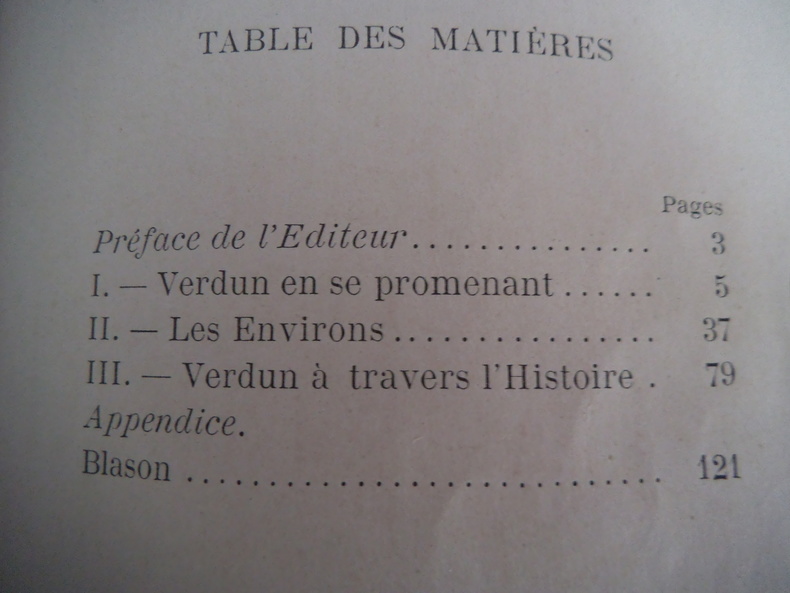
10226VERDUN en se promenant-les environs. Verdun à travers l’histoire. In 12 broché, couverture verte façon maroquin avec titre en rouge. Faux-titre, titre, 135 pages, 1 page de table des matières. Verdun L. MARCHAL libraire éditeur 1903. Bon exemplaire
2009Q-1572933666RBC Ministries 2009-01-01. Paperback. New. New. In shrink wrap. Looks like an interesting title! RBC Ministries paperback
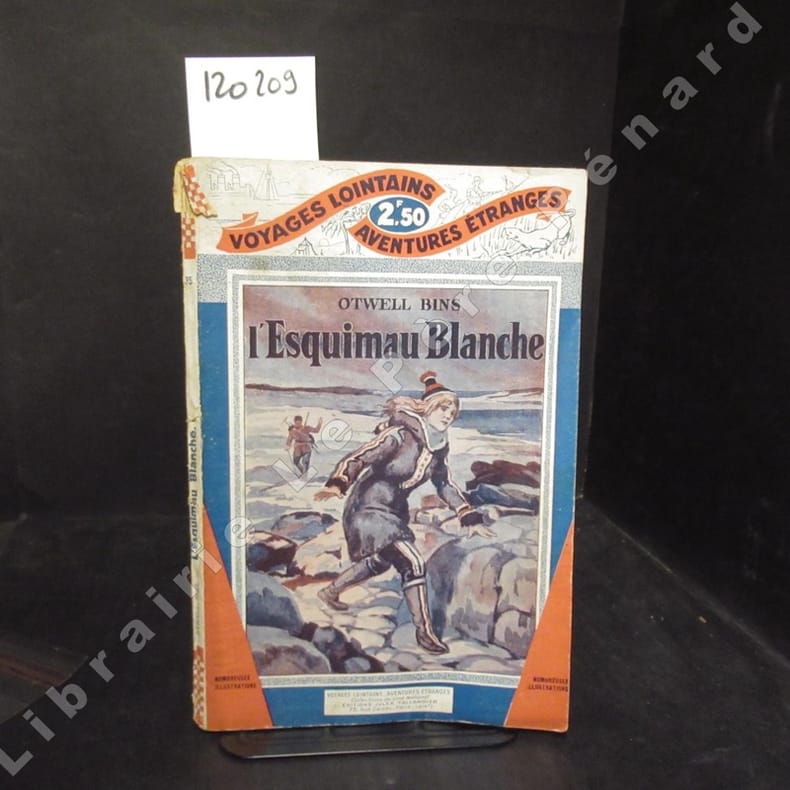
19291202091929 Editions Jules Tallandier, collection du Livre National, "Voyages lointains, Aventures Etranges", N° 35 - 1929 - In-8, broché couverture illustrée - 125 pages - Illustrations en N&B hors texte
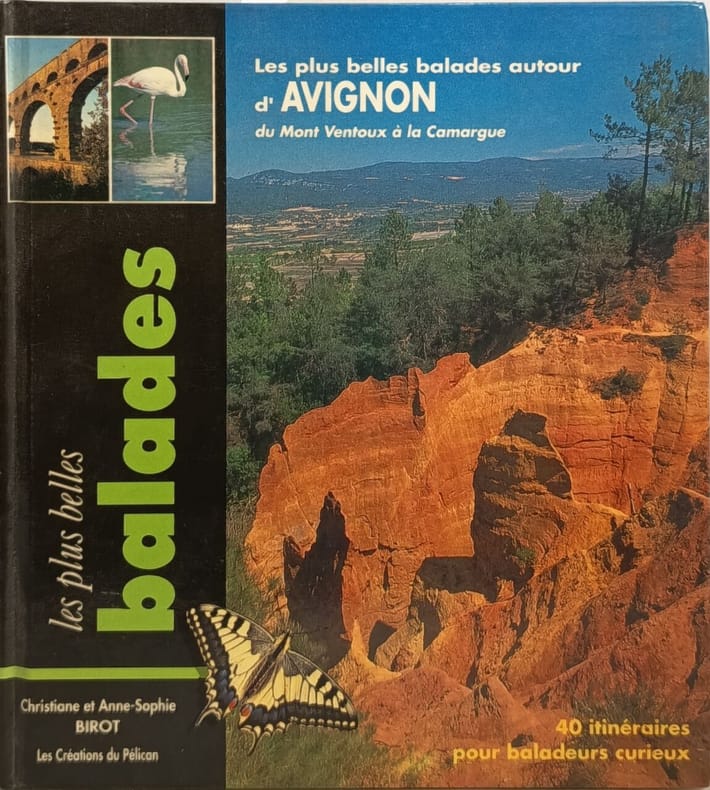
19967417Les créations du pélican 1996 144 pages in8. 1996. Reliure editeur cartonnée. 144 pages. Ce guide de randonnée propose 40 itinéraires pédestres pour découvrir la région d'Avignon du Mont Ventoux à la Camargue. Il met en valeur la diversité naturelle géologique historique et culturelle des paysages provençaux
Paris, Editions G. L. M., 1935. In-8, broché, couverture imprimée et rempliée, n.p. Tirage limité à 212 exemplaires numérotés. Un des 200 ex n° sur Hélio, n° 99. Bel exemplaire. Gregorio PRIETO : Images. Fernand POUEY : Chanson de Marguerite. Pierre COURTHION : L'époux - Le Parachutiste. Pierre-Jean LAUNAY : Dans la nuit. R. de SABLON-FAVIER : Poèmes. KLEIN : Images du cirque. Jacques BARON : Changement de saison. Lucien JUBLOU : Signaux. Jean FOLLAIN : Poèmes. Guy LEVIS-MANO : Il y a aussi des carrefours... Pierre ALBERT-BIROT: Mon ami Kyonos. Y. VINEUIL : Retour.