93 résultats
180842218London W. Bulmer and Co. 1808. 4to. No wrappers as extracted from "Philosophical Transactions" 1808 - Part I. Pp. 1-44. <br/><br/><em>First printing of this importent historical paper in chemistry in which Davy shows that electricity is capable of decomposing some alkalies isolating two new substances and discovering potassium and sodium. Neville in his Historical Chemical Library vol. I p.340 writes about this paper "ONE OF THE GREAT CLASSIC RESEARCHES IN CHEMISTRY in which Davy announced in this his second Bakterian lecture the isloation of metallic potassium and sodium by the electrolytic decomposition of their fused oxides.""He Davy began his own electrical experiments.The results were spectacular. On October 6 1807 the current passing through molten potash liberated a metal which Davy called potassium. The little globules of shining metal tore the water molecule apart as it eagerly recombined with oxygen and the liberated hydrogen burst into lavender flame. Davy danced about in a delirium of joy. A week later he isolated sodium from soda."Asimow. The paper offered here describes these discoveries."Humphry Davy was one of the most brilliant chemists of the early nineteenth century. His early study of nitrous oxide brought him his first reputation but his later and most importent investigations were devoted to electrochemistry. Following Galvani's experiments and the discovery of the voltaic pile interest in galvanic electricity had become widespread. The first electrolysis by means of the pile was carried out in 1800 by Nicholson and Carisle who obtained oxygen and hydrogen from water. Davy began to examine the chemical effects of electricity in 1800 and his numerous discoveries were presented in his Bakerian lecture to the Royal Society on November 20 1806.A Source Book in Chemistry p. 243. - Wheeler Gift: 2514. </em> unknown
180845884London W. Bulmer and Co. 1808. 4to. No wrappers as extracted from "Philosophical Transactions" 1808 - Part I. Pp. 1-44. Clean and fine wide-margined. <br/><br/><em>First printing of this importent historical paper in chemistry in which Davy shows that electricity is capable of decomposing some alkalies isolating two new substances and discovering potassium and sodium. Neville in his Historical Chemical Library vol. I p.340 writes about this paper "ONE OF THE GREAT CLASSIC RESEARCHES IN CHEMISTRY in which Davy announced in this his second Bakterian lecture the isloation of metallic potassium and sodium by the electrolytic decomposition of their fused oxides.""He Davy began his own electrical experiments.The results were spectacular. On October 6 1807 the current passing through molten potash liberated a metal which Davy called potassium. The little globules of shining metal tore the water molecule apart as it eagerly recombined with oxygen and the liberated hydrogen burst into lavender flame. Davy danced about in a delirium of joy. A week later he isolated sodium from soda."Asimow. The paper offered here describes these discoveries."Humphry Davy was one of the most brilliant chemists of the early nineteenth century. His early study of nitrous oxide brought him his first reputation but his later and most importent investigations were devoted to electrochemistry. Following Galvani's experiments and the discovery of the voltaic pile interest in galvanic electricity had become widespread. The first electrolysis by means of the pile was carried out in 1800 by Nicholson and Carisle who obtained oxygen and hydrogen from water. Davy began to examine the chemical effects of electricity in 1800 and his numerous discoveries were presented in his Bakerian lecture to the Royal Society on November 20 1806.A Source Book in Chemistry p. 243. - Wheeler Gift: 2514. </em> unknown
181045887London W. Bulmer and Co. 1810. 4to. No wrappers as extracted from "Philosophical Transactions" 1810 - Part I. Pp. 16-74 and 2 engraved plates showing Davy's electrochemical apparatus for decomposing substances Davy's versions of the Voltaic-pile. Plates a bit brownspotted otherwise clean and fine wide-margined. <br/><br/><em>First appearence of this historical chemical paper Davy' fifth Bakerian Lecture in which he announced his discovery of hydrogen telluride."Mr. Davy having from the commencement of his electro-chemical researches communicated the several steps of his progress to the Society The Royal Society takes the present opportunity of reporting the results of his further inquiries under four principal heads. First on the nature of the metals of the fixed alkalis. Second on the nature of Hydrogen and composition of ammonia. Thirdly on the metals of the earth; and Fourthly he makes a comparison between the antiphlogistic doctrine and a modified phlogistic hypothesis."Abstract. He further gives arguments for considering potassium and sodium which he discovered in 1808 as a element."Humphry Davy was one of the most brilliant chemists of the early nineteenth century. His early study of nitrous oxide brought him his first reputation but his later and most importent investigations were devoted to electrochemistry. Following Galvani's experiments and the discovery of the voltaic pile interest in galvanic electricity had become widespread. The first electrolysis by means of the pile was carried out in 1800 by Nicholson and Carisle who obtained oxygen and hydrogen from water. Davy began to examine the chemical effects of electricity in 1800 and his numerous discoveries were presented in his Bakerian lectures." - Wheeler Gift: 2518.Also with William Hyde Wollaston "The Croonian Lecture. Read November 16 1809.On Muscular Action - On Sea-Sickness - On the salutary Effects of Riding and other Modes of Gestation. Pp. 1-15. </em> unknown
188047008Paris Gauthier-Villars 1880. 4to. No wrappers. In: "Comptes Rendus Hebdomadaires des Séances de L'Academie des Sciences" Tome 91 No 5 entire issue offered. Pp. 251-310. The Curie's paper: pp. 294-295. <br/><br/><em>First apperance of the paper in which the two brothers announced their discovery of the Piezoelectric Effect as they observed how an electric potential appeared across crystals of quartza and of Rochelle salt when pressure was applied to them. The potential varied directly with the pressure and they named the phenomenon Piezoelectricity meaning "to press" Greek. Crystals with piezoelectric properties form an essential portion of sound-electronics devices such as microphones and record-players."The applications of piezoelectric crystals are innumerable; one of the most important is their use in frequency stabilization of oscillating electromagnetic cirasciots for radio broadcasting stations. They are used in most piezometers for measuring with great precision either very strong pressure variations such as those of a cannon at the moment of firing or very weak ones such as artery pulsations. These applications have led to the creation of a new industry the manufacture of large "mono" such as quartz obtained hydrothermally around 500°C. under high water pressures or crystals such as Rochelle salt obtained from aqueous solutions. These two substances were mentioned in the Curie brothers’ report announcing the discovery of piezoelectricity." DSB."The first experimental demonstration of a connection between macroscopic piezoelectric phenomena and crystallographic structure was published in 1880 by Pierre and Jacques Curie. Their experiment consisted of a conclusive measurement of surface charges appearing on specially prepared crystals tourmaline quartz topaz cane sugar and Rochelle salt among them which were subjected to mechanical stress. These results were a credit to the Curies' imagination and perseverance considering that they were obtained with nothing more than tinfoil glue wire magnets and a jeweler's saw." Piezo Systems Inc.Magee "A Source Book in Physics" p. 547 ff. </em> unknown
189846852Paris Gauthier-Villars 1898. 4to. No wrappers. In: "Comptes Rendus Hebdomadaires des Séances de L'Academie des Sciences" Tome 126 No 15. Entire issue offered. With htitle and titlepage to vol. 126. Pp. 1059-1110. Curie's paper: pp. 1101-1103. <br/><br/><em>First printing of this milestone paper being the first "Note" from Marie Curie about "radioactivity". This same "Note" contains a the fundamental observation: "Two uranium ores. are much more active than uranium itself. This fact. leads one to believe that these ores may contain an element much more active than uranium." This paper gives the first proof of the fact that radiation is an atomic property."Henri Becquerel discovered 1896 that uranium salts shielded from light for several months spontaneously emit rays related in their effects to Roentgen rays. Mme. Curie became enthusiastic about this subject filled with the unknown and as she later acknowledged involving no bibliographic research.The first step in the research was to determine whether there existed other elements capable like uranium of emitting radiation. Abandoning the idea of hyperfluorescence couldn’t one calculate by electrical measurement the effects on the conductivity of air that were revealed by the gold-leaf electroscope Pierre Curie and his brother Jacques had constructed an extremely sensitive apparatus to measure weak currents; Mme. Curie employed it in testing both pure substances and various ores. In her first "Note" in the Comptes rendus"de l Académie des sciences 12 April 1898 she described the method that she followed throughout her life the method that enabled her to make comparisons through time and crosschecks with other techniques:"I employed. a plate condenser one of the plates being covered with a uniform layer of uranium or of another finely pulverized substance diameter of the plates eight centimeters; distance between them three centimeters. A potential difference of 100 volts was established between the plates. The current that traversed the condenser was measured in absolute value by means of an electrometer and a piezoelectric quartz. In general she preferred the zero method in which the operator compensates for the current created by the active material by manipulating the quartz. All of her students followed this procedure."DSB.The first results came in 1898: the measurements varied between 83 × 10-12 amperes for pitch blende to less than 0.3 × 10⁻¹² for almost inactive salts passing through 53 × 10-12 for thorium oxide and for chalcolite double phosphate of uranium and copper. Thorium would thus be "radioactive" the term is Mme. Curie’s; its radioactive properties were discovered at the same time independently by Schmidt in Germany. </em> unknown
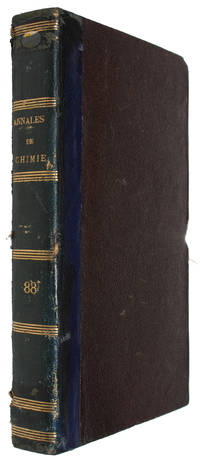
181343081Paris J. Klostermann 1813. Contemp. hcalf. Spine gilt. A few scratches to binding. In: "Annales de Chimie ou Recueil de Mémoires concernant la Chemie" Tome 88. - 336 pp. the entire volume offered. Pp. 304-310 311-318 319-321 a. 322-329. Scattered brownspots. <br/><br/><em>First printing of this paper announcing the discovery of Iodine. Courtois found this substance which he suspected to be a new element while burning algae in order to obtain sodium and potassium compounds. Although Courtois discovered the element in 1811 the announcement of it was not made until two years later after he had turned it over to Charles Desormés and Nicolas Clément."The first publication on iodine are somewhat confusing. Courtois's research is found in a paper attributed to him the paper offered but actually the work of Clément. was followed by an anonymous article the second paper offered. Gay-Lussac. who repeated and extended Courtios's work was responsible for this paper. Courtois himself published nothing. These two articles were immediately followed by short contributions of Gay-Lussac and Humphry Davy on the new element third and fourth paper offered. Gay-Lussacs views none too flattering to Davy on the history ofthe discovery of iodine appeared in his "Mémoire sur l'iode" 1814."DSB III p. 455. - Weeks "Discovery of the Elements" pp. 257-262.The volume contains further importent papers in chemistry Guyton de Morveau "Sur la chaux maigre" "Sur le dissolvant des pierres biliaires" an importent paper by Chevreul on animal fats "Recherches chimiques sur plusieurs corps gras et particulierement sur leurs combinaisons avec les alcalis" Berzelius's papers "Mémoires sur la compositions des fluides animaux" first edition in French Suite first edition Parmentier etc. etc. </em> unknown
182843318Leipzig Johann Ambrosius Barth 1828. Without wrappers as issued in "Annalen der Physik und Chemie. Hrsg.von Poggendorff" Bd. 14 Zweites Stück. =Jahrgang 1828 zehntes Stück. Pp. 191-306 a. 3 engraved plates. the entire issue offered Heft 2 together with the titlepage to 14. Band. Brown's paper: pp. 294-313. Clean and fine. Small stamp on verso of titlepage. <br/><br/><em>First appearance in German of this monumental paper in atomic theory and kinematics as it was the first evidence for atomism that was an observation rather than a deduction from abstract principles."In 1827 as he was viewing a suspension of pollen in Water under the microscope he noted that the individual grains were moving about irregularly. This he thought was the result of the life hidden within the pollen grains. However when he studied dye particles indubitably nin-livin suspended in water he found the same erratic motion. This has been called "Brownian motion" ever since and Brown could merely report on the observation. He had no explanation for it. Nor had anyone else until the development of the kinetic theory of gases by men such as Maxwell a generation later. It seemed plain. after Maxwell and especially after the work of Einstein and Perrin a half century after Maxwell that the Brownian Motion was actually a visible effect of the fact that water was composed of particles. It was the first evidence for atomism that was an observation rather than a deduction." Asimov.The issue contains other importent papers by C. Naumann G. Magnus Th. Saussure "Kohlensäuregas in der Atmosphäre" andothers.PMM: 290 the English paper from 1828 - Sparrow Milestones of Science No 31. - Magie "A Source Book in Physics p. 251-255. - Dibner Heralds of Science No 156. </em> unknown
187449327Leipzig Johann Ambrosius Barth 1874. 8vo. Contemp. hcalf. 5 raised bands gilt spine and gilt lettering to spine. A few scratches to spine. Small stamp on verso of first -and general- titlepage. In: "Annalen der Physik und Chemie. Hrsg. von J.C. Poggendorff" Sechste Reihe Bd. 3 = Poggendorff Bd. 153. X636 pp. 4 plates. Entire volume offered. Braun's paper: pp. 556-563. <br/><br/><em>First printing of Brown's importent paper in which he described his discovery of a semiconductor diode noting that electrical currents flows freely in only one direction at the contact between a metal point and a galena crystal."In 1874 Braun published the results of his research on mineral metal sulfides. He found that these crystals conducted electric currents in only one direction. This information was important in electrical research and in measuring another property of substances the electrical conductivity but Braun’s discovery did not have immediate practical application. In the early twentieth century the principle that Braun had discovered was employed in crystal radio receivers."DSB.The Nobel Prize in Physics 1909 was awarded jointly to Guglielmo Marconi and Karl Ferdinand Braun "in recognition of their contributions to the development of wireless telegraphy". </em> hardcover
182949248Leipzig Johann Ambrosius Barth 1829. Without wrappers as issued in "Annalen der Physik und Chemie. Hrsg.von Poggendorff" Bd. 16 Siebentes Stück. 2 pp. 1 folded engraved plate. Entire issue offered with titlepage to volume 16. Berzelius's paper: pp. 387-415. Clean and fine. <br/><br/><em>First German printing - printed simultaneously with the English and Swedish version - of the paper in which Berzelius described his discovery of Thorium the first element after Uranium to be identified as such. In 1829 Jöns Jakob Berzelius of the Royal Karolinska Institute Stockholm extracted thorium from a rock specimen sent to him by an amateur mineralogist who had discovered it near Brevig and realised that it had not previously been reported. The mineral turned out to be thorium silicate and it is now known as thorite. Berzelius even produced a sample of metallic thorium by heating thorium fluoride with potassium and confirmed it as a new metal. He called the black mineral thorite in honor of the Scandinavian god Thor.Parkinson "Breakthroughs" 1829 C. </em> unknown
185847111Paris Mallet-Bachelier 1858. 4to. No wrappers. In: "Comptes Rendus Hebdomadaires des Séances de L'Academie des Sciences" Tome 47 No 6 a. No 10. Pp. 245- 279 a. pp. 393- 431 entire issues offered. Bernard's papers: pp. 245- 253 a. pp. 393 -400. <br/><br/><em>First appearance of these landmark papers in which Barnard explains his discovery of how the nerves controls the blood vessels. This is the "discovery of the vascoconstrictor and vasodilator nerves and description of their function of regulating the blood supply to the different parts of the body."Garrison & Morton No. 774."In 1858 the papers offered Bernard demonstrated the existence of vasodilator nerves by finding an increased blood flow through the submaxillary gland when the corda tympani is stimulated. He also observed that the venous blood became bright red. Since that time an enormous amount of research has been carried out on the vasomotor system."R.J.S. Mcdowall.Garrison & Morton No. 774. </em> unknown
185547110Paris Mallet-Bachelier 1855 a. 1857. 4to. No wrappers. In: "Comptes Rendus Hebdomadaires des Séances de L'Academie des Sciences" Tome 41 No 13 and Tome 44 No 12 a. No. 26. Pp. 461-500 pp. 578-640 a. pp. 1293-1363 3 entire issues offered. Bernard's papers: pp. 461-469 pp. 578-586 a. pp. 1325-1331. Some scattered brownspots to the first paper. <br/><br/><em>First printing of these two milestone-papers in physiology in which Bernard discovers and isolates glycogen from the liver shows that it is converted into blood glucose and discovers the process of gluconeogenesis. He further creates the concepts "experimental determination" and "local interieur"Bernard undertook the task of tracing out the various transformations of food stuffs within the animal organism beginning with the carbohydrates; and he not only found contrary to the accepted view that sugar was formed in the liver but he was also able to isolate a substance from the hepatic tissue which though not sugar was converted by fermentation into dextrose. He made a special study of its properties and called it "glycogen"."The culmination of Bernard's work on the glycogenic function of the liver. He invented the term "internal secretion" and can be said to have started the scientific investigation of the internal secretions although for 30 years the significance of his work was not generally realized. By his research on glycogene Bernard showed that the body not only can break down but can also build up complex chemical substances."Garrison & Morton .Claude Bernard 1813-78 was a key figure in French nineteenth-century science and one of the world's great physiologists. With good reason he has been called the ‘father of experimental medicine’.Garrison & Morton No. 1000 a. 999.1 </em> unknown
185048830Paris Bachelier1850. 4to. No wrappers. In: "Comptes Rendus Hebdomadaires des Séances de L'Academie des Sciences" Tome XXXI No. 17. With titlepage to vol. 31. Pp. 561- 592. Entire issue offered. Bernard's paper: pp. 571-574. Titlepage with a faint stamp to top and a stamp in lower margin. <br/><br/><em>First appearance of the first exposition of the glycogenic function of the liver - one of the greatest physiological discoveries of the 19th century. Bernard showed that the liver builds up complex substances including glycogen from the nutriment brought to it by the blood and that these are subsequently modified for distribution to the body.Dibner "Heralds of Science" No 131 - Horblit "One Hundred Books famous in Science" No. 11a here listing "Nouvelle Fonction du Foie" from 1853 but with the remark "The work appeared earlier in abbreviated form in the "Comptes rendus" the paper offered. - Exhibition of First Editions of Epochal Achievements in the History of Science Berkeley 1934. No 107. </em> unknown
189646854Paris Gauthier-Villars 1896. 4to. Near contemp. full cloth. Spine gilt and with gilt lettering. Bookmark "The Chemists Club" in gold on lower part of spine. Light wear along edges. In: "Comptes Rendus Hebdomadaires des Séances de L'Academie des Sciences" Tome 122 Entire volume offered.1633 pp. The papers: 420-421 pp. 501-502 pp. 559-564 pp. 689-694 pp. 762-767 and pp. 1086-1088. <br/><br/><em>First appearance of the six landmark papers in which Becquerel documents his discovery of Radio-activity PROMPTING THE NUCLEAR AGE.Becquerel was an expert in fluorescence and phosphorescence continuing the work of his father and grandfather. Follwing the discovery of X-rays by Röntgen Bexquerel investigated fluorescent materials to see if they also emitted X-rays. He exposed a fluorescent uranium salt pechblende to light and then placed it on a wrapped photographic plate.He found that a faint image was left on the plate which he believed was due to the pichblende emitting the light it had absorbed as a more penetrating radiation. However by chace he left a sample that had not been exposed to light on top of a photographic plate in a drawer. he noticed that the photographic plate also had a a faint image of the pechblende. After several chemical tests he concluded that these "Becquerel rays" were a property of atoms. He had by chace discovered radio-activity and prompted thee beginning of the nuclear age. He shared the Nobel Prize for Physics in 1903 with Marie and Pierre Curie. The "Becquerel Rays" were later discovered to be a composite of three forms of emanation distinguished by Rutherford as alpha beta and gamma rays.Dibner: 163 the later Mémoire from 1903 - PMM: 393 1903- Mémoire - Garrison & Morton: 2001 only the first paper. - Magie "A Sourve Book in Physics" p. 610 ff. - Norman:157. </em> hardcover
182659047Paris Crochard 1826. Contemp. hcloth. Gilt lettering on spine. In: "Annales de Chimie et de Physique par Gay-Lussac et Arago" tome 32. 448 pp. 3 folded engraved plates. Balard's paper: pp. 337-84. Entire volume offered with original memoirs by Savart Berzelius Humboldt Arago Poisson Liebig Dumas et al. <br/><br/><em>First printing of Balard's famous memoire in which he records his discovery of the new element Bromine le brôme. While he was studying the flora of a salt marsh he notized a deposit of sodium saulfate which had crystallized out in a pan containing mother liquer from common salts. "In an attempt to find a use for the waste liquers he performed a number of experiments and notized that when certain reagents were added the mother liquer bacame brown. His investigation of this phenomenon.ked to the remarkable discovery.Weeks p. 264. "The discovery of a new chemical element by a young and obscure provincial pharmacist caused a sensation in Paris. Balard's achievemnt was recognized by the Academie des Sciences and he was awarded a medal by the Royal Society of London."DSB I p. 416. "The discovery of bromine is a very importent acquisition to chemistry and gives M. Balrad honorable rank inthe career of the sciences. We are of the opinion that this young chemist is every way worthy of the encouragement of the Academy and we have the honour to propose that his memoir shall be printed in the "Recueil des Savants Étrangers" The report from the French Academy signed by Vaugelin Thenard and Gay-Lussac. </em> hardcover
182643853Paris Crochard 1826. Without wrappers. In: "Annales de Chimie et de Physique par Gay-Lussac et Arago" tome 32 Sec. Series Cahier 4. Pp. 337-443 a. 1 fodled engraved plate. The entire issue offerd. Balard's paper: pp. 337-84. <br/><br/><em>First printing of Balard's famous memoire in which he records his discovery of the new element Bromine le brôme. While he was studying the flora of a salt marsh he notized a deposit of sodium saulfate which had crystallized out in a pan containing mother liquer from common salts. "In an attempt to find a use for the waste liquers he performed a number of experiments and notized that when certain reagents were added the mother liquer bacame brown. His investigation of this phenomenon.ked to the remarkable discovery.Weeks p. 264."The discovery of a new chemical element by a young and obscure provincial pharmacist caused a sensation in Paris. Balard's achievemnt was recognized by the Academie des Sciences and he was awarded a medal by the Royal Society of London."DSB I p. 416."The discovery of bromine is a very importent acquisition to chemistry and gives M. Balrad honorable rank inthe career of the sciences. We are of the opinion that this young chemist is every way worthy of the encouragement of the Academy and we have the honour to propose that his memoir shall be printed in the "Recueil des Savants Étrangers" The report from the French Academy signed by Vaugelin Thenard and Gay-Lussac. </em> unknown
184447225Paris Bachelier 1844. 4to. No wrappers. In "Comptes rendus hebdomadaires des séances de l’Académie des sciences" Vol. 19 No 14. Pp. 621- 686. Entire issue offered. Balard's paper: pp. 634-641. <br/><br/><em>First appearance of an importent paper in pharmacology as Balard here described his discovery of amyl nitrite and its preparation.Sir Thomas Lauder Brunton a Scottish physician later famously pioneered the use of amyl nitrite to treat angina pectoris. Brunton reasoned that the pain and discomfort of angina could be reduced by administering amyl nitrite to dilate the coronary arteries of patients thus improving blood flow to the heart muscle.Garrison & Morton No 1859. </em> unknown
186244063Leipzig Johann Ambrosius Barth 1862. Without wrappers as issued in "Annalen der Physik und Chemie. Hrsg. von J.C. Poggendorff" Vierte Reihe Bd. 27 117 Stück Zwei No. 10. The entire issue offered. Titlepage to vol. 27. Pp. 193-352 a. 1 engraved plate. Ångströms paper: pp. 290-302. <br/><br/><em>First appearance in German of Ångström's famous paper in which he announced the discovery of hydrogen in the atmosphere of the sun and in which he also confirmed the probable existence of of other elements there. The paper appeared in "Oefversigt af K. Vet. Acad. Förhandl." in 1861. The German paper here is expanded. At the same time it was translated into English and publishe as "On the Fraunhofer Lines Visible in the Solar Spectrum".Ångström was one of the early formulators of the science of modern spectroscopy; he wrote extensively on terrestrial magnetism the conduction of heat and especially spectroscopy. He published a monumental map of the normal solar spectrum that expressed the length of light waves in units of one ten-millionth of a millimeter a unit of length now known as the angstrom. He discovered that hydrogen is present in the sun's atmosphere and he was the first to examine the spectrum of the aurora borealis. </em> unknown
182044807Paris Crochard 1820. No wrappers as extracted fron 'Annales de Chimie et de Physique' Volume 15 2e Series. Pp. 93-102. <br/><br/><em>First appearance of this importent paper in which Arago gives an account of his discovery of how iron and steel could be magnetized by the action of the voltaic current THE FIRST STEP TOWARDS THE ELECTRIC TELEGRAPH. "Arago . made several important contributions to electromagnetism on his own. On 20 September 1820 he announced the discovery of the temporary magnetization of soft iron by an electric current which suggested to Ampère a theory about the nature of magnetic "currents" and provided the technological key to the electric telegraph. Ampère calculated that the magnetic power could be multiplied by twisting the current-carrying wire into a helix and with Arago he carried out the first experiments on primitive solenoids. In his historical articles Arago was always careful to credit Ampère with the major share of this discovery which ultimately depended upon Ampère’s mathematical theory."DSB.Arago formed a close freinship with Fresnelwhose views on the nature of light he ardently supported. He assisted Fresnel in some of his most importent work and made original discoveries in the same field.Magie "A Source Book in Physics" p. 443 ff. </em> unknown