232 résultats
1867VOEK0219cBln., Hempel 1867. Lex.-8°, XII, 552 S., mit 1 Titelbild und 326 Holzschnitten, HLdr. d. Zt., marmor. Schnitt, berieben, Ecken etwas bestoß., Leder beschabt,, neue Vorsätze., im vord. Bereich etw. wasserrandig, vereinzelt Text gebräunt. (= Der Erdball un d seine Naturwunder. 2. Bd.).
1865VOEK0219aBln., Hempel 1865. Lex.-8°, XV, 784 S., mit 123 Abb. u. Karten, 1 farblithogr. Front., HLdr. d. Zt., berieben, Ecken etwas bestoß., Leder beschabt, kl. Loch am Rpckenschwanz, neue Vorsätze, schwach stockfleck., vereinzelt kl. Schmutzstellen. (= Der Erdball un d seine Naturwunder. 4. Bd.).
185545031Paris Victor Masson 1855. 8vo. Without wrappers. In 'Annales de Chimie et de Physique' Series 3 tome 30 December-issue. With halftitle to vol. 30. Pp. 385-508 a. 1 plate. Entire issue offered. Wurtz's paper: pp. 443-506. <br/><br/><em>First appearance of the entire memoir in which Wurtz describes his outstanding discovery of Liebig’s prediction that there might be organic compounds analogous to ammonia and derivable from it by the replacement of hydrogen - the amines. The discovery was announced in 1849 and a small extract was printed in "Comptes rendu" 4 pp. The offered paper is the memoir in full.Wurtz is most noted for his investigation of glycols and for his discovery of the amines. The latter discovery in 1849 the paper offered was very significant at the time for ot suggested the possibility of a new type the ammonia type which helped to explain the behaviour of nitrogenous compounds. Leicester & Klickstein "A Source Book." pp. 362-63. - Parkinson "Breakthroughs" 1849 C.Charles Adolphe Wurtz was born at Strasbourg 1817. For many years he was Professor of Chemistry at the Ecole de Médicine and at Sorbonne in Paris. He was known not only for his researches in organic chemistry but also for his many literary works. He was editor of a Dictionnaire de Chemie Pure et Appliquée and after 1868 one of the editors of the Annalen der Chemie et de Physique. He died in Paris in 1884. </em> unknown
184947031Paris Bachelier 1849. 4to. No wrappers. In: "Comptes Rendus Hebdomadaires des Séances de L'Academie des Sciences" Tome 28 No 7. Pp. 189-240 entire issue offered. Wurtz's paper: pp. 223-226. <br/><br/><em>First appearance of the announcement of Wurtz's outstanding discovery of Liebig’s prediction that there might be organic compounds analogous to ammonia and derivable from it by the replacement of hydrogen - the amines. The entire memoir was not published in full until 1855 in 'Annales de Chimie et de Physique'.Wurtz is most noted for his investigation of glycols and for his discovery of the amines. The latter discovery in 1849 the paper offered was very significant at the time for ot suggested the possibility of a new type the ammonia type which helped to explain the behaviour of nitrogenous compounds. Leicester & Klickstein "A Source Book." pp. 362-63. - Parkinson "Breakthroughs" 1849 C. </em> unknown
180442469London Bulwer and Co. 1804. 4to. Without wrappers as extracted from "Philosophical Transactions of the Royal Society of London." Year 1804-Part II. Pp. 419-430. Clean and fine. <br/><br/><em>First appearance of the paper in which Wollaston announced his discovery of the metallic element Rhodium."Dr. Wollaston dissolved a portion of crude platinum in qgua regia and neutralized the excess acid with caustic soda. He then added salammoniac to precipitate the platinum as ammonium chloroplatinate and mercurous cyanide to precipitate the palladium as palladium cyanide. After filteringoff the precipitate he decomposed the excess mercurous cyanide inthe filtarate by adding hydrochloric acid and evaporating to dryness. When he washed the residue with alcohol everything dissolved except a beautiful dark red powder which proved to be a double chloride of sodium and a new metal which because of the rose color of its salts Dr. Wollaston named 'Rhodium'. He found that the sodium rhodium chloride could be easely reduced by heating it in a current of hydrogen and that after the sodium chloride had been washed out the rhodium remained as a metallic powder. he also succeeded in obtaining a rhodium button."Weeks: Discovery of the Elements. p. 104-05. </em> unknown
183748086Paris Crochard et Comp. 1837. Orig. printed wrappers. No backstrip. In: "Annales de Chimie et de Physique Par MM. Gay-Lussac et Arago." tome 64 Cahier 2 Fevrier 1837. Pp. 113-224. Entire issue offered with printed wrappers. Wöhler a. Liebig's papers: pp. 185-209 a. pp. 209-217. <br/><br/><em>First appearance of this classic paper in organic chemistry in which Wöhler and Liebig showed how Amygdalin could be decomposed by a vegetable emulsion the first example of a glycoside. The papers were issued at the same time in "Annalen der Physik und Chemie"."The conclusions which you have drawn from the investigation of bitter-almond oil" wrote Berzelius to Liebig and Wöhler "are certainly the most importent which have so far been reached in the domain of vegetable chemistry and give promise of shedding an unexpected light over this part of the science.The facts which you have set forth inspire such reflections that they may be regarded as the dawn of a new day in vegetable chemistry."Berzelius-Wöhler Briefwechsel."During the years that Liebig was preoccupied with the ether theory and with organic acids he also carried out two importent investigations with Wöhler. In october 1836 Wöhler wrote that he had discovered a way to transform amygdalin to oil of bitter almonds and hydrocyanid acis by distilling it with manganese and sulfuric acid and he invited Liebig to join in pursuing the topic. Two days later he made a more remarkable discovery. It had occurred to him that perhaps thetransformation of amygdalin could be effected by the albumin in the almonds in a manner similar to the action of yeast in sugar.Wöhler suspected that the decomposition was an example of what Berzelius had recently defined as catalysis. Liebig and Wöhler then divided up the detailed examination of the properties and composition of amygdalin. They precipitated from the emulsion of almonds a substance which when dissolved retain its action. They named the active substance "emulsion". Its effectiveness in very small quantities confirmed that it acted like yeast."DSB VIII p. 342. </em> unknown
183743739Leipzig Johann Ambrosius Barth 1837. Without wrappers as issued in "Annalen der Physik und Chemie. Hrsg.von Poggendorff" Bd. 41 Zweites Stück. Entire issue No 6 offered. Titlepage to vol. 41. Pp. 225-448 a. 2 folded engraved plates. Wöhler & Liebig's papers: pp. 345-366 pp. 366-374 a. pp. 393-397. Clean and fine. <br/><br/><em>First appearance of this classic paper in organic chemistry in which Wöhler and Liebig showed how Amygdalin could be decomposed by a vegetable emulsion the first example of a glycoside."The conclusions which you have drawn from the investigation of bitter-almond oil" wrote Berzelius to Liebig and Wöhler "are certainly the most importent which have so far been reached in the domain of vegetable chemistry and give promise of shedding an unexpected light over this part of the science.The facts which you have set forth inspire such reflections that they may be regarded as the dawn of a new day in vegetable chemistry."Berzelius-Wöhler Briefwechsel."During the years that Liebig was preoccupied with the ether theory and with organic acids he also carried out two importent investigations with Wöhler. In october 1836 Wöhler wrote that he had discovered a way to transform amygdalin to oil of bitter almonds and hydrocyanid acis by distilling it with manganese and sulfuric acid and he invited Liebig to join in pursuing the topic. Two days later he made a more remarkable discovery. It had occurred to him that perhaps thetransformation of amygdalin could be effected by the albumin in the almonds in a manner similar to the action of yeast in sugar.Wöhler suspected that the decomposition was an example of what Berzelius had recently defined as catalysis. Liebig and Wöhler then divided up the detailed examination of the properties and composition of amygdalin. They precipitated from the emulsion of almonds a substance which when dissolved retain its action. They named the active substance "emulsion". Its effectiveness in very small quantities confirmed that it acted like yeast."DSB VIII p. 342. </em> unknown
185649036Paris Mallet-Bachelier 1856. 4to. No wrappers. In: "Comptes Rendus Hebdomadaires des Séances de L'Academie des Sciences" Tome 43 No 13. Pp. 637- 672. Entire issue offered. Vulpian's paper: pp. 663-665. <br/><br/><em>First appearance of the paper in which Vulpian described his discovery of adrenaline in the adrenal medulla. Vulpian established that the medulla synthesised a substance that was liberated into the blood circulation. This substance was later identified as adrenaline.Garrison & Morton No. 1141. </em> unknown
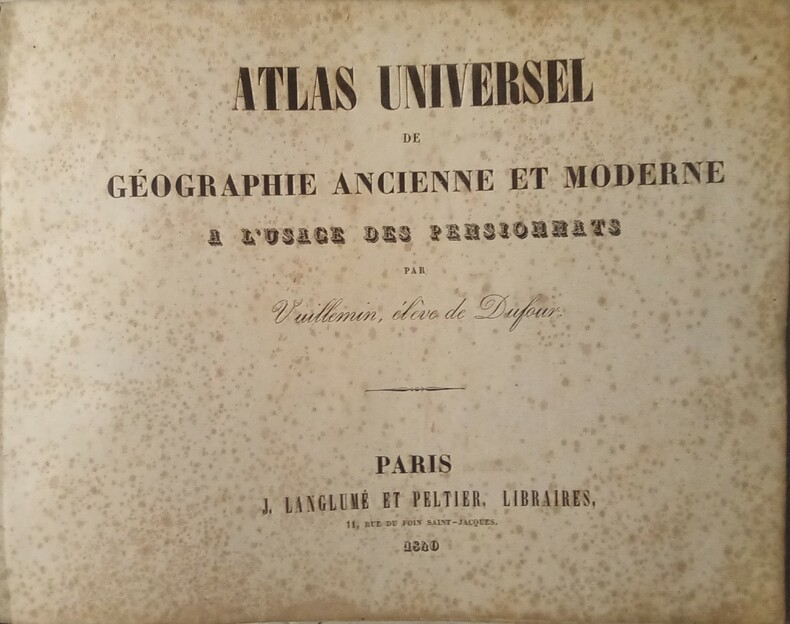
1840WOC-1374Paris, J. Langlumé et Peltier, Libraires, 1840. In-4 (25x32cm) oblong relié demi basane marron un peu passé, plats de papier marbré. Quelques rousseurs.
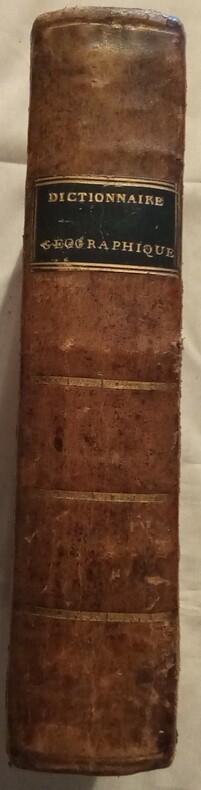
1810WOC-1373ou description des quatre parties du monde, par Vosgien. Nouvelle édition augmentée et entièrement refondue, renfermant les changements survenus par suite des différents traités, jusques et y compris celui de Vienne, du mois d'octobre 1809 par Giraud. Cet ouvrage est orné de six Cartes géographiques, et suivi de Tableau de réduction des francs en livres tournois, et des livres tournois en francs. Lyon, Chez Tournachon-Molin, Libraire, 1810. Fort in-8 (21x5x13cm) relié demi veau marron, dos orné de filets dorés, titre doré sur cuir noir, coins légèrement écornés, et manque dans le coin supérieur de 4 pages. 788pp. 80€
190051313Paris Gauthier-Villars 1900. 4to. No wrappers. In: "Comptes Rendus Hebdomadaires des Séances de L'Academie des Sciences" Tome 130 No 15 a. No 18. Pp. 962- 1044 a. pp. 1145- 1220. Entire issues offered. Villard's papers: pp. 1010-1012 a. 1178-1182 textillustrations. Clean and fine. <br/><br/><em>First apperance of Villard's two papers in which he announced and described the discovery of a new type of radiation more powerfull and penetrating than alpha-and beta rays. The new type of rays was named by Rutherford as gammarays. </em> unknown
190048207Paris Gauthier-Villars 1900. 4to. No wrappers. In: "Comptes Rendus Hebdomadaires des Séances de L'Academie des Sciences" Tome 130 No 15 a. No 18. Pp. 962- 1044 a. pp. 1145- 1220. Entire issues offered. Stamp on first pages. A few tears to margins. Poor paperquality fragile. Villard's papers: pp. 1010-1012 a. 1178-1182 textillustrations. <br/><br/><em>First apperance of Villard's two papers in which he announced and described the discovery of a new type of radiation more powerfull and penetrating than alpha-and beta rays. The new type of rays was named by Rutherford as gammarays."His Villardexperiments in radioactivity led to the unexpected discovery of gamma rays in 1900. Villard recognized them as being different from x rays because the gamma rays had a much greater penetrating depth. He had discovered they were emitted from radioactive substances and were not affected by electric or magnetic fields. These came to be called gamma rays by another scientist Ernest Rutherford. It wasn't until 1914 that Rutherford showed that they were a form of electromagnetic EM like light only with a much shorter wavelength than x rays. Now we know that gamma rays are a form of EM radiation similar to x rays. Gamma rays tend to have a higher energy and a shorter wavelength than x rays do. However the dividing line between these two forms of radiation is not clearly defined. Scientists typically apply the term gamma ray to EM radiation with energies above several hundred thousand electron volts." Hps - Healt Physics Society. - See Sigmund Brandt "The Harevst of a Century" Episode 6 p. 24 ff.The issues contains other importent papers HENRI BECQUEREL "Note sur la transmission du rayonnement du radium au travers des corps" pp. 979-984 and "Sur la transparance de l'aluminium pour le rayonnement du radium" pp. 1154-57. P. CURIE et G. SAGNAC "Électrisation négative des rayons secondaires produits au moyen des rayons de Röntgen" pp. 1013-1016. </em> unknown
1880100148526E. Dentu Editeur 1880 in12. 1880. Cartonné. Récit de voyage publié en 1880 par le journaliste et homme de lettres suisse Victor Tissot décrivant son périple en Hongrie pour découvrir la culture les modes de vie et les traditions des Tziganes tout en explorant les paysages et rencontrant les habitants de cette région alors méconnue
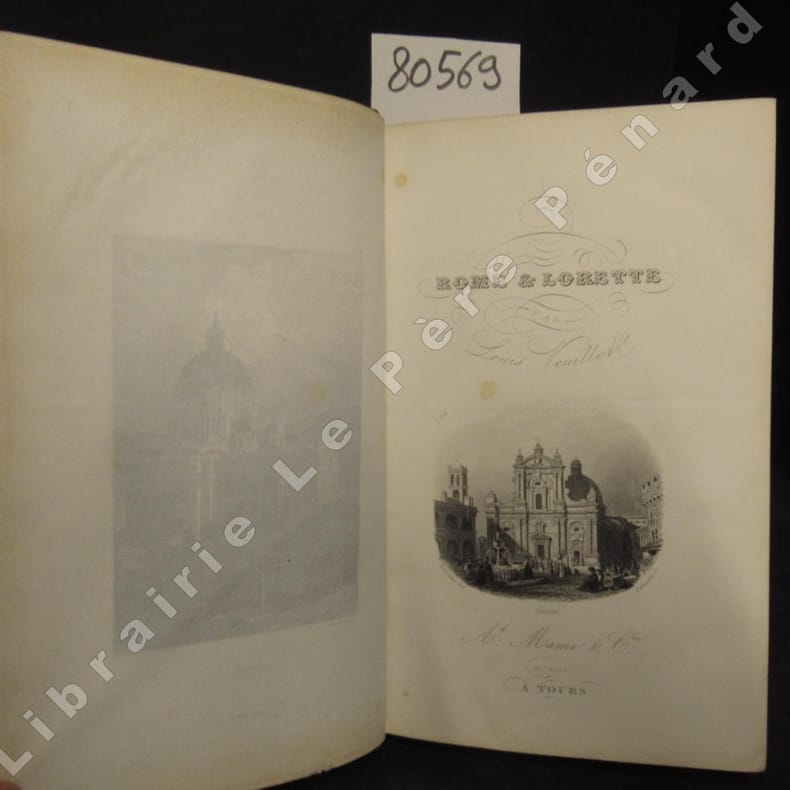
1866805691866 Tours, Alfred Mame et Fils, éditeurs, Bibliothèque de la Jeunesse Chrétienne - MDCCCLXVI (1866) - In-8, demi chagrin rouge, 4 nerfs, caissons et titres dorés, toutes tranches dorées - 394 pages - Gravures sur acier
18801974Couverture rigide Librairie Hachette 1880 Paris 22,5x14 cm
188225945Paris Ludovic Baschet 1882 in-4° avec cinq photogravures, 39 pp et le plan des ruines
182646031Leipzig Johann Ambrosius Barth 1826. Contemp. hcalf. Gilt spine. A few scratches to spine. In "Annalen der Physik und Chemie. Hrsg.von Poggendorff" Bd. 8. 10526 pp. and 3 folded engraved plates. Small stamps onverso of titlepage. Entire volume offered. Unverdorben's paper: pp. 253-265 397-410 477-487. Clean and fine. <br/><br/><em>First appearance of the paper in which Unverdorben describes the method by which he discovered Aniline which became so importent in the manufacture of dyes plastics and pharmaceuticals. "Aniline from the Portugese anil applied to indigo and derived from the Arabic an-nil the blue substance was first obtained by Unverdorben by heating indigo and was given the name 'crystalline'. In 1841 Carl Julius von Fritzsche 1807-71 an assistant to Mitscherlich and later a member of the Academy of Sciences in St. petersburg obtained the same compound from anthranilic acid which was produced by the action of caustioc alkalis on indigo and called it 'aniline'. in 1843 Hofmann showed that the three substances crystalline aniline and benzidam were identical with the base isolated from coal tar."Findlay "A Hundred years of Chemistry" p. 134.Parkinson "Breakthroughs" 1826 C.The volume contains other importent papers Antoine Jerome Balard "Ueber eine besondere Substanz im Meereswasser" in which he describes his discovery of the element BROMINE first German edition pp. 114-124 a. pp. 319-336. Parkinson "Breakthroughs" 1826 C. And Eilhard Mitscherlich "Ueber eine neue Klasse von Krystallformen" pp. 427-442. </em> unknown
1846WOC-127Illustrés d'après des dessins de l'auteur et de 15 grands dessins hors texte. 2 ème édition. Paris, Chez J.J. Dubochet, Le Chevalier et Compagnie, 1846. Grand in-8(28x18cm)relié demi chagrin noir,dos à faux-nerfs orné de larges caissons dorés,et tranches dorées,petite fente sur la charnière supérieure vers la coiffe supérieure. VIII,420pp.Un feuillet légèrement déboîté et quelques rousseurs.
1856mon0000018903George Virtue and Co c. 1856. HardcoverLeatherSpineCorners. Like New. in x in x in. No DJ. Volume II only. Few pages with light foxing. No other marks in lightly read book. 36 b/w plates no foxing. Binding intact. Three-quarter leather over marbled boards with wear of leather. No publication date. George Virtue and Co hardcover
181943320Leipzig Johann Ambrosius Barth 1819. Without wrappers as issued in "Annalen der Physik. Hrsg. von Ludwig Wilhelm Gilbert" Bd. 60 Heft 2 = Jahrgang 1818 zehntes Stück. Pp. 113-218 a. 1 engraved plate map. The entire issue offered Heft 2. Stromeyer's paper pp. 193-210. Clean and fine. <br/><br/><em>First appearance of Strohmeyer's account of his discovery of Cadmium. The history of its discovery was very complicated as some other laid claim to its discovery.Stromeyer was inspector general of apothecaries in Hannover. "In 1817 fulfilling the duties of his office he came across an apothecary's shop in which a bottle labeled zinc oxide contained zinc carbonate. Following this up Stromeyer found himself interested in zinc carbonate which turned yellow on strong heating as though it contained iron as an impurity yet it contained no iron. He traced the yellow to an oxide not of zinc but of a hitherto unknown metal rather like it chemically. He named it cadmium for a zinc ore in which it is usually found accompanying the zinc."Asimov.Weeks "Discovery of the Elements" pp. 135-39. </em> unknown
184245440Kjöbenhavn Bianco Luno 1842 a. 1845. 4to. Bound in one contemp. halfcalf spine gilt. A small tear to backhinge at lower compartment of spine. IV76 pp. and 3 double-page folded lithographed plates with many figs. XIV88 pp. and 2 double-apge lithographed plates with many figs. Light browning to the last leaves of the second work. <br/><br/><em>The scarce first edition of the work in which Steenstrup describes his discovery of the principle of 'ALTERNATION OF GENERATIONS'' sexual and asexual in plants and animals. "Steenstrup showed that certain animals produce offspring which never resemble them but which on the other hand bring forth progeny which return in form and nature to their grandparents or more distant ancestors." Garrison & Morton No 217. A German translation was published the same year and an English in 1845. Norman 2009 German translation. "The second major publication - the first dealing with geology - of 1842 was "Om Forplantning og Udvikling gjennem vexlende Generationsrækker." the work offered Steenstrup's comprehensive presentation of the form of reproduction that he called 'alternation of generations' that is the alternation of asexual and sexual reproduction or metagenesis. This phenomenon had previously been described by Chamisso but Steenstrup included a greater number of observations based on a significantly wider range of subjects and provided an importent chapter on its meaning. Steenstrup's growing reputation won him an appointment as professor of zoology at the University of Copenhagen where he tought from 1846 until 1885."DSB XII p. 9. </em> unknown
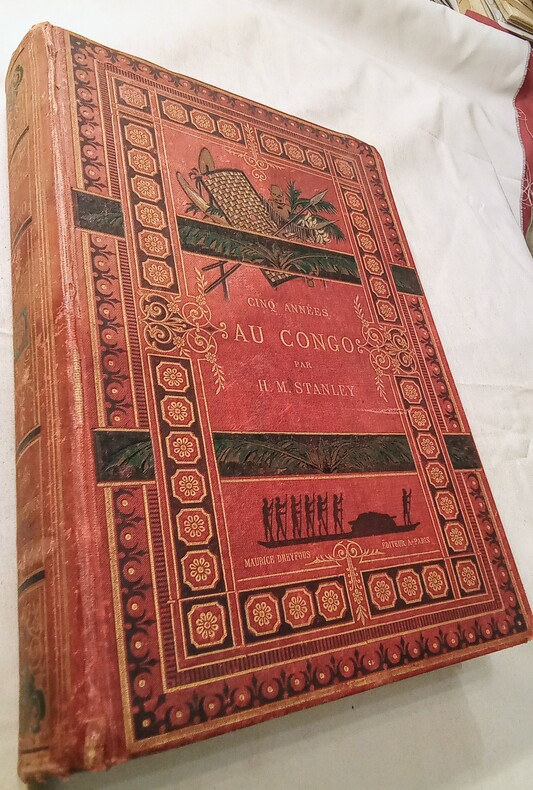
1890WOC-1655Voyages – Explorations – Fondation de L'État Libre du Congo. Traduit de l'anglais par Gérard HARRY. Ouvrage illustré de 100 gravures sur bois et de 4 cartes en couleur, dont une Carte murale dressée par H. M. STANLEY (qui manque ici). 2 ème édition. Paris, Maurice Dreyfous, éditeur, sans date (vers 1890). Petit in-4 (26x4x17cm) de percaline bordeaux éditeur orné et passé, charnières et coiffes faibles, tranches dorées et manque la page de garde du plat supérieur. XV,533pp.
183149604Paris Crochard 1831. Contemp. hcloth. Some scattered brownspots. "Annales de Chimie et de Physique" 2. Series Tome 48. 448 pp. 1 engraved plate. Entire volume offered. Soubeiran's paper: pp. 113-157. Scattered brownspots. <br/><br/><em>First appearance of an importent paper in chemistry and medicine as it for the first time relates the finding of Chloroform which some years later was proved to have anaesthetic effects and was introduced in chirurgy in 1848 by Simpson.Justus von Liebig Souberain and Guthrie independently discovered Chloroform in 1831 but Souberain was the first to publish his results. Garrison & Morton No. 1851. - Gedeon "Science and Technology in Medicine" 36.7.The volume contains other notable papers by LIEBIG DUMAS DUTROCHET WÖHLER LECANU BECQUEREL etc. </em> hardcover
183143365Paris Crochard 1831. No wrappers as extracted from "Annales de Chimie et de Physique" 2. Series Tome 48. Titlepage to vol. 48. Pp. 113-157. A few brownspots but fine. Small stamps on verso of titlepage. <br/><br/><em>First appearance of an importent paper in chemistry and medicine as it for the first time relates the finding of Chloroform which some years later was proved to have anaesthetic effects and was introduced in chirurgy in 1848 by Simpson.Justus von Liebig Souberain and Guthrie independently discovered Chloroform in 1831 but Souberain was the first to publish his results. - Garrison & Morton No. 1851. - Gedeon "Science and Technology in Medicine" 36.7. </em> unknown