93 résultats
187844231Paris G. Masson 1878. 8vo. Contemp. hcalf raised bands gilt spine. Light wear along edges. Small stamps on verso of titlepage. In: "Annales de Chimie et de Physique" 4e Series - Tome 15. 512 pp. a. 3 folded engraved plates. The entire volume offered. Janssen's memoir: pp. 414-426. <br/><br/><em>First appearance of this milestone paper in chemistry physics and astronomy announcing the discovery of the helium lines in the spectrum of the sun. It was Lockyer in the same year that named it 'helium' for Helios the Greek God of the Sun. Helium was not discovered on the earth before 1895 by William Ramsay and it was Crookes who established its identity with the helium Janssen and Lockyer observed in the spectrum of the sun."He Janssen met immortality by travelling to India in 1868 to study the total eclipse. It was then that he observed the helium line and forwarded the spectral data to ockyer. He also noted the size of the solar prominences. The day after the eclipse he attempted to take their spectra again and succeeded despite the absence of the obscuring moon. he then announced jubilantly that it was the day after the eclipse that was the real eclipse day for him. Lockyer also reported this method of studying prominences without an eclipse.Like Lockyer he lived to see his observation of the helium line vindicated by Ramsay's discovery of that element on earth."Asimov."This the discovery of helium lines in the sun by Lockyer was announced on the same day by the French astronomer Janssen who was in India observing a total eclipse. As a result the French government some ten years later struck a medallion showing the heads of both scientists.By that time the two men had made a much more dramatic discovery at the same time this time in cooperation. Janssen studying the spectrum ofthe sun during the eclipse had noted a fine line he did not recognize. he send a report on this to Lockyer an acknowledges expert on solar spectra. Lockyer compared the reported position of the line with lines of known elements concluding that it must belong to a yeat unknown element possibly not even existing on the earth. He named the element from the Greek word for the sun."Asimov.Parkinson "Breakthroughs" 1868 A. - The volume contains other notable papers by Dumas Berthelot et al. </em> hardcover
183645406Berlin G. Eichler 1836. In "Archiv für Anatomie Physiologie und Wissenschaftliches Medicin Herausgegeben von Johannes Müller". Jahrgang 1836. Pp. 66-89 a. pp. 90-139. The entire volume offered in its 6 parts in 5 all 5 issues uncut with orig. printed warppers. 2CCXXIV390 pp. and 15 engraved plates. The 2 first issues with a faint dampstain to lower part of leaves and plates. <br/><br/><em>First appearance of an importent paper in the history of biology in which Schwann describes his discovery and isolation of pepsin the substance in the stomach that aids digestion of eggwhite. It is the FIRST KNOWN ANIMAL ENZYME. The paper appeared at the same time in "Annalen der Physik und Chemie. Hrsg. von J.C. Poggendorff".Theodor Schwann 1810-1882 was a great German physiologist pathologist and experimenter. One of the founders of the cell doctrine and of the idea of the living nature of yeast. Born at Neuss near Düsseldorff. A catholic educated in the Jesuit Gymnasium in Cologne. Intended for the church but took to medicine. He was a pupil of Johannes Müller and a collegueand lifelong friend of J. Henle the anatomist. In Berlin Schwann was Johannes Müller's assistent for five years and it was then that he discovered pepsin in 1836 the paper offered.Parkinson "Breakthroughs" 1836 B. - Garrison & Morton no. 991.The first paper offered written together with Johannes Müller records the preliminary investigaions leading to the discovery of Pepsin. - Garrison & Morton no. 990.The volume also contains another famous paper by ROBERT REMAK "Vorläufige Mittheilung microscopischer Beobachtungen über den innern Bau der Cerebrospinalnerven und über die Entwicklung ihrer Formenelemente. Hierzu Tafel IV. Pp. 145-161. This paper contains the first announcement of his DISCOVERY OF "FIBRES OF REMAK" the non-medullated nerve-fibres. Garrison & Morton no. 1260. </em> unknown
180343638Halle Rengerschen Buchhandlung 1803. Without wrappers as extracted from "Annalen der Physik. Herausgegeben von Ludwig Wilhelm Gilbert" Jahrgang 1802 Bd. 12 Zwölftes Stück. Pp. 409-416. Titlepage to vol. 12. <br/><br/><em>This is Ritter's first expositon of his discovery of ultraviolet light. It was announced the year before in a halfpage letter addressed to Gilbert's Annalen and printed in the Annalen. With that discovery it became clear that visible light represents no more than a fraction of a continous spectrum.A year earlier in 1800 William Herschel discovered infrared light. This was the first time that a form of light beyond visible light had been detected. After hearing about Herschel's discovery of an invisible form of light beyond the red portion of the spectrum Ritter decided to conduct experiments to determine if invisible light existed beyond the violet end of the spectrum as well. He had heard that blue light caused a greater reaction in silver chloride than red light did. Ritter decided to measure the rate at which silver chloride reacted to the different colors of light. He directed sunlight through a glass prism to create a spectrum. He then placed silver chloride in each color of the spectrum and found that it showed little change in the red part of the spectrum but darkened toward the violet end of the spectrum. Johann Ritter then decided to place silver chloride in the area just beyond the violet end of the spectrum in a region where no sunlight was visible. To his amazement this region showed the most intense reaction of all. This showed for the first time that an invisible form of light existed beyond the violet end of the visible spectrum. This new type of light which Ritter called Chemical Rays later became known as ultraviolet light or ultraviolet radiation the word ultra means beyond. </em> unknown
182949248Leipzig Johann Ambrosius Barth 1829. Without wrappers as issued in "Annalen der Physik und Chemie. Hrsg.von Poggendorff" Bd. 16 Siebentes Stück. 2 pp. 1 folded engraved plate. Entire issue offered with titlepage to volume 16. Berzelius's paper: pp. 387-415. Clean and fine. <br/><br/><em>First German printing - printed simultaneously with the English and Swedish version - of the paper in which Berzelius described his discovery of Thorium the first element after Uranium to be identified as such. In 1829 Jöns Jakob Berzelius of the Royal Karolinska Institute Stockholm extracted thorium from a rock specimen sent to him by an amateur mineralogist who had discovered it near Brevig and realised that it had not previously been reported. The mineral turned out to be thorium silicate and it is now known as thorite. Berzelius even produced a sample of metallic thorium by heating thorium fluoride with potassium and confirmed it as a new metal. He called the black mineral thorite in honor of the Scandinavian god Thor.Parkinson "Breakthroughs" 1829 C. </em> unknown
180143599Halle Rengerschen Buchhandlung 1801. Without wrappers as published in "Annalen der Physik. Herausgegeben von Ludwig Wilhelm Gilbert" Bd. 7 Zweites Stück. The entire issue offered =Heft 2. Pp. 137-264 a. 2 folded engraved plates. Herschels papers: pp. 137-156. The plate depicts Herschel's experimental arrangements. <br/><br/><em>First appearance in German of Herschel's epochal announcement of his discovery of infrared light in 1800. This was the first time that a form of light beyond visible light had been detected. The paper offered is the German translation of the main parts of Herschel's paper "An Investigation of the Powers of Prismatic Colours to Heat and Illuminate Objects"."In 1800 he tested various portions of the sun's spectrum by thermometer to see if he could find interesting differences in the amount of heat the different colors delivered. He did but in a rather unexpected way for he found that the temperature rise was highest in no color at all at a spot beyond the red end of the spectrum. He concluded that the sunlight contained invisible light beyond the red. This is now called infrared radiation. The following year Ritter was to extend the visible spectrum in the other direction."Asimov.Parkinson "Breakthroughs" 1800 P. </em> unknown
184244147Leipzig Johann Ambrosius Barth 1842. Without wrappers. In "Annalen der Physik und Chemie. Hrsg. von J.C. Poggendorff" Ergänzungsband 1 Stück 2. Pp. 193-384 a. 1 folded engraved plate. The entire issue offered. Henry's paper: pp. 282-312. <br/><br/><em>First German version of Henry's description of his discovery of self-induction. He missed the credit for the discovery of induction to Faraday but he had done the key experiment ahead of Faraday but Faraday was the first to publish. But he is credited for the discovery of self-induction 1832 and Faraday discovered it independently two years later 1834."In Henry's paper however he explained thet the electric current in a coil can induce another current not only in another coil but in itself. The actual current observed in the coil is then the combination of the original current and the induced current. This is called self induction."Isac Asimov.The issue contains further notable papers Michael Faraday's "Vierzehnte Reihe von Experimental-Untersuchungen über Elektricität" § 2o-22. Nos 1667-1748. Pp. 249-281. First German version. In this paper FARADAYamplifies his theory of electrostatic induction by making further use of the analogy with the induction of magnetism. Whittaker describes the paper as having "THE FUNDAMENTAL EQUATION OF ELECTROSTATICS" as modified in order to take into account the effect of the specific inductive capacity."Whittaker I pp.187-89. </em> unknown
183445159Leipzig Johann Ambrosius Barth 1834. Without wrappers. Extracted from "Annalen der Physik und Chemie. Hrsg.von Poggendorff" Bd. 31 No 5. Pp. 65-80. <br/><br/><em>First printing of the paper in which Runge discloses his discovery of carbolic acid or phenol and how he prepared it by distilling coal.Parkinson "Breakthroughs" 1834 C. - Partington IV pp. 183-84. </em> unknown
186244063Leipzig Johann Ambrosius Barth 1862. Without wrappers as issued in "Annalen der Physik und Chemie. Hrsg. von J.C. Poggendorff" Vierte Reihe Bd. 27 117 Stück Zwei No. 10. The entire issue offered. Titlepage to vol. 27. Pp. 193-352 a. 1 engraved plate. Ångströms paper: pp. 290-302. <br/><br/><em>First appearance in German of Ångström's famous paper in which he announced the discovery of hydrogen in the atmosphere of the sun and in which he also confirmed the probable existence of of other elements there. The paper appeared in "Oefversigt af K. Vet. Acad. Förhandl." in 1861. The German paper here is expanded. At the same time it was translated into English and publishe as "On the Fraunhofer Lines Visible in the Solar Spectrum".Ångström was one of the early formulators of the science of modern spectroscopy; he wrote extensively on terrestrial magnetism the conduction of heat and especially spectroscopy. He published a monumental map of the normal solar spectrum that expressed the length of light waves in units of one ten-millionth of a millimeter a unit of length now known as the angstrom. He discovered that hydrogen is present in the sun's atmosphere and he was the first to examine the spectrum of the aurora borealis. </em> unknown
187449327Leipzig Johann Ambrosius Barth 1874. 8vo. Contemp. hcalf. 5 raised bands gilt spine and gilt lettering to spine. A few scratches to spine. Small stamp on verso of first -and general- titlepage. In: "Annalen der Physik und Chemie. Hrsg. von J.C. Poggendorff" Sechste Reihe Bd. 3 = Poggendorff Bd. 153. X636 pp. 4 plates. Entire volume offered. Braun's paper: pp. 556-563. <br/><br/><em>First printing of Brown's importent paper in which he described his discovery of a semiconductor diode noting that electrical currents flows freely in only one direction at the contact between a metal point and a galena crystal."In 1874 Braun published the results of his research on mineral metal sulfides. He found that these crystals conducted electric currents in only one direction. This information was important in electrical research and in measuring another property of substances the electrical conductivity but Braun’s discovery did not have immediate practical application. In the early twentieth century the principle that Braun had discovered was employed in crystal radio receivers."DSB.The Nobel Prize in Physics 1909 was awarded jointly to Guglielmo Marconi and Karl Ferdinand Braun "in recognition of their contributions to the development of wireless telegraphy". </em> hardcover
185943325Leipzig Johann Ambrosius Barth 1859. Without wrappers as issued in "Annalen der Physik und Chemie. Hrsg.von Poggendorff" Bd. 107 Viertes Stück.= Heft No. 8 of 1859. The entire issue offered Heft 4 of vol. 107 with titlepage to vol. 107. Pp. 497-660. - Plücker's papers: pp. 497-539 a. 638-643. Clean and fine. <br/><br/><em>First printing of this milestone paper describing Plückers first observations on Cathode Rays which he called "the beautiful and mysterious green glow" and produced by discharges in tubes exhausted by means of the Geissler pump. These importent observations lead directly to Röntgens discovery of the Röntgen Rays."Cathode rays were first observed by Julius Plücker in 1859 the paper offered. They are rays which are found in the neighbourhood of the point of exit of an electrical current passing through a Geissler tube. These rays stimulated intense interest and experiment. William Crookes greatly improved these discharge tubes and intensified the degree of rarification of gases within them. The tubes in this form is known as Crookes tube. Crookes declared his conciction that the cathode rays represented matter in a fourth hitherto unobserved form.It was reserved for J.J. Thomson in 1908 to discover the true nature of the cathode rays."PMM no 386. </em> unknown
189843857Berlin J.A. Barth 1898. No wrappers. In "Annalen der Physik" Neue Folge Band 65 No 5. Pp. 1-240. Entire issue offered No.5. Titlepage to vol. 65. Stamp on titlepage. Schmidt's paper: pp. 141-151 textillustr. A tear to inner lower corners of pp. 24-32. not affecting Schmidt's paper. Clean and fine. <br/><br/><em>First printing of Schmidt's full exposition in which he describes his discovery of the radioactivity of Thorium. Schmidt and Marie Curie independently demonstrated the radioactive quality but Schmidt's demonstration took place a few months before Curie's. The discovery was announced but not described in full in a short message published in "Verhandl. d. Phys. Gesellsch. zu Berlin 1898."Schmidt made his discovery while examining "many elements and compounds" in an effeort to determine whether any of the rays that were emitted bore a resemblance to those that Henri becquerel had found emerging from uranium and uranium compounds. He located only one such element thorium and immediately conducted absorption ionization reflection refradction and poklarization studies to determine the characteristics of its rays. Having combined a misinterpretation of Becquerel's with one of his own Schmidt concluded that thorium rays most resembled Röntgen rays - a conclusion that soon required revisoln in view of the researches of Marie Curie and Ernest Rutherford."DSB XII p. 191. </em> unknown
183743739Leipzig Johann Ambrosius Barth 1837. Without wrappers as issued in "Annalen der Physik und Chemie. Hrsg.von Poggendorff" Bd. 41 Zweites Stück. Entire issue No 6 offered. Titlepage to vol. 41. Pp. 225-448 a. 2 folded engraved plates. Wöhler & Liebig's papers: pp. 345-366 pp. 366-374 a. pp. 393-397. Clean and fine. <br/><br/><em>First appearance of this classic paper in organic chemistry in which Wöhler and Liebig showed how Amygdalin could be decomposed by a vegetable emulsion the first example of a glycoside."The conclusions which you have drawn from the investigation of bitter-almond oil" wrote Berzelius to Liebig and Wöhler "are certainly the most importent which have so far been reached in the domain of vegetable chemistry and give promise of shedding an unexpected light over this part of the science.The facts which you have set forth inspire such reflections that they may be regarded as the dawn of a new day in vegetable chemistry."Berzelius-Wöhler Briefwechsel."During the years that Liebig was preoccupied with the ether theory and with organic acids he also carried out two importent investigations with Wöhler. In october 1836 Wöhler wrote that he had discovered a way to transform amygdalin to oil of bitter almonds and hydrocyanid acis by distilling it with manganese and sulfuric acid and he invited Liebig to join in pursuing the topic. Two days later he made a more remarkable discovery. It had occurred to him that perhaps thetransformation of amygdalin could be effected by the albumin in the almonds in a manner similar to the action of yeast in sugar.Wöhler suspected that the decomposition was an example of what Berzelius had recently defined as catalysis. Liebig and Wöhler then divided up the detailed examination of the properties and composition of amygdalin. They precipitated from the emulsion of almonds a substance which when dissolved retain its action. They named the active substance "emulsion". Its effectiveness in very small quantities confirmed that it acted like yeast."DSB VIII p. 342. </em> unknown
183643417Leipzig Johann Ambrosius Barth 1836. Without wrappers. In "Annalen der Physik und Chemie. Hrsg. von J.C. Poggendorff" Band 38 No. 6 = Zweyte Stück. Titlepage to Vol. 38. Pp. 241-450 a. 3 engraved plates.Entire issue offered Heft No. 6 Bd. 38. Schwann's paper: pp. 358-364. Clean and fine. <br/><br/><em>First appearance of an importent paper in the history of biology in which Schwann describes his discovery and isolation of pepsin the substance in the stomach that aids digestion of eggwhite. It is the FIRST KNOWN ANIMAL ENZYME. The paper appeared at the same time in "Archiv für Anatomie Physiologie und Wissenschaftliches Medicin"Theodor Schwann 1810-1882 was a great German physiologist pathologist and experimenter. One of the founders of the cell doctrine and of the idea of the living nature of yeast. Born at Neuss near Düsseldorff. A catholic educated in the Jesuit Gymnasium in Cologne. Intended for the church but took to medicine. He was a pupil of Johannes Müller and a collegueand lifelong friend of J. Henle the anatomist. In Berlin Schwann was Johannes Müller's assistent for five years and it was then that he discovered pepsin in 1836 the paper offered.Parkinson "Breakthroughs" 1836 B.The issue contains other importent papers by Seebeck Matteucci Marchand G. Magnus "Ueber die Wirkung des Ankers auf Elektromagnete und Stahlmagnete" Schönbein J. Müller "Ueber die Structur und die chemischen Eigenschaften der thierischen Bestandtheile der Knorpel und Knochen" Nachtrag. Forchhammer "Der kopaische See und seine unterirdischen Abzugskanäle." with a map. </em> unknown
181943320Leipzig Johann Ambrosius Barth 1819. Without wrappers as issued in "Annalen der Physik. Hrsg. von Ludwig Wilhelm Gilbert" Bd. 60 Heft 2 = Jahrgang 1818 zehntes Stück. Pp. 113-218 a. 1 engraved plate map. The entire issue offered Heft 2. Stromeyer's paper pp. 193-210. Clean and fine. <br/><br/><em>First appearance of Strohmeyer's account of his discovery of Cadmium. The history of its discovery was very complicated as some other laid claim to its discovery.Stromeyer was inspector general of apothecaries in Hannover. "In 1817 fulfilling the duties of his office he came across an apothecary's shop in which a bottle labeled zinc oxide contained zinc carbonate. Following this up Stromeyer found himself interested in zinc carbonate which turned yellow on strong heating as though it contained iron as an impurity yet it contained no iron. He traced the yellow to an oxide not of zinc but of a hitherto unknown metal rather like it chemically. He named it cadmium for a zinc ore in which it is usually found accompanying the zinc."Asimov.Weeks "Discovery of the Elements" pp. 135-39. </em> unknown
182646031Leipzig Johann Ambrosius Barth 1826. Contemp. hcalf. Gilt spine. A few scratches to spine. In "Annalen der Physik und Chemie. Hrsg.von Poggendorff" Bd. 8. 10526 pp. and 3 folded engraved plates. Small stamps onverso of titlepage. Entire volume offered. Unverdorben's paper: pp. 253-265 397-410 477-487. Clean and fine. <br/><br/><em>First appearance of the paper in which Unverdorben describes the method by which he discovered Aniline which became so importent in the manufacture of dyes plastics and pharmaceuticals. "Aniline from the Portugese anil applied to indigo and derived from the Arabic an-nil the blue substance was first obtained by Unverdorben by heating indigo and was given the name 'crystalline'. In 1841 Carl Julius von Fritzsche 1807-71 an assistant to Mitscherlich and later a member of the Academy of Sciences in St. petersburg obtained the same compound from anthranilic acid which was produced by the action of caustioc alkalis on indigo and called it 'aniline'. in 1843 Hofmann showed that the three substances crystalline aniline and benzidam were identical with the base isolated from coal tar."Findlay "A Hundred years of Chemistry" p. 134.Parkinson "Breakthroughs" 1826 C.The volume contains other importent papers Antoine Jerome Balard "Ueber eine besondere Substanz im Meereswasser" in which he describes his discovery of the element BROMINE first German edition pp. 114-124 a. pp. 319-336. Parkinson "Breakthroughs" 1826 C. And Eilhard Mitscherlich "Ueber eine neue Klasse von Krystallformen" pp. 427-442. </em> unknown
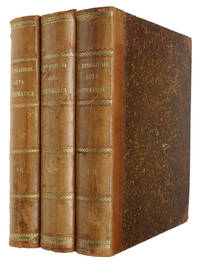
188460243Berlin Stockholm Paris F. & G. Beijer 1882-84. Large4to 272 x 230 mm. Three volumes uniformly bound in contemporary half calf with gilt lettering to spine. In "Acta Mathematica" volume 1-5. Light wear to extremities boards and spines with scratches. Stamp to verso of front board in all volumes. First three leaves in first volume detached otherwise internally fine and clean. Vol. I pp. 1-62; Pp. 193-294; Vol. II pp. 97-113; Vol. III. pp. 49-92; Vol. IV pp. 201-312; Vol. V pp. 209-278. <br/><br/><em>First publication of these groundbreaking papers which together constitute the discovery of Automorphic Functions. "Before he was thirty years of age Poincaré became world famous with his epoch-making discovery of the "automorphic functions" of one complex variable or as he called them the "fuchsian" and "kleinean" functions." DSB.These manuscripts written between 28 June and 20 December 1880 show in detail how Poincaré exploited a series of insights to arrive at his first major contribution to mathematics: the discovery of the automorphic functions. In particular the manuscripts corroborate Poincaré's introspective account of this discovery 1908 in which the real key to his discovery is given to be the recognition that the transformations he had used to define Fuchsian functions are identical with those of non-Euclidean geometry. See Walter Poincaré Jules Henri French mathematician and scientist.The idea was to come in an indirect way from the work of his doctoral thesis on differential equations. His results applied only to restricted classes of functions and Poincaré wanted to generalize these results but as a route towards this he looked for a class functions where solutions did not exist. This led him to functions he named Fuchsian functions after Lazarus Fuchs but were later named automorphic functions. First editions and first publications of these epochmaking papers representing the discovery of "automorphic functions" or as Poincaré himself called them the "Fuchsian" and "Kleinian" functions."By 1884 Poincaré published five major papers on automorphic functions in the first five volumes of the new Acta Mathematica. When the first of these was published in the first volume of the new Acta Mathematica Kronecker warned the editor Mittag-Leffler that this immature and obscure article would kill the journal. Guided by the theory of elliptic functions Poincarë invented a new class of automorphic functions. This class was obtained by considering the inverse function of the ratio of two linear independent solutions of an equation. Thus this entire class of linear diffrential equations is solved by the use of these new transcendental functions of Poincaré." Morris Kline.Poincaré explains how he discovered the Automorphic Functions: "For fifteen days I strove to prove that there could not be any functions like those I have since called Fuchsian functions I was then very ignorant; every day I seated myself at my work table stayed an hour or two tried a great number of combinations and reached no results. One evening contrary to my custom I drank black coffee and could not sleep. Ideas rose in crowds; I felt them collide until pairs interlocked so to speak making a stable combination. By the next morning I had established the existence of a Class of Fuchsian functions those which come from hypergeometric series; i had only to write out the results which took but a few hours.the transformations that I had used to define the Fuchsian functions were identical with those of Non-Euclidean geometry." </em> hardcover
1856mon0000018903George Virtue and Co c. 1856. HardcoverLeatherSpineCorners. Like New. in x in x in. No DJ. Volume II only. Few pages with light foxing. No other marks in lightly read book. 36 b/w plates no foxing. Binding intact. Three-quarter leather over marbled boards with wear of leather. No publication date. George Virtue and Co hardcover
181042219London W. Bulmer and Co. 1810. 4to. No wrappers as extracted from "Philosophical Transactions" 1810 - Part I. Pp. 16-74 and 2 engraved plates showing Davy's electrochemical apparatus for decomposing substances. The plates dampstained. Text fine and clean. <br/><br/><em>First appearence of this historical chemical paper Davy' fifth Bakerian Lecture in which he announced his discovery of hydrogen telluride."Mr. Davy having from the commencement of his electro-chemical researches communicated the several steps of his progress to the Society The Royal Society takes the present opportunity of reporting the results of his further inquiries under four principal heads. First on the nature of the metals of the fixed alkalis. Second on the nature of Hydrogen and composition of ammonia. Thirdly on the metals of the earth; and Fourthly he makes a comparison between the antiphlogistic doctrine and a modified phlogistic hypothesis."Abstract. He further gives arguments for considering potassium and sodium which he discovered in 1808 as a element."Humphry Davy was one of the most brilliant chemists of the early nineteenth century. His early study of nitrous oxide brought him his first reputation but his later and most importent investigations were devoted to electrochemistry. Following Galvani's experiments and the discovery of the voltaic pile interest in galvanic electricity had become widespread. The first electrolysis by means of the pile was carried out in 1800 by Nicholson and Carisle who obtained oxygen and hydrogen from water. Davy began to examine the chemical effects of electricity in 1800 and his numerous discoveries were presented in his Bakerian lectures." - Wheeler Gift: 2518. </em> unknown
180842218London W. Bulmer and Co. 1808. 4to. No wrappers as extracted from "Philosophical Transactions" 1808 - Part I. Pp. 1-44. <br/><br/><em>First printing of this importent historical paper in chemistry in which Davy shows that electricity is capable of decomposing some alkalies isolating two new substances and discovering potassium and sodium. Neville in his Historical Chemical Library vol. I p.340 writes about this paper "ONE OF THE GREAT CLASSIC RESEARCHES IN CHEMISTRY in which Davy announced in this his second Bakterian lecture the isloation of metallic potassium and sodium by the electrolytic decomposition of their fused oxides.""He Davy began his own electrical experiments.The results were spectacular. On October 6 1807 the current passing through molten potash liberated a metal which Davy called potassium. The little globules of shining metal tore the water molecule apart as it eagerly recombined with oxygen and the liberated hydrogen burst into lavender flame. Davy danced about in a delirium of joy. A week later he isolated sodium from soda."Asimow. The paper offered here describes these discoveries."Humphry Davy was one of the most brilliant chemists of the early nineteenth century. His early study of nitrous oxide brought him his first reputation but his later and most importent investigations were devoted to electrochemistry. Following Galvani's experiments and the discovery of the voltaic pile interest in galvanic electricity had become widespread. The first electrolysis by means of the pile was carried out in 1800 by Nicholson and Carisle who obtained oxygen and hydrogen from water. Davy began to examine the chemical effects of electricity in 1800 and his numerous discoveries were presented in his Bakerian lecture to the Royal Society on November 20 1806.A Source Book in Chemistry p. 243. - Wheeler Gift: 2514. </em> unknown
180845884London W. Bulmer and Co. 1808. 4to. No wrappers as extracted from "Philosophical Transactions" 1808 - Part I. Pp. 1-44. Clean and fine wide-margined. <br/><br/><em>First printing of this importent historical paper in chemistry in which Davy shows that electricity is capable of decomposing some alkalies isolating two new substances and discovering potassium and sodium. Neville in his Historical Chemical Library vol. I p.340 writes about this paper "ONE OF THE GREAT CLASSIC RESEARCHES IN CHEMISTRY in which Davy announced in this his second Bakterian lecture the isloation of metallic potassium and sodium by the electrolytic decomposition of their fused oxides.""He Davy began his own electrical experiments.The results were spectacular. On October 6 1807 the current passing through molten potash liberated a metal which Davy called potassium. The little globules of shining metal tore the water molecule apart as it eagerly recombined with oxygen and the liberated hydrogen burst into lavender flame. Davy danced about in a delirium of joy. A week later he isolated sodium from soda."Asimow. The paper offered here describes these discoveries."Humphry Davy was one of the most brilliant chemists of the early nineteenth century. His early study of nitrous oxide brought him his first reputation but his later and most importent investigations were devoted to electrochemistry. Following Galvani's experiments and the discovery of the voltaic pile interest in galvanic electricity had become widespread. The first electrolysis by means of the pile was carried out in 1800 by Nicholson and Carisle who obtained oxygen and hydrogen from water. Davy began to examine the chemical effects of electricity in 1800 and his numerous discoveries were presented in his Bakerian lecture to the Royal Society on November 20 1806.A Source Book in Chemistry p. 243. - Wheeler Gift: 2514. </em> unknown
181045887London W. Bulmer and Co. 1810. 4to. No wrappers as extracted from "Philosophical Transactions" 1810 - Part I. Pp. 16-74 and 2 engraved plates showing Davy's electrochemical apparatus for decomposing substances Davy's versions of the Voltaic-pile. Plates a bit brownspotted otherwise clean and fine wide-margined. <br/><br/><em>First appearence of this historical chemical paper Davy' fifth Bakerian Lecture in which he announced his discovery of hydrogen telluride."Mr. Davy having from the commencement of his electro-chemical researches communicated the several steps of his progress to the Society The Royal Society takes the present opportunity of reporting the results of his further inquiries under four principal heads. First on the nature of the metals of the fixed alkalis. Second on the nature of Hydrogen and composition of ammonia. Thirdly on the metals of the earth; and Fourthly he makes a comparison between the antiphlogistic doctrine and a modified phlogistic hypothesis."Abstract. He further gives arguments for considering potassium and sodium which he discovered in 1808 as a element."Humphry Davy was one of the most brilliant chemists of the early nineteenth century. His early study of nitrous oxide brought him his first reputation but his later and most importent investigations were devoted to electrochemistry. Following Galvani's experiments and the discovery of the voltaic pile interest in galvanic electricity had become widespread. The first electrolysis by means of the pile was carried out in 1800 by Nicholson and Carisle who obtained oxygen and hydrogen from water. Davy began to examine the chemical effects of electricity in 1800 and his numerous discoveries were presented in his Bakerian lectures." - Wheeler Gift: 2518.Also with William Hyde Wollaston "The Croonian Lecture. Read November 16 1809.On Muscular Action - On Sea-Sickness - On the salutary Effects of Riding and other Modes of Gestation. Pp. 1-15. </em> unknown
189359360Copenhagen 1893. Folio. 51 x 45 cm. Orig. printed clothbacked boards. Stamp on title-page. 28 pp. "In the present reproduction only those few pages are printed which concerns the discovery of America by the Northmen in the first years of the 11th century.". Lower right corners damaged by insect-bites no loss of text. Old Norse text English and Danish translation. hardcover
184947031Paris Bachelier 1849. 4to. No wrappers. In: "Comptes Rendus Hebdomadaires des Séances de L'Academie des Sciences" Tome 28 No 7. Pp. 189-240 entire issue offered. Wurtz's paper: pp. 223-226. <br/><br/><em>First appearance of the announcement of Wurtz's outstanding discovery of Liebig’s prediction that there might be organic compounds analogous to ammonia and derivable from it by the replacement of hydrogen - the amines. The entire memoir was not published in full until 1855 in 'Annales de Chimie et de Physique'.Wurtz is most noted for his investigation of glycols and for his discovery of the amines. The latter discovery in 1849 the paper offered was very significant at the time for ot suggested the possibility of a new type the ammonia type which helped to explain the behaviour of nitrogenous compounds. Leicester & Klickstein "A Source Book." pp. 362-63. - Parkinson "Breakthroughs" 1849 C. </em> unknown
185048830Paris Bachelier1850. 4to. No wrappers. In: "Comptes Rendus Hebdomadaires des Séances de L'Academie des Sciences" Tome XXXI No. 17. With titlepage to vol. 31. Pp. 561- 592. Entire issue offered. Bernard's paper: pp. 571-574. Titlepage with a faint stamp to top and a stamp in lower margin. <br/><br/><em>First appearance of the first exposition of the glycogenic function of the liver - one of the greatest physiological discoveries of the 19th century. Bernard showed that the liver builds up complex substances including glycogen from the nutriment brought to it by the blood and that these are subsequently modified for distribution to the body.Dibner "Heralds of Science" No 131 - Horblit "One Hundred Books famous in Science" No. 11a here listing "Nouvelle Fonction du Foie" from 1853 but with the remark "The work appeared earlier in abbreviated form in the "Comptes rendus" the paper offered. - Exhibition of First Editions of Epochal Achievements in the History of Science Berkeley 1934. No 107. </em> unknown
189847409Paris Gauthier-Villars 1898. 4to. No wrappers. In: "Comptes Rendus Hebdomadaires des Séances de L'Academie des Sciences" Tome 129 No 16. Pp. 567- 626. Entire issue offered. Debierne's paper: pp. 593-595. Paperquality rather poor a bit fragile. <br/><br/><em>First appearance of the paper in which Debierne announced his discovery of a new radioactive element found in uranium residues."In 1906 Professor Hahn discovered radioactinium between actinium an actinium X. Actinium emanation or "action" like radon is an inert gas was discovered independently by F. Giesel and André Debierne." Weeks "Discovery of the Elements" p. 307.Parkinson "Breakthroughs" 1899 C. </em> unknown