232 résultats
187844231Paris, G. Masson, 1878. 8vo. Contemp. hcalf, raised bands, gilt spine. Light wear along edges. Small stamps on verso of titlepage. In: ""Annales de Chimie et de Physique"", 4e Series - Tome 15. 512 pp. a. 3 folded engraved plates. (The entire volume offered). Janssen's memoir: pp. 414-426.
187844231Paris G. Masson 1878. 8vo. Contemp. hcalf raised bands gilt spine. Light wear along edges. Small stamps on verso of titlepage. In: "Annales de Chimie et de Physique" 4e Series - Tome 15. 512 pp. a. 3 folded engraved plates. The entire volume offered. Janssen's memoir: pp. 414-426. <br/><br/><em>First appearance of this milestone paper in chemistry physics and astronomy announcing the discovery of the helium lines in the spectrum of the sun. It was Lockyer in the same year that named it 'helium' for Helios the Greek God of the Sun. Helium was not discovered on the earth before 1895 by William Ramsay and it was Crookes who established its identity with the helium Janssen and Lockyer observed in the spectrum of the sun."He Janssen met immortality by travelling to India in 1868 to study the total eclipse. It was then that he observed the helium line and forwarded the spectral data to ockyer. He also noted the size of the solar prominences. The day after the eclipse he attempted to take their spectra again and succeeded despite the absence of the obscuring moon. he then announced jubilantly that it was the day after the eclipse that was the real eclipse day for him. Lockyer also reported this method of studying prominences without an eclipse.Like Lockyer he lived to see his observation of the helium line vindicated by Ramsay's discovery of that element on earth."Asimov."This the discovery of helium lines in the sun by Lockyer was announced on the same day by the French astronomer Janssen who was in India observing a total eclipse. As a result the French government some ten years later struck a medallion showing the heads of both scientists.By that time the two men had made a much more dramatic discovery at the same time this time in cooperation. Janssen studying the spectrum ofthe sun during the eclipse had noted a fine line he did not recognize. he send a report on this to Lockyer an acknowledges expert on solar spectra. Lockyer compared the reported position of the line with lines of known elements concluding that it must belong to a yeat unknown element possibly not even existing on the earth. He named the element from the Greek word for the sun."Asimov.Parkinson "Breakthroughs" 1868 A. - The volume contains other notable papers by Dumas Berthelot et al. </em> hardcover
1863E011416 cm X 24,5 cm, 468 pp + 23 planches d'illustrations du Durand-Brager dont 1 en frontispice sous serpentine, reliure demi-cuir, dos à 4 nerfs, titres dorés, décorations dorées sur les caissons. 3 tranches dorées. Signet
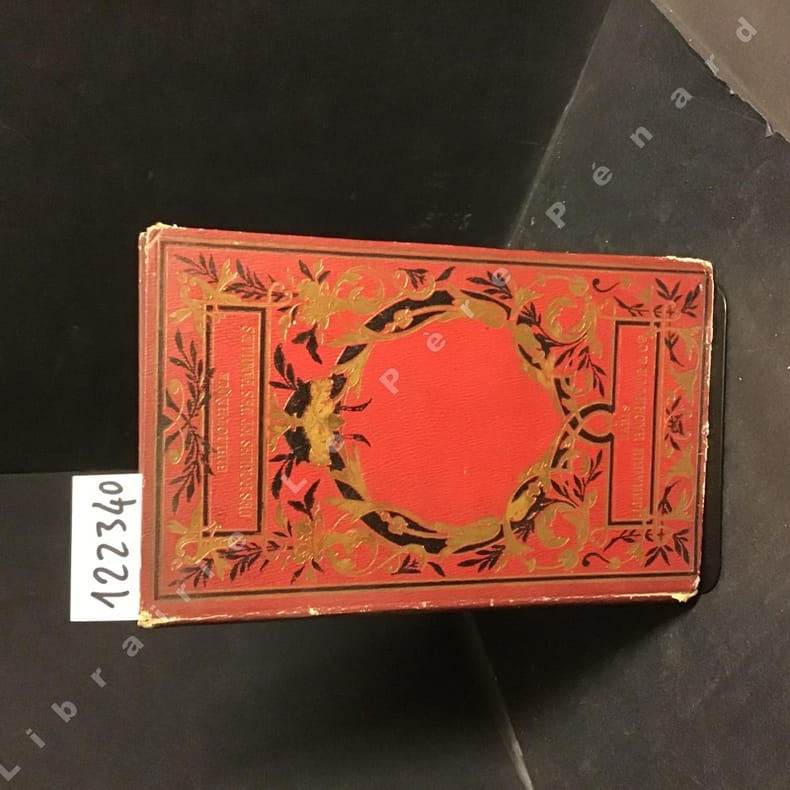
18801223401880 Editions Librairie Hachette, Bibliothèque des écoles et des familles - 1880 - In-8, pleine percaline rouge avec décors dorés - 206 pages - Illustrations en N&B hors-texte
1846WOC-127Illustrés d'après des dessins de l'auteur et de 15 grands dessins hors texte. 2 ème édition. Paris, Chez J.J. Dubochet, Le Chevalier et Compagnie, 1846. Grand in-8(28x18cm)relié demi chagrin noir,dos à faux-nerfs orné de larges caissons dorés,et tranches dorées,petite fente sur la charnière supérieure vers la coiffe supérieure. VIII,420pp.Un feuillet légèrement déboîté et quelques rousseurs.
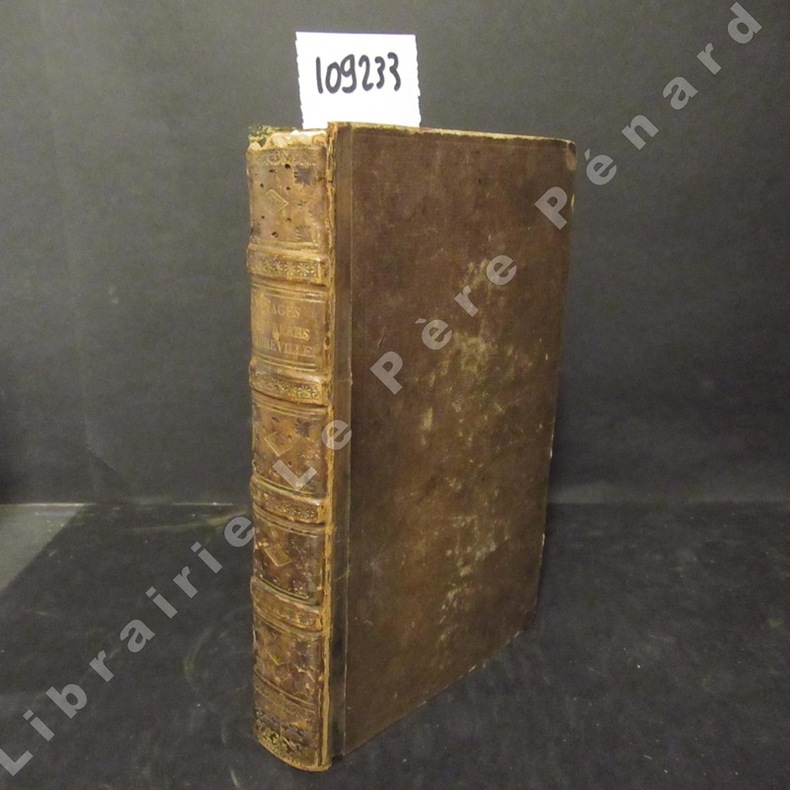
18221092331822 A Paris, Chez Béchet Ainé, Libraire et chez le Capitaine Bacheville - 1822 - Deuxième édition, revue et corrigée - In-8 (12,5 x 20cm environ), reliure pleine peau, 5 nerfs, fleurons, filets et titre doré au dos, tranches jaunes - 432 pages - Frontispice - Signature du Capitaine Bacheville, attestant de l'originalité du volume
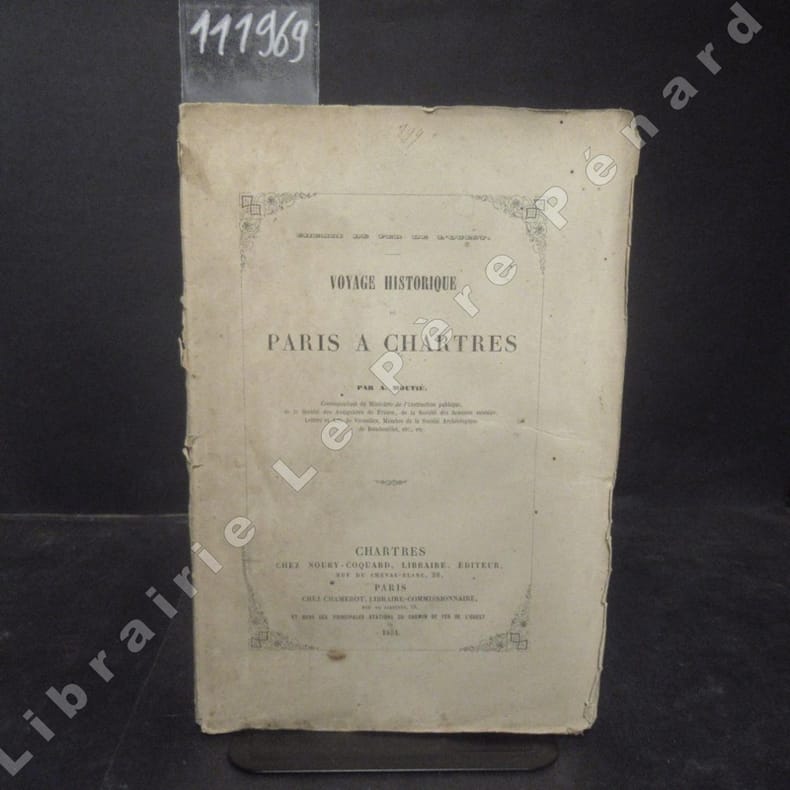
18511119691851 A Chartres, Chez Noury-Coquard, Libraire-Editeur et à Paris, Chez Chamerot, Libraire-Commissionnaire et dans les principales stations du chemin de fer de l'Ouest - 1851 - In-8, broché - 171 p. - 4 gravures hors texte
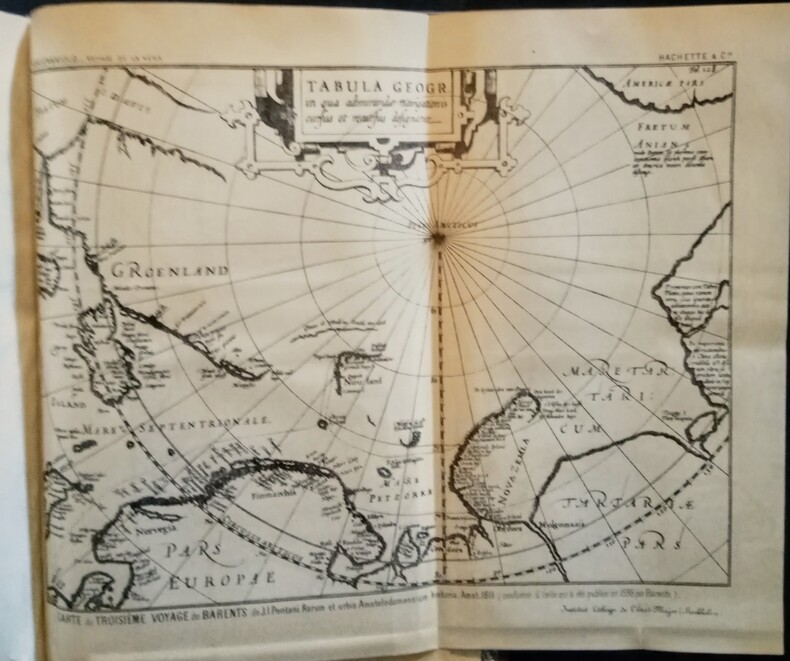
1883WOC-2661Accompagné d'un résumé des voyages précédemment effectués le Long des Côtes Septentrionales de l'Ancien Continent. Ouvrage traduit du Suédois avec l'autorisation de l'auteur par MM. Charles Rabot (Membre de la Société de Géographie de Paris) et Charles Lallemand (Ingénieur au Corps des Mines). Contenant 293 gravures sur bois, 3 gravures sur acier et 18 cartes. Paris, Librairie Hachettes et Cie, 1883-1885. 2 volumes in-4 (28,5x3,5x20cm) reliés demi chagrin brun à coins, dos petits nerfs ornés de caissons dorés, double filets sur les plats, têtes dorées (reliure d'époques). [2]ff. n. ch., IV,481pp. + [2]ff. n.ch., 278pp.
1888CCC-223amb.edition Librairie D'Education A. Hatier 1888, avec carte en couleur,tres bon etat, photo possible
18691254571869/1872 Paris, Henri-Plon, Imprimeur-Editeur - 1869 pour le tome I et II, 1872 pour le tome III - 3 volumes in-12 (12x18cm environ); reliure demi-chagrin; dos à 4 nerfs avec titres et caissons ornés de fleurons en doré, frontispice collé - 363 + 451 + 359 pages - Ouvrage richement illustré de gravures-photographies en N&B hors texte et en page dépliante avec également des cartes en couleur sur deux pages et dépliantes
1880100148526E. Dentu Editeur 1880 in12. 1880. Cartonné. Récit de voyage publié en 1880 par le journaliste et homme de lettres suisse Victor Tissot décrivant son périple en Hongrie pour découvrir la culture les modes de vie et les traditions des Tziganes tout en explorant les paysages et rencontrant les habitants de cette région alors méconnue
189286289Couverture rigide. Reliure toile de l'éditeur. 333 pages. Premier plat décoré. 21 x 31 cm . Rousseurs.
183645406Berlin, G. Eichler, 1836. In ""Archiv für Anatomie, Physiologie und Wissenschaftliches Medicin Herausgegeben von Johannes Müller"". Jahrgang 1836. Pp. 66-89 a. pp. 90-139. The entire volume offered in its 6 parts (in 5), all 5 issues uncut with orig. printed warppers. (2),CCXXIV,390 pp. and 15 engraved plates. The 2 first issues with a faint dampstain to lower part of leaves and plates.
180343638Halle, Rengerschen Buchhandlung, 1803. Without wrappers as extracted from ""Annalen der Physik. Herausgegeben von Ludwig Wilhelm Gilbert"", Jahrgang 1802, Bd. 12, Zwölftes Stück. Pp. 409-416. Titlepage to vol. 12.
183645406Berlin G. Eichler 1836. In "Archiv für Anatomie Physiologie und Wissenschaftliches Medicin Herausgegeben von Johannes Müller". Jahrgang 1836. Pp. 66-89 a. pp. 90-139. The entire volume offered in its 6 parts in 5 all 5 issues uncut with orig. printed warppers. 2CCXXIV390 pp. and 15 engraved plates. The 2 first issues with a faint dampstain to lower part of leaves and plates. <br/><br/><em>First appearance of an importent paper in the history of biology in which Schwann describes his discovery and isolation of pepsin the substance in the stomach that aids digestion of eggwhite. It is the FIRST KNOWN ANIMAL ENZYME. The paper appeared at the same time in "Annalen der Physik und Chemie. Hrsg. von J.C. Poggendorff".Theodor Schwann 1810-1882 was a great German physiologist pathologist and experimenter. One of the founders of the cell doctrine and of the idea of the living nature of yeast. Born at Neuss near Düsseldorff. A catholic educated in the Jesuit Gymnasium in Cologne. Intended for the church but took to medicine. He was a pupil of Johannes Müller and a collegueand lifelong friend of J. Henle the anatomist. In Berlin Schwann was Johannes Müller's assistent for five years and it was then that he discovered pepsin in 1836 the paper offered.Parkinson "Breakthroughs" 1836 B. - Garrison & Morton no. 991.The first paper offered written together with Johannes Müller records the preliminary investigaions leading to the discovery of Pepsin. - Garrison & Morton no. 990.The volume also contains another famous paper by ROBERT REMAK "Vorläufige Mittheilung microscopischer Beobachtungen über den innern Bau der Cerebrospinalnerven und über die Entwicklung ihrer Formenelemente. Hierzu Tafel IV. Pp. 145-161. This paper contains the first announcement of his DISCOVERY OF "FIBRES OF REMAK" the non-medullated nerve-fibres. Garrison & Morton no. 1260. </em> unknown
180343638Halle Rengerschen Buchhandlung 1803. Without wrappers as extracted from "Annalen der Physik. Herausgegeben von Ludwig Wilhelm Gilbert" Jahrgang 1802 Bd. 12 Zwölftes Stück. Pp. 409-416. Titlepage to vol. 12. <br/><br/><em>This is Ritter's first expositon of his discovery of ultraviolet light. It was announced the year before in a halfpage letter addressed to Gilbert's Annalen and printed in the Annalen. With that discovery it became clear that visible light represents no more than a fraction of a continous spectrum.A year earlier in 1800 William Herschel discovered infrared light. This was the first time that a form of light beyond visible light had been detected. After hearing about Herschel's discovery of an invisible form of light beyond the red portion of the spectrum Ritter decided to conduct experiments to determine if invisible light existed beyond the violet end of the spectrum as well. He had heard that blue light caused a greater reaction in silver chloride than red light did. Ritter decided to measure the rate at which silver chloride reacted to the different colors of light. He directed sunlight through a glass prism to create a spectrum. He then placed silver chloride in each color of the spectrum and found that it showed little change in the red part of the spectrum but darkened toward the violet end of the spectrum. Johann Ritter then decided to place silver chloride in the area just beyond the violet end of the spectrum in a region where no sunlight was visible. To his amazement this region showed the most intense reaction of all. This showed for the first time that an invisible form of light existed beyond the violet end of the visible spectrum. This new type of light which Ritter called Chemical Rays later became known as ultraviolet light or ultraviolet radiation the word ultra means beyond. </em> unknown
180143599Halle, Rengerschen Buchhandlung, 1801. Without wrappers as published in ""Annalen der Physik. Herausgegeben von Ludwig Wilhelm Gilbert"", Bd. 7, Zweites Stück. The entire issue offered (=Heft 2). Pp. 137-264 a. 2 folded engraved plates. Herschels papers: pp. 137-156. The plate depicts Herschel's experimental arrangements.
182949248Leipzig, Johann Ambrosius Barth, 1829. Without wrappers as issued in ""Annalen der Physik und Chemie. Hrsg.von Poggendorff"", Bd. 16, Siebentes Stück. (2) + pp., 1 folded engraved plate. Entire issue offered with titlepage to volume 16. Berzelius's paper: pp. 387-415. Clean and fine.
182949248Leipzig Johann Ambrosius Barth 1829. Without wrappers as issued in "Annalen der Physik und Chemie. Hrsg.von Poggendorff" Bd. 16 Siebentes Stück. 2 pp. 1 folded engraved plate. Entire issue offered with titlepage to volume 16. Berzelius's paper: pp. 387-415. Clean and fine. <br/><br/><em>First German printing - printed simultaneously with the English and Swedish version - of the paper in which Berzelius described his discovery of Thorium the first element after Uranium to be identified as such. In 1829 Jöns Jakob Berzelius of the Royal Karolinska Institute Stockholm extracted thorium from a rock specimen sent to him by an amateur mineralogist who had discovered it near Brevig and realised that it had not previously been reported. The mineral turned out to be thorium silicate and it is now known as thorite. Berzelius even produced a sample of metallic thorium by heating thorium fluoride with potassium and confirmed it as a new metal. He called the black mineral thorite in honor of the Scandinavian god Thor.Parkinson "Breakthroughs" 1829 C. </em> unknown
180143599Halle Rengerschen Buchhandlung 1801. Without wrappers as published in "Annalen der Physik. Herausgegeben von Ludwig Wilhelm Gilbert" Bd. 7 Zweites Stück. The entire issue offered =Heft 2. Pp. 137-264 a. 2 folded engraved plates. Herschels papers: pp. 137-156. The plate depicts Herschel's experimental arrangements. <br/><br/><em>First appearance in German of Herschel's epochal announcement of his discovery of infrared light in 1800. This was the first time that a form of light beyond visible light had been detected. The paper offered is the German translation of the main parts of Herschel's paper "An Investigation of the Powers of Prismatic Colours to Heat and Illuminate Objects"."In 1800 he tested various portions of the sun's spectrum by thermometer to see if he could find interesting differences in the amount of heat the different colors delivered. He did but in a rather unexpected way for he found that the temperature rise was highest in no color at all at a spot beyond the red end of the spectrum. He concluded that the sunlight contained invisible light beyond the red. This is now called infrared radiation. The following year Ritter was to extend the visible spectrum in the other direction."Asimov.Parkinson "Breakthroughs" 1800 P. </em> unknown
184244147(Leipzig, Johann Ambrosius Barth, 1842). Without wrappers. In ""Annalen der Physik und Chemie. Hrsg. von J.C. Poggendorff"", Ergänzungsband 1, Stück 2. Pp. 193-384 a. 1 folded engraved plate. (The entire issue offered). Henry's paper: pp. 282-312.
184244147Leipzig Johann Ambrosius Barth 1842. Without wrappers. In "Annalen der Physik und Chemie. Hrsg. von J.C. Poggendorff" Ergänzungsband 1 Stück 2. Pp. 193-384 a. 1 folded engraved plate. The entire issue offered. Henry's paper: pp. 282-312. <br/><br/><em>First German version of Henry's description of his discovery of self-induction. He missed the credit for the discovery of induction to Faraday but he had done the key experiment ahead of Faraday but Faraday was the first to publish. But he is credited for the discovery of self-induction 1832 and Faraday discovered it independently two years later 1834."In Henry's paper however he explained thet the electric current in a coil can induce another current not only in another coil but in itself. The actual current observed in the coil is then the combination of the original current and the induced current. This is called self induction."Isac Asimov.The issue contains further notable papers Michael Faraday's "Vierzehnte Reihe von Experimental-Untersuchungen über Elektricität" § 2o-22. Nos 1667-1748. Pp. 249-281. First German version. In this paper FARADAYamplifies his theory of electrostatic induction by making further use of the analogy with the induction of magnetism. Whittaker describes the paper as having "THE FUNDAMENTAL EQUATION OF ELECTROSTATICS" as modified in order to take into account the effect of the specific inductive capacity."Whittaker I pp.187-89. </em> unknown
183445159(Leipzig, Johann Ambrosius Barth, 1834). Without wrappers. Extracted from ""Annalen der Physik und Chemie. Hrsg.von Poggendorff"", Bd. 31, No 5. Pp. 65-80.
183445159Leipzig Johann Ambrosius Barth 1834. Without wrappers. Extracted from "Annalen der Physik und Chemie. Hrsg.von Poggendorff" Bd. 31 No 5. Pp. 65-80. <br/><br/><em>First printing of the paper in which Runge discloses his discovery of carbolic acid or phenol and how he prepared it by distilling coal.Parkinson "Breakthroughs" 1834 C. - Partington IV pp. 183-84. </em> unknown
189843857Berlin, J.A. Barth, 1898. No wrappers. In ""Annalen der Physik"", Neue Folge Band 65, No 5. Pp. 1-240.. (Entire issue offered, No.5). Titlepage to vol. 65. Stamp on titlepage. Schmidt's paper: pp. 141-151, textillustr. A tear to inner lower corners of pp. 24-32. (not affecting Schmidt's paper). Clean and fine.