304 résultats
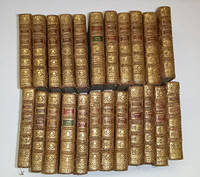
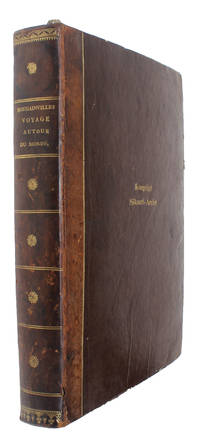
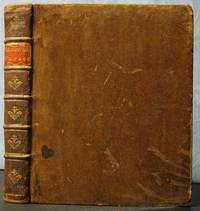
17725814Paris, chez Saillant et Nyon, 1772. 1772 3 vol. in-8° (205 x 130 mm) de : I. [4] ff. (faux-titre, titre, épître) ; XLIII (discours préliminaire) ; 336 pp. ; II. [2] ff. (faux-titre, titre) ; 453 pp. ; [3] pp. (approbation, privilège, avis au relieur) ; III. [1] f. (faux titre) ; XVI (avertissement) ; 362 pp. ; [3] pp. (approbation, privilège) ; 3 planches et 21 cartes dépliantes (numérotées de 1 à 20, la 16 étant en deux parties). (Quelques tâches). Plein veau marbré d'époque, dos à nerfs orné, pièce de titre de maroquin rouge, tranches rouges, gardes de papier marbré. (Reliures très usées avec manques).
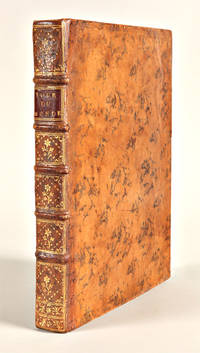
1772167241772 basane marbrée glacée, dos lisse. (tr. rouges pour les deux premiers vol. et bleu moucheté pour le troisième, mais les fers des dos sont identiques). 3 vol. in-8, TI: (4ff.), XLIV, 336pp., TII: (2ff.), 453pp. (1f.), 21 cartes et 3 gravures dépliantes, TIII: Titre, XVI-362pp., (2ff.). P. Saillant et Nyon 1772
16-6410Paris: Hotel de Thou 1780-1786. 8vo 12 x 19.5cm. Contemporary tree calf occasional worming rubbed bumping to corners and extremities .First 23 volumes of an eventual 45; half-titles 88 engraved plates 17 folding one large folding table vol. 22 lacking map I3 vol. 1 & Y3 vol. 3 with small marginal loss H8 vol. 3 with small marginal hole O2 vol. 9 with short marginal tears just touching text Z8 vol. 13 with paper defect at gutter E2 vol. 22 lacking lower corner very occasional faint spotting and soiling abrasion marks to front pastedowns where label removed.The first 21 volumes of this work were published together in 1780 with the subsequent volumes published between 1786 and 1804. The first of the additional volumes 22 & 23 including within this lot concentrate on the voyages of Captain Cook.OCLC Number / Unique Identifier:896641104:A collection of voyages based on Prévost's Histoire générale des voyages and illustrated with remarkably evocative plates. The work contains the most important voyages to Africa Asia America and the Pacific from the earliest Portuguese explorers to the 18th century extensively commenting on the culture natural history customs and languages of the various regions. Volumes 19-23 contain narratives of Captain Cook's three voyages with many folding illustrations of New Zealand Tahiti Hawaii and the Tonga Islands Paris: Hotel de Thou, 1780-1786 unknown
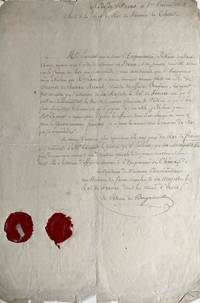
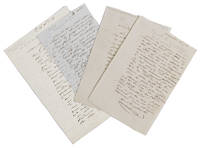
29401Manuscript in brown ink folio 1 page; headed 'Rade de Macao ce 1er Janvier 1825' the letter is to an unnamed recipient and concerns the Lazarist missionary Lamiot; old vertical and horizontal folds minor tears at the ends roughened at top and bottom edges else clean and complete with red wax seals preserved. Rare unpublished letter of Baron Hyacinthe de Bougainville 1781-1846 written at Macao aboard the corvette Thétis during its circumnavigation of 1824-26. Baron de Bougainville was the son of the navigator Louis-Antoine de Bougainville 1729-1811. Earlier on in his naval career he had taken part in the Baudin expedition to New Holland of 1800-1803. In the years 1824-26 he led a diplomatic mission to East Asia on a round the world expedition with the warships Thétis and Espérance. His ships set sail from France in March 1824 and visited Réunion Pondicherry Manila Macao Cochin-China and Soerabaia. On his return voyage across the Pacific - retracing in part his father's famous circumnavigation of 1766-1769 - he called in at Port Jackson for three months during 1825. Whilst in Sydney he erected monuments to La Pérouse and Receveur at Botany Bay. Bougainville's letter written at anchor off Macao concerns the Lazarist missionary Louis-François Lamiot 1767-1831 superior of the Vincentians in China. Having first arrived in Peking in 1794 for many years Lamiot had acted as court interpreter until in 1820 he was banished from the empire owing to his association with the disgraced Father Clet. He was living in exile at Macao at the time of the arrival of the Thétis and Espérance at the end of 1824. Bougainville writes: 'Lamiot having received the order to return to France after serving the Emperor in Peking for 26 years presented himself to be admitted on the King's frigate that I command'. Bougainville however acting on the advice of the king and of the Vicomte de Chateaubriand writes that he has refused to take Lamiot on board his ship: Lamiot is ordered to return to Peking to attempt to administer the French mission there as best he can. He states: 'I would be all the more reprehensible in the eyes of the King of France if I granted M. Lamiot the passage he is asking for' since Lamiot is currently in a position to offer his services to the Emperor of China as a tutor for young mathematicians. The French mission was as much a scientific enterprise as it was an apostolic one. Contrary to the King of France's wishes however Father Lamiot would remain in Macao until his death in 1831. Bougainville signs the letter with his title: 'The Ship's Captain Commanding a Division of the naval forces of his Majesty the King of France in the seas of Asia. H. Baron de Bougainville'. While Bougainville's brief communiqué is undoubtedly a piece of official correspondence containing information of a diplomatically sensitive nature it is not clear for whom precisely it was intended; nor can we be absolutely certain whether it was carried by him back to France or delivered to an unknown party en route. Immediately after leaving Macao Bougainville's ships called at Da Nang where the French were treated civilly for several weeks in January-February 1825 but were refused an audience with the Emperor Minh Mạng. The expedition then visited Soerabaia Sydney Valparaíso and Rio de Janeiro before returning to France. unknown
21527<p><b>BOUGAINVILLE LOUIS-ANTOINE. </b>1729-1811. French navigator who led the first French voyage around the world in 1766-1769 making significant geographical observations; the South American climbing plant Bougainvillea is named in his honor. ADS. <i>"De Bougainville"</i>. ½p. Tall 4to. Versailles September 5 1764. To the French Minister of Foreign Affairs <b>ÉTIENNE FRANÇOIS DUC DE CHOISEUL</b> 1719-1785. In French with translation.</p><p><i>"Memorandum</i></p><p><i>Mr de Bougainville begs Monseigneur the Duke de Choiseul to be good enough to grant Sir de Romainville an appointment of infantry lieutenant. This young man embarks with him and must be employed in the colony both for detachments and for the reconnaissance of the island. He's already participated to the campaigns of 1759 and 1760 and 1761 as volunteer in the chasseurs of Conflans and that of 1762 as aide-de-camp of Mr. Dennery chief of the Condé army general staff."</i></p><p>A French army officer who worked in London's French embassy Bougainville served as General Montcalm's aide in Canada during the French and Indian War – the American theater of the Seven Years War that pitted Britain Prussia Portugal against France Spain Russia and the Holy Roman Empire. Unable to prevent the British from capturing Quebec and Montreal Bougainville lost his military commission upon the French surrender. For the remainder of the war from 1761-1763 he was instrumental in negotiating the Treaty of Paris by France and Spain ceded vast amounts of overseas holdings to Great Britain including much of their North American territories. </p><p>Beginning in 1755 and with renewed vigor in 1758 the British expelled or deported Acadians French settlers of New Brunswick Nova Scotia the Magdalen Islands Prince Edward Island and parts of modern Maine. Following the Treaty of Paris many Acadians relocated to Louisiana which had been transferred from France to Spain at the end of the war. However Bougainville initiated and personally funded a plan to settle the displaced Acadians on the Isles Malouines or Falkland Islands. </p><p>Located off the coast of Chile the Falkland Islands first appeared on the maps of European explorers in the 16th century but remained uninhabited despite territorial claims of both Britain and Spain. With two ships Bougainville departed from France in September 1763 and arrived in the Falkland Islands in January 1764 establishing a naval base at Port Louis. Upon their return to France King Louis XV ratified French possession of the islands on September 12 1764 seven days after our letter. </p><p>However French claim to the island was contested and in 1766 Bougainville's colony was transferred to the Spanish who agreed to compensation. Thereafter Britain and Spain clashed over their claims to the Falkland Islands. Currently a British overseas territory the islands are still the object of contention having been fought over between Great Britain and Argentina in 1982. </p><p>After officially releasing the Falkland Islands to the Spanish in December 1766 Bougainville embarked upon a round-the-world voyage continuing to Buenos Aires the Tuamotu Archipelago and Tahiti before venturing across the Pacific. By the following September his ship <i>La Boudeuse</i> had reached Batavia now Jakarta and on February 16 1769 after nearly two-and-a-half years on the high seas she returned with the loss of only seven crew members to the northwestern French port of St.-Malo. Bougainville's lively account of his travels appeared in 1771. A participant in the American Revolution Bougainville was also a notable mathematician and the first to calculate longitude by means of astronomical observations. The flowering vine Bougainvillea is named in his honor.</p><p>A French noble and army officer Choiseul earned the patronage of Madame de Pompadour after he obtained for her letters written by King Louis XV to another mistress. She helped establish Choiseul's diplomatic career during which he helped author the Second Treaty of Versailles. He was French minister of foreign affairs during the Seven Years War after which he dedicated himself to rebuilding the military and French power abroad. He served as foreign minister from 1766-1770. </p><p>Our letter asks for the promotion to lieutenant of <b>Charles Routier de Romainville</b>1739-1808 and mentions his recent military service under <b>Louis Joseph Prince de Condé</b> 1736-1818 in the 1762 Battle of Nauheim during which Condé's French troops defeated Hanoverian and British troops. Romainville received his appointment to the rank of lieutenant in November 1764 and joined Bougainville on his expedition to the Falklands remaining there to implement their plans for the new colony until he joined Bougainville on his round-the-world voyage and in so doing made his name as an engineer and cartographer. He later went on to help establish a French colony on the Seychelles. </p><p>From the collection of 19th-century French chemist and autographs collector Antoine-François Boutron-Charlard and 19th-century French chemist Edmond Frémy. Very neatly written. Folded and in excellent condition. Rare.</p><br /> books
759P., Guérin, 1754/1756, 2 volumes in 4 reliés en plein veau marbré, dos à nerf pour le tome 1 ; plein veau marbré dos lisse pour le tome 2 (reliures de l'époque), (coiffes légèrement usées, un mors légèrement fendu, dos du tome 2 légèrement frotté, quelques rousseurs, coins émoussés), T.1 : 23pp., 340pp., 2 planches dépliantes, T.2 : 23pp., 259pp., 1 planche dépliante
177244162Five maps and one engraving all fldg The author was Colonel of Foot and Commodore of the Expedition in the Frigate La Boudeufe and the Store-Ship L'Etoile from the title page. Bougainville Nov.121729-Aug 31 1811 was a French Admiral and expolorer who circumnaviagated the globe in a scientific expedition. This is the travel log of that journey which proved to be very popular when it was published especially his observations on Tahitian society. J. Nourse hardcover
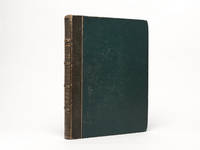
1771000180<p><strong>First edition of Louis Antoine de Bougainville's account of his famous circumnavigation between 1766 and 1769. </strong></p><p><strong>Description:</strong> Near contemp. green and brown morocco separated with gilt fillet; spine with 4 raised bands decorated with gilt fillets; gilt titling on spine. Brown marbled endpapers. Quarto: 27 × 20 cm; 4 ll. 417 3 pp. With 20 maps 17 fold-outs incl. the large world map and 3 engraved plates.</p><p><strong>Ref.:</strong> Brunet i 1167; Hill p.31; Sabin ii 6864</p><p><strong>Condition:</strong> Boards somewhat rubbed and bumped. Pages slightly yellowed with age occasional light mainly marginal spotting some maps slightly tanned.</p><p><strong>Notes:</strong> French Navy admiral and diplomat Louis Antoine de Bougainville 1729–1811 was commissioned by Louis XV in 1766 to circle the Earth in a voyage of exploration with the frigates La Boudeuse and L'Etoile. The purpose of this expedition was to explore the Pacific especially the Australian coast and New Guinea to examine the geographical and ecological conditions for economic benefit and to extend the influence of the French crown by seizing land. From an economic point of view the journey was not very successful but in Europe the description of Tahiti shaped the image of the island as a paradise where people seem to live free of constraints. Bouganville's travelogue became a bestseller that spread throughout Europe and the myth of the South Seas continues to inspire philosophers artists and writers to this day.</p> Saillant & Nyon hardcover
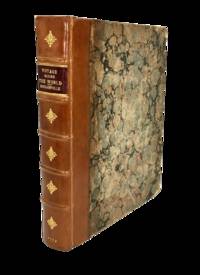
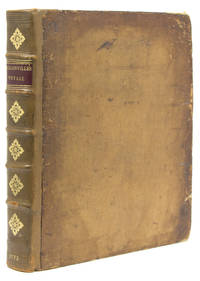
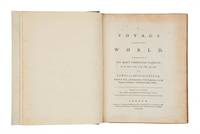
1772625061772. BOUGAINVILLE Lewis de. Voyage Round the World. Performed by Order of His Most Christian Majesty in the Years 1766 1767 1768 and 1769. London; Printed for J. Nourse . and T. Davies 1772. 1st English ed. 4to. xxviii476pp. Copper-engraved folding plate 12 charts on five copper-engraved folding plates. Orig. marbled boards rebacked in period-style gilt-decorated calf raised spine bands red morocco spine label. Boards rubbed edgewear some faint scattered foxing else very good or better. Cox I55. Hill 165. Sabin 6869. Account of the first official French circumnavigation. Louis de Bougainville had been aide-de-camp to Montcalm in Canada and acted for the French at their surrender at Montreal in 1760. A chapter of this work is devoted to the natural history of the Falkland Islands. "During this voyage Bougainville visited Rio de Janeiro Notevideo and Patagonia in South America; he was also in Buenos Aires when the order for the expulsion of the Jesuits of Paraguay arrived which he describes in detail. He then proceeded through the Strait of Magellan and across the Pacific visiting the Tuamotu Archipelago Tahiti the Samoa Islands the New Hebrides and the Salomon Louisiade and New Britain archipelagos. There is a long description of Tahiti containing observations on the natives as wel as a vocabulary of 300 words used on the island"--Hill. Bougainville's voyage created a great deal of interest among the French in the Pacific which resulted in the voyages of du Fresne and de La Perouse. The flowering vine is named for him as well as the largest island in the Solomons. He later took part in the American Revolution survived the French revolution and was made a senator and count by Napoleon. unknown
1837ABC_47451France 1837. Folded. 1 17.7 x 12 cm; 2 17.7 x 12 cm; 3 15.6 x 10 cm; 4 20.4 x 13.2 cm. All four letters written in French in an early 19th century cursive in brown ink. With the blind-stamped initials "H.B" in the top right corner of each letter. Including:1 Autograph letter from Hyacinthe de Bougainville to Gaspar baron Gourgaud.France Saturday 26 September 1835.2 Autograph letter from Hyacinthe de Bougainville to Madame Delpeche.France 25 March 1837.3 Autograph letter from Hyacinthe de Bougainville to a "Cher Ami".France 13 April 1838.4 Autograph letter from Hyacinthe de Bougainville to a "Cher Ami" and his best "Comrade".France 16 December 1845. Hyacinthe Bougainville 1781-1846 was a French naval officer son of the famous French Admiral and explorer Louis-Antoine Comte de Bougainville 1729-1811 who had circumnavigated the world in 1766-1779. Hyacinthe sailed around the world from 1824-1826 on board of the Thétis and the Espérance sent by the Minister of the Navy and the Colonies the Duc de Clermont-Tonnerre. It was virtually a diplomatic mission to Réunion Cochin-China Pondicherry in the Indian Ocean Manila and Macao. Hyacinthe returned across the Pacific and after anchoring at Port Jackson for three months he returned to France via Rio de Janeiro. Hyacinthe de Bougainville became Rear-Admiral in 1838.Ad 1: Autograph letter signed by Hyacinthe de Bougainville to Gaspar baron Gourgaud. Hyacinthe complained that he had heard nothing from him since their last "réunion gastronomique" 16 days earlier.Ad 2: Autograph letter signed by Hyacinthe de Bougainville to Madame Delpeche. She was the widow of François Delpeche an engraver who made a portrait of Hyacinthe's father Louis-Antoine de Bougainville in 1837.Ad 3: Autograph letter signed by Hyacinthe de Bougainville to a "Cher ami". He wrote that he had been presented by the Minister with some others that he didn't know to the King as an option for being made a contre admiral = Rear Admiral. "I am at the head of the list and if I stick to my titles I will be without worry ". He invokes his deeds since 1830 and says that he wants to retire "if I am not done justice; the name I bear does not allow me to serve any longer as a stepping stone for others". Three days before he was told that "le travail" was presented to the King and indeed his appointment followed the same year.Ad 4: Autograph letter signed by Hyacinthe de Bougainville to a "Cher ami" and his best "comrade". De Bougainville asks him a favour regarding the son-in-law of his "second" on the Thétis during his voyage around the globe in 1824-1826.All four letters with faint folding lines and pencil annotations; ads 2 and 4 with glue residue on the last leaf ad 2 with the remnants of a seal and a slight defect to the top corner of the last leaf where the letter was sealed and reopened. Overall in very good condition.l Howgego Encyclopaedia of Exploration 1800 to 1850 vol 2 B50. unknown
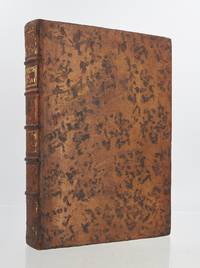
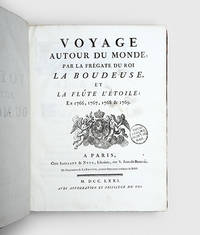
177153789Paris Saillant & Nyon 1771. 4to. Near contemp. hcalf. Gilt spine with gilt lettering. Very light wear along edges. Stamps on title-page. 8 incl. htitle4171 pp. 20 engraved maps and charts numb. 1-19 16 bis of which 18 are folded including the large world map. 2 engraved plates numb. 1-2. Internally clean and fine a few leaves with marginal brownspots. <br/><br/><em>First edition of this famous circumnavigation being the first voyage around the world with professional naturalists and geographers onboard. Bougainville was the first Frenchman to sail around the world. In 1771 Bougainville published his travel log from the expedition under the title "Le voyage autour du monde par la frégate La Boudeuse et la flûte L'Étoile". The book describes the geography biology and anthropology of Argentina then a Spanish colony Patagonia Tahiti and Indonesia then a Dutch colony. The book was a sensation especially the description of Tahitian society. Bougainville described it as an earthly paradise where men and women lived in blissful innocence far from the corruption of civilisation.Bougainville's descriptions powerfully expressed the concept of the noble savage influencing the utopian thoughts of philosophers such as Jean-Jacques Rousseau before the advent of the French Revolution. Denis Diderot's book Supplément au voyage de Bougainville retells the story of Bougainville's landing on Tahiti narrated by an anonymous reader to one of his friends. Diderot used his fictional approach including a description of the Tahitians as noble savages to criticise Western ways of living and thinking.Sabin 6864. </em> unknown
177153789Paris, Saillant & Nyon, 1771. 4to. Near contemp. hcalf. Gilt spine with gilt lettering. Very light wear along edges. Stamps on title-page. (8, incl. htitle),417,(1) pp., 20 engraved maps and charts (numb. 1-19 + 16 bis) of which 18 are folded, including the large world map. 2 engraved plates (numb. 1-2). Internally clean and fine, a few leaves with marginal brownspots.
1772305731London: Printed for J. Nourse.and T. Davies. 1772. First English Edition. 12 engraved maps and charts on 5 folding plates including the Straits of Magellan one folding engraved plate with the 3 images of Polynesian pirogues and a canoe with the Tahitian vocabulary. 1 vols. 4to 261 x 211 cm. Contemporary brown calf neatly rebacked with corners renewed.Clean copyWith bookplate of Frank Streeter. First English Edition. 12 engraved maps and charts on 5 folding plates including the Straits of Magellan one folding engraved plate with the 3 images of Polynesian pirogues and a canoe with the Tahitian vocabulary. 1 vols. 4to 261 x 211 cm. First English edition of the first French circumnavigation first published in Paris 1771. Bougainville's command was to first turn over the Falkland Malvinas Islands to the Spanish allies of the French. He tells the story of the discovery and occupation of the Falklands and devotes a chapter to their natural history. He was at Buenos Aires when the order came to expel the Jesuits of Paraguay which he describes in detail. He then continued through the Straits of Magellan and across the Pacific to the East Indies and thence home in a three year voyage which was France's first official circumnavigation of the word. Many Pacific Islands were visited there is a lengthy description of Tahiti including a 300 word vocabulary of words used on the island at the end of the book and although Bougainville made few important discoveries the effect of his voyage on the French was to stimulate their interest in the Pacific and inspire the later voyages of Du Fresne and La Pérouse. Bougainville after whom the tropical flower is named later fought in the American Revolution and was made a count of the Empire by Napoleon.<br /> <br /> It was translated by John Forster the Naturalist aboard the Resolution on James Cook's second voyage 1772-75. France's first official circumnavigation was commanded by Bougainville who saw the strategic advantage in commanding the route to the Pacific around Cape Horn hence his attempted colonization of the Falkland Islands in 1763 and his new charts of the Straits of Magellan. As well as bringing back news of his discoveries in the Pacific Bougainville also brought back a Tahitian Mayoa. It was the decision to return this young man to his home that prompted the French Government to mount another exploratory voyage led by de Fresne in 1771. Hill states that Johann Reinhold's son Georg also Naturalist aboard the Resolution may have been the actual translator of this work while Johann contributed the preface dedication and footnotes. Hill p. 32; Sabin 6869; Kroepelien 113; O'Reilly and Reitman 285 Printed for J. Nourse...and T. Davies.. unknown
1772305731London: Printed for J. Nourse.and T. Davies. 1772. First English Edition. 12 engraved maps and charts on 5 folding plates including the Straits of Magellan one folding engraved plate with the 3 images of Polynesian pirogues and a canoe with the Tahitian vocabulary. 1 vols. 4to 261 x 211 cm. Contemporary brown calf neatly rebacked with corners renewed.Clean copyWith bookplate of Frank Streeter. First English Edition. 12 engraved maps and charts on 5 folding plates including the Straits of Magellan one folding engraved plate with the 3 images of Polynesian pirogues and a canoe with the Tahitian vocabulary. 1 vols. 4to 261 x 211 cm. The First French Circumnavigation. First English edition of the first French circumnavigation first published in Paris 1771. Bougainville's command was to first turn over the Falkland Malvinas Islands to the Spanish allies of the French. He tells the story of the discovery and occupation of the Falklands and devotes a chapter to their natural history. He was at Buenos Aires when the order came to expel the Jesuits of Paraguay which he describes in detail. He then continued through the Straits of Magellan and across the Pacific to the East Indies and thence home in a three year voyage which was France's first official circumnavigation of the word. Many Pacific Islands were visited there is a lengthy description of Tahiti including a 300 word vocabulary of words used on the island at the end of the book and although Bougainville made few important discoveries the effect of his voyage on the French was to stimulate their interest in the Pacific and inspire the later voyages of Du Fresne and La Pérouse. Bougainville after whom the tropical flower is named later fought in the American Revolution and was made a count of the Empire by Napoleon.<br/><br/> It was translated by John Forster the Naturalist aboard the Resolution on James Cook's second voyage 1772-75. France's first official circumnavigation was commanded by Bougainville who saw the strategic advantage in commanding the route to the Pacific around Cape Horn hence his attempted colonization of the Falkland Islands in 1763 and his new charts of the Straits of Magellan. As well as bringing back news of his discoveries in the Pacific Bougainville also brought back a Tahitian Mayoa. It was the decision to return this young man to his home that prompted the French Government to mount another exploratory voyage led by de Fresne in 1771. Hill states that Johann Reinhold's son Georg also Naturalist aboard the Resolution may have been the actual translator of this work while Johann contributed the preface dedication and footnotes. Hill p. 32; Sabin 6869; Kroepelien 113; O'Reilly and Reitman 285 Printed for J. Nourse...and T. Davies.. unknown books
42052London Printed for J. Nourse . and T. Davies. 1772. 4to. 26.2cm the First Edition in English xxviii476p. with 5 engraved folding maps; 1 engraved folding plate of canoes contemporary notation on the top of the title page "John Campbell given by his brother Robert" in early half dark brown calf blind ruled raised bands blind stamped center panel device decorations gilt title grey pressed linen boards marbled endpapers text somewhat toned about normal on map slight over-folded both interior hinges started but the binding is sound there is a small whole in the margin of R3 and Dd3 paper flaws not affecting the text overall a very good sound copy.cgc. Hill 165. O'Reilly & Reitman 285. vide Borba de Moraes I pp.115-116 Dublin ed. Sabin 6869. Kroepelien 113. Dunmore French Explorers in the Pacific I pp57-113. "This account confirmed . Rousseau's 'noble savage' concept and inspired Denis Diderot to pen his denunciation of European contact with indigenous peoples." -Hill Sailing with the toile and the Boudeuse de Bougainville's expedition was the first successful attempt by the French to sail around the world. After delivering the Falklands to Spain as ordered by his government he proceeded across the Pacific to the East Indies visited Tahiti Samoa the New Hebrides the Solomon Islands etc. and returned to France three years later. The translation into English as specified on the title was by Johann Reinhold Forster who was naturalist on Cook's second voyage but there is thought to be the possibility that it was in fact done by his son George Forster. An important work "not only for its discoveries in the Pacific but also for having been organized with true scientific precision." - Borba de Moraes. London, Printed for J. Nourse ,... and T. Davies..., 1772 unknown
17725001027London: Printed for J. Nourse and T. Davies 1772. Quarto with five folding maps and a folding plate of canoes; an excellent copy in a pale polished calf binding by Aquarius spine gilt. <p><p>The first English edition of the first French circumnavigation the great French voyage of the Cook period in many ways responsible for the pervasive notions of tropical paradise and the noble savage. This English version was translated by Johann Reinhold Forster and has an introduction by him according to the preface although the translation at least is now thought to have been the work of Forster's son Georg. Forster senior calls the voyage "a work written by a learned intelligent and judicious traveller which abounds with remarkable events and curious observations." and says that he has edited "and partially vindicated the British nation where we thought the author had been unjustly partial".</p> <p>The publication of Bougainville's narrative did a great deal to build the notion of a romantic paradise in the South Seas. Bougainville showed the influence of Jean-Jacques Rousseau in naming Tahiti "Nouvelle Cythère" after Kythera the small island off the coast of southern Greece which in Greek mythology provided a sanctuary for Aphrodite goddess of love. The reality was less sublime: he took Aoutourou back with him from Tahiti to Paris giving him lessons in French for the remainder of the voyage but the uprooted Tahitian just didn't get it: Forster with typical arrogance dismissed him as "stupid". He was allowed to go home on a subsequent voyage but died of smallpox on the way another tragic minor player in the history of discovery and colonisation.</p> <p>Bougainville headed into the Pacific discovering the Tuamotos before in April sighting and claiming possession of Tahiti unaware of Wallis's visit less than a year before. He continued on finally reaching the New Hebrides and 'La Austrialia del Espíritu Santo' discovered by Quirós in 1606 and believed to be part of the supposed Southern Continent. The only way to determine this Bougainville resolved was to head further to the west in the hope of sighting the eastern coast of New Holland. 'This he did only to be impeded by the Great Barrier Reef and although several of his crew claimed to have sighted land this was not confirmed and the ships were headed to the N. Nevertheless Bougainville concluded that he was close to some extensive land and in running westwards from Espíritu Santo he had dared to face the risk of the legendary lee-shore of New Holland and New Guinea even though prudence shortage of food and the condition of his vessels would have justified his heading northwards at an earlier date' Colin Jack-Hinton The Search for the Islands of Solomon p. 256; G. A. Wood The Discovery of Australia pp. 369-79 observes that had Bougainville persevered 'he would have come to the Australian coast near Cooktown and would likely enough have been wrecked where Cook was wrecked two years later'.</p> </p> . Printed for J. Nourse and T. Davies unknown
1771274010Paris: Saillant & Nyon 1771. First. hardcover. good. Complete with 20 folding maps and 3 plates. 8 417 3pp. 4to contemporary mottled calf gilt decorated spine with red leather spine label spine rubbed with light wear on spine ends edges of corners worn and bumped maps and text slightly wavy throughout light browning to margins of half-title page last 3 leaves with some light dampstaining to some margins. Paris: Saillant & Nyon 1771. First Edition<br/> <br/> Internally a clean bright and tight copy. Narrative of Bougainville's voyage to South America across the Pacific Ocean through the East Indies on onward to France. This voyage was the first French circumnavigation around the world. The success of this voyage caused increased French interest in the islands of South Pacific. Bougainville was sent from France to colonize the Falkland Islands. The first part of this work describes the Falkland Islands including its natural history and the French colony there and the author's visits to Montevideo Paraguay and Rio de Janeiro. Bougainville sailed through the Strait of Magellan and across the Pacific to Tahiti. There are several chapters on his visit to Tahiti. Also included is a list of Tahitian vocabulary. He then sailed to the East Indies where he extensively describes his visits to the Moluccas Borneo and Batavia. "The largest island in the Solomons and two straits in the Pacific bear his Bougainville's name and the tropical flowering vine called bougainvillea was also named for him." Hill 163. Borba de Moraes p. 115. Sabin 6864. Cox I p. 55. Du Rietz 117. O'Reilly & Reitman 283.<br/> <br/> Saillant & Nyon unknown
1771274010Paris: Saillant & Nyon 1771. First. hardcover. good. Complete with 20 folding maps and 3 plates. 8 417 3pp. 4to contemporary mottled calf gilt decorated spine with red leather spine label spine rubbed with light wear on spine ends edges of corners worn and bumped maps and text slightly wavy throughout light browning to margins of half-title page last 3 leaves with some light dampstaining to some margins. Paris: Saillant & Nyon 1771. First Edition<br/><br/> Internally a clean bright and tight copy. Narrative of Bougainville's voyage to South America across the Pacific Ocean through the East Indies on onward to France. This voyage was the first French circumnavigation around the world. The success of this voyage caused increased French interest in the islands of South Pacific. Bougainville was sent from France to colonize the Falkland Islands. The first part of this work describes the Falkland Islands including its natural history and the French colony there and the author's visits to Montevideo Paraguay and Rio de Janeiro. Bougainville sailed through the Strait of Magellan and across the Pacific to Tahiti. There are several chapters on his visit to Tahiti. Also included is a list of Tahitian vocabulary. He then sailed to the East Indies where he extensively describes his visits to the Moluccas Borneo and Batavia. "The largest island in the Solomons and two straits in the Pacific bear his Bougainville's name and the tropical flowering vine called bougainvillea was also named for him." Hill 163. Borba de Moraes p. 115. Sabin 6864. Cox I p. 55. Du Rietz 117. O'Reilly & Reitman 283.<br/><br/> Saillant & Nyon unknown books
1771102382Paris, Saillant & Nyon, 1771, in-4, [8]-417-[3] pp. 23 pl, Veau raciné havane, frise dorée en encadrement sur les plats, dos long orné de frises et fleurons dorés, pièce de titre rouge, Édition originale illustrée de 20 planches géographiques (dont les cartes du trajet des vaisseaux autour du monde, des îles Malouines, du détroit de Magellan, des terres de la Nouvelle-Guinée), et de 3 planches de figures représentant des embarcations d'indigènes du Pacifique. En 1766, Bougainville est chargé de remettre aux Espagnols les îles Malouines, terres dont il avait pris possession au nom du roi de France lors d'un précédent voyage en Amérique du Sud en 1763-1764 (la relation de cette expédition est racontée par Pernetty, dans son Histoire d'un voyage aux îles Malouines fait en 1763 et 1764, publiée en deux vol. à Paris, en 1770). A bord de la frégate La Boudeuse, il quitte le port de Nantes en novembre 1766, relâche à Brest, puis atteint Montevideo au début de l'année suivante. En avril 1767, il livre l'établissement français des îles Malouines à la Couronne espagnole. Sa mission remplie, Bougainville se dirige ensuite à Rio de Janeiro où il rejoint L'Etoile au mois de juin. En 1767, les deux navires s'aventurent dans l'océan Pacifique pour retourner en Europe. C'est au cours de cette traversée que Bougainville explore Tahiti (1768), dont il laissera une image paradisiaque (se promenant à plusieurs reprises dans l'intérieur de l'île, le navigateur écrira dans sa relation: "Je me croyais transporté dans le jardin d'Eden"). L'expédition rentre en France en 1769, rapportant de précieuses informations sur Tahiti et ses habitants (notamment un vocabulaire tahitien), ainsi que sur la géographie de l'Océanie. Lors de sa parution le récit de Bougainville connut un immense succès; considéré comme l'ouvrage d'un humaniste, il entretiendra longtemps le mythe du paradis polynésien. Manques à la reliure, quelques taches et rousseurs éparses. Couverture rigide
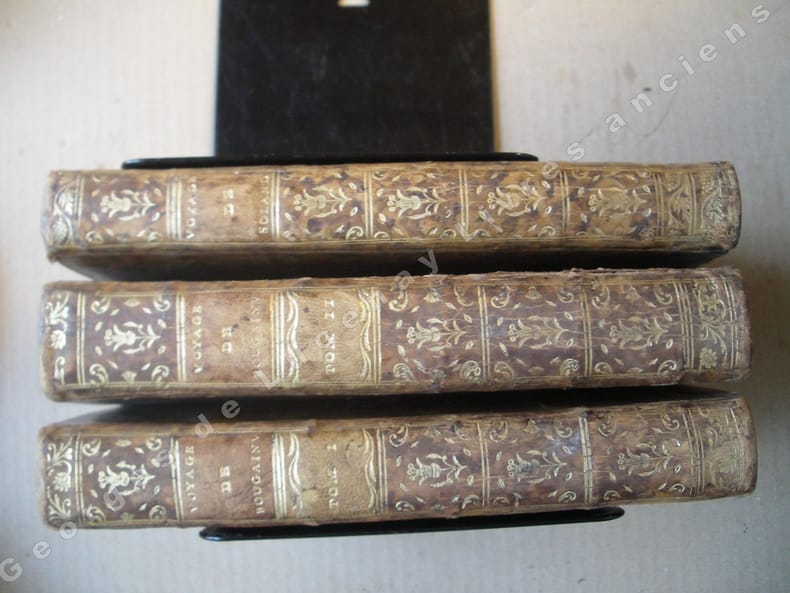
177182474Chez Saillant & Nyon | Paris 1771 | 19 x 26 cm | relié
177182474Paris: Chez Saillant & Nyon 1771. Fine. Chez Saillant & Nyon Paris 1771 19 x 26 cm relié First edition with 18 engraved maps et 5 folding engraved plates. Contemporary tan calf skillfully restored tear to the first folding map some marginal restorations to the map Troisième division - Archipel des navigateurs. Falkland Islands map expertly rebacked on the outer margin as well as the Magellan Strait map. Map of the Buton Strait with a small marginal tear and a second restored with a strip of paper. Bougainville undertook the first official French circumnavigation and scientific expedition. Starting from Nantes in November 1766 he sailed to the Falklands made a stopover in Buenos Aires and then crossed the Magellan Strait and the Pacific through the East Indies. The expedition visited the Samoan Islands Tahiti the New Hebrides. 300-word glossary of Polynesian language Tahiti in-fine. He first went to Paraguay to the main Portuguese settlement and gives engaging geographical and commercial descriptions. Details on the Falkland Islands and on Brazil are also instructive. The reader is pleasantly surprised to find . the delicious picture of the island of Tahiti. Sailing away from this blessed island the traveler visited several other islands . He stopped over in New Britain finally entered the Indian Sea visited the main islands such as Celebes Java Moluccas. Boucher de la Richarderie Bibliothèque universelle des voyages. Chez Saillant & Nyon unknown
elala2546<p>London: Printed for J.Nourse and T.Davies 1772. First Edition of the English Translation of the official account of the first French circumnavigation. Bougainville was instructed by the French government to surrender possession of the Falkland Islands to Spain and then to proceed across the Pacific to the East Indies. On his voyage he visited Tahiti which he believed he was the first to discover naming it ‘Nouvelle Cythère’ unaware of Wallis’s prior exploration the Solomon Islands Tuamotu Archipelago and the New Hebrides. The largest island in the Solomons and two straits in the Pacific were named after him. The narrative includes an account of the discovery and occupation of the Falkland Islands and a lengthy description of Tahiti and its inhabitants. Bougainville’s expedition stimulated great interest in France and bolstered European romantic notions of a ‘South Sea paradise’ inhabited by ‘noble savages’. Despite the attribution on the title-page the translation was probably done by Georg Forster while his father Johann Reinhold supplied the preface dedication and footnotes. Bell B423. Cox I 55. Hill p. 32. Howgego B142. JCB II 1816. Kroepelien 113. National Maritime Museum Cat. I 133. Sabin 6869 not mentioning plate. 4to. pp. xxviii 476. 5 folding engraved maps & 1 folding engraved plate. contemporary sprinkled calf rebacked with gilt spine mounted some scraping to covers but a nice copy</p> London: Printed for J.Nourse and T.Davies, 1772
1771166666Paris: Saillant & Nyon 1771. A wealth of scientific and geographical detail about the Pacific Ocean First edition of this account of the first French circumnavigation. Bougainville travelled to the Falkland Islands in 1766 to formally deliver the French settlement to Spain continuing into the Pacific and around the world. The clandestine passenger Jeanne Baret disguised as a man became the first woman on record to have circumnavigated the globe. Louis Antoine de Bougainville 1729-1811 studied law but abandoned it to join the army as a musketeer in 1753 serving in the Seven Years War. He was later appointed commander of the frigate La Boudeuse and the transport L'Étoile setting sail in December 1766. He entered the Pacific in 1768 and landed on Tahiti claiming it for France unaware of the visit of Samuel Wallis nine months earlier. On Tahiti it was discovered that the botanist's valet was a woman Jeanne Baret who enlisted as Jean Baret. The ships continued due west through Samoa and the New Hebrides eventually making the first recorded European sighting of the Great Barrier Reef. Turning north 100 miles from the coast of Queensland he passed through New Guinea to the Solomon Islands proceeding thence to the Moluccas where the Dutch allowed him to refit. Bougainville carried on to Djakarta and Mauritius and then home to St Malo. He was in Buenos Aires when the order of the expulsion of the Jesuits of Paraguay arrived which he describes in detail. Bougainville's name is given to the largest member of the Solomon Islands and to the strait which divides it from the British Island of Choiseul. It is also applied to the strait between Mallicollo and Espiritu Santo Islands of the New Hebrides group as well as to the South American climbing plant Bougainvillea. The book is notable for the influential description of Tahiti which Bougainville christened New Cythera after the abode of Aphrodite. "It is difficult to overstate the importance of the discovery of Tahiti on the European imagination of the context of utopian projections seemingly becoming real. Tahiti rapidly permeated European mythology" Arthur p. 82. His description of Tahiti and other South Sea islands also includes a 300-word vocabulary. Bougainville's account of the Tahitians followed the lead of thinkers such as Jean-Jacques Rousseau who was "popularizing the idea of the natural man in Europe. Denis Diderot inspired by Bougainville drew upon Rousseu's ideal of a natural state of humanity in his Supplement au voyage de Bougainville a work that can be understood as a commentary on colonialism" ibid. p. 82. Quarto 250 x 185 mm. With 3 engraved plates of boats 20 maps and charts most of them folding woodcut head- and tailpieces and historiated capitals. Contemporary French cat's paw calf tan morocco label spine gilt in compartments triple-ruled gilt panel to boards marbled endpapers and edges. 18th- or early 19th-century stamp of the Bibliothèque de Montmirail to title and last page. Skilful restoration to spine ends front joint and fore edge of rear board 100 mm closed tear to one fold of world map facing p. 18 loss to bottom corner of sig. Xxii not affecting text small nick to head of inner hinges of two gatherings. An excellent copy. Hill 163; Howgego I B142; Sabin 6864; Speake I p. 122-3. Paul Longley Arthur Travel Writing and the Antipodes 1605-1837 2011. hardcover
1771WRCAM49586Paris: Saillant & Nyon 1771. 84173pp. with twenty-three maps and plates. Half title. Quarto. Contemporary mottled calf gilt leather label. Minor shelf wear. Small contemporary bookplate of the Duc de Decrès on front pastedown. Very minor foxing in margins of half title and last leaf. A remarkably bright and clean copy. Fine. First edition of this important work. Bougainville first undertook an expedition to the Falkland Islands and Patagonia at his own expense to secure them for French colonization. To avoid possible conflict due to Spain's envy of this acquisition France gave up the territory to her. The narrative of that expedition was related in THE HISTORY OF A VOYAGE TO THE MALOUINE ISLANDS. Paris 1770. After delivering the Falklands to Spain Bougainville was ordered across the Pacific to the East Indies and then home. The completion of the three-year voyage marked the first official French circumnavigation and inspired much French interest in the Pacific islands. The party collected abundant natural history information concerning the regions visited; a chapter on the Falklands gives the history of their settlement as well. The expedition stopped at many South Sea islands among them Tahiti and included is a long section on that island as well as a vocabulary of the natives. Bougainville was in Buenos Aires when the order arrived for the expulsion of the Jesuits from Paraguay which he describes in detail. An extraordinary capstone to this remarkable voyage was that Bougainville lost only seven out of two hundred men. <br> <br> "Bougainville also touched at the Moluccas Batavia and Mauritius before he arrived once again in France in 1769. Although Bougainville made only a few important discoveries he created a great deal of interest among the French in the Pacific which resulted in the voyages of Marc-Joseph Marion de Fresne and Jean François de La Pérouse. The largest island in the Solomons and two straits in the Pacific bear his name and the tropical flowering vine called bougainvillea was also named for him. Bougainville later took part in the American Revolution survived the French Revolution and was made a senator and count of the Empire by Napoleon I. Bougainville's accounts of Pacific Islanders in this work echoed Jean Jacques Rousseau's concepts of the 'noble savage' and inspired Denis Diderot to write his denunciation of European contact with indigenous peoples" - Hill. <br> <br> This copy belonged to Admiral later Duc Denis Decrès Napoleon's Minister for the Navy and the Colonies from 1801 to 1814 with his bookplate on the front pastedown. Decrès was the Minister directly responsible for Nicholas Baudin's voyage to Australia. Therefore there could have been much instructive value in the present volume for Decrès who perhaps used Bougainville's experiences with regard to Baudin to assist in the various enquiries into voyage events many of them relating to Baudin's unfortunate command. A highly distinguished French naval provenance for one of the country's legendary travel narratives. HILL 163. SABIN 6864. O'REILLY & REITMAN 283. BORBA DE MORAES p.115. DU RIETZ 117. COX I p.55. Saillant & Nyon hardcover books
183789106Arthus Bertrand | Paris 1837 | 24 x 31.5 cm | 2 volumes reliés