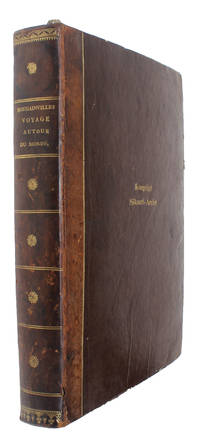
BOUGAINVILLE (Louis-Antoine de)Livre Rare Book
35 résultats
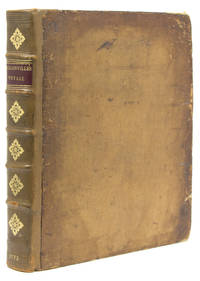
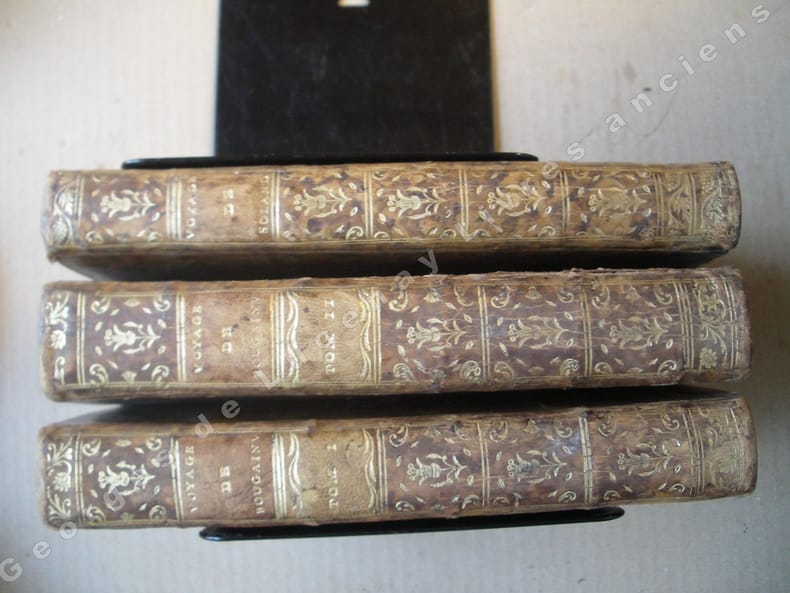
1772167241772 basane marbrée glacée, dos lisse. (tr. rouges pour les deux premiers vol. et bleu moucheté pour le troisième, mais les fers des dos sont identiques). 3 vol. in-8, TI: (4ff.), XLIV, 336pp., TII: (2ff.), 453pp. (1f.), 21 cartes et 3 gravures dépliantes, TIII: Titre, XVI-362pp., (2ff.). P. Saillant et Nyon 1772
17725001027London: Printed for J. Nourse and T. Davies 1772. Quarto with five folding maps and a folding plate of canoes; an excellent copy in a pale polished calf binding by Aquarius spine gilt. <p><p>The first English edition of the first French circumnavigation the great French voyage of the Cook period in many ways responsible for the pervasive notions of tropical paradise and the noble savage. This English version was translated by Johann Reinhold Forster and has an introduction by him according to the preface although the translation at least is now thought to have been the work of Forster's son Georg. Forster senior calls the voyage "a work written by a learned intelligent and judicious traveller which abounds with remarkable events and curious observations." and says that he has edited "and partially vindicated the British nation where we thought the author had been unjustly partial".</p> <p>The publication of Bougainville's narrative did a great deal to build the notion of a romantic paradise in the South Seas. Bougainville showed the influence of Jean-Jacques Rousseau in naming Tahiti "Nouvelle Cythère" after Kythera the small island off the coast of southern Greece which in Greek mythology provided a sanctuary for Aphrodite goddess of love. The reality was less sublime: he took Aoutourou back with him from Tahiti to Paris giving him lessons in French for the remainder of the voyage but the uprooted Tahitian just didn't get it: Forster with typical arrogance dismissed him as "stupid". He was allowed to go home on a subsequent voyage but died of smallpox on the way another tragic minor player in the history of discovery and colonisation.</p> <p>Bougainville headed into the Pacific discovering the Tuamotos before in April sighting and claiming possession of Tahiti unaware of Wallis's visit less than a year before. He continued on finally reaching the New Hebrides and 'La Austrialia del Espíritu Santo' discovered by Quirós in 1606 and believed to be part of the supposed Southern Continent. The only way to determine this Bougainville resolved was to head further to the west in the hope of sighting the eastern coast of New Holland. 'This he did only to be impeded by the Great Barrier Reef and although several of his crew claimed to have sighted land this was not confirmed and the ships were headed to the N. Nevertheless Bougainville concluded that he was close to some extensive land and in running westwards from Espíritu Santo he had dared to face the risk of the legendary lee-shore of New Holland and New Guinea even though prudence shortage of food and the condition of his vessels would have justified his heading northwards at an earlier date' Colin Jack-Hinton The Search for the Islands of Solomon p. 256; G. A. Wood The Discovery of Australia pp. 369-79 observes that had Bougainville persevered 'he would have come to the Australian coast near Cooktown and would likely enough have been wrecked where Cook was wrecked two years later'.</p> </p> . Printed for J. Nourse and T. Davies unknown
1772305731London: Printed for J. Nourse.and T. Davies. 1772. First English Edition. 12 engraved maps and charts on 5 folding plates including the Straits of Magellan one folding engraved plate with the 3 images of Polynesian pirogues and a canoe with the Tahitian vocabulary. 1 vols. 4to 261 x 211 cm. Contemporary brown calf neatly rebacked with corners renewed.Clean copyWith bookplate of Frank Streeter. First English Edition. 12 engraved maps and charts on 5 folding plates including the Straits of Magellan one folding engraved plate with the 3 images of Polynesian pirogues and a canoe with the Tahitian vocabulary. 1 vols. 4to 261 x 211 cm. First English edition of the first French circumnavigation first published in Paris 1771. Bougainville's command was to first turn over the Falkland Malvinas Islands to the Spanish allies of the French. He tells the story of the discovery and occupation of the Falklands and devotes a chapter to their natural history. He was at Buenos Aires when the order came to expel the Jesuits of Paraguay which he describes in detail. He then continued through the Straits of Magellan and across the Pacific to the East Indies and thence home in a three year voyage which was France's first official circumnavigation of the word. Many Pacific Islands were visited there is a lengthy description of Tahiti including a 300 word vocabulary of words used on the island at the end of the book and although Bougainville made few important discoveries the effect of his voyage on the French was to stimulate their interest in the Pacific and inspire the later voyages of Du Fresne and La Pérouse. Bougainville after whom the tropical flower is named later fought in the American Revolution and was made a count of the Empire by Napoleon.<br /> <br /> It was translated by John Forster the Naturalist aboard the Resolution on James Cook's second voyage 1772-75. France's first official circumnavigation was commanded by Bougainville who saw the strategic advantage in commanding the route to the Pacific around Cape Horn hence his attempted colonization of the Falkland Islands in 1763 and his new charts of the Straits of Magellan. As well as bringing back news of his discoveries in the Pacific Bougainville also brought back a Tahitian Mayoa. It was the decision to return this young man to his home that prompted the French Government to mount another exploratory voyage led by de Fresne in 1771. Hill states that Johann Reinhold's son Georg also Naturalist aboard the Resolution may have been the actual translator of this work while Johann contributed the preface dedication and footnotes. Hill p. 32; Sabin 6869; Kroepelien 113; O'Reilly and Reitman 285 Printed for J. Nourse...and T. Davies.. unknown
177244162Five maps and one engraving all fldg The author was Colonel of Foot and Commodore of the Expedition in the Frigate La Boudeufe and the Store-Ship L'Etoile from the title page. Bougainville Nov.121729-Aug 31 1811 was a French Admiral and expolorer who circumnaviagated the globe in a scientific expedition. This is the travel log of that journey which proved to be very popular when it was published especially his observations on Tahitian society. J. Nourse hardcover
17726475Dublin: J. Exshaw 1772. First Irish Edition. Hardcover. Very Good Textblock Near Fine. First Irish Edition. Hardcover. Period bookplate of "Buchan Hepburn Bar't". Pencil notation at rear reads "collated & perfect B. Quaritch" A handsome ocpy of the smaller Irish imprint published contemeraneously to the larger London edition. Sabin 6869 From the collection of Edouard Stackpole renowned whaling scholar curator of Mystic Seaport Museum Mystic CT. 1951-1966 and director of the Peter Foulger Museum Nantucket MA. 1969-1986. Minor shelf/edge wear binding professionally rebacked/restored see restoration report period bookplate at front pastedown bookseller pencil notation at rear pastedown small tear at tab of frontismap professionally repaired else tight bright and unmarred. Full leather binding red leather spine label gilt lettering and decorative elements large fold-out map folding plate. 8vo. xxxii 480pp. Illus. b/w plate. Glossary. J. Exshaw hardcover
1772305731London: Printed for J. Nourse.and T. Davies. 1772. First English Edition. 12 engraved maps and charts on 5 folding plates including the Straits of Magellan one folding engraved plate with the 3 images of Polynesian pirogues and a canoe with the Tahitian vocabulary. 1 vols. 4to 261 x 211 cm. Contemporary brown calf neatly rebacked with corners renewed.Clean copyWith bookplate of Frank Streeter. First English Edition. 12 engraved maps and charts on 5 folding plates including the Straits of Magellan one folding engraved plate with the 3 images of Polynesian pirogues and a canoe with the Tahitian vocabulary. 1 vols. 4to 261 x 211 cm. The First French Circumnavigation. First English edition of the first French circumnavigation first published in Paris 1771. Bougainville's command was to first turn over the Falkland Malvinas Islands to the Spanish allies of the French. He tells the story of the discovery and occupation of the Falklands and devotes a chapter to their natural history. He was at Buenos Aires when the order came to expel the Jesuits of Paraguay which he describes in detail. He then continued through the Straits of Magellan and across the Pacific to the East Indies and thence home in a three year voyage which was France's first official circumnavigation of the word. Many Pacific Islands were visited there is a lengthy description of Tahiti including a 300 word vocabulary of words used on the island at the end of the book and although Bougainville made few important discoveries the effect of his voyage on the French was to stimulate their interest in the Pacific and inspire the later voyages of Du Fresne and La Pérouse. Bougainville after whom the tropical flower is named later fought in the American Revolution and was made a count of the Empire by Napoleon.<br/><br/> It was translated by John Forster the Naturalist aboard the Resolution on James Cook's second voyage 1772-75. France's first official circumnavigation was commanded by Bougainville who saw the strategic advantage in commanding the route to the Pacific around Cape Horn hence his attempted colonization of the Falkland Islands in 1763 and his new charts of the Straits of Magellan. As well as bringing back news of his discoveries in the Pacific Bougainville also brought back a Tahitian Mayoa. It was the decision to return this young man to his home that prompted the French Government to mount another exploratory voyage led by de Fresne in 1771. Hill states that Johann Reinhold's son Georg also Naturalist aboard the Resolution may have been the actual translator of this work while Johann contributed the preface dedication and footnotes. Hill p. 32; Sabin 6869; Kroepelien 113; O'Reilly and Reitman 285 Printed for J. Nourse...and T. Davies.. unknown books
17726475Dublin: J. Exshaw 1772. First Irish Edition. Hardcover. Very Good Textblock Near Fine. Minor shelf/edge wear binding professionally rebacked/restored see restoration report period bookplate at front pastedown bookseller pencil notation at rear pastedown small tear at tab of frontismap professionally repaired else tight bright and unmarred. Full leather binding red leather spine label gilt lettering and decorative elements large fold-out map folding plate. 8vo. xxxii 480pp. Illus. b/w plate. Glossary. <br/><br/>Period bookplate of "Buchan Hepburn Bar't". Pencil notation at rear reads "collated & perfect B. Quaritch" A handsome ocpy of the smaller Irish imprint published contemeraneously to the larger London edition. Sabin 6869 From the collection of Edouard Stackpole renowned whaling scholar curator of Mystic Seaport Museum Mystic CT. 1951-1966 and director of the Peter Foulger Museum Nantucket MA. 1969-1986. J. Exshaw hardcover books
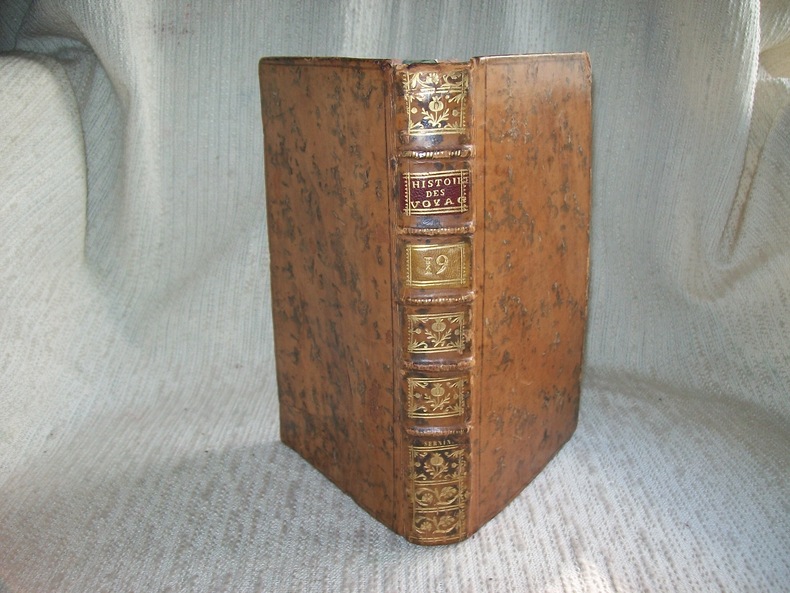
1730GITj082Paris Hôtel de Thou 1730. In-8 438pp 1 feuillet non chiffré table et errata. Pleine basane havane racinée, dos à nerfs orné de cadres de filets et fleurettes dorés, pièces de titre grenat et de tomaison tabac, tranches brique, reliure de l'époque. Orné de 4 belles gravures hors texte dépliantes dont 2 grandes. Bel exemplaire frais, complet, reliure en excellent état et décorative. TOME XIX seul contenant: nouveaux voyages dans les Mers du Sud, Byron, Carteret, Wallis, M de Bougainville, Cook. (4756)
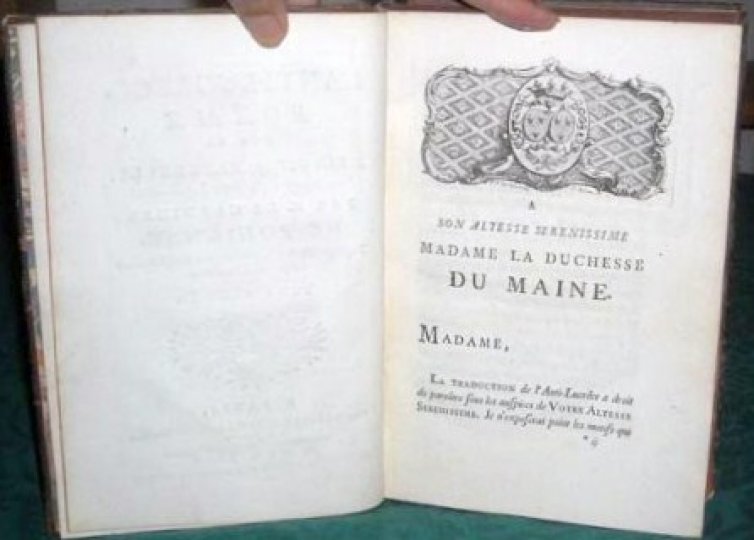
174917145Par le Cardinal de Polignac; Traduit par M. de Bougainville. Tome premier.Discours préliminaire de Bougainville. Eloge de M. le cardinal de Polignac par M. de Boze.Portrait-frontispice du cardinal de Polignac par Hyacinthe Rigaud. 5 vignettes de chapitre et 2 culs-de-lampe de Eisen.Édition originale de la traduction. A Paris, chez Desaint & Saillant 1749. lxxv et 229 pages.Reliure demi-veau marbré de l'époque. Dos à nerfs orné et doré avec pièces de titre et de tomaison maroquin rouge. Tranches rouges. Coiffe sup. manquante. Coins émoussés. Pas de rousseur. Bon état. Format in-8°(22x15).
174953946Traduit par M. de Bougainville, 1 vol. grand in-8 reliure de l'époquepleine basane mouchetée, dos à 5 nerfs orné, Desaint et Saillant, Paris, 1749, 1 f. blanc, 2 ff., 338 pp.
175162206Traduit par M. de Bougainville, de l'Académie Royale des Belles-Lettres, 1 vol. in-12 reliure pleine basane marbrée, Chez François Foppens, A Bruxelles, 1751, 3 ff., LXXIV-460 pp.
174911253A Bruxelles, chez François Foppens, 1749. 2 tomes reliés en 1 vol. in-12 (168 x 98 mm) de 1 f. bl., 3 ff. n.fol., lxxviii - 185 pp. ; [492] pp. et 1 f. bl. [pagination continue sur les 2 vol.). Reliure de l'époque de pleine basane moucheté havane, dos à nerfs orné de filets à froid, caissons d'encadrement dorés, fleurons dorés, pièce de titre de maroquin cerise, titre doré, palette dorée en tête et queue, dentelle dorée sur les coupes, toutes tranches mouchetées.
176765143368 pages & 336 pages each with different publisher's device to title page all text in French date on vol.1 printed as M. DCC. LV II. Published by Desaint & Saillant [ vol.2 Desaint ] hardcover
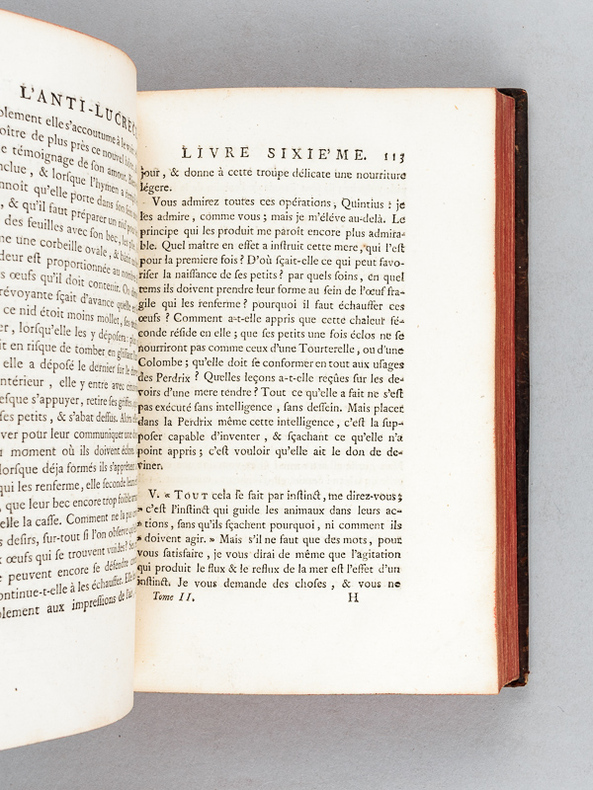
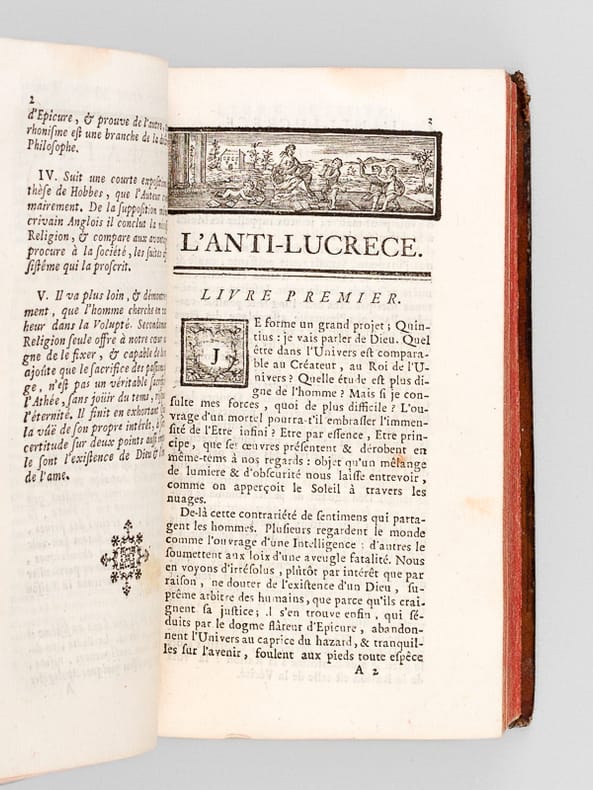
1749112531749. A Bruxelles chez FranÂois Foppens 1749. 2 tomes reliÂŽs en 1 vol. in-12 168 x 98 mm de 1 f. bl. 3 ff. n.fol. lxxviii - 185 pp. ; 492 pp. et 1 f. bl. pagination continue sur les 2 vol. Reliure de l'ÂŽpoque de pleine basane mouchetÂŽ havane dos ˆ nerfs ornÂŽ de filets ˆ froid caissons d'encadrement dorÂŽs fleurons dorÂŽs piÂce de titre de maroquin cerise titre dorÂŽ palette dorÂŽe en tÂte et queue dentelle dorÂŽe sur les coupes toutes tranches mouchetÂŽes. Edition originale de la traduction franÂaise parue concomitamment ˆ l'ÂŽdition de Paris chez GuÂŽrin. Complet des deux tomes reliÂŽs en un volume ˆ pagination continue mais pages de titre particuliÂres pour chacun. Voltaire fit l'ÂŽloge de ce texte dans Le Temple du gožt. ''Homme politique et religieux le cardinal Melchior de Polignac fut un des familiers de la cour du duc du Maine. DÂŽfenseur farouche de l'ordre ÂŽtabli de la philosophie cartÂŽsienne en particulier ainsi que de l'existence de Dieu et de l'immortalitÂŽ de l'‰me Polignac avait rÂŽdigÂŽ l'Anti-LucrÂce contre les ÂŽcrits de Pierre Bayle''. Cet ouvrage ne fut pas sans jouer un r™le certain dans la lutte philosophique de l'ÂŽpoque ; mettant en lumiÂre - tout en les combattant - la progression des idÂŽes matÂŽrialistes qui dÂŽbordaient alors le cercle philosophique et venaient concurrencer la religion. L'argumentation de Polignac quÕil pare adroitement dÕimages et expressions poÂŽtiques analogues ˆ celles de LucrÂce bÂŽnÂŽficie surtout de la connaissance ÂŽtendue quÕil avait de lÕhistoire des arts et des sciences.Ó A. Marquet QuÂŽrard VII La France littÂŽraire p. 249 - Brunet IV Manuel du libraire et de l'amateur de livres 777 - Graesse V TrÂŽsor de livres rares et prÂŽcieux p. 388. Angles ÂŽlimÂŽs; LÂŽgers frottements affectant les plats. Petite faiblesse affectant le mors infÂŽrieur du premier plat. Coiffe supÂŽrieure lÂŽgÂrement arasÂŽe. Quelques rousseurs dans le texte. Petite cerne angulaire affectant quelques feuillets. En outre petite galerie de vers affectant les fonds de cahier de quelques feuillets. Du reste bonne condition. b42961 unknown
179024539Paris MERCURE DE FRANCE 1790 -in-12 broché un journal (original d'époque), broché bleu-gris in-douze Editeur (paperback duodecimo editor)(19 x 11,5 cm), dos muet, couverture imprimée en noir, brochure d'origine non rognée, texte imprimé sur papier velin, ligné et filigrané, sans illustrations (no illustration), pagination (24ff. chiffrées de la page 121 à la page 168 et 36 ff. chiffrées de la page 229 à la page 300 ), Journal du samedi 22 Mai 1790 (n°21) Paris MERCURE DE FRANCE Editeur,
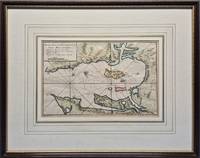
1770026738Paris: Saillant & Nyon / Delalain. 1st printing n.d. 1770. 255 x 170mm 425 x 340mm framed. Copperplate engraving with hand colour; mounted with gilt border and framed in gilt decorated wood with glass. Plate VIII in "Histoire d'un Voyage au Isles Malouines fait en 1763 & 1764". Par Dom Pernetty &c. chez Saillant & Nyon & Delalain Paris 1770 Fordham 12. Framed by The Parker Gallery London BADA. VG condition with very slight fold as issued . Very Good. No Binding. 1770. Saillant & Nyon / Delalain unknown
175442599Reliure d'époque. Dos à nerfs en maroquin avec pièces de titre et de tomaison de maroquin rouge. Tranches sanguines. Plats en veau fauve marbré avec au centre du premier plat les armes dorées de Nicolas de Livry, évêque de Callinique, dernier abbé de Sainte-Colombe de Sens, un des bienfaiteurs de l'ancienne bibliothèque de la ville de Paris. Sur le second plat : « Bibliothèque de la Ville de Paris » en lettres dorées (dite bibliothèque de l'Hôtel de Ville)..
1761127201761 LONDRES, chez Jean Nourse, 1761 - in-12 - Reliure frottée plein veau clair de l'époque - Dos lisse à caissons étoilés dorés - Toutes tranches rouges - signet - Eloge historique de l'auteur XL & 296 pages - Ex-libris armorié "Mr de Bougainville, de l'Académie Française" - Très frais
177153789Paris, Saillant & Nyon, 1771. 4to. Near contemp. hcalf. Gilt spine with gilt lettering. Very light wear along edges. Stamps on title-page. (8, incl. htitle),417,(1) pp., 20 engraved maps and charts (numb. 1-19 + 16 bis) of which 18 are folded, including the large world map. 2 engraved plates (numb. 1-2). Internally clean and fine, a few leaves with marginal brownspots.
17725814Paris, chez Saillant et Nyon, 1772. 1772 3 vol. in-8° (205 x 130 mm) de : I. [4] ff. (faux-titre, titre, épître) ; XLIII (discours préliminaire) ; 336 pp. ; II. [2] ff. (faux-titre, titre) ; 453 pp. ; [3] pp. (approbation, privilège, avis au relieur) ; III. [1] f. (faux titre) ; XVI (avertissement) ; 362 pp. ; [3] pp. (approbation, privilège) ; 3 planches et 21 cartes dépliantes (numérotées de 1 à 20, la 16 étant en deux parties). (Quelques tâches). Plein veau marbré d'époque, dos à nerfs orné, pièce de titre de maroquin rouge, tranches rouges, gardes de papier marbré. (Reliures très usées avec manques).
17728625Neuchâtel, De l'Imprimerie de la Société Typographique, 1772. 2 parties en 1 volume in-8 (191 x 116 mm), 248-(2)-297-(3) pp. Reliure demi-basane à coins, dos lisse, cachet ex-libris et cachet de bibliothèque sur page de titre, étiquette de bibliothèque partiellement conservée en pied du dos, trace de pli au dos, petit manque de papier au premier plat, minimes manques de papier à la page de titre, coins frottés, très bel état intérieur sans rousseurs.
177297781772 basane marbrée, dos à n., tr. mouchetées, cachets de séminaire (petits mq. a certaines coiffes) vol. in-8, T I:(4ff.), XLIII-336pp. ; T II: (2ff.), 453pp., (1f.) 3 planches et 21 cartes depl., P. Saillant et Nyon 1772,
1771102382Paris, Saillant & Nyon, 1771, in-4, [8]-417-[3] pp. 23 pl, Veau raciné havane, frise dorée en encadrement sur les plats, dos long orné de frises et fleurons dorés, pièce de titre rouge, Édition originale illustrée de 20 planches géographiques (dont les cartes du trajet des vaisseaux autour du monde, des îles Malouines, du détroit de Magellan, des terres de la Nouvelle-Guinée), et de 3 planches de figures représentant des embarcations d'indigènes du Pacifique. En 1766, Bougainville est chargé de remettre aux Espagnols les îles Malouines, terres dont il avait pris possession au nom du roi de France lors d'un précédent voyage en Amérique du Sud en 1763-1764 (la relation de cette expédition est racontée par Pernetty, dans son Histoire d'un voyage aux îles Malouines fait en 1763 et 1764, publiée en deux vol. à Paris, en 1770). A bord de la frégate La Boudeuse, il quitte le port de Nantes en novembre 1766, relâche à Brest, puis atteint Montevideo au début de l'année suivante. En avril 1767, il livre l'établissement français des îles Malouines à la Couronne espagnole. Sa mission remplie, Bougainville se dirige ensuite à Rio de Janeiro où il rejoint L'Etoile au mois de juin. En 1767, les deux navires s'aventurent dans l'océan Pacifique pour retourner en Europe. C'est au cours de cette traversée que Bougainville explore Tahiti (1768), dont il laissera une image paradisiaque (se promenant à plusieurs reprises dans l'intérieur de l'île, le navigateur écrira dans sa relation: "Je me croyais transporté dans le jardin d'Eden"). L'expédition rentre en France en 1769, rapportant de précieuses informations sur Tahiti et ses habitants (notamment un vocabulaire tahitien), ainsi que sur la géographie de l'Océanie. Lors de sa parution le récit de Bougainville connut un immense succès; considéré comme l'ouvrage d'un humaniste, il entretiendra longtemps le mythe du paradis polynésien. Manques à la reliure, quelques taches et rousseurs éparses. Couverture rigide
177182474Chez Saillant & Nyon | Paris 1771 | 19 x 26 cm | relié
177153789Paris Saillant & Nyon 1771. 4to. Near contemp. hcalf. Gilt spine with gilt lettering. Very light wear along edges. Stamps on title-page. 8 incl. htitle4171 pp. 20 engraved maps and charts numb. 1-19 16 bis of which 18 are folded including the large world map. 2 engraved plates numb. 1-2. Internally clean and fine a few leaves with marginal brownspots. <br/><br/><em>First edition of this famous circumnavigation being the first voyage around the world with professional naturalists and geographers onboard. Bougainville was the first Frenchman to sail around the world. In 1771 Bougainville published his travel log from the expedition under the title "Le voyage autour du monde par la frégate La Boudeuse et la flûte L'Étoile". The book describes the geography biology and anthropology of Argentina then a Spanish colony Patagonia Tahiti and Indonesia then a Dutch colony. The book was a sensation especially the description of Tahitian society. Bougainville described it as an earthly paradise where men and women lived in blissful innocence far from the corruption of civilisation.Bougainville's descriptions powerfully expressed the concept of the noble savage influencing the utopian thoughts of philosophers such as Jean-Jacques Rousseau before the advent of the French Revolution. Denis Diderot's book Supplément au voyage de Bougainville retells the story of Bougainville's landing on Tahiti narrated by an anonymous reader to one of his friends. Diderot used his fictional approach including a description of the Tahitians as noble savages to criticise Western ways of living and thinking.Sabin 6864. </em> unknown