McKINLAY, JohnBiblio.com
442 résultats
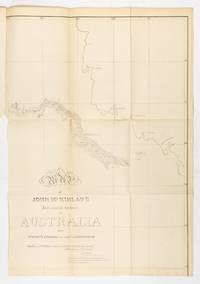
1862140416Adelaide: W.C. Cox Government Printer 1862. First Edition. Hardcover. Very Good. Adelaide W.C. Cox Government Printer 1862 first edition. Foolscap folio drop-title 56 pages plus 4 large folding maps respective maximum sheet sizes and printed surface areas are 754 × 545 mm and 739 × 521 mm; 757 × 545 mm and 724 × 520 mm; 756 × 542 mm and 730 × 517 mm; and 758 × 556 mm and 724 × 525 mm. Recent cloth lettered in gilt on the front cover; maps lightly foxed in a few spots with a few tiny tears expertly sealed and a few tiny chips to some top and leading edges; an excellent copy. South Australian Parliamentary Paper Number 12 of 1862. The earliest printing of McKinlay's journal of his Burke and Wills Relief Expedition and a rarity. 'The South Australian House of Assembly chose John McKinlay to lead the South Australian relief expedition in August 1861. Setting out from Kapunda with a well-equipped party he reached Cooper's Creek in October. From his depot at Lake Buchanan he made numerous excursions into the surrounding country and found what he believed to be the grave of one of the Burke party. Coming to the conclusion that all of Burke's men had died he sent back for instructions. When his instructions arrived he learned that Howitt had already discovered King and that Burke Wills and Gray were indeed dead. <p>McKinlay proceeded to examine the land to the north of Lake Eyre discovering much useful pastoral and grazing land. In December he set out for the Gulf of Carpentaria to rendezvous with the Northern Relief Expedition under Commander Norman. His crossing was made difficult by diminished stores and his position was critical in May 1862 when he arrived with his men at the Albert River where he expected to find relief only to discover that the "Victoria" had already sailed. Sensibly he decided to make for the Queensland coastal settlement at Port Denison 500 miles to the east. After a difficult trip of over three months McKinlay brought all his men into Port Denison by the end of August. <p>When he reached Adelaide in October 1862 McKinlay handed his journal to the South Australian Government. It was printed soon afterwards in the South Australian parliamentary papers. The text of his journal was later published for general distribution in the colonies by two Melbourne publishers' Wantrup. <p>Only the first public account published by Baillière in 1863 contained maps 'three large folding maps loose in a back endpocket' but it is 'virtually unprocurable in fine clean condition owing to the poor quality of the paper used' Wantrup. This first edition large-format parliamentary paper is far superior in every respect. McLaren 12963; Wantrup 2023 pages 317-18. W.C. Cox, Government Printer hardcover
1880104852Adelaide: Goodfellow & Hele almost certainly the Author - James Dally was convinced 1880. First Edition. Hardcover. Very Good. Adelaide Goodfellow & Hele almost certainly the Author - James Dally was convinced 1880. Octavo 182 30 advertisements pages plus 6 lithographed plates of farm machinery by James Martin & Co. and 17 albumen paper carte-de-visite photographs individually mounted on tipped-in captioned leaves. Blind-decorated maroon cloth lettered in gilt on the front cover with a later gilt-lettered cloth title-label along the spine originally untitled; cloth a little flecked slightly sunned on the spine and a little rubbed and bumped at the extremities; some mounts lightly cockled as ever a production flaw; a few trifling signs of use; basically an excellent copy internally fine with the photographs in superb condition. A rare and desirable item attested to by the provenance of this copy: it has the armorial bookplate of Charles Glover on the pastedown and the blind-stamp of Sir Thomas Ramsay on the flyleaf 'T.M.R. Library of T.M. Ramsay'. Ferguson 11744; Holden 70. Holden's entry is more accurate and informative although the photographs may vary slightly between copies. The photograph facing page 16 in this copy is a portrait of Dr Nott rather than 'Frankel's Hotel' as called for in Holden facing page 17. Two other photographs are less-common variant images of the same subject: these are 'Fotheringham's Cordial Factory' facing page 57 and 'Stewart's Music Emporium' facing page 96. These variations notwithstanding two separate editions were produced: one in wrappers with advertisements on the verso of the front cover and on both sides of the rear cover without photographs but with the lithographs not noted by Ferguson; the other in gilt-lettered cloth without the cover advertisements containing 17 mounted photographs plus the lithographs. Both contain 30 pages of advertisements at the rear. <p>Rare in any state and in our view the version on offer is one of the more important and interesting photographically illustrated books produced in Australia. 'The handbook is illustrated with a number of views by Mr J. Taylor the local photographic artist representing the most important edifices and establishments in town' Holden quoting a contemporary review. The frontispiece is a portrait of John McKinlay 1819-1872; there are 14 pages devoted to him he married a Gawler woman in the early 1850s and was based in the town until his death. Justice is not done to the other photographs in describing them prosaically as 'the most important edifices and establishments in town'. Without exception signs of life and day-to-day activities flesh out the images and most of the businesses - butcher shop photographic studio cordial factory furnishing warehouse music emporium - feature well-stocked windows or yards and numerous staff members or customers. Holden reproduces two interesting ones including perhaps the best the butcher shop captioned merely 'Hodgson & Clements' but there are wonderful vignettes in many others. Not least of these are the horse-drawn tram in front of the 'Commercial Bank' and the ornate hearse outside 'F. Fowler's Furnishing Warehouse'. <p>While we are on the subject of death one chapter stands out. Among those to be expected say on 'Horticultural and Agricultural Progress. Gardens around Gawler' or 'The Humbug Society. Flam! Bam! Sham!' or 'The Streets - Number of Businesses - Description of Hotels' there is Chapter XI: 'The Neville and Adamson Tragedy'. Its thirteen pages describe in great detail the events surrounding the double suicide 'and its romantic accomplishment' of Neville and his partner Adamson. 'It is universally believed that Neville was the leading spirit in the suicide and so strong was Adamson's affection love friendship or whatever it may be termed for his companion that he consented to take that final leap in the dark in the wine cellar with him to visit that "bourne whence none return"'. Goodfellow & Hele [almost certainly the Author - James Dally was convinced] hardcover
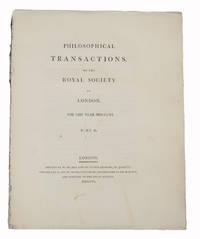
180645128London W. Bulmer and Co. 1806. 4to. No wrappers as extracted from "Philosophical Transactions" 1806 - Part II. Pp. 239-268. Having also the titlepage to the volume Part II 1806. A faint bit of soiling to outer right margin of the first 2 leaves otherwise clean and wide-margined. <br/><br/><em>First printing of this important paper relating Flinder's observations on the ship "Investigator" when exploring the coast of Australia. IN THE PAPER THE NAME "AUSTRALIA" APPEARS PROBABLY FOR THE FIRST TIME IN A SCIENTIFIC MEMOIR p. 247.The name Australia was popularised by Matthew Flinders who pushed for the name to be formally adopted as early as 1804. When preparing his manuscript and charts for his 1814 A Voyage to Terra Australis he was persuaded by his patron Sir Joseph Banks to use the term Terra Australis as this was the name most familiar to the public. Flinders did so but allowed himself the footnote:"Had I permitted myself any innovation on the original term it would have been to convert it to Australia; as being more agreeable to the ear and an assimilation to the names of the other great portions of the earth." In the paper offered he used the name "Australia" as early as 1806."Captain Matthew Flinders RN 16 March 1774 - 19 July 1814 was one of the most successful navigators and cartographers of his age. In a career that spanned just over twenty years he sailed with Captain William Bligh circumnavigated Australia and encouraged the use of that name for the continent which had previously been known as New Holland. He survived shipwreck and disaster only to be imprisoned for violating the terms of his scientific passport by changing ships and carrying prohibited papers. He identified and corrected the effect upon compass readings of iron components and equipment on board wooden ships and he wrote what may be the first work on early Australian exploration A Voyage to Terra Australis."Wikepedia </em> unknown
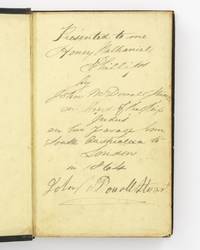
1860135299London: George E. Eyre and William Spottiswoode 1860. First Edition. Hardcover. Very Good. London George E. Eyre and William Spottiswoode 1860. 'Small pica 16mo' unpaginated. Original full morocco all edges gilt; leather a little rubbed at the extremities with a small glass-ring on the front cover; some foxing throughout; mild signs of age and use including a dried sprig of maidenhair fern loosely inserted at one opening; in very good condition. The front free endpaper is signed by John McDouall Stuart at the foot of the following inscription: 'Presented to me Henry Nathaniel Phillips by John McDouall Stuart on board of the Ship "Indus" on her pasage sic from South Australia to London in 1864'. <p>Written on the verso in another hand is '"Ask and it shall be given you". Matt 7th - 7.v'. The book has the contemporary blindstamp of the Adelaide booksellers W.C. Rigby 53 Hindley St Adelaide on the top corner of the rear free endpaper. We would like to think the book was purchased in Adelaide inscribed with a most apposite Biblical text and given to Stuart prior to his departure from Adelaide in late 1861 on his ultimately successful sixth expedition across the continent and back. However in many ways it was a Pyrrhic victory: 'Ill with scurvy and nearly blind Stuart had to be carried on a stretcher slung between two horses; recovering sufficiently to ride by the time they reached Mount Margaret on 26 November he pushed on with three of the party and arrived in Adelaide on 17 December 1862. On a public holiday on 21 January 1863 crowds lined the streets amid banners strung from buildings. He was awarded £2000 though allowed only the interest from it and his party received £1500 between them. <p>White-haired exhausted and nearly blind Stuart decided to visit his sister in Scotland and sailed in April 1864. He later went to London. His claims for a greater reward from the South Australian government led to another £1000 again with only the interest. His "Explorations in Australia. The Journals of John McDouall Stuart" was edited by W. Hardman and published in 1864. <p>He died of ramolissement and cerebral effusion on 5 June 1866 aged only 50 in London and was buried in the Kensal Green cemetery. He has remained a lonely and independent figure with a fierce pride. His reputation as a heavy drinker has led detractors to minimize his achievements even to the extent of doubting that he reached the Indian Ocean in 1862' 'Australian Dictionary of Biography'. Surprisingly apart from this singularly personal gift from Stuart Henry Nathaniel Phillips has left no other trace of his existence that we can find. George E. Eyre and William Spottiswoode hardcover
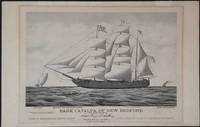
187623907Boston: Forbes Lith. Mfg. Co. 1876. First edition. This scarce tinted lithograph was issued to commemorate the escape of Irish political prisoners from Fremantle W.A. on April 17th 1876. The Fenians are shown rowing towards the bark which is under full sail. The Catalpa is flying a flag with the initials "J T R" - for John T Richardson the ship's agent. A pennant with the letter C the Fenian flag and the American flag are also flying. <br /> <br /> The police boat is in hot pursuit and the British steamship "Georgette" is steaming in from a distance. Among the Fenians freed in this effort was John Boyle O'Reilly who became a leading citizen in Boston and was later to edit the 'Boston Pilot'. <br /> <br /> Captain George Anthony an American whaling captain out of New Bedford Massachusetts recruited a crew for this mission and set sail for Western Australia where two Fenian agents John Breslin and Tom Desmond had already established themselves with aliases. With several delays the day for the escape was set for the 17th of April when most of the convict garrison was distracted by watching the Perth Yacht Club regatta.<br /> <br /> Captain Anthony who refused to surrender the escaped prisoners to the British later sold his story to Zephaniah W. Pease who published the account in 'The Catalpa Expedition'. See also Laubenstein 'The Emerald Whaler'.<br /> <br /> On its arrival in New York in August of 1876 the Catalpa was met with great crowds; jubilant celebrations were held in the US and Ireland.<br /> <br /> 17 x 13" on paper 22 x 14 1/4". For information on the artist E. N. Russell see Blasdale Artists of New Bedford pp 160-161; Kendall Prints 28; Ingalls 318. OCLC: 191908718 1 copy at the Boston Athenaeum. Trove 45254 at the Australian National Maritime Museum; and 57714676 at the State Library of Western Australia. Professionally deacidified. In very good condition. <br /> <br /> A rare print important for its depiction of an important Western Australian colonial event. Forbes Lith. Mfg. Co. unknown
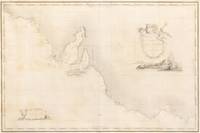
1812133915Paris: Imprimerie Royale 1812. Very Good. Paris Imprimerie Royale 1812 second issue/ 1811. An engraved map 'Gravé par P.A.F. Tardieu . Ecrit par Giraldon et Lale' matted framed and glazed visible image size surface 510 × 760 mm; external dimensions approximately 725 × 980 mm. Vertical centrefold crease as issued; paper a little tanned with some offsetting and a few spots of foxing; in excellent condition not examined out of the frame. One of the earliest published charts of the South Australian coastline compiled by Louis de Freycinet on the Baudin voyage 1800-1803. It includes the complete coastline of Kangaroo Island which was first circumnavigated and fully charted by the French on this voyage Matthew Flinders had charted its north coast a short time previously. The charming engraved vignettes of Australian wildlife are after drawings by Charles Alexandre Lesueur. <p>This example is from the scarce second issue published as Plate 10 of the imperial folio atlas to the 'Partie navigation et géographie' volumes of the official account of the expedition 'Voyage de découvertes aux terres australes' 1812. It had previously appeared as Plate 2 in the second part of the atlas to the 'Historique' volumes published in 1811 Tooley 611. Tooley does not appear to list this issue but does list a subsequent state twice as 414 and 633 which includes a price at the bottom right and the reference 'Hyd. Fr. N° 636' next to the plate number. Imprimerie Royale unknown
184625916Paris: French Admiralty chart 1846. Very rare early map of the south west coast of Western Australia just 17 years after the founding of the colony. The map covers much of the Western Australian coast from the Dampier Archipelago in the north Broome Exmouth Gulf Shark Bay Perth Geographe Bay Cape Leeuwin Albany all the way to Port Lincoln in South Australia. To our knowledge the only copy held in an Australian institution is at the State Library of Western Australia. It is not recorded in the collection of National Library of Australia collection nor other Australian institutions.<br /> <br /> It is very interesting for the early inland detail. The areas around Perth and Fremantle are shown extending inland to Beverley York Bejoording Toodjoy and Northam on the Swan River with the Swan Avon & Moore Rivers.<br /> <br /> There are 4 insets: Plan de la entree de la Riviere Cygnes Swan River et de l'Ile Rottnest J. L. Stokes; Plan de Port Grey nomme aussi Baie Champion Captain Wickham Plan du Havre Peel dans la Baie Warnbro Lieut. J. S. Roe Plan de la Baie Warnbro J.S. Roe. Coastal features include Baie de l'Esperence; Houtmann's Abrolhos; Albany north east of Albany a mountain described as "Montagne escarpee visible a 10 lieues"; Golfe Exmouth with a prominent Cape Nord Ouest. Depth soundings are taken all around the coast. <br /> <br /> Daussy maps are rare. The State Library of Western Australia holds two. Their copy of this map bears the "Prix deux francs" lower right; with an applied printed chart sellers label from P. Sauvat Bordeaux below the rule on the lower right. They also hold the following: "Carte des mers Australes partie comprise entre les méridiens du Cap de Bonne Espérance et du Port du Roi Georges" cartographic material / dressée par M. Daussy Ingénieur Hydrographe en Chef ; gravé par Jacobs ; écrit par J.M. Hacq. MAPR0000018. This map is recorded as Tooley 1470 and Libraries Australia ID 23501679 which calls it "Rare". <br /> <br /> Centered below the margin - Ecrit de J. M. Hacq Grave par Jacobs lower left Noo. 1111 in upper right margin. Printed area 34.5 x 23.25" with very large margins 40 1/4 x 27 1/2". Backed with tissue on the center fold and margin edges supporting some small closed tears. <br /> <br /> In magnificent condition overall. An extremely rare map especially in this condition. French Admiralty chart unknown
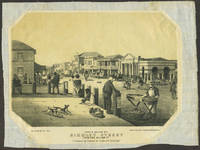
185128279Adelaide: Penman & Galbraith 1851. Print. An extraordinarily rare set of four of S. T. Gill's Adelaide views no. 1-3 i.e. Views in Adelaide No. 1. Hindley Street from King William St.; No. 2. Hindley Street Looking East; No. 3 Rundle Street Looking East; with a variant second copy of No. 3 which is black & white. The images are held at the Art Gallery of South Australia; the State Library of New South Wales the National Library of Australia and some a the City of Adelaide. There are tinted lithographs some with a tinted border others not and black & white lithographs as well. The street images appear to be the same in all the recorded prints consistent with these four- there are some minor variations which are noted. The three tinted lithographs are mounted on polished cloth. The period cloth mounting is unusual. It is not known if these were a reference set or perhaps proofs.<br /> <br /> Views in Adelaide No. 1./ Hindley Street from King William St./ Published by Penman & Galbraith Adelaide/ On Stone by S. T. Gill/ Printed by Penman & Galbraith/ Signed in the stone S T G 1851. Tinted plate with no tinted border outline. Image 17.5 x 22.5 on paper 18 x 23.5 cm. AGSA 684G11; SLNSW nmQdoR5n. SLNSW image has tan border outline this copy does not. Mounted on cream cloth trimmed outside the catty corners with margins.<br /> <br /> Views in Adelaide No. 2./ Hindley Street Looking East/ Published by Penman & Galbraith Pirie St. Adelaide./ On Stone by S. T. Gill/ Printed by Penman & Galbraith/ Signed in the stone S T G indistinct date. Tinted plate with a faint tinted border outline. Image 18 x 23.1 cm on paper 18.3 x 24 cm. AGSA 684G12; SLNSW 9PQ8kDxn; Nat Lib ID 7566602 Rex Nan Kivell Collection NK3544/B. Slt. foxing on left lower margin. Mounted on saffron cloth trimmed outside the catty corners with margins.<br /> <br /> Views in Adelaide No. 3/ Rundle Street Looking East/ Published by Penman & Galbraith Pirie St. Adelaide./ On Stone by S. T. Gill/ Printed by Penman & Galbraith/ Signed in the stone S T G 1851 S inverted. Tinted plate with tinted border outline. Image 18 x 22.8 on paper 18.2 x 23.4 cm. AGSA B 2430; SLNSW Yj7djR39 for 3 print set which is colored and without border outlines. Mounted on saffron cloth trimmed outside the catty corners with margins.<br /> <br /> Views in Adelaide No. 3/ Rundle Street Looking East/ Published by Penman & Galbraith Pirie St. Adelaide./ On Stone by S. T. Gill/ Printed by Penman & Galbraith/ Signed in the stone S T G 1851 S inverted. Black and white plate with no tinted border outline. Image 18 x 22.2 on paper 20.9 x 25.8 cm. AGSA B 2430; NLA Lib ID 7566601 Nan Kivell NK3544/C. Printed on cream paper some watermarks.<br /> <br /> A rare set of images by one of the master artists of this period in Australia. Penman & Galbraith unknown
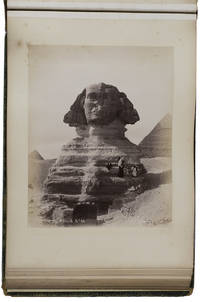
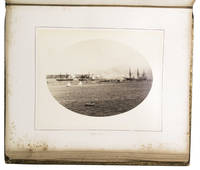
1895ABC_475631895. Oblong folio 28 x 39 cm. Contemporary gold-tooled black morocco gilt edges. With 58 photograph prints ca. 21 x 25.5 to 13.5 x 20 cm. Mounted on both sides of the leaves in the album. 60 pp. The album contains 15 silver albumen photographs of Melbourne taken mainly from the series C. Rudd's new views of Melbourne 1886-1887 by Charles Rudd 1849-1901. They show Collins Street Melbourne town hall the public library Parliament House the Court of Law Government House and various other buildings and infrastructure as well as botanical gardens such as Fitzroy Gardens. The photographs of Sydney were the work of the renowned Australian photographer Henry King 1855-1923 born in England in 1855 who emigrated to Australia with his family in 1856. He worked as a photographer at J. Hubert Newman's studio in Sydney before opening his own studio in 1880. King gained recognition for his photographic studies of Australian Aboriginal people and his scenic views of Sydney. He died in 1923 leaving behind his wife son and three daughters. His glass negatives were acquired by J.R. Tyrrell after his death and are now held by the Powerhouse Museum. King is one of Australia's most significant early photographers. The album contains seventeen of Kings photographs of the harbour including Farm Cove and the Circular Quay Government House and interior and exterior photographs of the town hall King and George Street the Mutual Life Association Building the General Post Office and the Ferner Botanical Garden. Rural New South Was appears in nine photographs including images of Illawarra National Park the Hawkesbury River and a series of outdoor photographs taken along the coast at Blackwall and dated July 1895.This curious album of 58 photographs from France Egypt and most importantly Australia opens with a section with six photos from Marseille showing street views the city harbour the Avenue du Prado and the castles.The ten photographs from Egypt depict both the cultural highlights of the country such as the Pyramids the Sphinx the Citadel of Cairo and the Palace of Gizeh as well as ordinary Arabian villages and street scenes. They stemmed from the ateliers of the Abdullah brothers of Constantinople. The Abdullah Frères namely Viçen 1820-1902 Hovsep 1830-1908 and Kevork 1839-1918 Abdullahyan were three Ottoman brothers of Armenian heritage who gained international fame as photographers during the late Ottoman Empire. Some evidence suggests that he may have collaborated with the Zangaki Brothers and he may have been the official photographer for the Universal Company of the Suez Canal. Later he worked in partnership with the British-Italian photographer Antonio Beato.With an owners inscription in pencil "a appartenu Alfred Schmid" some photographs are captioned in black ink or pencil detailing the places. With a small label from the bookshop that sold the album: "Papeterie Sauwen-Jehotte" in Antwerp. The edges are somewhat bumped and some browning and foxing throughout. Otherwise in good condition. unknown
1885ABC_49517Australia 1885. Folio ca. 44 x 36.5 cm. Contemporary gold-tooled black morocco with the title lettered in gold on the front gold-tooled turn-ins gilt edges watered-silk end papers. With 65 albumen prints. 29 ll. Late 19th-century photo album with views of New South Wales. The album contains 65 albumen prints of highlights in the region primarily in Sydney and the Blue Mountains. It was bought by the civil engineer Clément van de Velde dates unknown who was born in Belgium and moved to Australia in 1884 where he attempted to set up a sugar-beet industry. He also served as the vice-consul for Belgium. He gifted the album to his friend Cobus in 1885 possibly as a keepsake for a trip they undertook together.At least a third of the photographs show important buildings and other landmarks in Sydney including the Government House the Town Hall the General Post Office the Australian Museum the different colleges of the University of Sydney the Department of Lands building and the public library in Bent Street that has been demolished in 1967. Most of these buildings were relatively new at the time these photographs were taken. Also included are photographs of Hyde park and the Captain Cook monument the Man O'War steps Argyle cut Mrs Macquarie's Chair and the botanic gardens. The other photographs in the album show the towns and nature surrounding Sydney such as the Katoomba Falls the Three Sisters Govetts Leap and Mount Victoria in the Blue Mountains the Zig Zag railway the Fitzroy Falls Fort Denison Broken Bay various views of the Nepean River as well as four portraits of Australian Aboriginals.With a contemporary French inscription on the verso of the first flyleaf "Mon cher Cobus Je prie de vouloir accepter cet album en souvenir de nos bons rapporte. Votre dévote Clément van de Velde. Sydney 10 may 1885.". The binding has been professionally restored the boards are somewhat scratched and dented. The leaves are warped and foxed the lower corners of some of the leaves are torn without affecting the photographs the photographs have somewhat discoloured. Otherwise in good condition.l Cf. McLennan N. T. "Henri van de Velde 1878-1947" in: Australian Dictionary of Biography 16 2002. hardcover
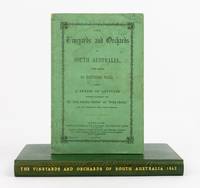
1862140418Adelaide: Printed and published at the 'Advertiser' and 'Chronicle' Offices 1862. First Edition. Paperback. Very Good. Adelaide Printed and published at the 'Advertiser' and 'Chronicle' Offices 1862. Octavo 78 xxii advertisements pages plus advertisements on both sides of the rear wrapper. Original green wrappers with the title page details repeated within a different border on the front cover; wrappers a little marked and creased with some slight wear at the corners affecting also the bottom corner-tip of the last few leaves; spine a little cracked but sound with minimal loss at both ends; minor signs of age and use but overall an excellent copy of a rarity seldom found in any condition - let alone as pleasing as this - now housed in a fine mid-green morocco Solander box by Sangorski & Sutcliffe. Descriptions 'are given of most of the most important vineyards and of some of the less important of them having due regard to age extent and quality of produce. South Australia will without doubt become one of the most important Wine countries of the world. The experiments of the past twenty years have proved the advantage of its soil and climate and enough practical knowledge has been acquired to enable its Vignerons to guard against the common errors which so frequently produced discouragement in the earlier days of the Colony'. The original articles are here supplemented 'by revision and some trifling annotations'. <p>Ferguson 18189 noting only green cloth boards. Printed and published at the 'Advertiser' and 'Chronicle' Offices paperback
1899111095London: Macmillan and Co. Limited 1899. Very Good. London Macmillan and Co. Limited 1899. Octavo xx 671 pages with 12 unnumbered line illustrations of churingas a map and 130 illustrations mainly after photographs plus 2 folding maps 3 folding charts 4 folding chromolithographic plates and an erratum slip tipped in at page 1 noting that on page 570 the tassel should be 'pubic' not 'public'. Olive-green gilt-pictorial buckram a little flecked and rubbed with the spine a little sunned; all edges uncut; scattered light foxing; minimal chipping to some uncut leading edges; an excellent copy. The head of the title page is signed in ink by both authors as 'W. Baldwin Spencer' and 'F.J. Gillen'. Inscribed in indelible pencil before the signatures in an unknown hand is 'With Kindest Regards from'. <p>The 'Australian Dictionary of Biography' makes short work of the significance of the book and by extension this signed copy in its entry on Sir Walter Baldwin Spencer 1860-1929: 'The 1894 Horn scientific exploring expedition to central Australia recruited Spencer as zoologist and photographer. Because of friction between members and their sponsor Spencer later combined mediation with editorship of all four volumes of reports. His own seminal contribution included his classic biogeographic interpretation of Australian faunal distribution. This expedition rekindled his anthropological interest when he met F.J. Gillen the Alice Springs postmaster Francis James Gillen 1855-1912 ethnologist. What began as his offer to assist in publishing Gillen's ethnological notes matured into an enduring partnership and a landmark in anthropological history. <p>In 1896 Spencer joined Gillen for the most intensive field-work then attempted in Australia. "The Native Tribes of Central Australia" 1899 which resulted was to influence contemporary theories on social evolution and interpretations of the origins of art and ceremonial. It impressed Sir James Frazer author of "The Golden Bough" who developed a lifelong friendship with Spencer'. Macmillan and Co. Limited unknown
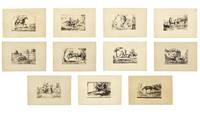
1864142931Adelaide: The Author 1864. Fine. Adelaide The Author 1864. Eleven albumen paper photographs approximately 88 × 134 mm mounted on the recto of individual cards approximately 165 × 240 mm neatly captioned below the plate with the title at the head of the first one with all captions by George Hamilton himself. A few light spots and marks to some of the cards; essentially in fine condition with the photographs uniformly rich in colour. The Art Gallery of South Australia has all 11 original artwork - pen and ink with wash - in its collection. The 'Adelaide Observer' on Saturday 27 August 1864 contains a review of Hamilton's recently self-published book 'a well-conceived well-written neatly-printed and elegantly-illustrated brochure under the above title'. It describes at length the illustrations '11 in number photographed from the author's drawings by Colonel Biggs Mr. Baines and Professor Hall and they bear ample evidence of the artistic taste as well as the correct judgment displayed in the spirited originals'. <p>Robert Holden 'Photography in Colonial Australia. The Mechanical Eye and the Illustrated Book' 1988 describes this book and one other Molesworth Jeffrey's 'Various Exercises and Fragments in Metre by Divers Authors' Hobart 1864 as being the 'first recorded use of original photographs as illustrations in commercially produced and dated books' in Australia. His descriptive bibliography records that the published work indeed contains 'Photographs of eleven drawings . by Colonel Briggs sic from rough sketches by the author. It would appear that these images were printed eleven to a sheet and then arranged in random order throughout the text'. His collation of the three copies in the State Library of South Australia indicates the individual print sizes range from 20 × 35 mm to a maximum of 40 × 60 mm. <p>The present offering clearly predates the published use of these images and its presentation is much to be preferred. The first and most obvious difference is the superior size and quality of the prints. However the captions greatly enhance the images; when they are read and viewed in the intended order numbers 1-11 are lightly pencilled in the top right-hand corner of the cards this becomes a proto-photobook of the highest order . and far from being a prosaic account of how to look after a horse as the title might suggest it is a searing indictment of the widespread ill-treatment of horses. 'Mr. Hamilton proceeds with pen and pencil to describe and portray some of the trials a horse has to undergo from the time his liberty is first invaded in the bush until in the last scene of all that ends this painful history he is reduced to the drudgery of a hackney car'. <p>See Ferguson 10180b and 10181a; Holden 50 and 51 plus pages 13-21. Both bibliographies contain errors. 11 items. The Author] unknown
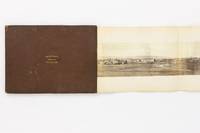
1866141595Adelaide: Townsend Duryea 1866. First Edition. Hardcover. Adelaide Townsend Duryea circa 1866. A photograph album 254 × 340 mm containing a magnificent panorama of Adelaide comprising five roughly uniform albumen paper photographs mounted as issued slightly overlapping to form a continuous image 124 × 880 mm on a linen-backed card mount 244 × 951 mm folded into three plus 12 albumen paper photographs nine of them around 130 × 200 mm or the reverse one 130 × 172 mm and the last two approximately 220 × 285 mm mounted on the rectos of stiff card leaves. Original russet pebble-grain cloth lettered in gilt on the front cover; cloth slightly flecked with minor wear to the extremities; endpapers foxed with slight loss to silverfish and the rear free endpaper is missing; leading edge ribbon ties appear never to have been inserted; mounts lightly cockled and occasionally lightly spotted and foxed; bottom margin of the final mount lightly stained with trifling loss to silverfish; minimal signs of age and use; overall a very pleasing copy with the photographs - and in particular the stunning panorama - in uniformly fine condition. The twelve individual photographs are captioned in pencil on the mounts: 'View in botanical gardens - showing Asylum' 'View in Botanical Gardens' 'View in Gardens' five captioned simply 'Botanical Gardens' 'Bridge between N & S Adelaide' 'near Willunga' and two captioned 'Willunga' both superb large-format prints. <p>New York-born Townsend Duryea 1823-1888 emigrated to Australia Melbourne in 1852 and commenced work as a photographer the following year. In 1855 he relocated his studio to Adelaide. By the early 1870s Duryea's panoramas royal portraits and prizes won in Society of Arts photographic competitions had made him famous 'Australian Dictionary of Biography'. Much more detail on Duryea may be had from the lengthy article in Joan Kerr's 'Dictionary of Australian Artists . to 1870'. However the panorama in this album is not the one described in Kerr 'a fold-out 360-degree panorama of Adelaide taken from the tower of Adelaide Town Hall in 1865 was the album's major feature' nor is it the larger panorama 'taken from the top of the GPO tower soon after it was completed in 1870'. The present panorama is taken from a local rise in North Adelaide and sweeps left to right from the hills towards the sea. All of these panoramas are very rare indeed not least because 'Duryea's studio and enormous collection of glass-plate negatives stated to number 50 000 were destroyed by fire in 1875'. This catastrophe effectively ended Duryea's career as a photographer. It must assuredly account for the genuine scarcity of material by Duryea on the open market other than bread-and-butter carte de visite portraits. <p>This album is very rare in our experience and if the available records are any guide for long before we came on the scene in the mid-1970s. Although this is the fourth example we have handled it is also only the fourth one we have seen on the open market in that time. We have inspected three other examples in institutions; all seven copies are bound similarly and contain the same panorama. However the balance of the contents varies in quantity and image selection in each instance. <p>Duryea began to advertise these albums in Adelaide newspapers in August 1866. One such from the 'South Australian Register' for 28 August 1866 reads: 'DURYEA'S VIEW ALBUMS. These Albums are neatly bound in cloth and form a beautiful acquisition either for the drawing-room table or transmission home. A PANORAMIC VIEW of the CITY of ADELAIDE and the SUBURBS three feet in length has been introduced as a Frontispiece; and as a further advantage purchasers have the privilege of choosing Photographs from a large Album containing 90 of the most interesting and picturesque Views of Adelaide and the Country. The above are open to the inspection of the public at Mr. Duryea's Studio 66 and 68 King William-street. Any of the Views mentioned above can be had separately. Photographs of Gentlemen's Country Seats Business Offices Shops &c. taken at the shortest notice by Ross's Improved Wide Angle Lens'. <p>Provenance: Edwin Ashby 1861-1941 South Australian property developer and naturalist; by descent. While Ashby was obviously not the first owner of this album its numerous images of the Botanical Gardens must have appealed to him. The fine gardens he established at his property 'Wittunga' at Blackwood in the Adelaide hills after the turn of the century were later donated to the State by his heirs and are now the Wittunga Botanic Garden. Townsend Duryea hardcover
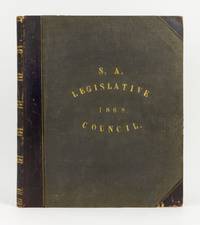
1868142860Adelaide: Townsend Duryea 1868. First Edition. Hardcover. Very Good. Adelaide Townsend Duryea 1868. A large quarto album approximately 415 × 365 mm containing 18 albumen paper portraits each approximately 280 × 210 mm mounted on the rectos of cloth-hinged thick card leaves interleaved with guards plus one leaf of letterpress see below. Contemporary half roan and cloth lettered and tooled in gilt with a binder's ticket on the front pastedown 'Bound at the "Register" Office Grenfell Street Adelaide'; covers slightly worn; leaves slightly cockled; one guard missing; most photographs lightly discoloured near the right-hand edge; a few light spots of foxing mainly to the guards and the versos of the mounts and some minor signs of age and handling but overall in excellent condition. The subjects include some of the most prominent figures in early colonial South Australia. In order of appearance the portraits depict John Morphett President Henry Ayers Charles Hervey Bagot John Henry Barrow Charles George Everard John Baker William Wedd Tuxford Thomas Elder William Peacock William Morgan Thomas Hogarth John Tuthill Bagot Thomas English Henry Mildred John Crozier William Parkin John Hodgkiss and Emanuel Solomon. <p>The 'South Australian Advertiser' for 20 August 1868 records that: 'Mr. Duryea is preparing a parliamentary group containing the members of both Houses of the Legislature which promises to be an effective affair. The members of the Council have already given him sittings and a fine series of portraits is the result'. In the subsequent months Duryea exhibited the photographs at his King William Street studio but most accounts refer to them assembled as a group around Morphett. This photo-collage with the portraits all heavily cropped is almost certainly the basis for a contemporary carte de visite published by Duryea see SLSA B 9258. However most of the images in this album appear to be rare or even unrecorded in their uncropped form; indeed the only other examples we located were of Henry Ayers and Charles Hervey Bagot. It is also rare to find photographs of early colonists at all let alone of this size quality and quantity. <p>The guard leaves for the portraits of Morphett Hogarth J.T. Bagot and Mildred contain manuscript biographical details in a single hand. Although we have not identified the writer it is likely to be one of the eighteen MLCs as he refers to 'our chamber' in the entry for Morphett. The portrait of C.H. Bagot is accompanied by a similar short biography but this time in letterpress and misspelling his middle name as 'Harvey'. C.H. Bagot English Mildred Crozier Parkin and Solomon are identified in another hand on the mounts beneath the image. Townsend Duryea] hardcover
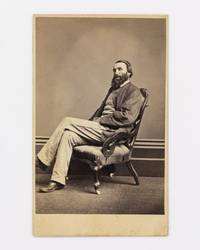
1866135300Adelaide: Townsend Duryea 1866. Adelaide Townsend Duryea printed circa 1866; original negative circa 1863. An albumen paper photograph 90 × 59 mm mounted on the original card 102 × 62 mm with 'T. Duryea Photographer to His Excellency 66 King William St. Adelaide' printed on the verso under the Vice-Regal Coat of Arms. 'Townsend Duryea began making cartes de visite in late 1862 or early 1863 and was advertising his "new" style of carte in May 1863' Bob Noye AGSA website. The portrait taken in Duryea's Adelaide studio shows Stuart after his epic crossing of the continent of Australia: he is visibly depleted - emaciated even - with his injured hand positioned awkwardly in his lap. The accident that caused this permanent injury occurred on 25 October 1861 the day the main party of the successful sixth expedition departed Adelaide. Stuart later described it in a letter to Charles Sturt: 'the accident I received from one of the horses being in a state of strangulation and endeavoured to release him reared up struck me in the temple knocked me senseless and springing again with his hind feet on my right hand has disabled me for life' Ian Mudie: 'The Heroic Journey of John McDouall Stuart' 1968 page 171. It is a most evocative image of the great explorer towards the end of his life. <p>The negative number 18592/3 is inscribed in ink on the verso below Duryea's imprint. This particular imprint dates to around 1866 see Noye and the negative number is consistent with this date. Noye notes that 'A carte with a number belonging to a much earlier number range would be a reprint from an old negative held in storage'; this suggests that this photograph is not printed from the original negative perhaps lost damaged or destroyed. This further suggests that this photograph is printed from a negative produced by rephotographing an existing print of the portrait of Stuart taken earlier by Duryea. This would explain why Stuart has what appears to be his left hand in his lap: the image is printed in reverse. <p>It was likely produced after news of the explorer's death in London on 5 June 1866 had reached Adelaide. A small item of local news 'Mr T. Duryea's Studio' in the 'South Australian Register' on 23 November 1866 lends weight to this possibility: 'A visitor to Adelaide may spend a very pleasant and profitable half-hour in Mr Duryea's photographic studio where a number of elegant photographs in every style of art are displayed. Mr. Duryea also exhibits some superior examples of photographs worked up in water-colours which are soft and some of them exquisitely finished. Amongst these there is a fine portrait of the late J.M. Stuart the explorer'. This carte de visite is clearly not that exhibition piece but it is most definitely a fine portrait. Townsend Duryea unknown
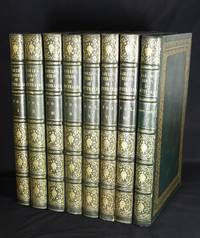
186929221London: by the author printed by Richard and John E. Taylor 1840-_ 1869. First edition. A FINE COPY OF GOULD'S MOST IMPORTANT WORK which was issued in 41 parts over 30 years and occupied more than half of his career. In the original publishers' full morocco gilt stamped binding.<br /> <br /> Provenance: Presented to the Right Reverend Mathew Blagden Hale by the members of the Church of England and other Denominations of Christians of Western Australia Perth October 28th 1876. With large presentation label printed in gold dated in each volume. Mathew Blagden Hale 1811-1895 was the first Bishop of Western Australia and founder of Hale School.<br /> <br /> Gould started work on the Birds of Australia in 1837 but ceased this effort when he found he did not have enough material to work from in England. He and his family departed for Australia where his wife had two brothers and remained there for 18 months collecting new specimens in New South Wales and Tasmania. John Gilbert was sent to collect specimens from Western Australia Queensland and South Australia. As Gould had introductions to the explorers working at the time he also received contributions of specimens from Sturt and Grey. As a result of this intensive effort 300 new species were claimed by Gould. <br /> <br /> AUSTRALIAN EXPLORERS' CONTRIBUTION TO GOULD'S BIRDS OF AUSTRALIA<br /> <br /> In May 1838 Gould his wife Elizabeth John Gilbert their zoological collector one of their sons a nephew & two servants sailed for Australia. On their 27 montsh stay in the Colonies they received assistance from all sides ~ the Colonial Governors and most importantly the early explorers of Australia's interior.<br /> <br /> In Tasmania the Goulds were looked after by the Governor Sir John Franklin of later Arctic fame and Lady Franklin who were greatly interested in the flora and fauna of the country. Gould and Gilbert explored much of Tasmania and the Bass Strait islands. <br /> <br /> In February 1839 John Gilbert departed for an eleven month stay in the Swan River Colony. Gilbert made further explorations to the Northern Territory with Ludwig Leichhardt but during Leichhardt's overland expedition in 1845 from Brisbane to Port Essington was tragically killed by aboriginals. Book - Journal of an Overland Expedition in Australia. 1847.<br /> <br /> In June of 1839 Gould began a journey with Captain Charles Sturt from Adelaide to "the Murray Scrubs" the Mallee returning to Adelaide in July from where he visited Kangaroo Island before returning to Hobart. Books- Two Expeditions into the Interior of Southern Australia. 1833 & Narrative of an Expedition into Central Australia. 1849.<br /> <br /> Contributions of specimens & information came from all quarters. George French Angas contributed eggs and information about the Yellow- eared Black Cockatoo. Book- South Australia Illustrated one of the great Australian topographical view books. In the course of his hydrographical voyage on the H.M.S. Rattlesnake John MacGillivray contributed information about the Great Palm Cockatoo. Book- Narrative of the Voyage of H.M.S. Rattlesnake commanded by the late Captain Owen Stanley. 1852 Cape York area. T.L. Mitchell surveyor general of New South Wales supplied descriptions of the Leadbeater's Cockatoo commonly known as the "Major Mitchell". Books- Three Expeditions into the Interior of Eastern Australia.1838 & Journal of an Expedition into the Interior of Tropical Australia.1848. <br /> <br /> The last voyage of the "Beagle" was in Australian waters from 1837 to 1843. In 1841 Capt. Wickham suffering ill-health was relieved of his command by Lieut. John Lort Stokes Book - Discoveries in Australia; with an account of the Coasts and Rivers explored and surveyed during the Voyage of H.M.S. Beagle In the Years 1837- 1843. 1846. The task of the expedition was to survey those parts of the northern coast of Australia not already charted by Flinders or King. Accompanying them on this trip was the young lieutenant George Grey whose duty it was to explore the land in Australia's northwest with a view to establishing a permanent settlement there. Book - Journals of Two Expeditions of Discovery in North-West and Western Australia. 1841 The scientific appendices in volume two of Grey's "Journals" include one on birds by John Gould ~ " Mr. Gould kindly forwarded the following enumeration of the species which have come under his notice as inhabiting that part of the country Western Australia." There follows a 7 pp listing of birds of W.A. "Officers of the Beagle" are credited by Gould's "Handbook to the Birds of Australia" as supplying information on the Rose-breasted Cockatoo. <br /> <br /> To conclude the history of Australia's inland exploration is inextricably bound up with Gould's masterwork The Birds of Australia. It was an extremely fertile and productive time in Australia ~ Sturt Mitchell & Angas in eastern & southern Australia; Leichhardt MacGillivray Stokes & Grey in the north & west. Reading the letter-press that accompanies each color plate of Gould's Birds bears witness to the combined efforts of Gould and the explorers and settlers of Australia ~ Gould constantly refers to specimens and information on the birds' customs and habitat sent to him by various explorers. Many times this spirit of cooperation overflows into the naming of the bird itself. Gould was the touchstone who pulled together the contributions of Australia's explorers into the foundation work on Australia's ornithology. This combined with Gould's work with Darwin interpreting the specimens from the famous "Beagle" voyages takes Gould's Birds of Australia out of a strictly natural history realm and places it firmly alongside the great scientific discovery expeditions of the 19th century.<br /> <br /> GOULD'S CONTRIBUTION TO DARWIN'S THEORY OF EVOLUTION<br /> <br /> Before the Goulds' plans for the work on the Birds of Australia came to fruition John Gould became involved in a co-operative project with another scholar - Charles Darwin. In October 1836 Darwin returned to England from his 5 year circumnavigation on the H.M.S. Beagle on which John Lort Stokes served for 18 years- rising from midshipman in 1825 to commander in 1841. Darwin needed expert help in the description & identification of the preserved birds insects rocks shells & insects for his production of the Zoology of the Voyages of H.M.S. Beagle. Darwin had heard of Gould's books from Thomas Campbell Eyton a naturalist friend from Cambridge days who had bought Gould's Toucan prints. They were expensive he wrote but of good value as he had since been offered a higher price! Through the Zoological Society where Gould had established his reputation as a premier taxidermist Darwin initially made contact with Gould about a special Rhea seen during his travels in Northern Patagonia. This Rhea was an ostrich of dark mottled color with shorter legs than the Common Rhea. Conrad Martens the artist on the Beagle expedition shot one for food and it was cooked and eaten before Darwin realized that it was a less-known species. Fortunately the head neck feathers & skin had been preserved and were sent to the Zoological Society where it was put together and a nearly perfect specimen made for display. Gould classified the Rhea as a new species "Rhea Darwinii". <br /> <br /> The third volume of the "Zoology of the Voyage of the H.M.S. Beagle" contained fifty bird plates which was advertised by Darwin as "taken from sketches made by Mr. Gould himself and executed on stone by Mrs. Gould". When Gould & Darwin were examining the birds brought from the Galapagos Islands they were fascinated by a group of about thirteen finches of the same species which had curiously different-sized beaks. These modifications occurred on different islands and it was the investigation of this and other scientific data accumulated over a long period that led to Darwin's theories of evolution by adaptation formulated many years later. Frank Sulloway Harvard University 1982 has investigated Gould's part in Darwin's theory of evolution and shows that Gould astutely realised the basic peculiarities of these birds thus paving the way for Darwin's first notes on the "Transmutation of Species". Gould presented descriptions of the Galapagos finches and mockingbird specimens at the Zoological Society in January 1837. However he was unable to finish his work for Darwin. Due to the rush before the Goulds' departure to Australia parts of his manuscript were left unresolved and the work was completed by George Robert Gray of the British Museum.<br /> <br /> As Gould only published 250 sets of "The Birds of Australia" the number of complete copies which could possibly come on the market is significantly diminished by many factors ~ the work was issued in parts and not all copies were bound which would contribute to their demise over time. Many of the sets that survive are in institutional hands and unlikely to come onto the market. Over the last 20 years at least 10 copies have been "broken up" and sold as plates. This loss of a number of complete sets will certainly lead to a complete and undisturbed Gould attracting a premium by virtue of its increasing scarcity. <br /> <br /> 8 imperial folio volumes including supplement 2 pp list of subscribers 681 hand-colored lithograph plates including 3 double-page by John and Elizabeth Gould or by Gould and H.C. Richter. Printed by Hullmandel and Walton. Occasional minor spotting. Uniformly bound in publisher's green period full green morocco sides with gilt borders spines gilt in 6 compartments gilt edge by Clyde. The books are presently in the UK. <br /> <br /> Nissen IVB 370; Anker 174 and 179; Fine Bird Books p. 78; Wood p. 365; Zimmer pp 255-6 and 259; Sauer 9 and 18; Ferguson 4773 & 10032a. <br /> <br /> Bibliography: Lambourne Maureen Wm. McEvoy & Dr. Gordon Sauer. "John Gould - BIRD MAN" London 1987 Wantrup Jonathan "Australian Rare Books 1788-1900" Sydney 1987. by the author, printed by Richard and John E. Taylor, (1840-_ unknown