Japanese-American in HawaiiBiblio.com
521 résultats
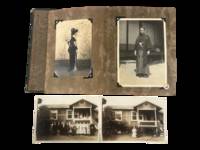
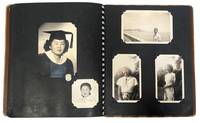
1946230681946. Japanese-American Women's Education Postwar Hawaiʻi identified Japanese-American university school girl's photo album. Oʻahu Territory of Hawaiʻi 1946-1950 spanning the years right after World War II. Approximately 260 silver gelatin photographs documenting the daily life friendships education and civic participation of a Japanese American young woman living on Oʻahu in the immediate postwar period. The photographs are mounted in a 9" x 11" woven album with photos cornered in on black board pages. Images range from small snapshot-format prints to larger horizontal photographs. Following Pearl Harbor Hawaii was initially considered a war zone and the Japanese Americans there were subject to heavy surveillance and civil rights violations until the war ended in 1945. This album ranges 1946 to circa 1950 with one loose photograph predating the album by approximately a decade likely depicting the compiler as a child. The compiler is identified by name in captions as Reiko who also went by "Rei" Reiko was a Japanese American college student and Pre-Med Club member residing on Oʻahu.<br /> <br /> This substantial and unusually well-captioned album offers a deeply personal record of Japanese American civilian life in Hawaiʻi following the end of World War II and the lifting of martial law. The first third of the album features extensive handwritten captions frequently identifying individuals locations and events while the latter portion contains fewer annotations but continues the visual narrative of family friendship and place. Reiko's life is documented across academic social and community spheres depicting college friendships Pre-Med Club activities leisure outings and participation in Laulima a Hawaiian community support organization emphasizing mutual aid and collective responsibility. Numerous images record friendships among young women posed confidently in dresses skirts slacks and swimsuits as well as traditional Japanese dress and Hawaiian dress and leis showcasing cross-cultural identity. Family life appears alongside repeated photographs of Lorraine Nakamuta age 2½ likely a relative shown in candid domestic and outdoor scenes some in western attire and a few photos playfully dancing in a straw hula skirt. The album also serves as a visual geographic survey of mid-century Hawaiʻi with identified sites including Halemaʻumaʻu Crater sugar cane fields irrigation infrastructure such as a wooden pipe transporting water Robert Louis Stevenson's hut beaches valleys and residential neighborhoods.<br /> <br /> Public and civic life figure prominently. Several sequences document an Hawaiian beauty pageant as well as floats marching bands and crowds celebrating the Philippine Islands Independence Day Parade July 4 1946 Honolulu situating Japanese American life within Hawaiʻi's broader multiethnic and postcolonial Pacific context. These images underscore the reemergence of public celebration and civic participation after wartime restriction while highlighting interethnic solidarity and shared urban space. Taken together the album constitutes a rare large-scale vernacular record of Japanese American womanhood education and community engagement during the transitional years between World War II and Hawaiʻi's statehood era. The album remains intact and structurally sound with thick board pages and photographs securely attached using original corner mounts. A few photos loose. Minor age-related wear is present including light scuffing to covers. Handwritten captions remain largely legible throughout. Overall very good condition. This album is an exceptional primary-source document for institutional collections offering sustained visual evidence of Japanese American youth culture women's education in the sciences and everyday resilience in postwar Hawaiʻi enriched by named individuals identified locations and detailed contemporaneous annotations. unknown
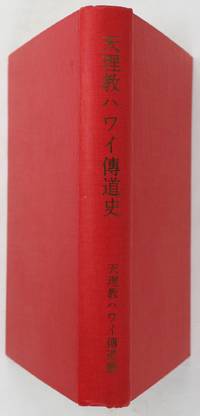
19575046Honolulu: Tenrikyo Hawaii Mission 1957. Very good. 1632365pp. including 32pp. of photographically-illustrated plates errata slip laid in. Original orange cloth gilt spine titles housed on the original cardboard slipcase with black spine lettering. Very minor wear to boards internally clean. Small puncture and some wear to spine of slipcase. A rare history of the Tenrikyo Mission in Hawaii beginning with the founding of its first church in Honolulu in 1929. Tenrikyo was a new Japanese religion founded in the 19th century in Japan by Nakayama Miki. The present work also includes information on many other churches on the islands including the Hilo Church Kauai Church the Maui Church and more. The photographic plates contain portraits of some mission members views of churches scenes from church life and more. The text is mostly in Japanese save for a fifteen-page section printing a series of English-language lectures on the Tenrikyo religion by members of the Hawaiian mission. OCLC records just a single physical copy of this rare Japanese-American work at the University of Hawaii at Manoa. Tenrikyo Hawaii Mission unknown
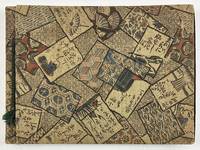
192812860Various locations in Hawaii and Japan 1928. 12 leaves illustrated with 123 mounted sepia-toned photographs many captioned in the image area occasional manuscript captions on the album leaves. Oblong folio. Contemporary pictorial cloth illustrated with various Japanese motifs string tied. Minor wear to cloth. Internally clean. Very good. An attractive and informative vernacular photograph album memorializing the experiences of Protestant missionaries in the Pacific. Protestant missionaries came to Hawaii starting in the 1820s and eventually became quite socially and politically influential. The first Protestant missionaries arrived in Japan in the mid-1840s. They were relegated to treaty ports and prohibited from proselytizing but once these restrictions were lifted they were fairly successful with 300 churches and 34000 converts by 1889. Their main avenue was education and by the 1920s they were well established in this sector. The present album of photographs were taken by an American missionary in Hawaii and Japan in 1927 and 1928. It is not entirely clear whether the photographer did any missionary work in Hawaii or if it was just a stop on the way to Japan; the photos from Hawaii show Honolulu harbor from the deck of the President Madison the "Club House" and Diamond Head.<br /> <br /> The photographs from Japan are more clearly missionary. The photographer was involved in teaching in Kyoto; captions include "Kami Kyoku Bishamon Cho" listed as a theological school in the 1928 Japan Mission Year Book "Japanese Language School" "The Faculty" "Nihongo Faculty" and "St Agnes Ena -- Music." There are two St. Agneses in the Year Book both middle schools one in Tokyo and one in Kyoto. Two photos of an older Japanese man in a clerical collar captioned "Mr Hayakawa" suggest this is the St. Agnes in Kyoto as Mr. K. Hayakawa is listed as the head of that school. Other individuals listed in the Year Book include Sally Rembert Thora Johnson and "Maxine" who is probably Maxine Schannep with the ABCFM. Generally the school shots are exteriors of buildings and people posing outside of them; there are also shots of Christmas trees at St. Agnes the students of "Helen’s Kindergarten" in Koriyama girls in school uniform with deer at Nara Park and several of the nurse's home at St. Luke's Hospital in Tokyo.<br /> <br /> Other photos show life around Kyoto and other cities including Nikko and Fukui. Most of the men are in Western dress while the women and children wear kimono. Two photos of Buddhist monks included in the album were taken by Japanese photographer Kurokawa Suizan; these show a KomusŠin a tengai hat playing the flute and a kasa-hatted monk on the steps of a building. Finally some uncaptioned shots show a procession taking place in front of an audience. Some in the procession carry flags a few are on horseback and a few carry plants on their heads and part of the procession carries a litter.<br /> <br /> Overall the album documents both religious education and everyday life in late 1920s Japan; of particular interest to historians of Protestant missionaries. unknown
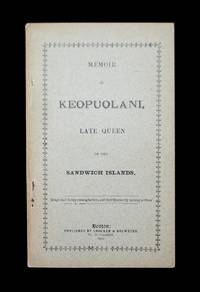
182569601Boston: Crocker & Brewster 1825. HAWAII. RICHARDS William author. Memoir of Keopuolani. Late Queen of the Sandwich Islands. Boston: Crocker & Brewster n.d. reprint of 1825 edition.<br> <br> Early reprint of the 1825 first edition. Small sixteenmo pamphlet 7 x 4 1/4 inches; 177 x 108 mm. vii 8-55 pp. With two full page engraved plates in the text.<br> <br> Original full printed drab gray wrappers. Staple bound. Some light toning along spine and edges of wrapper. Staples causing minor rust stains. Still about fine.<br> <br> An early reprint of "the first biographical account of the first Christian convert in the Hawaiian Islands and of the highest-ranking of the Hawaiian ali'i of her time" Forbes.<br> <br> "Memoir of Keopuolani Late Queen of the Sandwich Islands is a book written by William Richards in 1825. It is a historical account of the life of Keopuolani one of the most important figures in the history of Hawaii. Keopuolani was the wife of Kamehameha I the first king of Hawaii and the mother of Kamehameha II and Kamehameha III. The book provides a detailed account of Keopuolani's life from her childhood to her death. It describes her upbringing her marriage to Kamehameha I and her role in the unification of the Hawaiian Islands. The book also discusses her conversion to Christianity and her efforts to spread the faith throughout Hawaii. Memoir of Keopuolani Late Queen of the Sandwich Islands is an important historical document that provides insight into the life and culture of Hawaii during the early 19th century." Booksamilion.<br> <br> Forbes 623 for first edition.<br> <br> HBS 69601.<br> <br> $1250. Crocker & Brewster unknown
1930227421930. Japanese-American Hawaii Japanese American military family photograph album 1930s documenting everyday life of a Nisei household in interwar Hawaii and tracing the transpacific connections linking Japanese American communities with Japan and Japanese occupied Manchuria. The photographs record family relationships social gatherings military friendships and overseas travel at a time when second generation Japanese Americans were negotiating identity within both American and Japanese spheres of influence. Handwritten captions written in the first person suggest the compiler was a Nisei man with associations to the United States Army referring to relatives and companions as "My father" "My sis Chiyo" and identifying a group of men in a tropical field as "China Souza Manuel myself Choy" further captioned "Army Buddies." During the 1930s Japanese Americans faced significant barriers to military advancement on the mainland United States yet Hawaii's National Guard accepted some Nisei soldiers prior to the Second World War due in part to the islands' large Japanese population. The album therefore documents a rare prewar moment when Japanese American military participation and family life intersected within the broader social landscape of Hawaii.<br /> <br /> Photo album compiled during the 1930s containing approximately 103 original silver gelatin photographs mounted to brown paper leaves and annotated in ink identifying individuals and locations. Bound in green pebbled boards titled "Photo Album" in gilt on the cover. Each photo measures approximately 2.5 x 3.5 inches to 5 x 7 inches. Album measures approximately 6 x 9.5 inches. The images depict family gatherings beach excursions on Oahu graduations and informal portraits of relatives and friends. Early pages include a graduation photograph of Edna Omatsu and portraits of family members including Uneiko members of the Takayama family Jeanette Ayako and a military dressed man identified as Rob Ogawa. One family group portrait shows individuals wearing leis with the caption "Honolulu - Hakada's Departure to Japan." Several photographs document military friendships and camp environments including the previously noted "Army Buddies" image. A small sequence captioned "Manchurian Trip" records the family's travels through northern China during the period of Japanese control following the establishment of the Japanese puppet state of Manchukuo in 1932 illustrating the mobility of Japanese diaspora families moving between Hawaii Japan and imperial territories across East Asia.<br /> <br /> Interwar Hawaii contained one of the largest Japanese populations outside Japan with Japanese immigrants and their American born children forming a substantial portion of the islands' workforce and social life during the 1930s. Album spine partially detached at front cover with wear to boards; photographs remain clean and crisp with mostly legible handwritten captions. Overall very good condition. Nisei communities balanced participation in American civic institutions with continuing family linguistic and cultural ties to Japan creating networks that stretched across the Pacific. This album documents those connections through scenes of leisure education military companionship and international travel shortly before the geopolitical tensions that culminated in the Pacific War. unknown
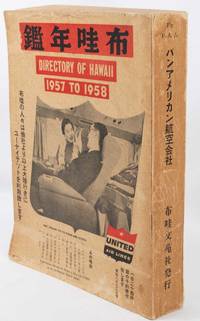
1957214107Honolulu.: 布哇文苑社 Hawai Bun'ensha. 1957. Maps black and white photographic illustrations 29 x 22cm 682pp. Browned original wrappers a little insect damage along edges. Text very good and clean. Spine a little creased and a trifle worn but overall a very good copy. This comprehensive Japanese directory from 1957 focuses on businesses and individuals in Hawaii. It was published shortly after Japanese citizens were once again able to travel abroad following the occupation period. The directory commences with a welcome message from Prime Minister Kishi Shinsuke and is meticulously arranged according to islands and locations. <br> <br>At the outset of the directory one can find a collection of business advertisements accompanied by many photographic illustrations. Following this the directory features listings of businesses and individual names presented in both Japanese and English along with their respective addresses. These listings are interspersed with full-page advertisements. <br> <br>This publication serves as an invaluable resource for understanding the Japanese presence in Hawaii during this time offering insights into both businesses and individuals. The arrangement detailed listings and visual elements provide a snapshot of the Japanese community's activities and contributions in Hawaii during the mid-20th century. . 布哇文苑社, [Hawai Bun'ensha]. unknown
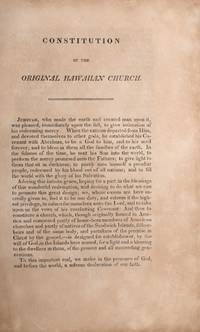
1830329926Honolulu 1830. 4pp. Signed in print Hiram Bingham and 54 others. 8vo. Folded sheet. Browned. 4pp. Signed in print Hiram Bingham and 54 others. 8vo. "The text of this was drawn up in Boston just prior to the departure of the first American Protestant missionaries to Hawaii. Although issued without an imprint or colophon it can be dated to 1830. The last signatories on this are those of the Third Company of missionaries who arrived at Honolulu on the Ship Parthian March 20 1828" Forbes. Forbes 742 unknown
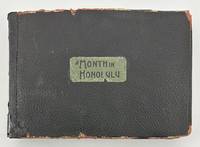
19143378Various locations in Southern California and Hawaii 1914. About very good. Sixty-one leaves illustrated with 214 mounted silver gelatin photographs most with manuscript annotations in white ink; plus numerous mounted postcards menus and assorted ephemera. Oblong quarto. Contemporary black textured limp cloth over boards. Edges a bit chipped and tattered inelegant black tape repairs to spine. First leaf detached contents otherwise clean. A wonderful annotated vernacular photograph album documenting a well-to-do family's vacation to Hawaii via brief stops along the West Coast in 1914. The album opens with a group image of the travelers in San Francisco numbering around twenty-two men women and children captioned "Southern California - Honolulu." This is followed by several pages picturing their initial journey from Seattle down to San Pedro Los Angeles and San Diego before they departed for Honolulu on the S.S. Matsonia on June 17. A passenger list is included and many of the images are captioned with the names of the subjects providing a nice opportunity for identifying the travelers by cross-referencing the passenger list.<br /> <br /> The group spends their vacation time at the Sea Side Hotel on Waikiki Beach in bathing houses and on the beach visiting local businesses plantations and other hotels surfing fishing and more. Through the course of the album much of the landscape of Waikiki is featured providing a snapshot of the hotel and details of its surroundings along with shots of a "Native Village" sugar cane fields and a plantation pineapple fields street views of Honolulu a picnic for "Kids of all nations" at Waikiki the Port of Honolulu and more. The album also features a few early images of surfing at Waikiki Beach. In mid-July true to the title of the album the group heads back across the Pacific Ocean aboard the R.M.S. Niagara after just one month.<br /> <br /> Most notable among the photographs are about thirty risqué images of local Hawaiian women interspersed throughout. The pictures of the "Native Girls" often feature them topless or scantily clad identifying them with additional captions such as "Hawaiian Beauty" "Maidens bathing" "Girls" "Hula Hula Dancers" and "The Ex. Queen of Hawaii." One group shot shows ten Hawaiian women eating fish captioned "'Lunau' sic Lu'au or Native feast." Another side-view image of a naked Hawaiian woman is annotated "The Natives are a sturdy race of people." There are also numerous images featuring other indigenous Hawaiian people in a variety of settings including a couple of images showing a "Hawaiian boy climbing a cocoa nut palm" two pictures of "Native fisher boys" a "Native hut" "Hawaiian kiddies" a "Native canoeist" a "Group of Natives" a "Native Priest - looks as if he had been fasting for some time" and images showing "Natives selling 'Leis' for departing visitors" and "Native 'Leis' vendors on Honolulu." The images of the Hawaiian women as well as the men combined with the captions provide an opportunity for further studying the ways in which affluent American mainlanders have traditionally viewed indigenous Hawaiians and other native peoples encountered throughout the world.<br /> <br /> In addition to the passenger list mentioned above the ephemeral items include shipboard menus a program for an onboard concert newspaper clippings cigar labels and postcards. The latter includes a series of forty-one vibrantly-colored postcards illustrated with Hawaiian fish. An interesting travel album detailing a trip to Hawaii at the outset of the First World War with many notable observations on indigenous peoples in Honolulu especially the young women of the island. unknown
178444312Paris ca. 1784-87. 4to. Series of 6 engraved plates in original handcolouring. 21x145 cm. With broad margins: 255x19 cm. <br/><br/><em>The fine series of these early depictions Hawaiians comprises: 1. Femme des Isles Sandwich . 2. Guerrier de Sandwich - 3. Danseur des Isles Sandwich - 4. Pretre des Isles de Sandwich - 5. Roi des Isles de Sandwich - 6. Insulaire des Isles Sandwich. J. Grasset. direc. - J. Laroque Sculp.Colas 1287 ff. - Sabin: 28334 </em> unknown
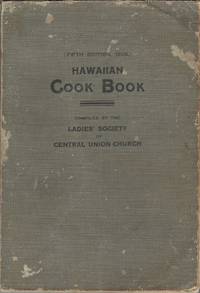
190910018Honolulu: Hawaiian Gazette Co 1909. Octavo 21 x 14.5 cm. 150 16 pages. Interleaved with unpaginated blanks for the addition of handwritten recipes. Index and advertisements. Stated "Fifth Edition Revised and Enlarged". Later edition of Hawaii's first cookbook a community cookbook with recipes attributed. The much slimmer first edition - just forty-nine pages - was issued in 1879 by "The Ladies of the Fort Street Church" and printed by P.C. Advertising Printing Establishment. In the new preface to this Fifth Edition the current editor Elizabeth C.V. Hall speaks to the book's origins though miscalculates the original publication date to be 1882. While the chapter headings are fairly standard – Cakes Confectionery Desserts Eggs Fish Game and Poultry etc. – there is a presence of more local recipes and ingredients. Taro breadfruit papaya alligator pear and of course cocoanut and pineapple. Some spotting and light soil throughout. In original limp cloth titled in black on the front panel; wear and abrasions to cloth especially at the spine thought it remains structurally sound. Near very good. With two handwritten recipes "Steamed Chocolate Pudding" and "Caramel Pudding" added to a blank. OCLC locates nine copies of this edition; the first edition is known only by one copy NYPL; Brown 524 for the first edition; Cook page 55; not in Cagle. Hawaiian Gazette Co hardcover
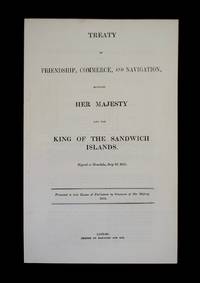
185269457London: Harrison and Son 1852. HAWAII. Signed at Paris June 29 1869. Presented to both Houses of Parliament by Command of Her Majesty. 1869. London: Harrison and Sons 1869.<br> <br> First Edition. Small folio pamphlet 12 5/8 x 8 inches; 321 x 205 mm. 4 pp. Two sheets unbound. Inner margin a bit frayed. Inked page numbers to upper right corner of both leaves. Some light foxing. Still about fine.<br> <br> The first pamphlet is the text of the new treaty between Great Britain and Hawaii. This treaty of friendship commerce and navigation between Kamehameha III King of the Hawaiian Islands and Victoria Queen of Great Britain and Ireland to promote relations and trade between the two nations. Drafted on July 10th 1851 and ratified on May 6th 1852. The second pamphlet is in regards to a declaration made in 1869 between the United Kingdom and the Sandwich Islands Hawaii canceling part of Article VII of the Treaty of July 10 1851 specifically regarding British whaling ships while continuing the remaining articles for seven years. Article VII stated that British whale-ships would have access to the ports of the Hawaiian Islands."<br> <br> Forbes 1862<br> <br> HBS 69457.<br> <br> $2250. Harrison and Son unknown
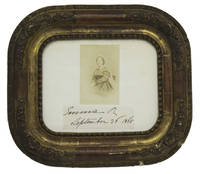
1870303122Honolulu 1870. Photograph measuring 3-3/8 x 2-1/4 in. with the ms slip laid down beneath it. Framed and glazed measuring 9 x 10⁻¹/2 in. Photograph measuring 3-3/8 x 2-1/4 in. with the ms slip laid down beneath it. A particularly fine example of Emma's photograph and signature in a contemporary frame. She has signed herself "Emma R / September 26 1865."<br /> <br /> Born in Honolulu in 1836 she was adopted by her maternal aunt the chiefess Grace Kamaʻikuʻi Young Rooke and her husband Dr. Thomas C. B. Rooke. She married Kamehameha IV on 19 June 1856. Emma was an active queen concerned with palace affairs and was involved in the expansion of the royal library. She is best known for founding the Queen's Hospital in 1860 which was built to care for native Hawaiians who had no immunity to many of the European diseases which they encountered. The hospital exists to this day as Queen's Medical Center. Her philanthropic endeavours set a precedent for sitting queens.<br /> <br /> Although unattributed this image is likely taken by Andreas Montano the Colombian photographer who came to Hawaii in 1870 and immediately set up a studio at 87 Fort St. He photographed much of Hawaiian royalty and became Emma's official photographer. unknown
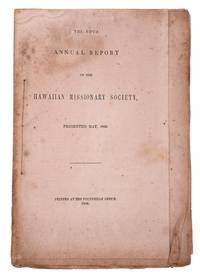
1863332951Honolulu: American Mission Press 1863. With: 9 additional Reports of the Hawaiian Missionary Society being the Second Report and the Fifth through Twelfth Reports. 10 vols. 8vo. Original wrappers or self-wrappers. With: 9 additional Reports of the Hawaiian Missionary Society being the Second Report and the Fifth through Twelfth Reports. 10 vols. 8vo. The Hawaiian Missionary Society aimed to send missionaries from Hawaii to other Pacific islands. "The first annual report states that preparations were being made to send two missionaries Rev. Mr. Snow and Rev. Luther H. Gulick and their wives to Micronesia. A list of contributions made to the society shows the extraordinary generosity of native Hawaiian churches to this object . From this date the annual reports include excerpts from letters of the missionaries both in Micronesia and in the Marquesas. Twelve annual reports were published between 1852 and 1863 . The first three were printed at the American Mission Press; the fifth at the Polynesian office; and the remainder by the press of H.M. Whitney or the Pacific Commercial Press. This is an important source of information about missionary work by native Hawaiian missionaries in Micronesia the Marquesas and other parts of the Pacific" Forbes<br /> <br /> This group comprises the following:<br /> First Report. Honolulu: American Mission Press 1852. 12pp. Green wrappers.<br /> Second Report. Honolulu: American Mission Press 1853. 19pp. Unopened. Tan wrappers.<br /> Fifth Report. Honolulu: Printed at the Polynesian Office 1856. 24pp. Uncut and unopened. Stitched self-wrappers. <br /> Sixth Report. Honolulu: Press of H.M. Whitney 1857. 24pp. Stitched self-wrappers. <br /> Seventh Report. Honolulu: Commercial Advertiser Print 1858. 24pp. Stitched self-wrappers.<br /> Eighth Report. Honolulu: Commercial Advertiser Print 1859. 16pp. Stitched self-wrappers. <br /> Ninth Report. Honolulu: Henry M. Whitney 1860. 35pp. Stitched self-wrappers. <br /> Tenth Report. Honolulu: Henry M. Whitney 1861. 23pp. Stitched self-wrappers. <br /> Eleventh Report. Honolulu: Henry M. Whitney 1862. 24pp. Stitched self-wrappers. <br /> Twelfth Report. Honolulu: Henry M. Whitney 1863. 12pp. Stitched self-wrappers. Forbes 1877 First Report American Mission Press unknown
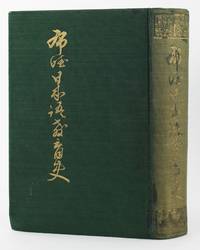
19374006Honolulu & Tokyo 1937. About very good. 27021pp. plus plates. Original green silk over boards gilt t.e.g. Spine faded corners bumped and rubbed. Contents clean. A very rare history of Japanese-language schools in Hawaii between 1911 and 1937. The work is written entirely in Japanese and illustrated with several plates depicting school children teachers and other officials. "Once the Issei had decided to settle in Hawaii they wanted their children to become good Americans of Japanese ancestry with a command of both the English and Japanese languages and cultures. In the mid-1910s they came to feel the impact of the Americanization movement and feared that Hawaii's Japanese language schools would be attacked. Thus in 1914 to cope with this pressure the Hawaii Kyoiku Kai Japanese Educational Association of Hawaii was organized by the school principals and teachers to unify over 130 schools. In 1917 the Kyoiku Kai published their own textbooks with content suitable to Hawaii born Nisei and decided to teach only the Japanese language and moral lessons eliminating Japanese patriotic lessons and adding new lessons to encourage Japanese to become loyal Americans who would nonetheless also cherish their Japanese heritage" -- Davidann. We could not locate any copies in OCLC.<br /> Davidann Jon: Hawaii at the Crossroads of the U.S. and Japan Before the Pacific War 2008. unknown
1880J6SGPBJ1IXLV1880. With 12 albumen prints ranging in size from ca. 16.5 x 23 cm to 21 x 28 cm. Collection of 12 vintage photographs from the late 19th century showing China Indonesia the Hawaiian Islands California and Egypt. Of the 4 photographs of China 2 show Hong Kong including one possibly by the famous Chinese photographer Lai Fong ca. 1839-1890 showing Queen's Road Central. The two rarest photographs show several of the 7500 imperial examination cubicles in Canton Guangzhou while a photograph by A Chan Ya Zhen shows the famous five-story pagoda on Kun Yam Hill in 1870. The Indonesian island Java can be seen on 3 photographs including one of lake Telaga Warna by the British firm Woodbury & Page based in Batavia Jakarta. Taken further to the west were 3 photographs of Hawaii probably all taken in or near Honolulu. A rare undated photograph of the statue of King Kamehameha was taken probably right after the unveiling ceremony in 1883 as it shows a small wooden fence around the statue which can be seen in an illustration in The Graphic 28 April 1883 but is absent from all later images. Of the 2 final images one by Isaiah West Taber 1830-1912 shows Midway Point in Monterey California and the other by Hippolyte Arnoux fl. 1860-1890 a group of Arabs and camels waiting for the ferry near El Qantara in Egypt. Most of the photographs are worn at the edges with small tears and folds and a few have small holes; one of the images of Hawaii with a waterstain at the lower margin. unknown
1900329931Honolulu 1900. Nearly complete run from 1853 to 1900 lacking only the Fourteenth Annual Report from 1866. 47 vols. 12mo. Original wrappers in various colors mostly in very good condition. Nearly complete run from 1853 to 1900 lacking only the Fourteenth Annual Report from 1866. 47 vols. 12mo. "This society was formed in 1852 in the 'Old Mission School House' partly as a social organization but more specifically to lend support to the Micronesian mission then getting started . reports have excerpts from letters from Luther Halsey Gulick and several native Hawaiian missionaries stationed in Micronesia. An address by Hiram Bingham Jr. on 'the cultivation of the Missionary Spirit' is in the 1857 report. The 1858 report includes an essay by Orramel Gulick on his trip to Micronesia. The president's reports found in almost every issue have continued references to local social and religious interests in Hawaii . The birth marriage and death notices and obituaries of these missionary 'Cousins' found in issue after issue are a major source of information on missionary family histories . In the twenty-fifth annual report 1876 an essay by 'Cousin' General Samuel C. Armstrong discusses his educational work with African Americans at Hampton Virginia ." Forbes. Forbes 1942; Carter p. 81; Hunnewell p. 65 unknown
184736493Honolulu: Charles Edwin Hitchcock 1847. 24 consecutive issues bound together 4to. Volume V Numbers 1-24. 192pp. Woodcut illustrations. Expertly bound to style in half calf and period marbled paper covered boards<br/> <br/> A full year's run of a noted Hawaiian newspaper.<br/> <br/> Beginning publication in January 1843 under the title Temperance Advocate the newspaper began under the present title The Friend with the January 1845 issue continuing publication into the 20th century. "The expressed intent of the proprietor Rev. Samuel Chenery Damon Seaman's Chaplain for Honolulu was to produce a 'Temperance paper' for the benefit of seamen and the subjects found on its pages particularly during the first decade reflected Damon's work in this vein among sailors and crews of whale ships . Damon however also made an effort to include general information and news of interest to those in the Pacific and in New England. Extensive coverage was given to the whaling industry. Shipping lists were reproduced. 'Marine Intelligence' columns gave detailed reportage on whale ships throughout the Pacific. Considerable effort was made to fill other columns with arrival and departure lists of vessels and their passengers . Occasionally editor Damon included notes on his visits to Kauai Maui and Hawaii" Forbes. Of particular note in these early issues is a register of foreign residents in Honolulu January 15 1847. Advertisements include notices of publications in Hawaii. Illustrations include a street map of Honolulu with 35 numbered references January 15 1847. Consecutive runs of issues from the newspaper's first decade are very rare.<br/> <br/> Forbes 1388. Charles Edwin Hitchcock unknown
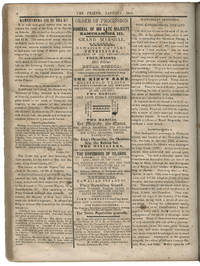
185423745<p><i>"The American Sloop-of-war SARATOGA Capt. Walker arrived at this port on the 29th ult. in 25 days from Japan which is the shortest passage ever made. The S. brings Capt. H.A. Adams U.S.N. as bearer of despatches to the Government at Washington. The point of interest in this intelligence is the fact that Com. Perry concluded a TREATY OF AMITY AND FRIENDSHIP with the EMPIRE OF JAPAN."</i></p><p><i>The Friend</i> was the mouthpiece of Congregational missionaries and reported everything from important local Hawaiian issues to international news reprinted from eastern sources. The nine months covered here feature a great deal of the news of the day ranging from war between England and Russia to lots of whaling and maritime news including shipping arrivals and departures the discovery of new sperm whaling grounds naval intelligence all peppered with a liberal dose of good old fashioned conservative proselytizing.</p><p>This particular volume was sent from Sag Harbor New York to Thomas Spencer a Rhode Island sea captain who went native opening a successful ship's chandlery and marrying a local girl.</p> <b>HAWAII.</b>Newspapers. Bound volume of <i>The Friend</i> Honolulu HI containing 22 consecutive issues dated from Feb 1 1854 through Oct 25 1855.<p><br /></p><p>This volume has the first report of the death of Hawaiian King Kamehameha III including the order of procession Jan 1 1855 issue and the first report of the signing of the US-Japan Treaty negotiated by Commander Matthew Perry May 6 1854 issue and an Independence Day celebration July 6 1854 issue.</p><p><b><i>The Friend</i></b> was a local newspaper published from 1843 to 1954. Published by and for the missionaries it is invaluable as a source of information concerning the activities experiences and accomplishments of the 19th-century Congregational missionaries to Hawaii as well as 20th-century figures and the development of the United Church of Christ in Hawaii. Today <i>The Friend</i> is the newsletter of the Hawaii Conference of the United Church of Christ.</p><p><b>Thomas Spencer</b> 1815-1884 was a whaling captain out of Warwick Rhode Island. He was stranded in the Sandwich Islands Hawaii and decided to remain there. He opened a very successful ship's chandlery in Honolulu and later purchased property on the "big" island in the village of Hilo. His brothers also joined him in Hawaii. He was a notorious celebrity well-liked by all and especially supportive of the Hawaiian royal family. He is buried in Oahu.</p><p>The children of Thomas Spencer and Makaleka Margaret Robinson were Thomas Spencer Jr. and Charles Lucy Jennie Lily Helen Margaret and Kaliko Spencer.</p>
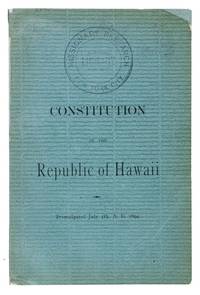
1894H6TGCND412W1Honolulu 1894. Stapled leaves in publisher's original turquoise wrappers paste-paper imitating laid paper colourfully reproducing chain and laid lines with letterpress title on front. Kept in modern half morocco clamshell box. 22 x 14.5 cm. The 56-page issue plus index of the first edition of Hawaii's last constitution as a sovereign country containing 103 numbered articles. When in 1893 Queen Liliuokalani of Hawaii was overthrown she was replaced by a provisional government consisting of members of the American Committee of Safety striving to achieve annexation of Hawaii to the United States of America. When annexation was not forthcoming they set up a constitutional convention and adopted the present constitution for the Republic of Hawaii. The annexation was finally ratified four years later the transfer of sovereignty taking place in August 1898. "The present constitution is among the more important pieces of literature pertinent to these times" Streeter.Forbes notes that page 56 is unnumbered and blank "56 blank" but in this copy it is numbered and contains the last names of the members of the constitutional convention. The present copy includes the 6-page index often lacking.With a library stamp on front wrapper the spine of the wrapper reinforced. A very good copy.l Forbes 4569 55-page issue; Streeter 3766 55-page issue; cf. A.F. Lee The Hawaii state constitution: a reference guide 1993 p. 5. unknown
196756001Honolulu HI & Kohala HI: Frost & Frost 1967-1972. Archive. Approx. 820 photographs 760 are 3.25 x 4.5 in. black & white silver gelatin; 40 colour photos damage to 10 or so from dampstaining at margin affecting image all photos carefully marked in black & red ink codes keyed to the film negatives also included with the archive many with photo lab stamp on verso a few with annotations on versos; more than 30 contact negative print strips; 257 strips of film photo negatives with over 1000 images majority .35 mm. film stock about 30% in colour; 70 strips of larger 4 x 5 negatives with most of those in colour nearly all preserved in original wax paper negative sleeves and almost all carefully marked in pen with numbers corresponding to the printed photos as well as manuscript annotations indicating places objects as well as some dates added in manuscript or in date codes; 8vo. 35 loose sheets held together with metal clip in pencil & ink manuscript dated 1972 diagrams illustrations some edgewear foxing to first & last leaves minor insect predation to outer leaves still VG- exemplar. This noteworthy archive consisting of over 820 original photographs and over 1000 individual negative images provides an essential visual record of the historic archaeological and architectural surveys carried out by the Frosts for the Hawaiian Mission Children’s Society beginning in 1967 in the Bond Historic District located in the Iole Ahupua’a one of the few remaining traditional land divisions in Hawaii. The Bond homestead Kalahikiola Church the Kohala Seminary and attached medical doctor’s office are all located within the Bond District and the well preserved homestead was first established by Rev. Elias Bond 1813-1896 in 1841 with the Kalahikiola Church completed in 1855 rebuilt after devastating earthquake in 2006 and the Kohala girl’s school founded in 1872. The hundreds of photos show the household objects textiles tools furnishings documents artwork books equipment and more all accumulated from 1841 through 1930 by the Bond family. Elias and his wife Ellen had sailed with the Ninth Company of Missionaries from Boston and settled at Kohala HI in the mission established by Rev. Isaac Bliss who had completed the main building before their arrival. The Bond’s immediately began adding additional buildings such as the wash house archway & walls foundations of woodshed and carpenter sheds as well as begun work on the Kalahikiola Church. Rev. Bond had founded the Kohala Sugar Co. in 1862 as “The Missionary Plantation†to support his church and schools and he refused to institute the slave-like labor conditions of other sugar growers in the Hawaiian Islands. The profits made the Kohala Sugar Co. one of the largest benefactors to other missions operating for 110 years. Many of the artifacts depicted appear to have been accumulated and used by Dr. Benjamin Bond 1853-1930 his son who finished medical school at the Univ. of Michigan in 1882 and returned to live and work on the homestead with a doctor’s office attached to the main house in 1884 for his practice. After Dr. Bond married Emma Mary Renton 1866-1951 in 1889 a wood-framed cottage was added at the East end for them. In addition a small shed was expanded to shelter a horse carriage and single horse stall for emergency medical calls. A series of photos shows the scene of the Frost’s driving to the homestead and then heading into the Bond properties. The photos meticulously document the china glassware stoneware needlepoint & embroidery samples an ABC sampler by Eliza Bond signed 1817 silver flatware bellows original photos & illustrations of homestead buildings chairs large benches and sideboards. The kitchen cooking implements cookware and equipment receive significant attention with photos showing the ancient kitchen burners hot water tank propane or oil-fired stove historic coral stone chimney dining chairs and more. Of particular interest are the extended series of images depicting the artifacts medical instruments and furnishings in Dr. Bond’s office including his book collection Chautauqua desk large safe dried medical herbs razors astronomy atlas anatomy atlas diagrams eyeglasses glass beakers pharmacy tools and much more. Also included are photos of abandoned boxes for chemical and pharmaceutical supplies in the attic. The breadth of clothing textiles toiletry items jewelry rope beds architectural elements family photos a Chinese compass art easel and more reflect the growing affluence of the family not only from Dr. Bond’s practice but also as the sugar production and mill expand however with much of the profit still being devoted to Mission Society projects. The negatives and photos also show the wagons used by the doctor and his family the extensive tools employed on the homestead to maintain not only the family holdings but also the Church and Girl’s School buildings. Photos also show a bookpress bottles sawmill equipment a rock crusher installed for road paving and more. After Dr. Bond’s death the buildings were maintained by a special trust fund which terminated in 1968 and subsequent to that time a family corporation helped finance the care of the estate. The manuscript diagrams and notes by the Frost indicate where windows were replaced from the original when electrical work was done on the property improvements to the buildings where the hallway from the shop to kitchen was located the women’s toilet pantry cupboards and rough charts and maps of locations of buildings and objects on some of the walls. For a time the Industrial Building housing 12 occupational students and one teacher continued to operate but in 1955 the school stopped functioning. For over a decade the properties were used for conferences retreats and camping grounds but eventually they became unoccupied and unused so they were in very poor condition when surveyed by the Frosts over three years. The Frosts prepared a very scarce photo album and report consisting of 6 pages of text and 12 leaves containing 82 tipped-in photos in January 1968 followed by a Feasibility Study for the Hawaiian Mission Children’s Society in 1969 but we could find no similar extant collection of these photographs or records of this historical survey. The National Register Survey was completed in 1973 and then filed in 1977 finally approved in 1978 for adding the properties to the National Register. See: Laura Souliere & Nathan Napoka Father Elias Bond District SE of Kapaau off Highway 27 National Register of Historic Places March 30 1978; Frost & Frost Report of an Inspection Visit to the Bond House Complex 1840-1968 in Kohala Hawaii January 11 & 12 1968; Land of Iole Kohala Institute 2018; Rebekah Oe-Len Kehaulani Luke My Grandfather Chong’s House Rebekah’s Studio 2011; Edward Beechert The Reverend Mr. Bond and Kohala Plantation Working in Hawaii: A Labor History 1985 pp. 71-72. Frost & Frost, hardcover
19802080202102900002Honpo shoseki 1980. Soft Cover. Fine. Books: 14 books Honpo shoseki paperback