335 résultats
19942080302106806866Nagasaki Prefectural Assembly 1994. Soft Cover. Fine. Size: B5 size 2224 pages Number of books: 1 Nagasaki Prefectural Assembly paperback
19812083002115801175Ehime Prefecture Assembly 1981. Soft Cover. Fine. Volume: 1 Ehime Prefecture Assembly paperback
1991489This book is in very good condition. There is little to no wear on the front back spine and edges of the cover boards. The pages are white crisp and clear of all markings. <br /><br /> "The daily obligatory prayers. Are three in number.Th e believer is entirely free to choose any one of these three prayers but it is under the obligation of reciting one of them and in accordance with any specific directions with which it may be accompanied." - <i>from a letter written on behalf of Shoghi Effendi </i>from<i> Baha'i Prayers: A Selection Of Prayers Revealed By Baha'U'Llah The Bab And 'Abdu'L-Baha</i><br /><br /><br /><br /> Baha’i Publishing Trust
19642080302106807896Nagasaki Prefectural Assembly 1964. Soft Cover. Fine. Size: A5 version 1520 pages Number of books: 1 Nagasaki Prefectural Assembly paperback
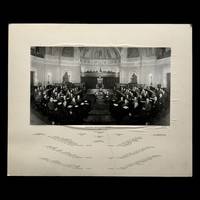
19477621Winnipeg Manitoba: Gauvin Gentzel Studio 1947. First Edition. Original Photograph on Mount. Original silver gelatin photograph panoramic format measuring 13" x 7.25" mounted on its original heavy card mat to an overall size of 14" x 17". Bears the imprint of the prominent Winnipeg firm "Gauvin Gentzel Studio" to the upper left. A printed caption below the image identifies the "Manitoba Legislative Assembly 1947" and lists all members by row along with the Speaker and legislative staff. <br /> <br />A crisp and detailed panoramic photograph capturing the 22nd Manitoba Legislature in session. The image provides a rare wide-angle view of the historic chamber with all members present at their desks. This 1947 assembly is a fascinating snapshot of Manitoba's unique "Coalition" era. The government led by Premier Stuart S. Garson K.C. pictured in the 3rd row was a fusion of Liberal-Progressives and Progressive Conservatives a "non-partisan" administration that had its origins in the war years. <br /> <br />The photograph is a roster of Manitoba's post-war political establishment. In addition to Premier Garson who would leave in 1948 to join the federal cabinet the roster includes his successor Hon. Douglas L. Campbell 3rd Row who would go on to be Premier for a decade. Also present are numerous other cabinet ministers and future luminaries including: Hon. J. S. McDiarmid 3rd Row who would be appointed Lieutenant-Governor of Manitoba in 1953; Lt.-Col. Gordon Churchill 1st Row a future federal MP and prominent cabinet minister in the Diefenbaker government; Gunnar S. Thorvaldson K.C. 2nd Row a future Senator. <br /> <br />Most remarkably this image captures the legislature's sole dissenter and one of its most notable figures: William "Bill" A. Kardash 2nd Row. As the only member of the Labor-Progressive Party Communist in the assembly Kardash was a conspicuous and often isolated voice in the coalition-dominated house. His presence seated amongst the very establishment he ideologically opposed is a powerful visual representation of the era's complex political landscape at the dawn of the Cold War. <br /> <br />The photograph itself is a fine example of the large-format group portraiture perfected by the Gauvin Gentzel Studio one of Winnipeg's leading photographic firms for decades known for their clarity and high-quality compositions. The silver gelatin print retains excellent clarity sharp detail and strong contrast. The mat is clean and bright with only very light toning to the edges and minor bumping to the corners. A near-fine example. <br/><br/> Gauvin Gentzel Studio unknown
19712080502106600415Not Available 1971. Soft Cover. Fine. Volume: 1 Not Available paperback
19682080502106600302Not Available 1968. Soft Cover. Fine. Volume: 1 Not Available paperback
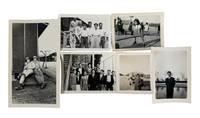
1944211521944. Japanese American incarceration photographs dating from World War II document civilian life and military presence at several internment and assembly centers established after the forced removal of Japanese Americans from the West Coast. Following Executive Order 9066 in 1942 more than 120000 people of Japanese ancestry were confined in temporary assembly centers and longer term relocation camps administered by the War Relocation Authority. The photographs record daily activities of men women and children within these camps and illustrate the physical environment of the barracks settlements created to house incarcerated civilians during the war.<br /> <br /> Archive contains six original silver gelatin photographs measuring approximately 2.5 × 2.75 inches to 3.5 × 5.75 inches. The images depict Japanese American families and individuals at Heart Mountain Relocation Center in Wyoming Camp Amache in Granada Colorado and Pomona Assembly Center in California. Several photographs show families gathered in front of barracks style housing units typical of the camps. One image from Amache shows a family of six standing on the steps of their assigned unit with the wooden barracks structure visible behind them. Another photograph from Pomona shows two United States soldiers seated on a storage trunk outside a camp building likely serving as patrol or security personnel. One image from Heart Mountain shows a military medic standing beside an ambulance truck while gesturing toward camp structures in the distance. Other photographs include a group portrait of Japanese American young men standing in front of a brick building possibly a school building within the camp and a separate image of the same individual standing beside a lake. Another photograph shows a young Japanese American girl playing on a see saw while families watch a sports game in the background with camp buildings visible beyond the field.<br /> <br /> Pomona Assembly Center served as one of the temporary detention facilities established in 1942 before incarcerated families were transferred to permanent camps such as Heart Mountain. Heart Mountain became the fourth largest relocation center eventually housing nearly fourteen thousand people while Amache in Colorado confined more than seven thousand internees the majority of whom were American citizens by birth. Living quarters in these camps consisted of small rooms within hastily constructed wooden barracks assigned to individual families. The photographs preserve small moments of social life and recreation within these confined communities illustrating how families attempted to maintain routines despite the conditions of incarceration. Photographs remain clear and well preserved with light age wear consistent with vernacular prints. Very good condition overall and a revealing visual record of Japanese American life within wartime relocation centers. unknown
19682080502106917719Not Available 1968. Soft Cover. Fine. The book is in fine condition. Not Available paperback
19632080402107100394Not Available 1963. Soft Cover. Fine. Number of books: 12 books set Not Available paperback