13 résultats
1936S11023Lyon France:: M.C. Chalumeau 1936. 1936. Volume I only. 4to. 10 252 2 pp. Illustrations. Original printed wrappers; covers detached and edges severely chipped spine head missing a piece. As is. "Andre-Marie Ampere 1775-1836 was a French physicist natural philosopher and mathematician who is best known for his important contributions to the study of electrodynamics. He invented the astatic needle a critical component of the modern astatis galvanometer and was the first to demonstrate that a magnetic field is generated when two parallel wires are charged with electricity. He is generally credited as one of the first to discover electromagnetism." web-source M.C. Chalumeau, 1936. unknown books
1963BL4051Lyon:: Poleymieux 1963. 1963. Series: Bulletin de la Societe de Amis d'Andre-Maries Ampere. no. 20 Jan. 1963. 8vo. 39 pp. Printed wrappers. Ink inscription on supper cover not signed. Fine. Jean-Claude Bredin. Poleymieux, 1963. unknown books
1995BL3998Cambridge:: Blackwell Publishers 1995. 1995. 8vo. xiv 406 pp. Figs. index. Black cloth dust-jacket; jacket worn waterstained throughout. HEAVILY MARKED COPY WITH PENCILING mostly at front and rear esp. the bibliography by L. PEARCE WILLIAMS. AS IS. Williams was known to be interested to write a text on Ampere. This book contains a hint of his intellectual application to Ampere's story. Blackwell Publishers, 1995. hardcover books
1970S11024no location:: n.d. c. 1970s. 1970. Facsimile reprint photocopy of 1866 edition Paris: Didier 186. Oblong 8vo. xix 461 pp. Green cloth gilt-stamped spine. Very good. [n.d., c. 1970s]. hardcover books
193615384Lyon: Chalumeau 1936. paperback. very good. Compte rendu des Journees 567 et 8 Mars 1936. Numerous plates and text illustrations. 2 vols 4to original printed wrappers; upper hinge of vol. I worn.Lyon: Chalumeau 1936. Very good.<br/><br/> Among the papers presented at this conference in honor of the great French physicist who formulated the mathematical basis of electro-dynamics were contributions by Jean-Baptiste Perrin Auguste Lumiere Maurice Broglie and Frederic and Irene Joliot-Curie.<br/><br/> Chalumeau unknown books
1863001695Paris: Calmann Levy 1863. 4 vols. complete folded map 3/4 brown leather with green marbled boards ex libris. The second and third volumes from the 2d printing; the fourth volume from the 4th printing. Calmann Levy unknown books
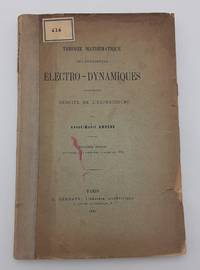
1883182054Paris.: Hermann. 1883. 2nd edition. Publisher's printed wraps. Good plus wrappers browned and chipped endpapers brittle light browning at edges throughout contents very good. 4to. 27.5x18 cm. . French text. Second edition conforming to the first edition of 1826. This is Ampere’s great treatise on electromagnetism. weight: 1.1 lb. 2 Folding plates. Hermann. paperback books
1331709Unsigned manuscript in the hand of Jean-Jacque Antoine Ampere son of physicist André Marie Ampère with calculus equations on both sides. Sheet measures 17 1/2 x10 3/4 cm. Part of the Maurice Car Collection. Shelved case 0. 1331709. Shelved Dupont Bookstore. unknown books
162379First Edition. hardcover. 2 vols. 8vo handsomely bound in modern 3/4 red morocco original wrappers bound in both volumes; original wrappers in both volumes lightly soiled bookplate of former owner on half-title in each volume a few lines of text underlined in pencil on one page in vol. II very light foxing to some pages in both volumes otherwise very good. Paris: Michel Levy 1855.<br/><br/> "Jean Jacques Ampere was a teacher historian philologist authority on Scandinavian and German epic poetry and a member of the French Academy. He made a grand tour of.the United States Cuba and Mexico." Clark III 442. During his travel in the United States Ampere ".covered the east and the south and as far west as Cincinnati and Chicago." Howes A-222<br/><br/> unknown books
181627600Paris: 1816 1816. First Edition. Hardcover. Very Good. André Ampère 1775-1836 classified the 48 known elements into three major families gaxolytes leucolytes and chriocolytes that he further divided into 15 "genres" based on "analogies" between the elements chemical properties that seemed related to one another. He did this in three papers in this multi-volume set:   <br/> Also contains Augustin Fresnel's "Mémoire sur la diffraction de la lumière où l'on examine particulièrement le phénomènes des franges colorées que présentent les ombres des corp éclaireés par un point lumineux" by Augustin Fresnel Volume I pp. 239-281 1816 and André Ampère's "D'une Classification naturelle pour les Corps simples" Annales de Chimie et de Physique 1 pp. 295-308 1816; "Suite de l'Essai d'une Classification naturelle pour les Corps simples" Volume I pp. 373-394 1816; and  "Suite d'une Classification naturelle pour les Corps simples" Volume II pp. 5-32 & 108-125 1816. 452 440 448 pp. 8vo. Volumes I & II have blue paper boards with a brown tape spine; Volume III has the same brown paper spine but with brown leather covers also has marbled endpapers. Light scuffing from shelf wear. Clean within. Numerous plates and illustrations some folding. Text in French. 1816 hardcover books
182022536Paris: Chez Crochard 1820. First Edition. Boards. Very Good. First Edition. 448 pages plus 5 plates 1 folding. 8vo. Contemporary quarter calf over marbled boards with black spine labels. Early label Coquard a Epinal on front pastedown. The entire volume of "Annales de Chimie et de Physique" Vol. Quinzieme XV 15 offered. Surface wear/damage to the leather finish resulting in minor loss to gilding and top label and minor fraying to the head/tail spine panel. Small spot of worming inside lower rear board at the gutter. Text generally bright and clean. <br/><br/>This volume contains the original journal appearance of the separately issued "Memoires sur l'Action Mutuelle de Deux Courans Electriques" in three sections over two articles pp. 59-76 & 170-218. Section 1: "De l'Action mutuelle de deux courans electriques" pages 59-76 continued as "Suite Du Memoire sur l'Action mutuelle entre deux courans electriques entre un courant electrque et un aimant ou le globe terrestre et entre deux aimans" on pages 170-188. Section 2: "Direction des courans electriques par l'action du globe terrestre" on pages 188-196. Section 3: "De l'Action mutuelle entre un conducteur electrique et un aimant" pages 196-218. Plus plate number 4 in the rear which illustrates the articles. Boards. Ampere is today celebrated for his fundamental work in the new field of electrodynamics. The three part paper offered here established "the relationship between electric current-flow and magnetism and established the new science of electrodynamics." Norman <br/><br/>"In a four page circular dated Copenhagen July 21st 1820 H.C. Orsted communicated his great discovery that a closed voltaic circuit exerts forces on an adjacent magnetic needle. In more modern language: a current-carrying electric circuit gives rise to magnetic forces in its surroundings. Orsted had found the long sought affinity between electricity and magnetism. The letter reached Arago . who at the next meeting of Academie des Sciences on Sept. 11th 1820 with Ampere in attendance presented the letter and Orsted's experiment. It was indeed a memorable meeting. Already at the next weekly meeting on Sept. 18th Ampere delivered an explanation of Orsted's experiment and supported it with new experiments of his own. At every weekly meeting in the following months Ampere produced new results." Ekelof<br/><br/>'In this first paper Sept. 18 he explains the law determining the position of the magnetic needle in relation to the electric current and he also makes known his intended experiments with spiral of helical wires which he predicts will acquire and retain the properties of magnets so long as the electrical current flows through them He constructed his spirals and helices and to the astonishment of all he produced magnets formed only of spools of copper wire traversed by electric currents.' Mottelay<br/><br/>The Honeyman sale #82 notes that the paper offered here is "The first appearance of the first of a series of important papers reporting Ampere's discoveries on the electric current." Honeyman also had #83 the first separate appearance of these journal articles published as "Memoires sur l'Action mutuelle de deux courans electriques." which we believe had additional information not present in this journal appearance and hence is not a traditional "offprint" but a later state of the work. Norman notes that Ampere developed the science of electrodynamics over the next seven years publishing in a "bewildering array of journal articles offprints and revisions of earlier works.further noting some 'reprints' of Ampere's articles appear in as many as five different versions."<br/><br/>This is an opportunity to own the original first printed appearance of Ampere's fundamentally important work in Electrodynamics. It would be an interesting collection to build the variations of Ampere's work over those seven years to see how his thought evolved. As far as we are aware there is no standard bibliographic reference for Ampere's work.<br/><br/>Dibner Heralds of Science 62 first separate edition; Honeyman Sale 82 original journal appearance; Mottelay Bibliographical History of Electricity and Magnetism p. 472 ; Norman 43 first separate edition. Ekelof Catalogue of Books and Papers in Electricity and Magnetism pp 284-286; Sparrow Milestones of Science p33 first separate edition. Chez Crochard unknown books
182440488Paris 1824. <p>Ampère André Marie 1775-1836. Autograph letter signed to Samuel Hunter Christie 1784-1865. Paris 14 July 1824. 1 page. 225 x 175 mm. Light marginal staining lacuna from ink oxidation affecting one word. </p> <p>From Ampère founder of the science of electrodynamics to British mathematician and physicist Samuel Hunter Christie who performed important research on terrestrial and other forms of magnetism:</p> <p>"Depuis que vous m'avez fait l'honneur de m'envoyer votre excellent mémoire sur le sujet de physique sur lequel nous travaillons particulièrement tous deux je désirais vivement trouver une occasion pour vous envoyer un des 3 ou 4 exemplaires qui me reste de mon ouvrage sur ce sujet dont l'édition est épuisée. . . .Je joins à mon recueil une petite brochure qui en est extraite et qui est l'exposé rapide de tous les faits découverts relativement à l'électricité dynamique."</p> <p>Ever since you did me the honor of sending me your excellent memoir on the subject of physics on which we are both particularly working I have wanted very much to find an occasion to send you one of my 3 or 4 remaining copies of my work on this subject which is out of print. . . . I add to my work a small pamphlet extracted from it which is a brief summary of all the discoveries relating to electrodynamics.</p> <p>The "ouvrage" Ampère referred to here was his Recueil d'observations électro-dynamiques 1823 representing "the most complete single summary of his accomplishments to that date" Hofmann p. 321; the work included observations on terrestrial magnetism. The "petite brochure" was Ampère's Précis de la théorie des phénomènes électro-dynamiques pour servir de supplément au "Recueil d'observations électro-dynamiques" 1824. Ampère whose scientific creativity far exceeded his powers of organization was in the habit of issuing numerous revisions additions and explanations to his previously published works; the Précis is an example of this practice. Ampère sent these two publications to Christie via his friend Baron Jean-Frédéric Maurice 1775-1851 a Swiss-born mathematician and astronomer.</p> <p>Samuel Hunter Christie Ampère's correspondent is best known for inventing a forerunner of the "Wheatstone bridge" method for comparing the resistances of wires of different thicknesses published in the Philosophical Transactions in 1833. At the time of Ampère's letter Christie had published two works Observations on Magnetic Attractions 1821 and On the Diurnal Deviations of the Horizontal Needle when under the Influence of Magnets 1823. We do not know which one of these he presented to Ampère. Hofmann André-Marie Ampère 1995. </p> . unknown books
182144552Paris 1821. <p>Ampère André Marie 1775-1836. Mémoires sur l'action mutuelle de deux courans électriques sur celle qui existe entre un courant électrique et un aimant ou le globe terrestre et celle de deux aimans l'un sur l'autre. Extrait des Annales de Chimie et de Physique. 68pp. 5 folding plates. Paris: impr. de Feugeray 1821. 196 x 128 mm. Old paper wrappers small crease in back wrapper. Minor foxing but fine otherwise.</p> <p> First Separate Edition of Ampère's two landmark memoirs establishing the science of electrodynamics significantly revised from the journal versions. Ampère was present at the Académie des Sciences on Sept. 11 1820 when François Arago performed—for the first time in France—Hans Christian Oersted's experiment demonstrating the magnetic effects of current-carrying wires on magnetized needles. Inspired by Oersted's discovery Ampère immediately concluded that magnetism was electricity in motion an intuitive leap which he sought to confirm by experiment. During September and October 1820 Ampère performed a series of experiments designed to elucidate the exact nature of the relationship between electric current-flow and magnetism as well as the relationships governing the behavior of electric currents in various types of conductors. His investigations reported weekly before the Académie des Sciences established the new science of electrodynamics.</p> <p> Among the discoveries described in this memoir are Ampère's demonstration of the tangential orientation of a magnetic needle by an electric current when terrestrial magnetism is neutralized; his proof that conducting planar spirals attract and repel each other and respond to bar magnets in an analogy to magnetic poles; and his demonstration of electrodynamic forces between linear conducting wires. The memoir's plates illustrate the several instruments that Ampère devised to carry out his experiments.</p> <p> Ampère's scientific genius while capable of remarkable leaps of insight was somewhat lacking in organization and discipline. It often happened that Ampère would publish a paper one week only to find the following week that he had thought of several new ideas that he felt ought to be incorporated into the paper. Since he could not alter the original he would add his revisions to the separately published reprints of the paper and even modify the revised versions later if he felt it necessary; some of his papers exist in as many as five different versions. Dibner Heralds of Science 62. Hofmann Andre-Marie Ampère ch. 7 containing a detailed account of Ampère's investigations. Norman 43. </p> . unknown books