"AMPÈRE, ANDRÉ-MARIELivre Rare Book

620 résultats
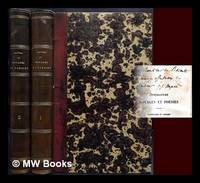
182559780Paris, Crochard, 1825. 8vo. Bound in contemporary half calf with gilt lettering to spine. In: ""Annales de Chimie et de Physique, Par MM. Gay-Lussac et Arago."", tome 29. Entire volume offered. Very light occassional foxing, otherwise a fine and clean copy with no institutional stamps. Pp. 381-404"" 373-381. [Entire volume: 448 pp. + folded plate].
182559780Paris Crochard 1825. 8vo. Bound in contemporary half calf with gilt lettering to spine. In: "Annales de Chimie et de Physique Par MM. Gay-Lussac et Arago." tome 29. Entire volume offered. Very light occassional foxing otherwise a fine and clean copy with no institutional stamps. Pp. 381-404; 373-381. Entire volume: 448 pp. folded plate. <br/><br/><em>First appearance of this famous memoir in which Ampère presented his collected results on electrodynamics to the French Academy creating the foundation of 19th century developments in electricity and magnetism. In the words of James Clark Maxwell "We can scarcely believe that Ampère really discovered the law of action by means of the experiments which he describes. We are led to suspect what indeed he tells us himself that he discovered the law by some process which he has not shown us and that when he had afterwards built up a pefect demonstration he removed all traces of the scaffolding by which he raised it." The offered memoir was published BEFORE the famous "Theorie mathématique des phénomènes électro-dynamiques uniquement déduite de L'expérience" which did not appear until 1827. That 1827-Memoire incorporates together with a new presentation of Ampère's results from 1820 1822 1823 the offered memoir 1825. Horblit: 100 - Dibner: 62. "From 1814 until 1820 Ampére did not perform the kind of research that would have made it into the annals of the histrory of science but on September 11 1820 when he heard Francois Arago speak about Oersted's work he got fresh inspiration and started the work that made him famous. Arago related how Oersted had found that a steady electric current influences the orientation of a compass needle. After a weak Ampère had determined experimentally that that two straight parallel and current-carrying wires execute a force on each other. The magnitude of the force is inversely proportional to the distance between the wires and proportional to the strenghts of the current. During the following years he continued his researches both experimentally and theoretically. he built an instrument for measuring electricity that later was developed into the galvanometer. Finally in 1825 he presented his collected results to the Academy IN ONE OF THE MOST CELEBRATED MEMOIRS IN THE HISTORY OF NATURAL PHILOSOPHY The paper offered." Citizen's Compendium p. 2. - Norman No 47. The volumes contain many other notable papers by: Wöhler Fresnel Marcet Berzelius Felix Savart De la Rive Braconnet Boussingault Magnus Poncelet Vaugelin Poisson Gay-Lussac Faraday Laplace etc. </em> unknown
18303542Paris, J. Barbezat, 1830 ; 4 tomes, in-8, demi-veau glacé aubergine, dos lisses ornés de grandes compositions romantiques dorées, titres dorés (reliure de l’époque, Vernier-Reitz) ; 512-516-415-535 pp.
181627600Paris: 1816 1816. First Edition. Hardcover. Very Good. André Ampère 1775-1836 classified the 48 known elements into three major families gaxolytes leucolytes and chriocolytes that he further divided into 15 "genres" based on "analogies" between the elements chemical properties that seemed related to one another. He did this in three papers in this multi-volume set:   <br/> Also contains Augustin Fresnel's "Mémoire sur la diffraction de la lumière où l'on examine particulièrement le phénomènes des franges colorées que présentent les ombres des corp éclaireés par un point lumineux" by Augustin Fresnel Volume I pp. 239-281 1816 and André Ampère's "D'une Classification naturelle pour les Corps simples" Annales de Chimie et de Physique 1 pp. 295-308 1816; "Suite de l'Essai d'une Classification naturelle pour les Corps simples" Volume I pp. 373-394 1816; and  "Suite d'une Classification naturelle pour les Corps simples" Volume II pp. 5-32 & 108-125 1816. 452 440 448 pp. 8vo. Volumes I & II have blue paper boards with a brown tape spine; Volume III has the same brown paper spine but with brown leather covers also has marbled endpapers. Light scuffing from shelf wear. Clean within. Numerous plates and illustrations some folding. Text in French. 1816 hardcover books
182448831Paris, Crochard, 1824. 8vo. Contemp. hcloth with gilt lettering to spine. In 'Annales de Chimie et de Physique', Series 2 - Volume 26. 448 pp. a. 5 large folded engraved plates. (Entire volume offered). Ampere's papers: pp. 134-162, 246-258 a. 390-411. A bit of browning to halftitle and verso of last plate. A few scattered brownspots.
182547420(Paris, Crochard, 1825). Extracted from ""Annales de Chimie et de Physique, Par MM. Gay-Lussac et Arago."", tome 29 a. 30. Ampère's papers: pp. 381-404 a. 1 folded engraved plate (tome 29) + Suite pp. 29-41 (tome 30) + ""Lettre à Gerhardi"": pp. 373-381 (tome 29). With both halftitlepages to vol. 29 a. 30. Scattered brownspots.
182448831Paris Crochard 1824. 8vo. Contemp. hcloth with gilt lettering to spine. In 'Annales de Chimie et de Physique' Series 2 - Volume 26. 448 pp. a. 5 large folded engraved plates. Entire volume offered. Ampere's papers: pp. 134-162 246-258 a. 390-411. A bit of browning to halftitle and verso of last plate. A few scattered brownspots. <br/><br/><em>The first paper is the first appearance of one of Ampere's importent contributions to electrodynamic. This memoir was later incorporated in his great memoir of 1827 "Mémoire sur la théorie mathématique des phénomenes electro-dynamiques." published 1827 the "Principia" of electrodynamics.The second paper is the first appearence of the paper in which Ampere describes his invention of the SOLENOID the electro-magnetic device he used in his early electrodynamical experiments."A solenoid is a coil wound into a tightly packed helix. In physics the term solenoid refers to a long thin loop of wire often wrapped around a metallic core which produces a magnetic field when an electric current is passed through it. Solenoids are important because they can create controlled magnetic fields and can be used as electromagnets. The term solenoid refers specifically to a magnet designed to produce a uniform magnetic field in a volume of space where some experiment might be carried out."The volume contains further importent papers by Poisson "Sur la Chaleur rayonnante" pp. 225-246 Note. pp. 442-44 Gay-Lussac Savart Pelletier et Caventou Becquerel etc. </em> hardcover
182547420Paris Crochard 1825. Extracted from "Annales de Chimie et de Physique Par MM. Gay-Lussac et Arago." tome 29 a. 30. Ampère's papers: pp. 381-404 a. 1 folded engraved plate tome 29 Suite pp. 29-41 tome 30 "Lettre à Gerhardi": pp. 373-381 tome 29. With both halftitlepages to vol. 29 a. 30. Scattered brownspots. <br/><br/><em>First appearance of this famous memoir in which Ampère presented his collected results on electrodynamics to the French Academy creating the foundation of 19th century developments in electricity and magnetism. In the words of James Clark Maxwell "We can scarcely believe that Ampère really discovered the law of action by means of the experiments which he describes. We are led to suspect what indeed he tells us himself that he discovered the law by some process which he has not shown us and that when he had afterwards built up a pefect demonstration he removed all traces of the scaffolding by which he raised it."The offered memoir was published BEFORE the famous "Theorie mathématique des phénomènes électro-dynamiques uniquement déduite de L'expérience" which did not appear until 1827. That 1827-Memoire incorporates together with a new presentation of Ampère's results from 1820 1822 1823 the offered memoir 1825. Horblit: 100 - Dibner: 62."From 1814 until 1820 Ampére did not perform the kind of research that would have made it into the annals of the histrory of science but on September 11 1820 when he heard Francois Arago speak about Oersted's work he got fresh inspiration and started the work that made him famous. Arago related how Oersted had found that a steady electric current influences the orientation of a compass needle. After a weak Ampère had determined experimentally that that two straight parallel and current-carrying wires execute a force on each other. The magnitude of the force is inversely proportional to the distance between the wires and proportional to the strenghts of the current. During the following years he continued his researches both experimentally and theoretically. he built an instrument for measuring electricity that later was developed into the galvanometer. Finally in 1825 he presented his collected results to the Academy IN ONE OF THE MOST CELEBRATED MEMOIRS IN THE HISTORY OF NATURAL PHILOSOPHY The paper offered." Citizen's Compendium p. 2. - Norman No 47. </em> unknown
1824317101824. Paris Crochard & Bachelier 1824 8° 24 pp. 1 folding plates untrimmed in contemporary wrapper; preserved in fine halfleather book case. Rare first edition! In 1824 Ampère invented the solenoid "Ampére knonstruiert zur Beobachtung der Wirkung galvanischer Ströme das Solenoid eine beweglich aufgehängte vom Strom druchflossene Drahtspirale welche sich nach Ampère's Gesetz so einstellt daß ihre Achse mit dem magnetischen Meridian zusammenfällt. Er brauchte den Kunstgriff die Drahtenden in Quecksilber zu sTellen" Darmstädter p.345 Weaver 814; Poggendorff I Sp.40; Cushing A.168 and Sotheran had only the second edition 1828 hardcover
240053S.l., s.d. (janvier-avril 1828) 7 parties en un vol. in-4, titre, [111] ff. n. ch., dont certains vierges entre les cahiers, écriture fine, cursive, mais lisible, environ 30 lignes par page, biffures et ratures occasionnelles, avec des figures géométriques dans le texte, demi-basane fauve modeste, dos lisse orné de filets dorés, titre poussé sur le dos "Analyse & mécanique I", coins en vélin rigide (reliure de l'époque). Dos très frotté.
182149574Leipzig, Johann Ambrosius Barth, 1821. 8vo. Contemp. hcalf. Gilt spine and with gilt lettering. Some scratches to spine. In: ""Annalen der Physik und der Physikalischen Chemie. Hrsg. Ludwig Wilhelm Gilbert"", Bd. 7 (= Bd. 67 der Reihe). (8),444 pp., 2 folded tables and 8 engraved plates. Small stamp to verso of titlepages. Ampére's paper: pp. 113-167 a. 225-258 with 4 engraved plates. Internally clean and fine.
182149574Leipzig Johann Ambrosius Barth 1821. 8vo. Contemp. hcalf. Gilt spine and with gilt lettering. Some scratches to spine. In: "Annalen der Physik und der Physikalischen Chemie. Hrsg. Ludwig Wilhelm Gilbert" Bd. 7 = Bd. 67 der Reihe. 8444 pp. 2 folded tables and 8 engraved plates. Small stamp to verso of titlepages. Ampére's paper: pp. 113-167 a. 225-258 with 4 engraved plates. Internally clean and fine. <br/><br/><em>First German versions of Ampére's famous papers the first announcements of Ampère's discoveries on electromagnetism being the German version of Ampére's "Mémoires sur I'action mutuelle de deux courans électriques sur celle qui existe entre un courant électrique et un aimant ou le globe terrestre et celle de deux aimans I'un sur I'autre."Ampère first heard of Ørsted's discovery of electromagnetism on the 4th of September when Arago announced Ørsted's results to the Paris Academy of Sciences. In Ørsted's experiment a current-carrying wire is held over and under a compass needle - the result being that the needle is positioned at 45 degrees in respect to the wire. Ampére immediately saw that this result made no physical sense and realized that the true nature of the effect could not be observed until the force of terrestrial magnetism was somehow neutralized; what Ørsted had observed and reported on was the resultant of the force from the wire and that from the earth's magnetic field. Ampère discovered that the compass needle sets at 90 degrees to the current-carrying wire when the effect of terrestial magnetism is eliminated. He also observed that current-carrying wires which are formed as spirals act as permanent magnets and this lead him to his theory that electricity in motion produces magnetism and that permanent magnets must contain electrical currents. And thus Ampère laid the foundation of the new field of electrodynamics.Ampère announced his theory and experimental results for the first time in a series of memoires read before the Paris Academy of Sciences in September and October 1820. These memoires were first published in the September and October issues of Arago's 'Annales de Chimie et de Physique'. In November Ampère had a seperate printing of his findings published under the title 'Mémoires sur I'action mutuelle de deux courans électriques sur celle qui existe entre un courant électrique et un aimant ou le globe terrestre et celle de deux aimans I'un sur I'autre.' Dibner 62 Norman 43. Honeyman 82 Barchas 51 Wheeler 762. The French versions.The volume contains other importent papers of historical importence relating to the discovery of electro-magnetism by Oersted in 1820. Raschig Bechstein Georg von Buquoy Prechtl Boisgiraud. </em> unknown
182444786Paris, Crochard, 1824. 8vo. Without wrappers. In 'Annales de Chimie et de Physique', Series 2 - Volume 26, issue 2 and 3. With titlepage to vol. 26. Pp. 113-224 a. pp. 225-336, 1 folded engraved plate (entire issues offered). Ampere's papers: pp. 134-162 a. pp. 246-258.
182444786Paris Crochard 1824. 8vo. Without wrappers. In 'Annales de Chimie et de Physique' Series 2 - Volume 26 issue 2 and 3. With titlepage to vol. 26. Pp. 113-224 a. pp. 225-336 1 folded engraved plate entire issues offered. Ampere's papers: pp. 134-162 a. pp. 246-258. <br/><br/><em>First appearance of one of Ampere's importent contributions to electrodynamic. This memoir was later incorporated in his great memoir of 1827 "Mémoire sur la théorie mathématique des phénomenes electro-dynamiques." published 1827 the "Principia" of electrodynamics. </em> unknown
16165Paris, Méquignon-Marvis, 1818-1822.
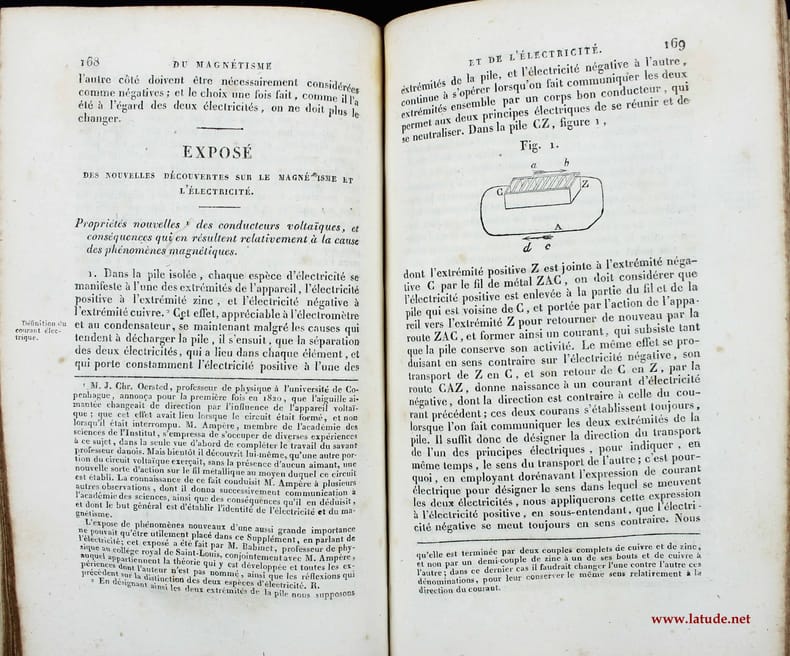
1825346411 vol. in-8 cartonnage marbré de l'époque, Chez Crochard, Paris, 1825, 448 pp. avec 3 planches dépliantes. Contient notamment : Mémoire sur une nouvelle Expérience électro-dynamique, sur son application à la formule qui représente l'action mutuelle de deux élémens de conducteurs voltaïques, et sur de nouvelles conséquences déduites de cette formule (Ampère) ; Lettre de M. Ampère à M. Gerhardi sur divers phénomènes électro-dynamiques ; Extrait d'un Rapport fait à l'Académie par M. Ampère sur les Piles sèches de M. Zamboni ; Examen de quelques minéraux du genre grenat (Vachmester) ; Note sur la Répulsion que des corps échauffés exercent les uns sur les autres à des distances sensibles (Fresnel) ; Note sur l'existence de l'iode dans le règne minéral (Vauquelin) ; Analyse des Séléniures du Harz oriental (Rose) ; Sur la séparation de l'acide titanique de l'oxide de fer (Henri Rose) ; Analyse d'un Alliage d'or avec du rhodium, de la maison du Départ de Mexico (André del Rio) ; De l'action des poisons sur le règne végétal (Marcet) ; Examen du Platine trouvé en Russie (Laugier) ; Nouvelles Recherches sur les Vibrations de l'air (Félix Savart), etc...
162379First Edition. hardcover. 2 vols. 8vo handsomely bound in modern 3/4 red morocco original wrappers bound in both volumes; original wrappers in both volumes lightly soiled bookplate of former owner on half-title in each volume a few lines of text underlined in pencil on one page in vol. II very light foxing to some pages in both volumes otherwise very good. Paris: Michel Levy 1855.<br/><br/> "Jean Jacques Ampere was a teacher historian philologist authority on Scandinavian and German epic poetry and a member of the French Academy. He made a grand tour of.the United States Cuba and Mexico." Clark III 442. During his travel in the United States Ampere ".covered the east and the south and as far west as Cincinnati and Chicago." Howes A-222<br/><br/> unknown books
1855162379Paris: Michel Levy 1855. First Edition. hardcover. 2 vols. 8vo handsomely bound in modern 3/4 red morocco original wrappers bound in both volumes; original wrappers in both volumes lightly soiled bookplate of former owner on half-title in each volume a few lines of text underlined in pencil on one page in vol. II very light foxing to some pages in both volumes otherwise very good. Paris: Michel Levy 1855.<br/> <br/> "Jean Jacques Ampere was a teacher historian philologist authority on Scandinavian and German epic poetry and a member of the French Academy. He made a grand tour of.the United States Cuba and Mexico." Clark III 442. During his travel in the United States Ampere ".covered the east and the south and as far west as Cincinnati and Chicago." Howes A-222<br/> <br/> Michel Levy unknown
1824346381 vol. in-8 cartonnage marbré de l'époque, Chez Crochard, Paris, 1824, 448 pp. avec 7 planches dont 6 planches dépliantes hors texte, Contient notamment : Extrait d'un Mémoire sur les Phénomènes électro-dynamiques (Ampère) - Sur la chaleur rayonnante - Note relative au Mémoire sur la Chaleur rayonnante (Poisson) - Développemens relatifs aux Effets électriques observés dans les actions chimiques ; et de la Distribution de l'électricité dans la pile de Volta, en tenant compte des actions électro-motrices des liquides sur les métaux (Becquerel) - Description d'un appareil électro-dynamique (Ampère). Recherches sur les usages de la membrane du tympan et de l'oreille externe (Savart) ; Instruction sur les Paratonnerrres (Gay-Lussac) ; Sur la corrosion du cuivre qui forme le doublage des vaisseaux (Davy) ; Observations sur la température de la terre à Paramatta (Nouvelle-Galles du Sud par Sir Brisbane) ; Instruction sur l'Essai du Chlorure de Chaux (Gay-Lussac) ; Extrait d'un mémoire sur les mortiers hydrauliques (Treussart) ; Examen chimique d'un fragment d'une masse saline considérable rejetée par le Vésuve dans l'éruption qui a eu lieu en 1822 (Laugier) ; etc...
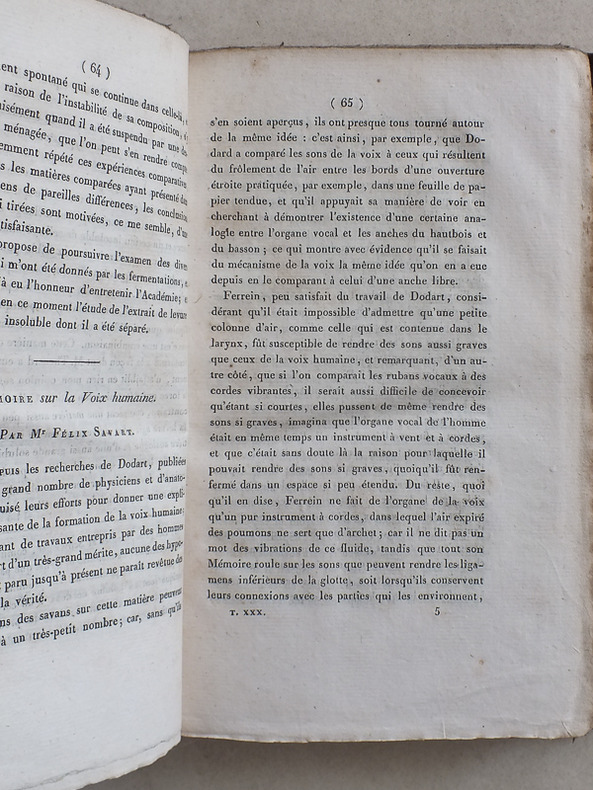
1825346421 vol. in-8 cartonnage marbré de l'époque, Chez Crochard, Paris, 1825, 448 pp. avec 2 planches dépliantes. Contient notamment : Suite du Mémoire de M. Ampère sur une nouvelle Expérience électro-dynamique, sur son application à la formule qui représente l'action mutuelle de deux élémens de conducteurs voltaïques, et sur de nouvelles conséquences déduites de cette formule (Ampère) ; Mémoire sur la Voix humaine (Félix Savart) ; Recherches relatives à l'Influence de la température sur les forces magnétiques (A.-F. Kupffer) ; Mémoire sur les Roues verticales à palettes courbes mues par dessous, suivi d'expériences sur les effets mécaniques de ces roues (Poncelet) ; Lettre de M. Marcel de Serres à M. Gay-Lussac sur les Cavernes à ossemens ; De l'Influence exercée par divers milieux sur le nombre de vibrations des corps solides (Félix Savart) ; etc...
1331709Unsigned manuscript in the hand of Jean-Jacque Antoine Ampere son of physicist André Marie Ampère with calculus equations on both sides. Sheet measures 17 1/2 x10 3/4 cm. Part of the Maurice Car Collection. Shelved case 0. 1331709. Shelved Dupont Bookstore. unknown books
182141248Paris, Crochard, 1821. Contemp. full cloth. Light wear to spine ends. Gilt lettering to spine. In: Annales de Chimie et de Physique, Par MM. Gay-Lussac et Arago."", Tome 18. 448 pp. and 6 folded engraved plates (4 of these belonging to the described papers). Ampère: pp. 88-106 + pp. 313-333 and 4 plates. Faraday: pp. 337-379. Savary: pp. 370-379. The plates depicts experimental arrangements and Ampère's initial Rotation Apparatus. The whole volume present.
182141248Paris Crochard 1821. Contemp. full cloth. Light wear to spine ends. Gilt lettering to spine. In: Annales de Chimie et de Physique Par MM. Gay-Lussac et Arago." Tome 18. 448 pp. and 6 folded engraved plates 4 of these belonging to the described papers. Ampère: pp. 88-106 pp. 313-333 and 4 plates. Faraday: pp. 337-379. Savary: pp. 370-379. The plates depicts experimental arrangements and Ampère's initial Rotation Apparatus. The whole volume present. <br/><br/><em>Fisrt edition and first printings of the demonstrations of Ampere's new Equilibrium technique. When Faraday had completed his importent paper on Electro-magnetic motions the paper offered here in the first French edition he send it to Ampere. Ampere invented the Rotation Apparatus in order to repeat Faraday's experiment on the electro-magnetic rotation. He produced an uninterrupted rotation either of magnetic pole around a wire or of a wire around a magnetic pole. From these experiments originated a new theory of electricity and magnetism. - The third memoir is the First French edition of Faraday's famous paper "On some New Electro-Magnetical Motions and on the Theory of Magnetism" Quaterly Journal of Science October 1821 in which is recorded for the first time the conversion of electrical into mechanical energy. It also contains the first notion of the "Line of Force". He employed a magnet and a wire with a flowing current which causd each separately to rotate round the other. He concluded that a current-carrying wire is sorraunded by a circular "line of force". Oersted had spoken of the "electrical conflict" surrounding the wire and had noted that "this conflict performs circles". </em> hardcover
1850438105Paris : Didier 1850. First Edition. Hardcover. Very good copy bound in contemporary 1/2 leather over marbled boards. Gilt-blocked leather label to spine with spine bands uniformly tooled in gilt. Marbled endpapers. Spine bands and panel edges slighty rubbed and dulled as with age. Remains particularly well-preserved overall; tight bright clean and strong. Signed and inscribed by the author. Physical description; 2 v. ; 19 cm. Subjects; Literature Modern History and criticism. Paris : Didier hardcover
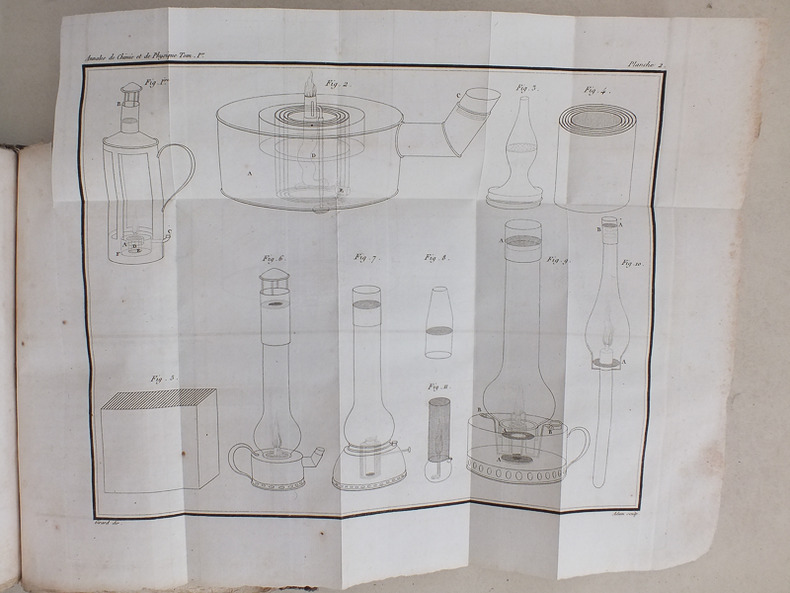
1816346131 vol. in-8 cartonnage d'origine, Chez Crochard, Paris, 1816, 452 pp. avec 3 planches dépliantes hors texte . Contient notamment : Sur les Puissances réfractives et dispersives de certains liquides et des vapeurs qu'ils forment (Arago et Petit) ; Note sur le Principe colorant du sang des Animaux (Vauquelin) ; Expériences sur la combustion du Diamant et d'autres substances carbonacées (Humphry Davy) ; Observations sur l'oxidation de quelques métaux (Gay-Lussac) ; Relation de la chute d'une pierre météorique tombée dans les environs de Langres (Virey) ; Sur la hauteur relative des Niveaux de la mer Noire et de la mer Caspienne (Maurice d'Engelhardt et François Parrot) ; Tables des dilatations linéaires qu'éprouvent différentes substances depuis le terme de la congélation de l'eau jusqu'à celui de son ébullition d'après les expériences de MM. de Laplace, Lavoisier, Smeaton, Roy ; Description d'un nouveau Baromètre portatif (Gay-Lussac) ; Mémoire sur l'air inflammable des mines de charbon (Humphry Davy) ; Observations sur l'influence que le vent apporte dans la propagation du son (Delaroche) ; Note sur un phénomène remarquable qui s'observe dans la diffraction de la lumière (Arago) ; Sur les lois que l'on observe dans la distribution des formes végétales (Alex. de Humboldt) ; Mémoire sur la Diffraction de la lumière, où l'on examine particulièrement le phénomène des franges colorées que présentent les ombres des corps éclairés par un point lumineux (Fresnel) ; Essai d'une classification naturelle pour les Corps Simples (Ampère) ; Suite de l'Essai (Ampère) ; Sur les lampes de sûreté de Sir Humphry Davy ; Justification de la Théorie de M. Dalton, sur l'absorption des Gaz par l'eau, contre les conclusions de M. de Saussuren par M. John Dalton ; Sur les combinaisons de l'Azote avec l'Oxigène (Gay-Lussac) ; Sur la vertu électrique de quelques minéraux (M. Haüy)