13 336 résultats
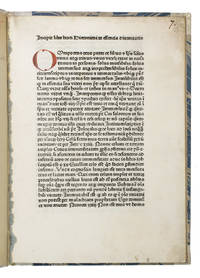
1468ABC_47851Augsburg: Günther Zainer 1468. 20th-century quarter vellum with blue and brown marbled paper sides blue edges modern brown blue and red marbled endpapers. Folio. With manuscript initials in red throughout a 4-line initial at the start of the first work a 3-line initial at the start of the second work and 2-line initials at the start of new paragraphs. Including: AQUINAS Thomas. De articulis fidei et ecclesiae sacramentis. The first and only incunable edition of this theological work printed by the first printer of Augsburg Günther Zainer -1478. He started his printing career in Augsburg in 1468 and is known to have been one of the printers at the new printing shop in the Augsburg Saint Ulrich and Saint Afra's Abbey. He probably learned the trade from Johannes Mentelin ca. 1410-1478 in Strasbourg. Zainer's paper presswork and typefaces are all of high quality and about 80 books are known to have been printed by him.The De essentia divinitatis the first tract in this collection was thought to have been written by Saint Jerome but it is actually the first chapter of Formulae spiritualis intelligentiae by Saint Eucherius of Lyon ca. 380-ca. 449. In the present edition this tract is printed together with Aquinas' De articulis fidei; the second tract starts on the leaf on which the first one ends. These works are part of a larger collection of separately published tracts which includes Imitatio Christi by Thomas à Kempis Soliloquia by Saint Augustine and Dispositorium moriendi by Johannes Nider. Nearly each tract was sold independently so every collection differs in composition and number varying from 1 to 11 of tracts.With the bookplate of Bernd Pattloch mounted on the front pastedown and a manicule in the margin of page 14 of Aquinas's tract and some manuscript annotations in the margins of several leaves. The spine is slightly rubbed and the blue edges are mostly faded. The gutters of the first and last leaves excluding the modern endpapers show remnants of earlier blue paper wrappers. With a water stain in the lower corner throughout and a water stain in the outer margin in the second half of the work both without affecting the text. With a repair in the blank foot margin on the final leaf of the text and in the outer margin of the last blank leaf. Overall in good condition.l Goff H-179; GW 12451 II; Hain-Copinger 8589; IDL 2290; ISTC ih00179000; Oates 884; Proctor 1564 mentions only 6 leaves; cf. Hampden The life of Thomas Aquinas: A dissertation of the scholastic philosophy of the middle ages 1848; Saint Eucherius Formulas for spiritual intelligence translated by D. P. Curtin. Günther Zainer, hardcover
19600001561Liao Village Yong Qing County HeBei Province PEO. Good. 1960. On offer is an extraordinary original historically significant 139 page manuscript archive of Mao Zedong's Cultural Revolution handwritten by a man named Liao Zi Yu of Liao Village Yong Qing County HeBei Province was born in 1912 worked as a proof-reader at the printing works the HeBei Agriculture University from 1951 to 1973. The Liao family owned 1400 Mu of the land before 1937 and it also owned a shop selling fabrics. Liao ZiYu inherited properties including land of 710 Mu brick house with 30 rooms mud house with 3 rooms 6 large animals and 2 man-powered vehicles. He started to manage the family affairs in 1934 together with his brother who was killed by the Japanese in 1938. He then worked alone till 1946 when the Land Reform reached the area. At the onset of Mao Zedong's Cultural Revolution landlords and capitalists in the urban and rural centres were identified and accused of exploiting and oppressing the working class. Overthrowing the exploiting and oppressing class was a primary concern of Chairman Mao and the Communist Party of China. Mao pushed the Chinese into a civil war in order to overthrow the Republic of China which succeeded and the result People's Republic of China in 1949. Mao then began to liquidate and suppress those persons who belonged to the exploiting class. This was known as the 'Movement of Suppressing Counter-Revolutionaries' in early 1950's in China. In this archive we follow Liao Zi Yu's attempt to avoid being suppressed as a member of the exploiting class and a counter-revolutionary by moving and concealing his real identity. He lived hidden and got work as a common labourer for more than ten years from 1949. But early on in the Cultural Revolution his real identity was disclosed as was his former life as a landlord. From that time on his was a doomed life: investigated jailed and forced to confess his crime this file recorded the complete process. RESEARCH NOTES: He was accused of 1 Exploitation of the workers: He employed 7 long term workers 6 monthly ones 4 to 5 short term ones and 4 others for the house duties. He owned 5 pieces of gun. He exploited the workers brutally. 2 Exploitation of the land rental: He rented out over half of his land holdings with rent up to 4 Yuan per Mu. The rent must be paid before October for next year's rental. He forced the peasants to pay the rent using the power of his uncle who was the town's Reeve. 3 Serving the enemy: He was the town secretary of AnCi County for a month by making anticommunist slogans such as "Welcome the Nationalist Army". 4 Escaping the supervised labour: He got a job at the HeBei Agriculture University by falsifying his résumé and hiding the fact that he was a land owner. He was put into the supervised reform by the revolutionary mass in 1966 soon after the exposure of him as a landowner. He was moved by the policies of the communist party and was able to admit his crime and made confession. He was not classified as the landowner but would be expelled from the University and be sent back to his home village to work as a farmer. The decision was reached by the committees of the communist party at the levels of the printing works the University and the District of BaoDing in a period from 1970 to 1973. The archive includes: comprehensive files regarding the investigation evidence confession 80 pages!! handwritten on People's Republic of China stationary. Overall G. HISTORICAL NOTES: As one online source succinctly sums up the times: "People's Republic of China from 1966 through 1976. Set into motion by Mao Zedong then Chairman of the Communist Party of China its stated goal was to enforce socialism in the country by removing capitalist traditional and cultural elements from Chinese society and impose Maoist orthodoxy within the Party. The most important yet naturally unstated reason for the revolution was the return of Mao Zedong to a position of political power after he lost most of his political influence after his failed Great leap forward."; Chinese Language; 4to - over 9¾" - 12" tall; KEYWORDS: HISTORY OF GREAT PROLETARIAN CULTURAL REVOLUTION CULTURAL REVOLUTION CONFESSIONS RECENT ANTI SOCIALIST ACTIVITIES ANTI CAPITALISM MAO ZEDONG MAO TSE TUNG GREAT LEAP FORWARD MAOIST SOCIALISM COMMUNISM MOVEMENT OF SUPPRESSING COUNTER-REVOLUTIONARIES MIAO ZI YU COMMUNIST CHINE CHINESE SINO POLITICS JIANG QING GRASSROOTS SOCIALISM PROPAGANDA POST FIVE YEAR PLAN 5 YEAR PLAN GANG OF 4 GANG OF FOUR LIN BIAO BEIJING PENG LUO LU AND YANG ZHONGFA 267 INDOCTRINATION RED CHINA CHAIRMAN MAO MARXISM-LENINISM MAOISM LIN YURONG HANDWRITTEN MANUSCRIPT AMERICANA DOCUMENT LETTER AUTOGRAPH DIARY JOURNAL LOG KEEPSAKE WRITER HAND WRITTEN DOCUMENTS SIGNED LETTERS MANUSCRIPTS HISTORICAL HOLOGRAPH WRITERS DIARIES JOURNALS LOGS AUTOGRAPHS PERSONAL MEMOIR MEMORIAL PERSONAL HISTORY antiquité contrat vélin document manuscrit papier Antike Brief Pergament Dokument Manuskript Papier oggetto d'antiquariato atto velina documento manoscritto carta antigüedad hecho vitela documento manuscrito Liao Village Yong Qing County HeBei Province . unknown
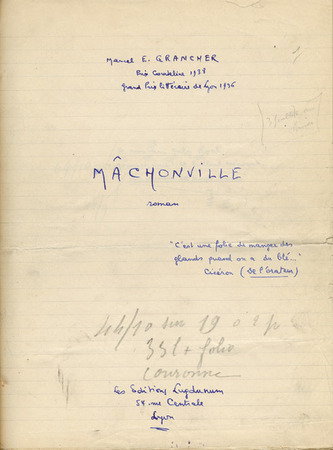
19425627et qui paraitra sous le titre définitif "Le Charcutier de Machonville", par Marcel-E. Grancher, auteur lyonnais, journaliste, écrivain, un des principaux chefs de la Résistance à Lyon pendant l'Occupation allemande. In-4 ; demi-maroquin bordeaux, dos à nerfs, titre doré, non rogné ; (3) ff., 230 feuillets recto, à l'écriture bien lisible.Il s'agit du manuscrit brut, rempli de ratures, rajouts, modifications diverses y compris de bandes collées, du plus célèbre roman de Grancher, Grand Prix littéraire de Lyon en 1936 et Prix Courteline en 1938 ; il est daté de "Reyrieux, janvier 1942" et est émaillé d'indications typographiques. Comme il ne s'agit pas de la "mise au propre", il serait intéressant de comparer précisément ce texte avec celui finalement publié.Mention manuscrite sur la page de garde : "J'ai relié ce livre pendant la guerre de 40, le client ne m'a pas donné son nom ni adresse, je le tiens donc à sa disposition. Signé H. Jacquet, relieur 7, rue des Marronniers. Lyon".Document en très bel état.
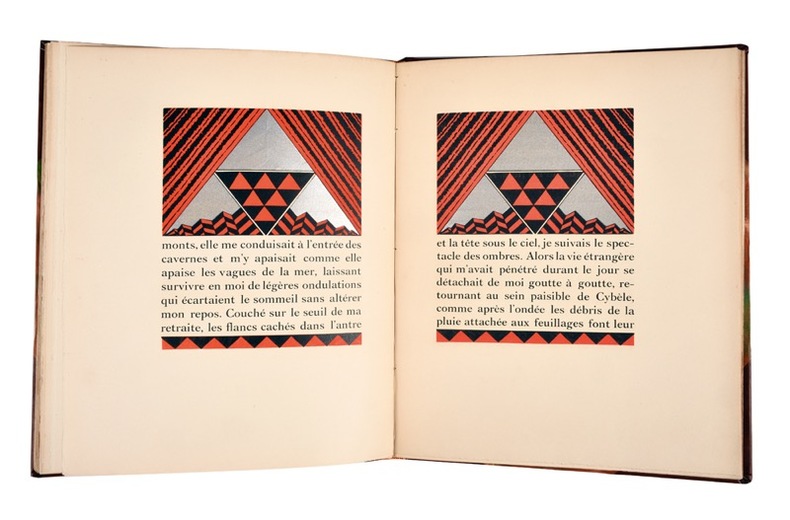
192921587Lyon, (Aux dépens du Cercle Gryphe, Marius Audin imprimeur), 1929. In-quarto, demi-basane à coins fauve, dos décoré de 20 nerfs épais, titre doré à la japonaise, couverture illustrée du logo du Cercle Gryphe gravé sur bois par Philippe Burnot et tiré en rouge (Missol relieur-Lyon) ; [38] ff., le premier blanc; illustré de 73 compositions géométriques de Claudius Linossier gravées sur bois par Philippe Burnot et tirées en rouge, noir, gris, beige et argent (palladium).
33427Complet en 625 pages in8 reliées en deux volumes - râtures et corrections - Reliure cartonnées plein papier - petit accroc - trés bon état - La date du 15 février 1924 est rayée -
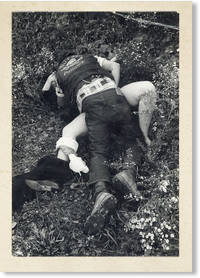
196543698N.p.: S.i. 1965. Original silver gelatin photograph measuring 6" x 8.75" 15.25cm x 22.5cm; mounted to off-white mat board to a total size of 11" x 14" 28cm x 35.5cm. Photographer has titled dated and signed on verso of matting: "McHenry Illinois. Oct.1965. Danny Lyon." Photograph shows some trivial wear to extremities a diagonal crease to upper right corner and faint spidering across center; Very Good. Mild toning to mat board with some scattered foxing and a few faint stains. An outtake from Lyon's 1968 debut The Bikeriders his attempt at recording and glorifying American motorcycle culture. "McHenry Illinois" depicts a member of the Chicago Outlaws motorcycle club of Cicero Illinois mounting his girlfriend in a field of grass and wildflowers. Lyon lived and traveled with the Outlaws between 1963-1967 becoming a member of the club and immersing himself in all aspects of their activities. Provenance: From the collection of Steve Dalber Lyon's roommate at the University of Chicago. S.i. unknown
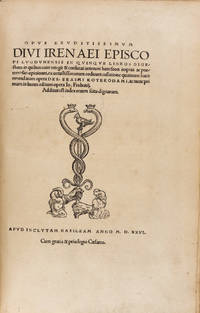
152642820865<p>FIRST EDITION of the works of Irenaeus "<strong>the father of Christian theology</strong>" as he is widely known.</p><p>Irenaeus is one of the most important of the early Church Fathers. Writing at the end of the second century with the authority of direct links to the followers of the original Apostles he defended the Church against existential threats and helped to establish its fundamental underpinnings.</p><p>Irenaeus's principal work is <em>Adversus Haereses</em> Against Heresies "<strong>one of the most precious remains of early Christian antiquity</strong>." The work comprises a refutation of the Gnostic heresies then a serious threat to the Church and exposition and defense of the Catholic faith" Roberts ed. Saint Irenaeus of Lyons <em>Against Heresies</em>. This is "the chief work of Irenaeus and truly of the highest importance; it … constitutes an invaluable source of information on the most ancient ecclesiastical literature from its beginnings to the end of the second century. In refuting the heterodox systems Irenaeus often opposes to them the true doctrine of the Church and in this way furnishes positive and very early evidence of high importance. Suffice it to mention the passages so often and so fully commented upon by theologians and polemical writers concerning the origin of the Gospel according to St. John the Holy Eucharist and the primacy of the Roman Church" <em>Catholic Encyclopedia</em>.</p><p><strong>Irenaeus is "one of the few really original and creative thinkers in the history of the church … He united the ethical and religious the legal and the mystical and so founded historic Catholicism … To no other Father does Catholic theology owe so much"</strong> McGiffert.</p><p>"Irenaeus asserted in a positive manner the validity of the Jewish Bible the Old Testament which the Gnostics denied claiming that it upheld the laws of the Creator God of wrath. Though Irenaeus did not actually refer to two testaments one old and one new he prepared the way for this terminology. He asserted the validity of the two testaments at a time when concern for the unity and the difference between the two parts of the Bible was developing. Many works claiming scriptural authority which included a large number by Gnostics flourished in the 2nd century; by his attacks on the Gnostics Irenaeus helped to diminish the importance of such works and to establish a canon of Scriptures" <em>Encyclopedia Britannica</em> 11th ed. Irenaeus the earliest witness to the four gospels as canon played a central role in establishing the canonical Christian Bible.</p><p>Edited by Erasmus this first edition of Irenaeus was central to Erasmus's effort to publish the works of the Church Fathers at the Froben Press at Basel. Erasmus was convinced that the Roman Catholic Church would only be fully reformed and renewed by turning again to the Bible as interpreted by the Fathers of the Church. More than any other single figure Erasmus brought to light the ancient writings of the Church Fathers. In the case of Irenaeus Erasmus crowed in his preface "Why should I not call him 'mine' since I found him almost buried and have done my best to clear away the dust of ages and restore him to the light"</p><p>The first edition of Irenaeus is very scarce in collector's condition. No example has appeared for public sale in the past thirty years.</p><p>Bound with the following work which is first in the volume:</p><p>CLEMENT I Pope. <em>Divi Clementis Recognitionvm Libri X. Ad Iacobvm Fratrem Domini Rvfino Torano Aqvileiense Interprete…</em> Basel: Froben 1526.</p><p>First edition. This work once attributed to Pope Clement I concerns on St. Peter and his disciple Clement. The ornamental borders are designed by Hans Holbein.</p><p>Folio. Contemporary blind-tooled pigskin over wooden boards stained and with some wear and scratches clasps manuscript title on spine. Early inscriptions including marginalia and underlining h4 repaired small wormhole to last leaf. A very good copy.</p> Froben hardcover
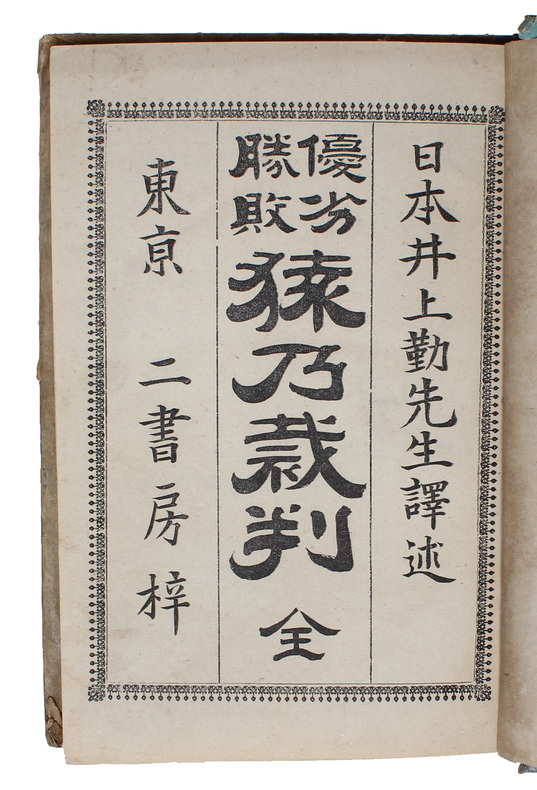
188157971Tokyo, Nishimura Tomijiro, Fukuda Eizo, Meiji 21 [1881]. 8vo. In the original cloth binding with printed front board (depicting a monkey reading a newspaper). Light wear and soiling to extremities and end papers soiled, otherwise in fine condition. 285 pp. + 3 plates.
188157971Tokyo Nishimura Tomijiro Fukuda Eizo Meiji 21 1881. 8vo. In the original cloth binding with printed front board depicting a monkey reading a newspaper. Light wear and soiling to extremities and end papers soiled otherwise in fine condition. 285 pp. 3 plates. <br/><br/><em>The rare first Japanese translation of W. P. Lyon's anti-evolutionary text ' Homo versus Darwin'. It constitutes the very first publication in Japanese to reject Darwin's theory. A year after the publication the book was banned for 'corrupting public morals'.The present work is Lyon's reply to the publication of Darwin's The Descent of Man. Here he sees Darwin being charged by Homo of denying him from being a creature made by a God and declaring man to be merely some kind of animal. The author is recorded as being 'Eisa Gurei' Asa Gray but in 1986 a study confirmed the text to be a translation of Lyon's work.'Saru no Saiban' is an important work in the history of the reception of Darwinism in Japan. Darwin's theories had a profound influence on Japan and Japanese culture but in a slightly different way than in the West: Darwinism was marked as social and political principles primarily embraced by social thinkers philosophers and politicians to advocate the superiority of Japanese culture and society and military and not by biologists and zoologists. "It was as if Darwin's famous oceanic journey and the meticulous research into the animal and plant kingdoms that he spent his life undertaking had all been staged as an elaborate excuse for composing a theory whose true object was Victorian society and the fate of the world's modern nations." Golley Darwinism in Japan: The Birth of Ecology. </em> hardcover
1492Millertown NY: Aperture. 1st Edition. Hardcover. Good/Very Good. FIRST TRADE EDITION DANNY LYON'S OWN ANNOTATED COPY. 
This copy Lyon's own was sent to the former executive editor of Camera Arts Fred Ritchen. Lyon's enclosed letter states "I've marked some pages which I think makes a good progression over the years showing a change in subject and style… For the most part I have also marked pictures that are less well known and often have only appeared in print in this book. Nothing was run by any magazines when the hard back was printed… P.S. I'll need this particular copy back when you're done as it is my own; though I'm sure I can get you another from Aperture" December 17 1982. The resultant May 1983 issue of Camera Arts is included as is a provenance letter by Tom Ridinger co-founder of Camera Arts stating this "must be the rarest copy of Danny Lyon's Pictures from the New World." Lyon critiques his most famous subject in this copy scrawling "A BAD reproduction of my BEST picture Bike riders" pg. 30. This copy features around a dozen pages with pencilled layout drawings and instructions and over a dozen pages marked with Lyon's original paper clips and sticky tabs. Danny Lyon was a twentieth-century photographic luminary who released Pictures from the New World in 1981 on the dynamic work of his past eighteen years. In the introduction he writes "In order to to make this book I have had to face directly everything I have done in photography…Now I give it back to you America from whom I took it all in the first place. The slate is clean and I am free to begin again." "Among a group of revolutionaries whose work rose to prominence in the late 1960s and '70s and transformed the nature of documentary photography - a group that includes friends and colleagues of Mr. Lyon's like Mary Ellen Mark and Larry Clark - the idea of conscience has been imbedded more deeply in Mr. Lyon's photographs than in those of all but a few of his contemporaries" The New York Times April 24 2009. The Focal Encyclopedia of Photography recounts"He was self-taught as a photographer and his first images document the social struggle. It was a pattern to be repeated throughout his career - to actively live with subgroups or participate with segments of society he would document. He became a member of a Chicago motorcycle gang The Outlaws before producing the book The Bike Riders in 1968. Later he spent time with construction workers stock care races prison inmates and peoples of the Third World to make his books and films" pg. 268. Millertown NY: Aperture 1981. Oblong quarto original cloth original dust jacket; custom silk box. Text block sprung from binding; very clean text. Dust jacket with only a centimeter closed tear and light toning. Also with: a letter from Danny Lyon about this copy an additional letter of provenance from Tom Ridinger and associated magazine copy. A significant ensemble illustrating Lyon's own assessment of his work. Aperture hardcover books
1492Millertown NY: Aperture. 1st Edition. Hardcover. Good/Very Good. FIRST TRADE EDITION DANNY LYON'S OWN ANNOTATED COPY. 
This copy Lyon's own was sent to the former executive editor of Camera Arts Fred Ritchen. Lyon's enclosed letter states "I've marked some pages which I think makes a good progression over the years showing a change in subject and style… For the most part I have also marked pictures that are less well known and often have only appeared in print in this book. Nothing was run by any magazines when the hard back was printed… P.S. I'll need this particular copy back when you're done as it is my own; though I'm sure I can get you another from Aperture" December 17 1982. The resultant May 1983 issue of Camera Arts is included as is a provenance letter by Tom Ridinger co-founder of Camera Arts stating this "must be the rarest copy of Danny Lyon's Pictures from the New World." Lyon critiques his most famous subject in this copy scrawling "A BAD reproduction of my BEST picture Bike riders" pg. 30. This copy features around a dozen pages with pencilled layout drawings and instructions and over a dozen pages marked with Lyon's original paper clips and sticky tabs. Danny Lyon was a twentieth-century photographic luminary who released Pictures from the New World in 1981 on the dynamic work of his past eighteen years. In the introduction he writes "In order to to make this book I have had to face directly everything I have done in photography…Now I give it back to you America from whom I took it all in the first place. The slate is clean and I am free to begin again." "Among a group of revolutionaries whose work rose to prominence in the late 1960s and '70s and transformed the nature of documentary photography - a group that includes friends and colleagues of Mr. Lyon's like Mary Ellen Mark and Larry Clark - the idea of conscience has been imbedded more deeply in Mr. Lyon's photographs than in those of all but a few of his contemporaries" The New York Times April 24 2009. The Focal Encyclopedia of Photography recounts"He was self-taught as a photographer and his first images document the social struggle. It was a pattern to be repeated throughout his career - to actively live with subgroups or participate with segments of society he would document. He became a member of a Chicago motorcycle gang The Outlaws before producing the book The Bike Riders in 1968. Later he spent time with construction workers stock care races prison inmates and peoples of the Third World to make his books and films" pg. 268. Millertown NY: Aperture 1981. Oblong quarto original cloth original dust jacket; custom silk box. Text block sprung from binding; very clean text. Dust jacket with only a centimeter closed tear and light toning. Also with: a letter from Danny Lyon about this copy an additional letter of provenance from Tom Ridinger and associated magazine copy. A significant ensemble illustrating Lyon's own assessment of his work. Aperture hardcover
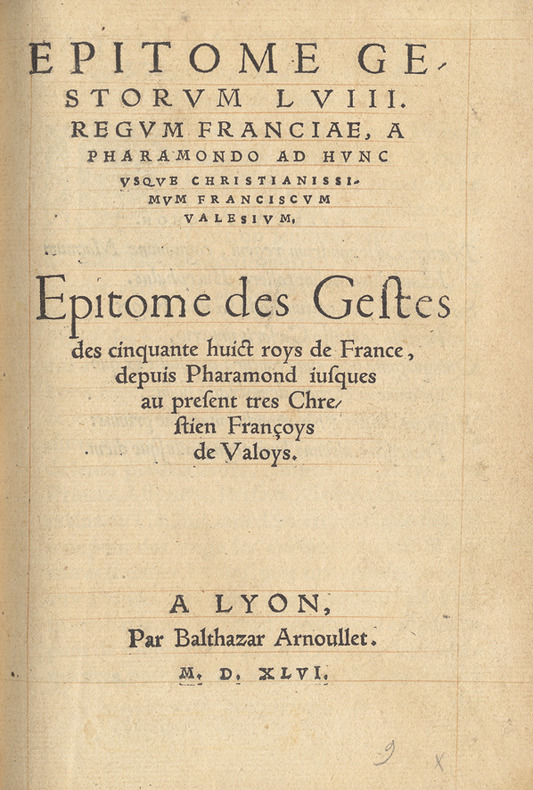
154616173Lyon, Balthazar Arnoullet, 1546 ; in-4 (178x124mm) ; maroquin lavallière, dos à nerfs pincés, titre doré, filets dorés sur les coupes, roulette intérieure, tranches dorées sur marbrure (R. Petit) ; 159, (1) pp., 58 portraits signés CC (Claude Corneille) ; exemplaire entièrement réglé (A-V4).
33428328 pages in-folio et 20 pages de notes préparatoires, sur papier bleu, corrigées à l'encre rouge - Reliure en maroquin havane à encadrement, dos plat, plats de papier peigné - tête dorée - trés bon état -
179914752Richmond Virginia: James Lyon 1799. Original wraps. Good . The June 1st 1799 maiden issue of "National Magazine" which represents the first magazine ever published in Virginia the first magazine printing of the Virginia Constitution and Kentucky Resolutions and "an extraordinary contemporary resource for the anti-Federalist Jeffersonian Strict Constructionist philosophy of the Virginia School a philosophy that Virginians developed to oppose the policies of Alexander Hamilton and the Washington-Adams administrations " from "The Remnant Trust". This the "first National Magazine" was issued in Richmond by its young publisher and editor James Lyon and was printed semi-quarterly. Six issues all told were published in Richmond "after which Lyon removed to the new seat of the Federal government". This orginal issue has been beautifully and skillfully re-bound in 1998 by the Thistle Bindery of Florence MA and has had both its original light-brown wrappers seemlessly bound-in. The wrappers show chipping along the edges and a degree of inevitable wear but miraculously almost no loss to the titling. Crisp new endsheets and thick card wrappers nicely protect the fragile original text which has held up surprisingly well. There's a bit of light forgivable offsetting to the body --and along the original endsheets-- and the Subscription page which shows that one "Prin Perkins" is to receive a six month subscription for the price of two dollars INCLUDES JAMES LYON'S STRONG SIGNATURE IN INK AS AFFIRMATION. Octavo 107 original pgs. plus an itemized laid-in letter from Thistle Bindery and a wonderful handwritten 2 pg. example of "Binder's Notes" along the new rear endsheets mapping out the care --and the technical processes-- that went into both creating such an elegant re-binding and protecting the original text. An impressive important piece of Americana. James Lyon unknown
179914752Richmond Virginia: James Lyon 1799. Original wraps. Good . The June 1st 1799 maiden issue of "National Magazine" which represents the first magazine ever published in Virginia the first magazine printing of the Virginia Constitution and Kentucky Resolutions and "an extraordinary contemporary resource for the anti-Federalist Jeffersonian Strict Constructionist philosophy of the Virginia School a philosophy that Virginians developed to oppose the policies of Alexander Hamilton and the Washington-Adams administrations " from "The Remnant Trust". This the "first National Magazine" was issued in Richmond by its young publisher and editor James Lyon and was printed semi-quarterly. Six issues all told were published in Richmond "after which Lyon removed to the new seat of the Federal government". This orginal issue has been beautifully and skillfully re-bound in 1998 by the Thistle Bindery of Florence MA and has had both its original light-brown wrappers seemlessly bound-in. The wrappers show chipping along the edges and a degree of inevitable wear but miraculously almost no loss to the titling. Crisp new endsheets and thick card wrappers nicely protect the fragile original text which has held up surprisingly well. There's a bit of light forgivable offsetting to the body --and along the original endsheets-- and the Subscription page which shows that one "Prin Perkins" is to receive a six month subscription for the price of two dollars INCLUDES JAMES LYON'S STRONG SIGNATURE IN INK AS AFFIRMATION. Octavo 107 original pgs. plus an itemized laid-in letter from Thistle Bindery and a wonderful handwritten 2 pg. example of "Binder's Notes" along the new rear endsheets mapping out the care --and the technical processes-- that went into both creating such an elegant re-binding and protecting the original text. An impressive important piece of Americana. <br/><br/> James Lyon paperback books
193320863S.d. (circa 1933-1934); in-folio en feuilles, couverture rempliée gris clair illustrée, chemise demi velin et pièce de titre en cuir, titre doré, papier à la cuve multicolore et doré en forme de feuillage, étui de même ; 86 feuillets non chiffrés, le dernier blanc ; couverture et 50 aquarelles originales de Barta, dont 3 hors-texte.
164219929Lyon, Jean Caffin et F. Plaignard, 1642 ; in 8, vélin rigide de l’époque ; [8], 299 pp, [5] pp. bl., (signatures : â4, A-T8) le dernier f. blanc est collé au contreplat de la reliure.
alb0a46725f8b46339eA Million Dreams. A New and Complete Sleepiness. Dreaming Prediction, Mapping, etc. Recognizing the Future by a Mans Hand and Face. In Russian /Million snov. Novyy i polnyy sonnik. Predskazanie snov, gadanie na kartakh i pr. Raspoznavanie budushchego po rukam i litsu cheloveka. Compiled according to the instructions of the best authors and scientists on ancient and new philosophy and hermetics. Moscow, Typography of T-va I. D. Sytin, 1902. 108 p. We have thousands of titles and often several copies of each title may be available. Please feel free to contact us for a detailed description of the copies available. SKUalb0a46725f8b46339e.
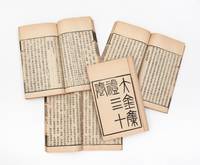
948796; 94; 101; 84 folding leaves. Four vols. Large 8vo orig. wrappers orig. stitching. Guangzhou: Guangya shuju 廣雅書局 1895.<br /> <br> <br> <br /> <br /> Early — possibly the first — printed edition of a work on the state rites of the Jurchen Jin dynasty probably written in the late 12th century. The Jurchens ruled northern China under the name of Jin from 1115 to 1234. They were a people from present-day northeast China who spoke a Tungusic language related to Manchu. The Jurchen had their own institutions but also adopted many aspects of Chinese rulership. This book outlines ceremonies and events at the Jurchen Jin court.<br /> <br> <br> The book is of unknown authorship and date. Qing scholar Weng Fanggang ç¿æ–¹ç¶± 1733-1818 wrote that “the book contains mentions of events dated Dading 7 1167 11 1171 19 1179 and 27 1187…the book was thus probably completed toward the end of the Dading reign period i.e. before 1190†Weng Weng Fanggang zuan Siku tiyao gao 409. One theory holds that the book is in fact what Minister of the Board of Rites Zhang Wei å¼µæš presented to the Jin throne in 1195 under the title Da Jin liyi 大金禮儀 Rites of the Great Jin a title that is no longer extant Lao Zhonghua yeshi cidian 376.<br /> <br> <br> Our edition WorldCat 123342086 is preceded by the bibliographical summary written for its inclusion in Complete Books of the Four Repositories Siku quanshu 四庫全書 in the early 1780s.<br /> <br> <br> The publisher of our edition Guangya shuju was founded in Guangzhou in 1887 by Zhang Zhidong 張之洞 1837-1909 a prominent late-Qing conservative official and promoter of education largely through fundraising among fellow officials and local gentry. It had a sister institution in Guangya xueyuan 廣雅å¸é™¢ the “Academy for Expanding What Is Good and Proper.†The vast majority of the titles put out by the publisher were historiographical works like our book. The publisher was <br /> extremely exacting and precise in its collation of books. Every title was without exception collated three times and at the end of every juan the names of the three collators were listed in order to demonstrate this careful and strict approach. Furthermore at the end of some books the editors added a colophon explaining the book’s provenance extant editions and their circulation the collation process and any lacunae with great benefit for the reader. Li Qingdai Guangdong buxue yanjiu 119.<br /> <br /> Our book has one of these colophons written by Liao Tingxiang 1842-97 a professor at the academy and a classical scholar who was one of the collators. Liao explains that the editors had worked from manuscript versions. A record of textual variants has been added by Miao Quansun 繆èƒå« 1844-1919 who had been a member of Zhang Zhidong’s secretarial staff and worked at the publishing house.<br /> <br> <br> Our copy has a seal saying that the book was “donated by Guangdong Commissioner of Education Shen Zengtong æ²ˆæ›¾æ¡ 1850-1921.†Shen was a late Qing official who served both at court and in the staff of Li Hongzhang æŽé¸¿ç« 1853-1901 one of the leading statesmen of the era.<br /> <br> <br> Fine and fresh set preserved in a hantao. We find no earlier printed edition in WorldCat.<br /> <br /> <br> <br> References<br /> <br> <br> Lao Tie è€é“. Zhonghua yeshi cidian ä¸åŽé‡Žå²è¾žå…¸. Zhengzhou: Daxiang chubanshe 1998.<br /> <br> <br> Li Xubo æŽç»ªæŸ. Qingdai Guangdong buxue yanjiu 清代广东朴å¦ç ”究. Guangzhou: Guangdong sheng tushuguan chubanshe 2001.<br /> <br> <br> Weng Fanggang ç¿æ–¹çº². Weng Fanggang zuan Siku tiyao gao ç¿æ–¹çº²çº‚四库æè¦ç¨¿. Shanghai: Shanghai kexue jishu wenxian chubanshe 2005. unknown
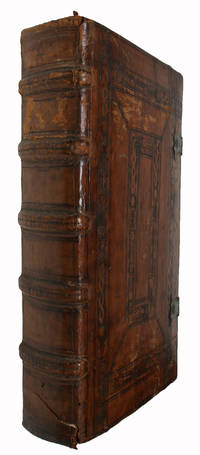
153147178Basel, Froben, 1531 + Coloniae, Petrus Quentell, 1536. Folio. Bound together in a beautiful contemporary full calf binding over wooden boards. Blindstamped ornamental frames to boards. Five raised bands to spine. Remains of brass clasps to boards. Brass at corners of boards and brass strips to bottom edges of boards. A tear through the letter at the lower capital, no loss. Some scrathing of leather, mostly to back board and upper part of spine. The titles of the two works written in contemporary hand to the outer edge. The strong vellum cords, which go through the the wooden boards can be seen on the inside of the wooden boards, which also have some initials in red and blue paint, possibly from a painted leaf that has rubbed off? First title-page a bit dusty, otherwise very nice, clean, and crisp throughout. [Eucherius:] Froben printer's device to title-page, to final leaf of the first part, to the half-title of the second part (Episcopi Commentariorum in libros Regum ad Veranium & Salonium) and to the last leaf of that part. Beautiful large woodcut initial at beginning of each new work. (8), 194, (2)" 310, (2) pp.[Radulphus:] Woodcut device to title-page. Numerous beautiful woodcut, allegorical initials, both large and smaller, throughout. (4 - title, dedications), (14 - index), (6), 314 pp.
153147178Basel Froben 1531 Coloniae Petrus Quentell 1536. Folio. Bound together in a beautiful contemporary full calf binding over wooden boards. Blindstamped ornamental frames to boards. Five raised bands to spine. Remains of brass clasps to boards. Brass at corners of boards and brass strips to bottom edges of boards. A tear through the letter at the lower capital no loss. Some scrathing of leather mostly to back board and upper part of spine. The titles of the two works written in contemporary hand to the outer edge. The strong vellum cords which go through the the wooden boards can be seen on the inside of the wooden boards which also have some initials in red and blue paint possibly from a painted leaf that has rubbed off First title-page a bit dusty otherwise very nice clean and crisp throughout. Eucherius: Froben printer's device to title-page to final leaf of the first part to the half-title of the second part Episcopi Commentariorum in libros Regum ad Veranium & Salonium and to the last leaf of that part. Beautiful large woodcut initial at beginning of each new work. 8 194 2; 310 2 pp.Radulphus: Woodcut device to title-page. Numerous beautiful woodcut allegorical initials both large and smaller throughout. 4 - title dedications 14 - index 6 314 pp. <br/><br/><em>First editions of both works being the first edition of the works "Several Studies" of St. Eucharius most of them printed for the first time here as well as the first edition of Rodulfus Tortarius' or Radulphus Flaviacensis commentaries of Leviticus the third of the Books of Moses written in Latin in 20 books. Saint Eucherius bishop of Lyon ca. 380 - ca. 449 was a high-born and high-ranking ecclesiastic in the Christian Church of Gaul. He is remembered for his letters advocating extreme self-abnegation. Henry Wace ranked him "except perhaps St. Irenaeus the most distinguished occupant of that see"."St. Eucherius Bishop of Lyons theologian born in the latter half of the fourth century; died about 449. On the death of his wife he withdrew to the monastery of Lérins where his sons Veranius and Salonius lived and soon afterward to the neighbouring island of Lerona now Sainte-Marguerite where he devoted his time to study and mortification. Desirous of joining the anchorites in the deserts of the East he consulted John Cassian who in reply sent him some of his "Collationes" describing the daily lives of the hermits of the Thebaid. It was at this time that Eucherius wrote his beautiful letter "De laude Eremi" to St. Hilary of Arles c. 428. Though imitating the virtues of the Egyptian solitaries he kept in touch with men renowned for learning and piety e.g. Cassian St. Hilary of Arles St. Honoratus later Bishop of Marseilles and Valerian to whom he wrote his "Epistola parænetica de contemptu mundi". The fame of Eucherius was soon so widespread in southeastern Gaul that he was chosen Bishop of Lyons. This was probably in 434; it is certain at least that he attended the First Council of Orange 441 as Metropolitan of Lyons and that he retained this dignity until his death. In addition to the above-mentioned letters Eucherius wrote "Formularium spiritualis intelligentiæ ad Veranium" and "Institutiones ad Salonium" besides many homilies. His works have been published both separately and among the writings of the Fathers." Catholic Encyclopedia. His "Epistola paraenetica ad Valerianum cognatum de contemptu mundi "Epistle of exhortation to his kinsman Valerian On the contempt of the world" is an expression of the despair for the present and future of the world in its last throes shared by many educated men of Late Antiquity with hope for a world to come. Erasmus thought so highly of its Latin style that he edited and published it at Basel in 1520. His commentaries on the work are also included here. His "Liber formularum spiritalis intelligentiae" which is addressed to his son Veranius is a defence of the lawfulness of reading an allegorical sense in Scripture bringing to bear the metaphors in Psalms and such phrases as "the hand of God" The term anagoge in Greek is employed for the application of Scripture to the heavenly Jerusalem to come and there are other examples of what would become classic Medieval hermeneutics.Rodulfus Tortarius also known as Raoul of Tourtier Raoul de La Tourte Radulphus Flaviacensis c.1063 - c.1122 was a French Benedictine monk of the Abbey of Fleury-sur-Loire and a poet writing in Latin. He is known both for his style of writing his biblical commentaries and religious works and his literary and comic tales. His commentary on "Leviticus" is considered important and influential. The first edition of the work is rare. </em> hardcover
1906018645New York: Frank S. Holby. Complete in 12 Volumes. Chawton Edition No. 629 of 1250 numbered and registered copies. Original brown cloth with spine slips. Top edges gilt fore-edges untrimmed. Slight normal edge wear small edge bumps on three volumes faint spots on spine slips of two volumes small corner chips of spine slips of two volumes no text affected tissue covering an illustration in one volume mostly missing Very Good. Color illustrations. A nice set. . Very Good. Hard Bound. First Edition Thus. 1906. Frank S. Holby unknown
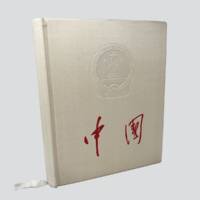
1959255<p>First Edition. Folio 39cm32cm. Tipped-in frontispiece portrait of Mao Zedong profusely illustrated throughout with black and white and colour photographs text in Chinese. Publisher's cream cloth front board lettered in red in Chinese with blind-stamped emblem of the People's Republic of China spine ends decoratively stamped in blind publisher's clear mylar wrapper brown endpapers flecked with gold publisher's white bookmark 562pp. Housed in original box with the original recipient's address details written to the front of the box. Accompanying the book are three separate items: The publisher's compliments slip in French one small sheet from the publisher in Chinese and a table of contents booklet in French. Published by the China Album Editing Committee Beijing 1959.</p><p>The book is in fine condition. The publisher's clear mylar wrapper is in very good condition with a couple of small tears and some very minor loss. The box is in very good condition with some expected wear and two of the edges are spilt.</p><p>Provenance: This copy is from the collection of Julien Creytens 1897-1972 who was a Belgian Post-Impressionist painter Professor at the Antwerp Academy and a committee member of the Royal Museum of Fine Art in Antwerp. He was given this copy of the book during a study trip to China in 1959.</p><p>This landmark propaganda photography book was commissioned by the Ministry of Culture to commemorate the tenth anniversary of the People's Republic of China. Created by leading photograph journalists and officials over more than a year copies of the book were distributed solely to political elites foreign dignitaries and key national libraries. Thus copies very rarely appear in commerce. RareBookHub records only a single appearance at auction.<br /><br />The book highlights a decade of achievements by the Communist Party in agriculture industry science education and the arts. It features images of modernisation such as airports factories mechanized farms together with views of Beijing revolutionary sites like Zunyi and scenes of China's rich cultural heritage such as artwork by Qi Baishi and Xu Beihong.<br /><br />Martin Parr & WassinkLundgren The Chinese Photobook: From the 1900s to the Present second edition 2016 pp. 176-179.</p><p>Please contact us for shipping costs if ordering from outside the UK.</p> hardcover
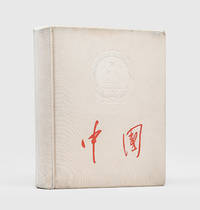
1959178136Beijing: "Zhongguo" huace bianji weiyuanhui 1959. Revolutionary imagery First edition first printing of this archetypal example of the propaganda photobook genre. Under the supervision of the Ministry of Culture top photojournalists and officials worked for over a year to deliver this ostentatious celebration of ten years of the People's Republic of China. Copies were distributed only to political elites foreign VIPs and important libraries. By the tenth anniversary of the People's Republic on 1 October 1959 the Chinese Communist Party had strengthened its hold on the country despite persistent threats from the US and the Kuomintang in Taiwan. This lavish photobook comprehensively reviews the party's decade in power from the successes of socialist agriculture and industrialization to breakthroughs in the arts education and the sciences. Images of modernity - airports factories and mechanized farming - mix with vistas of the capital and photographs of important revolutionary sites such as the meeting house at Zunyi. Numerous plates also celebrate China's rich history and culture including folk dancing recent archaeological finds and artworks by Qi Baishi Xu Beihong and He Xiangning. Folio. Tipped-in frontispiece portrait of Mao Zedong 474 plates 144 colour 5 folding. Text in Chinese. Original cream cloth spine ends decoratively stamped in blind front board lettered in red in Chinese with blind-stamped emblem of People's Republic of China brown coated endpapers flecked with gold white bookmarker. Housed in publisher's card box. Binding scuffed and somewhat soiled light wear foxing and offsetting internally but plates still bright; box scuffed and browned old tape strengthening splits along couple of edges: a very good copy. Martin Parr & WassinkLundgren The Chinese Photobook: From the 1900s to the Present second edition 2016 pp. 176-179. hardcover
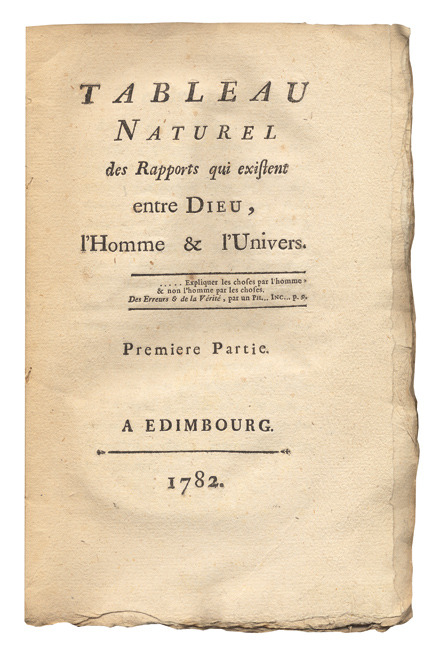
178216243A Edimbourg (Lyon), s.n., 1782 ; 2 tomes in-8, brochés dans leur première couverture de papier dominoté en couleurs marqué "A Orléans chez Leblond N°68" ; (4) de titre, blanc, avis des Editeurs et table, 276 pp. ; (4) faux-titre et titre, 244 pp.