6 303 résultats
20102080202104504525library 2010. Soft Cover. Fine. Number of pages: 254p Size: 19cm Number of books: 1 library paperback
19762090202118100026Nipponhyojun 1976. Soft Cover. Fine. The book is in fine condition. Nipponhyojun paperback
19952081402109803718Akitsu Publishing Company 1995. Soft Cover. Fine. Number of books: 1 book Akitsu Publishing Company paperback
19992080502106401629Kumamoto Prefecture Environment and Life Department Nature Conservation Division 1999. Soft Cover. Fine. Number of pages: 216p Kumamoto Prefecture Environment and Life Department Nature Conservation Division paperback
19992080502106401533Kumamoto Prefecture Environment and Life Department Nature Conservation Division 1999. Soft Cover. Fine. Number of pages: 216p Kumamoto Prefecture Environment and Life Department Nature Conservation Division paperback
19972091502135419153Yura Yamato Ancient Culture Research Association 1997. Soft Cover. Fine. Number of books: 1 Yura Yamato Ancient Culture Research Association paperback
2091202133302300Meiji tosho N.A. Soft Cover. Fine. Number of pages: 213p Size: 19cm Meiji tosho paperback
6620Scroll 273 x 13760 mm. At end in trans.: "All the images are of the whaling at Taiji.April 1857 Tennojiya Shinsuke owned." A remarkable long and vividly rendered whaling scroll from Wakayama Prefecture depicting the whaling activities in unusual detail of the famous town of Taiji and its bay "Taiji ura" the site of the annual dolphin slaughter featured in the 2009 Oscar-winning documentary The Cove. Taiji has long been known as a whaling town and its history is essentially the history of whaling in Japan. In the 17th century whalers of the town developed a series of more sophisticated whaling techniques including the group hunting system 1606 a handheld harpoon and the whaling net technique 1675. The scroll begins with a quite detailed history of whaling in Japan written in a very legible hand describing the above-mentioned new methods of whaling with dates of introduction. There is information on when certain species of whales pass by during the year signaling systems other technical aspects of whaling etc. The first images depict six species of whales found off the coast of Taiji: Semi kujira North Pacific right whale Zato kujira humpback whale Nagasu kujira fin whale Katsuo kujira Bryde's whale Koku kujira gray whale and Makko kujira sperm whale. Each of the dramatically and richly painted whales have notes regarding their most notable identifying features. The next scene takes place at Taiji: it shows the captured Semi kujira whales being winched onto shore and the highly specialized butchering of the carcasses. The slaughter area is fenced off and there are observation decks for government officials to review the work. We see a cross-section of the whale and the various products rendered from it in various stages of dismemberment: skin flesh bone intestines fins penis all displayed in large piles. Spectators stand to the side watching the work. A shrine is depicted in the background. This scene has been heightened with metallic pigments. All the harpoons in this scroll are depicted with metallic pigments. Following this is a scene of the different kinds of boats entering the greater bay towing a whale. The scenes of the houses on shore reveal what a prosperous community it once was. The subsequent scene depicts the specialized boats going out to sea passing two elevated signal posts "Kajitorizaki" & "Shomyozaki" which receive news of whales in the distance and sends signals by a flag system. Smoke is rising a signal to the boats. One of the boats is a "tool" boat containing special harpoons to kill the whale after it had been entangled in a net. Other boats are "net" boats each of which requires 81 sailors; they are seen spreading out the net. There are other boats - seko bune - which guide the whale into the net. Another vessel is fast-moving messenger boat giving directions to the others. In the following two scenes the sky and ocean are very beautifully depicted with delicate gradations of colors. The whale a humpback is shown caught in the net writhing and fighting for its freedom desperately spouting water. The enormous motion of the whale has caused the water to turn white with foam which is very expressively painted on the scroll with almost a 3-D Jackson Pollock splashed effect. A young whaler is seen climbing on the whale to stab it in the nose. The whalers all have special tasks to fulfill and the scroll provides the names of each special function. The next scene shows whalers catching a North Pacific right whale just off the Mikisaki peninsula. Following this we are on shore again at the enormous supply storage compound. The first scene shows government observers at the security gate of the compound with men shown mending and storing the whaling nets. The workers wear different head gear and colors of clothes denoting their jobs and ranks. One room has bundles of poles for harpoons. The next building shows men making boat paddles blacksmiths making harpoon heads barrel makers men assembling the harpoons and men making ropes. The subsequent scene depicts men painting three "leader" whaling boats in vivid colors and patterns. The designs on the boats have been highlighted with metallic pigments. The finished boats are stored in sheds which are shown behind. This is followed by a scene of the sheds where boats are constructed. We see a group of shipbuilders constructing a seko bune using saws planes and various other woodworking tools. The next scene depicts the tools of the whalers: various harpoons of different weights and lengths with different metal heads and large knives on long poles. Each harpoon's specific purpose is mentioned. The ropes attached to the harpoons are contained in a series of bundles to avoid tangling. In fine and fresh condition. This is the finest whaling scroll we have yet encountered with a number of scenes of specific and well-known sites. Preserved in the original but rather decrepit wooden box with metal clasps. Accompanying the scroll is an original metal harpoon tip with the name "Eishichi" engraved. hardcover books
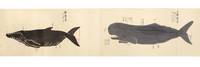
6620Scroll 273 x 13760 mm. At end in trans.: “All the images are of the whaling at Taiji…April 1857 Tennojiya Shinsuke owned.â€<br/> <br/> A remarkable long and vividly rendered whaling scroll from Wakayama Prefecture depicting the whaling activities in unusual detail of the famous town of Taiji and its bay “Taiji ura†the site of the annual dolphin slaughter featured in the 2009 Oscar-winning documentary The Cove. Taiji has long been known as a whaling town and its history is essentially the history of whaling in Japan. In the 17th century whalers of the town developed a series of more sophisticated whaling techniques including the group hunting system 1606 a handheld harpoon and the whaling net technique 1675.<br/> <br/> The scroll begins with a quite detailed history of whaling in Japan written in a very legible hand describing the above-mentioned new methods of whaling with dates of introduction. There is information on when certain species of whales pass by during the year signaling systems other technical aspects of whaling etc.<br/> <br/> The first images depict six species of whales found off the coast of Taiji: Semi kujira North Pacific right whale Zato kujira humpback whale Nagasu kujira fin whale Katsuo kujira Bryde’s whale Koku kujira gray whale and Makko kujira sperm whale. Each of the dramatically and richly painted whales have notes regarding their most notable identifying features.<br/> <br/> The next scene takes place at Taiji: it shows the captured Semi kujira whales being winched onto shore and the highly specialized butchering of the carcasses. The slaughter area is fenced off and there are observation decks for government officials to review the work. We see a cross-section of the whale and the various products rendered from it in various stages of dismemberment: skin flesh bone intestines fins penis all displayed in large piles. Spectators stand to the side watching the work. A shrine is depicted in the background. This scene has been heightened with metallic pigments. All the harpoons in this scroll are depicted with metallic pigments.<br/> <br/> Following this is a scene of the different kinds of boats entering the greater bay towing a whale. The scenes of the houses on shore reveal what a prosperous community it once was.<br/> <br/> The subsequent scene depicts the specialized boats going out to sea passing two elevated signal posts “Kajitorizaki†& “Shomyozaki†which receive news of whales in the distance and sends signals by a flag system. Smoke is rising a signal to the boats. One of the boats is a “tool†boat containing special harpoons to kill the whale after it had been entangled in a net. Other boats are “net†boats each of which requires 81 sailors; they are seen spreading out the net. There are other boats — seko bune — which guide the whale into the net. Another vessel is fast-moving messenger boat giving directions to the others.<br/> <br/> In the following two scenes the sky and ocean are very beautifully depicted with delicate gradations of colors.<br/> <br/> The whale a humpback is shown caught in the net writhing and fighting for its freedom desperately spouting water. The enormous motion of the whale has caused the water to turn white with foam which is very expressively painted on the scroll with almost a 3-D Jackson Pollock splashed effect. A young whaler is seen climbing on the whale to stab it in the nose. The whalers all have special tasks to fulfill and the scroll provides the names of each special function.<br/> <br/> The next scene shows whalers catching a North Pacific right whale just off the Mikisaki peninsula.<br/> <br/> Following this we are on shore again at the enormous supply storage compound. The first scene shows government observers at the security gate of the compound with men shown mending and storing the whaling nets. The workers wear different head gear and colors of clothes denoting their jobs and ranks. One room has bundles of poles for harpoons. The next building shows men making boat paddles blacksmiths making harpoon heads barrel makers men assembling the harpoons and men making ropes.<br/> <br/> The subsequent scene depicts men painting three “leader†whaling boats in vivid colors and patterns. The designs on the boats have been highlighted with metallic pigments. The finished boats are stored in sheds which are shown behind. This is followed by a scene of the sheds where boats are constructed. We see a group of shipbuilders constructing a seko bune using saws planes and various other woodworking tools.<br/> <br/> The next scene depicts the tools of the whalers: various harpoons of different weights and lengths with different metal heads and large knives on long poles. Each harpoon’s specific purpose is mentioned. The ropes attached to the harpoons are contained in a series of bundles to avoid tangling.<br/> <br/> In fine and fresh condition. This is the finest whaling scroll we have yet encountered with a number of scenes of specific and well-known sites. Preserved in the original but rather decrepit wooden box with metal clasps. Accompanying the scroll is an original metal harpoon tip with the name “Eishichi†engraved. unknown
ria9781032926230_inpPaperback / softback. New. New Book; Fast Shipping from UK; Not signed; Not First Edition; Utilises a comparative approach to examine paradigm shifts in climate change policy in Germany and Japan. paperback
18822090502113716331Not Available 1882. Soft Cover. Fine. The book is in fine condition. Not Available paperback
19712092902137704323Wakayamaken 1971. Soft Cover. Fine. The book is in fine condition. Wakayamaken paperback
19802091502135301702Not Available 1980. Soft Cover. Fine. Volume: 1 Not Available paperback
19812080202105100757Not Available 1981. Soft Cover. Fine. Volume: 1 Not Available paperback
19652090502113702638Not Available 1965. Soft Cover. Fine. The book is in fine condition. Not Available paperback
19912092902140701002Wakayama Prefecture Dowa Committee 1991. Soft Cover. Fine. Size: A5 Number of books: 2 Wakayama Prefecture Dowa Committee paperback
19792110502150905573Wakayamaken 1979. Soft Cover. Fine. Volume: 1 Wakayamaken paperback
19752110502151107958Wakayamaken 1975. Soft Cover. Fine. Number of books: 2 Wakayamaken paperback
19832110502151106571Wakayamaken 1983. Soft Cover. Fine. Number of books: 1 Wakayamaken paperback
19762092902137704401Niu Government Office Shrine 1976. Soft Cover. Fine. The book is in fine condition. Niu Government Office Shrine paperback
19802092902137704396Koyasan Cultural Property Preservation Society 1980. Soft Cover. Fine. The book is in fine condition. Koyasan Cultural Property Preservation Society paperback
19772110502151110595Niutsuhime Shrine 1977. Soft Cover. Fine. Number of books: 1 Niutsuhime Shrine paperback
19972110502151106277Tomobuchi Hachiman Shrine 1997. Soft Cover. Fine. Number of books: 1 Tomobuchi Hachiman Shrine paperback
19752110502151106587Not Available 1975. Soft Cover. Fine. Number of books: 1 Not Available paperback
2090502128704882Wakayama Prefecture Loyal Spirit Tower Protection Association N.A. Soft Cover. Fine. Size: chrysanthemum format Number of books: 1 Wakayama Prefecture Loyal Spirit Tower Protection Association paperback