Nautré , François (15.. - 16.. ?) , peintreLivre Rare Book
3 résultats
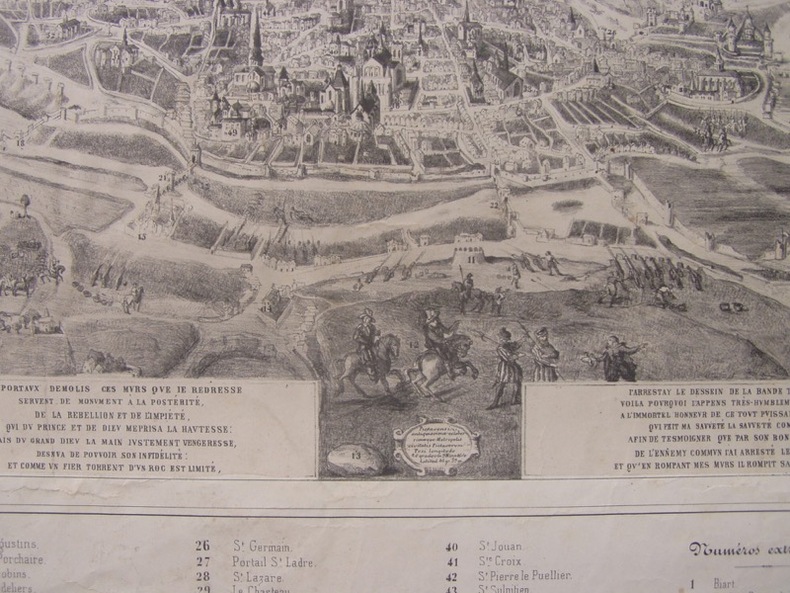
1569268661569 IN PLANO non rogné,tirage ancien ,grandes marges non rognées,un peu effrangées- 70x53 cm - Notes :En haut de l'image cartouche en forme de draperie : on lit : à gauche texte en ancien français : Figure et plan de la Ville de Poictiers assiégée [en] 1569 par Gaspard de Coligni, Admiral de Franc 1569 estant lors maire Sire Joseph Le Bascle. la dite figure levée par commadement de Sire Jean Pidoux, Maire et de Messieurs les Pairrs en Eschevin. l' An 1619 - à droite texte en latin : Hoc oeternitaticonsecrat puictavium in laudem dei optimi maximi vindicis sui, quo prpopugnate cessit inanis hostium, obsidio, per sesquismense abante Ix cal sextil vsqas VII septeb..]. armoiries au milieu du titreFrançois NAUTRE, maître en l'art de peinture. en 1618, domicilié rue des Cordeliers Légende : abécédaire pour indication des lieux remarquables du siège. L'image représente non seulement la ville mais ses entours immédiats : Dunes, faubourgs de Montbernage et de Saint Saturnin, coteaux de Rochereuil ; à gauche : faubourg de la Tranchée ; tout au fond les hauteurs s'étendant de Biard jusqu'à La Cueille. on y voit aussi : des escadrons de reitres, massifs carrée d'infanterie hérisés de piques et d' où émergent des drapeaux , des canons en batterie crachant des flammes, des cavaliers isolés. tout cela rappelle la manière de Tortorel et Périssin mais avec l'exactitude et le décor en plus . Au 1er plan : Henri de Navarre (futur Henri IV) et le jeune Prince de Condé. . à gauche banderole avec légende (titre) en français .
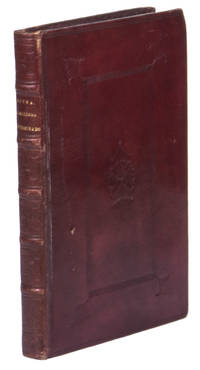
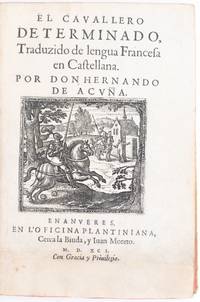
1591ABC_46862Antwerp 1591. 8vo. Officina Plantiniana the widow of Plantin Jeanne Rivière and Jean Moretus Late 18th- or early 19th-century diced and blind-tooled red morocco with the title and author lettered in gold on the spine with an almond shaped ornament in the center of both boards surrounded by two fillet frames blind tooled board edges and turn-ins marbled end papers. With an etched vignette on the title page 20 full-page etchings a full-page printer's device at the end decorated woodcut initials and woodcut tailpieces. 32 208 5 3 blank pp. Splendid first and only Plantin edition of a popular allegorical chivalric romance with twenty beautiful full-page etchings. It contains the Spanish translation of Olivier de La Marche's 1425-1502 Le chevalier déliberé made by Hernando de Acuña 1518-1580 the famous poet and translator of the Golden age of Spanish literature. The text was incredibly popular in its own time and is known to have been the favourite book of Emperor Charles V r. 1519-1556 who even commissioned the present translation.Olivier de La March 1422-1502 was a Burgundian courtier poet and chronicler. The present work is considered his best. It was first published in 1488 but earlier manuscript copies are known. The story was written in praise of Charles the Bold and describes a knights search for salvation in the form of a quest. At the start of the story he is impulsive and leaves his house without a plan. He is started along the way by "Thought" who brings him to realise how unprepared he is for the quest and his enemies "Accident" and "Debility". The knight befriends the hermit "Understanding" and eventually arrives at the house of "Study" where "Fresh Memory" begins his real instruction. While the story was originally written in prose the Spanish translation is in verse. It contains 379 numbered poems double limericks of 10 lines each and was first published in Antwerp by Jan Steelsius in 1553. The present edition is the eighth overall but the first by Plantin and the first with the 20 etchings which were most likely made by Pieter van der Borcht ca. 1530-1608 one of the regular illustrators of the Plantin Press. These etchings closely follow the iconographic programme established by the second incunable edition Gouda ca. 1489-1490.Hernando de Acuña represents the first generation of Petrachian poets in Spain. He is best known for his sonnets eclogues and elegies. Several works were dedicated to Charles V who admired him for both his military and literary talents. He fought with Charles V in Germany Italy and Flanders and with Felipe II in San Quentin before he in ca. 1560 abandoned his military career and went back to Spain to settle in Granada. His translation of le Chevalier délibéré was ordered and much esteemed by the emperor. It was originally published in 1553. In 1591 in the same year as our Plantin edition of El Cavallero was printed his Poesías varias appeared edited by his widow.The boards have been scratched. The work is internally very lightly browned and foxed the leaves may have been washed as the few annotations in the margins have nearly completely faded. Otherwise in good condition.l Adams L 59; Belg. Typ. 1761; Bibl. Belg. L 1 III p.647; Brunet III p. 782; Graesse IV p. 82; Imhof Jan Moretus I Mo5 pp. 437-438; Machiels L 36; Palau VII 130356; Peeters Fontainas 663; USTC 440151; cf. Delen A. J. J. De illustraties can Le chevalier déliberé dOlivier de la Marche in: Het Boek 12 pp. 250-232 plates; New Hollstein Dutch Peeter van der Borgt Bookill. part V 2327-2347 plates. hardcover
15911521En Anveres Antwerp: En l’Oficina Plantiniana Cerca la Biuda Iuan Moreto widow of Plantin and Jan Moretus 1591. First Plantin edition. In contemporary limp vellum. Title on spine lettered in ink. Edges tinted in red. Roman type. 20 verse lines and headline. Large floriated and historiated woodcut initials ornamental tailpieces printer's device at the end. A few stains on the binding rear panel rubbed at lower left corner. Title page artistically restored at the lower margin with no effect on the text. Last leaf O4 cut the residual part mounted on pastedown. Inside clean illustrations are sharp the margins wide. An attractive copy in fine condition. Illustrated with an engraved title vignette of a knight on horseback with background and 20 full-page etchings attributed to Pieter van der Borcht. Illustrated with an engraved title vignette of a knight on horseback with background and 20 full-page etchings attributed to Pieter van der Borcht. First Plantin edition. In contemporary limp vellum. Title on spine lettered in ink. Edges tinted in red. Roman type. 20 verse lines and headline. Large floriated and historiated woodcut initials ornamental tailpieces printer's device at the end. 8º: –8 A–N8 O4 O4 blank its residual part mounted to pastedown; 32 208 8 p. <p><br /> Scarce illustrated Spanish edition the first by Plantin of La Marche’s allegorical work Le chevalier délibéré.<br /> <p><br /> <p><br /> A beautiful 16th-century edition of this popular allegory with the suite of twenty-one splendid etchings attributed to Pieter van der Borcht. Translated into Spanish by Hernando de Acuna c.1520–1580 the much-esteemed poet and translator of the Spanish Golden Age.<br /> <p><br /> <p><br /> Le chevalier délibéré is the most important poetic work of Olivier de La Marche 1422–1502 the Burgundian courtier poet and chronicler “a didactic poem describing a knight's search for salvation through the vehicle of a quest. At first he is impulsive leaving his house par une soudaine achoison on the spur of the moment. He is started along the way by Thought who brings him to a realization of his soul's unprepared state and who acquaints him with the encounters he must face with the henchmen of Atropos Goddess of Death: Accident and Debility. The knight as Author is befriended by the hermit Understanding and eventually arrives at the house of Study where Fresh Memory begins his real instruction.†Caroll 1999.<br /> <p><br /> <p><br /> USTC 440151; Imhof M-5; Brunei 111:782; Hollstein Dutch 111:106 473–493; Palau VII 130356.<br /> <p><br /> <p><br /> Bibliography: Caroll C. W. ed.: Olivier de La Marche. Le Chevalier delibere The Resolute Knight. Medieval & Renaissance Texts & Studies. Volume 199. Tempe: Arizona Center for Medieval and Renaissance Studies 1999. p. 4. Imhof D.: Jan Moretus and the Continuation of the Plantin Press. A Bibliography of the Works published and printed by Jan Moretus I in Antwerp 1589–1610. Vol. I. A–M. Leiden: Brill 2014. pp. 437–438. <br /> <p>. En l’Oficina Plantiniana, Cerca la Biuda, Iuan Moreto [widow of Plantin and Jan Moretus] unknown