322 résultats
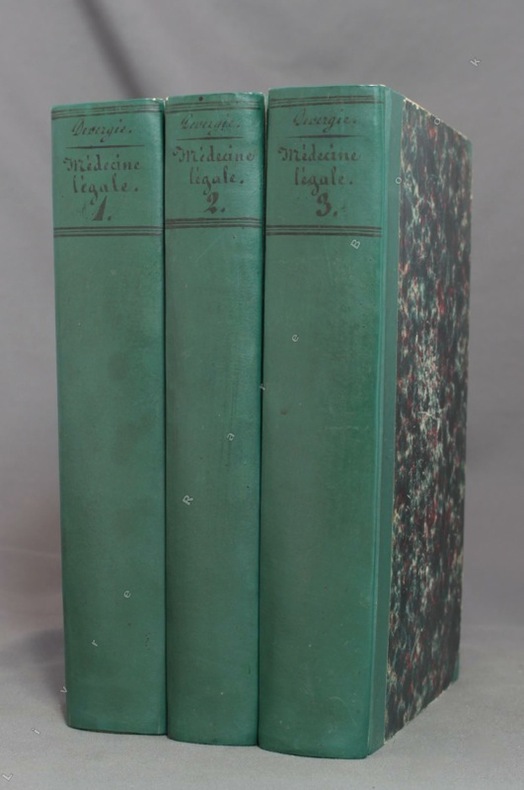
18402480Paris, Germer Baillière, 1840. 3 volumes in-8 de XII, 770 + 648 + 832 pages, demi-vélin teinté vert, dos lisses. Quelques rousseurs.
181121701811 Imprimerie F. Agard, Privas, 1811. In-8, demi-basane, dos orné. (XV), 449, (I), 8 pages. Prospectus de l'imprimeur en fin de volume. Ex-libris manuscrit. Préface de Laboissière dde 11 pages
187523817P. Firmin-Didot et Picard 1875- 1873 3 volumes in-8 .(15,5 x 24,5 cm) demi chagrin marron, dos à nerfs, fleurons dorés. XVI-559 et 548 pp.et 368 pages (Reliure de l'époque).
184020303Paris, Ernest Bourdin et Cie éditeur, 1840. In-8 de 4-VII-[1]-VIII-621-[3] pages, demi-veau beige à petits coins, dos à nerfs orné de filets et fleurons dorés, roulette à froid.
1889boz_001785Gravure par Armand-Émile Mathey-Doret d’après Charles Édouard Delort - Très grande eau-forte orientaliste – “Fâcheuse aventure” – Marché d’esclaves Grande eau-forte orientaliste, “Fâcheuse aventure”, Marché d’esclaves, 1889. La gravure est l’œuvre d’Armand-Émile Mathey-Doret, ici d’après un tableau de Charles Édouard Delort. Dimensions : taille du cadre : 82 x 68 cm ; taille du sujet : 65,7 x 53 cm (sans légende) État : Gravure encadrée, mouillure en bas à droite, cadre avec traces d'usure, sinon bel état de conservation, belle épreuve bien contrastée, tirage de qualité sur papier fort. Charles Édouard Delort né à Nîmes le 4 février 1841 et mort à Saint-Eugène le 6 mars 1895 est un peintre français. Armand-Émile Mathey-Doret est un graveur né le 18 novembre 1853 à Besançon et mort à Buffard le 29 septembre 1931.
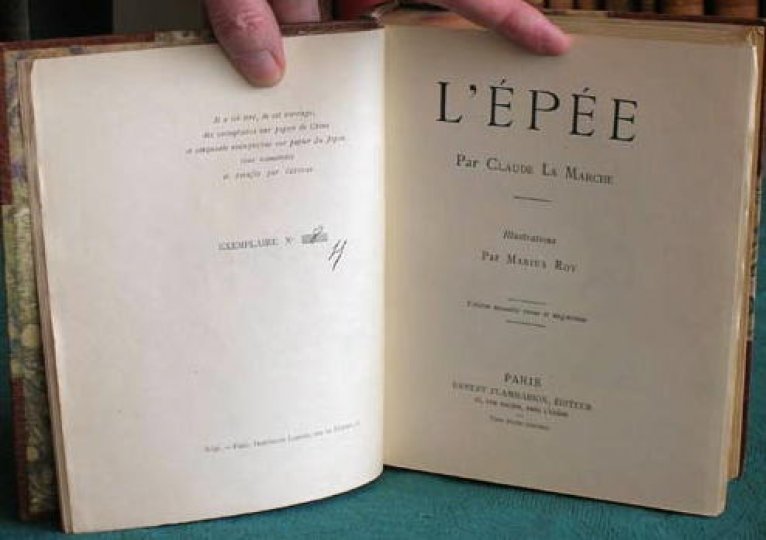
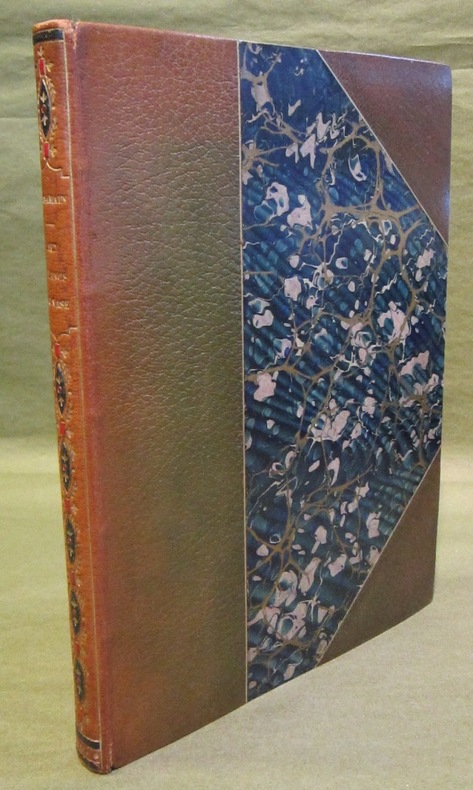
189814831Illustrations par Marius Roy.14 planches, la reproduction d'une gravure de Bonnart et une gravure sur la couverture. Vignette dans le texte.Édition limitée à 60 exemplaires. Il a été tiré, de cet ouvrage, 10 exemplaires sur papier de Chine et cinquante exemplaires sur papier du Japon tous numérotés et parafés par l'éditeur. Celui-ci (N°8) sur Japon.Édition nouvelle revue et augmentée. Paris, Ernest Flammarion, non daté, vers 1898 - 312 pages.Superbe reliure demi-maroquin chocolat à coins. Dos à 4 gros nerfs, filets dorés. Tête dorée sur témoins. Non rogné. Couverture illustrée et dos conservés. Très bon état pour ce bel exemplaire. Format in-8°(20x15).
18752091202133207734Libr. de Firmin-Didot Frere Fils et Cie 1875. Soft Cover. Fine. Number of books: 2 books in total Libr. de Firmin-Didot Frere, Fils et Cie paperback
18972111902160200201Book by Gakudo 1897. Soft Cover. Fine. Number of books: 1 book Book by Gakudo paperback
189011240NY: Ruder Photographer 1890. Original photograph 5-3/4 x 4-3/8 inches mounted on grey board 8 x 12 inches within triple rules some sunning to top inch of board on which photo is mounted lacking tissue guard was was previously affixed photograph is fine. This is a handsome image of the pianist and composer seated on a rocker on a proch most likely in the country reading a book. The tree outside the porch and the light colored and light-weight dress indicates summer. Amy Beach 1867-1944 composer and pianist showed her musical precocity early on; by four she was composing waltzes. her mother a talented singer and pianist undertook her daughter's first musical education; later she studied Ernst Perebo Junius W. Hill and Carl Baermann. During the winter of 1881-1882 Hill taught her harmony 'the only formal instruction in music theory she ever received. lNAW At the age of 16 she debuted with the Boston Symphony Orchestra as a pianist and finding favor with critics and public alike continued to give recitals. Her marriage in 1885 to Dr. H.H.A. Beach a distinquished surgeon and colleague of Dr. Oliver Wendell olmes considerable altered the course of her career. her husband appreciated and supported her music but disliked her performing in public. With his encouragement she focusted on composing teaching herself the priciples of musical composition. Her Mass in E Flat major for vocal quarter chorus orchestra and organ was first performed in 1892 by the Handel and Haydn Society with the Boston Symphony Orchestra. It was the "first work by a woman performed by this oldest and most conservative of American choral organizations." NAW remarkable for any composer all but three of her 150 works were published. She also sought to encourage other woman in music founding in 1926 and serving as first President the Association of American Women Composers. THE BOOK OF WMEN'S FIRSTS Highly regarded throughout her career Beach's music fell into oblivion after her death; new recordings in the 1970's reawakened interest in this fine composer and musician. AMERICAN COMPOSERS pp. 44-46. DICTIONARY OF AMERICAN BIOGRAPHY V. II pp. 41-43. THE NATIONA NATIONAL CYCLOPEDIA. Read THE BOOK OF WOMEN'S FIRSTS FAMOUS AMERICAN WOMEN pp. 25l-26. TIMELINES pp. 342 347 351. Ruder Photographer unknown books
184120011<p>Julius Rubens Ames and Gilbert Vale compilers.<i> The Bible of Nature and Substance of Virtue.</i> Albany: C. Van Benthuysen 1842. </p><p>Bound with:</p><p><i>The Bible of Nature Comprising the Moral State of Nations the Revelation of Nature and the Substance of the Essay on Materialism and Extract from the Lectures and Discourses and from a Translation of the Philosophy of Nature by John Stewart the Pedestrian Philosopher.</i> Albany: C. Van Benthuysen 1842. </p><p>Bound with: </p><p><i>The Moral State of Nations or Travels over the Most Interesting Parts of the Globe</i> . . . Granville Middletown N. J.: Printed by George H. Evans 1840. </p><p>Bound with: </p><p><i>The Revelation of Nature </i>. . . London: Printed for J. Ridgway 1790; from the original edition revised and re-printed by G. Evans 1835. </p><p>Bound with: </p><p><i>Opus Maximum an Essay on Materialism . . . by John Stewart the Pedestrian Philosopher.</i> New-York: n. p. 1841. <br /></p><p>5 vols bound into contemporary cloth 7.25 x 4.63 inches frontispiece 202; 2; vii-viii ix-xxv 1; 4; frontispiece 4 126; 122; 74 pages. Excised leaf of an advertisement also laid in. First American editions of the <i>Bible of Nature</i> and of the <i>Opus Maximum</i>.</p>An interesting example of an early American radical book publishing consortium. Pedestrian Stewart 1742-1822 was by all accounts a brilliant eccentric who had traveled across Europe and England and large chunks of North America on foot all in an attempt to reform both men and their minds; his ideas tended toward the radical if perhaps at times unreadable. See the DNB. <br /><br />The two volumes here of <i>The Bible of Nature</i> were published together by a consortium of free thought and radical publishers including expatriate English free thought emigrants Gilbert Vale and George Evans and by J. P. Mendum; the second volume as collected here appears either to be fragmentary or published solely as an introduction to stereotype editions of the Evans editions of <i>Moral State of Nations</i> and the <i>Revelation of Nature</i>. <br /><br />Something of a bibliographical tangle given that the stereotype plates were evidently available free to the asking for American radical publishers of the period and completeness of the second part of the <i>Bible of Nature</i> is unclear and may have been included here simply as a sort of table of contents to the volumes that here follow; whether this sammelband is as published and sold by the radical reformer George Henry Evans or had collected by an early reader is unclear. The New-York edition of <i>Opus Maxium</i> not located in OCLC. <br /><br />Somewhat rubbed bumped and a trifle shaken; some foxing and light staining; a good copy. [v. p.] books
1882291905Philadelphia: Gorton 1882. hardcover. near fine. Illustrated with 6 exquisite color aquatints and six black & white steel engravings. 685 pages very thick tall 8vo full brown morocco with elaborately carved and pictorially gilt front and back covers all edges gilt. Philadelphia: Gorton 1882. Near Fine.<br/><br/> Gorton unknown books
1898000282Paris Mercure de France 1898
1880191253Philadelphia: J. C. McCurdy & Co 1880. Hardcover. Good in boards. Both hinges cracked. Rubbing along panel edges. Flyleaf opposite title page torn in middle. J. C. McCurdy & Co hardcover
18832111902160200450Shahon 1883. Soft Cover. Fine. Volume: 1 Shahon paperback
1898WRCAM34106Boston: Bates & Guild Company 1898. Two volumes. 680pp. plus fifty photographic plates; 4528pp. including numerous in-text illustrations and plans plus 100 loose photographic plates. Each plate is 9 1/2 x 12 inches and mounted on a heavy card 15 1/2 x 19 inches. Half titles. Large folio. Gathered signatures laid into original half cloth and paper board portfolios paper labels on covers. Portfolios shaken and worn particularly along spines. Minor dust soiling in margins. A few plates with slightly greater edge wear. Contemporary ownership inscription on paper labels. Overall images bright and clean. Very good. From an edition limited to 500 copies. An impressive tour of Boston municipal architecture divided into two parts. The first part features "schoolhouse architecture" almost entirely while the second part features hospitals institutions and miscellaneous buildings. The text accompanying each portfolio offers a detailed description of the buildings illustrated in the large plates. In the plates the buildings are usually shown from the front; but these views are often supplemented by side detail or interior shots. Some of the plates are photographic reproductions of relevant architectural plans. <br> <br> "Wheelwright's architectural imagination was wide; he sought the monumental the classic solution. Stylistically he was catholic even erratic. Some of his schools are Italianate some Georgian some rather nondescript; the half-timber of the hospitals and the Marine Park Bath House illustrated here is blatant.Yet in all the work there is counter-trend apparent based on strict practicality and basic simplicity; and some of the municipal work like the Hook and Ladder House No. 1 and the Eustic School both also shown here has a colonial style remarkably pure and charming for its date" - DAB. <br> <br> An unparalleled visual exhibition of Boston civic infrastructure at the close of the 19th century and an important American architectural work. Wheelwright is perhaps best known for being a founding member of the Harvard Lampoon. He later designed the publication's enigmatic Lampoon Castle in 1909. DAB XX pp.61-62. Bates & Guild Company hardcover books
18621589511862. MARCH T.C. Flower and Fruit Decoration: With some Remarks on the Treatment of Town Gardens Terraces &c. viii 112 pp plus 16 pp of ads. Illustrated with a hand-coloured wood-engraved frontispiece numerous black and white wood engravings throughout and 8 plates with a total of 43 hand-coloured wood engravings juxtaposing colours for table settings and floral boarders for gardens. 8vo. 220 x 140 mm rebound in gray cloth with the original illustrated paper covers laid down. London: Harrison 1862. First Edition. A scarce work that applies colour theory to flower arrangements and small garden designs through a series of unusual hand-coloured wood engravings. The diagrams demonstrate the best colour combinations for groups of three table arrangements followed by illustrations of different coloured borders for small gardens. T.C. March participated in table arrangement competitions held by Dobson and Pearce St. James Street in 1861 and also made arrangements of the Great Exhibition of 1862. Some scattered light spotting the colour plates are bright and fresh overall very good. hardcover
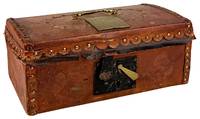
182047134Portsmouth NH: Nath'l B. March 1820. Very Good. Portsmouth NH: Nath'l B. March n.d. ca. 1820. Small leather and wood trunk 25.5x11x12.5cm adorned with brass rivets scalloped edges to leather on lid retaining original brass latch and handle engraved ownership brass buckle of the original owner Jeremiah Emery of Shapleigh Maine 1790-1838; interior lined with the original white paper with a lovely blue polka dot design maker's label illustrated with a woodcut horse affixed inside of lid. Leather a bit dried and cracked some light dustiness and a couple small damp stains to lid else an excellent example. <br /> <br /> Small portable letter trunk manufactured by Nathaniel B. March 1783-1862 "Saddle Harness and Trunk Maker" located at State-Street in Portsmouth New Hampshire. His manufacturer's label further notes "Also Fur Caps & Curled Hair Mattresses." A lovely survival and an excellent example of American craftsmanship and paper design. Nath'l B. March unknown
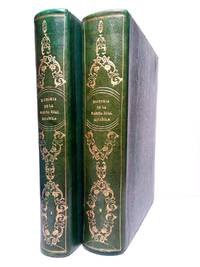
185447593Tomo I. de la 2ª Ed. y Tomo II. de la 1ª Ed.- Madrid: Imp. de José María Ducazcal Domingo Carlos Vila y Juan Manini Editores 1856 1854 respectivamente; 2 VOLS. 1 h. 696 p.; 2 h. 835 p.: Tomo I. con Frontis litográfico ante la portada 11 retratos litograficos 21 láminas litográficas alegóricas y profusión de grabados en madera intercalados en el texto; Tomo II. con Frontis litográfico ante la portada 36 retratos litográficos 30 láminas litográficas alegóricas y profusión de grabados en madera intercalados en el texto los grabados litográficos son la mayoría de Urrabieta C. Mújica D. Valdivieso C. Legrand J.Vallejo ; in Folio Mayor 32 x 225 cm; Excelente impresión sobre papel de gran calidad; Enc. de la época en Media Piel de lomo liso sin nervios cuajado en oro guardas en papel de aguas marbreado. La portada del Tomo 1º restaurada de un desgarro que casi no toca texto. Ambos tomos con leves señales de óxido en algunas pocas hojas. La encuadernación con algunas rozaduras en los bordes de las tapas que han sido restauradas. Dicho esto que es preceptivo la obra se encuentra en muy buen estado general. RARO EJEMPLAR. Palau Nº 90491 dice: Es curioso consignar que las pautas de las láminas para ambos tomos solo dan 11 y 36 retratos pero nada dice del resto de las láminas cuyo número no coincide ser el mismo en todos los ejemplares y es de suponer que se añadieron a la obra. Creemos que nuestro ejemplar está completo de láminas. MARINA PIRATAS CORSARIOS BUCANEROS Libro en español Imp. de José María Ducazcal (Domingo Carlos Vila y Juan Manini, Editores) hardcover
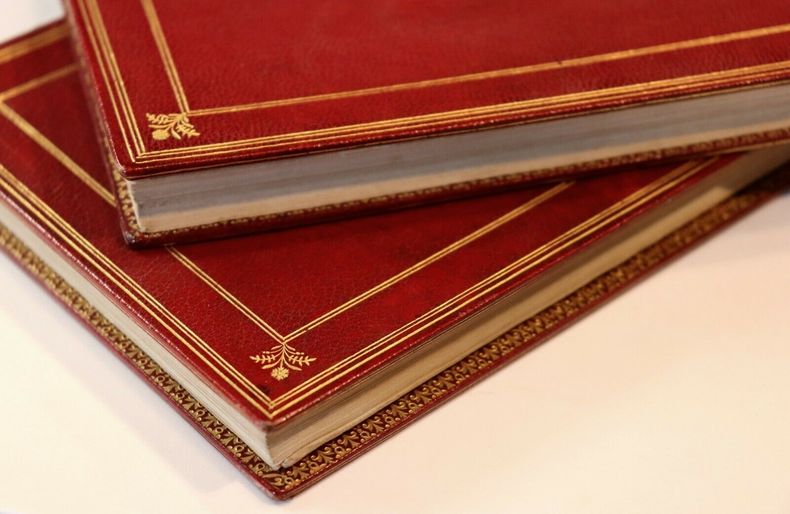
1877AMO-3303Paris, Typographie et Lithographie Jules-Juteau et Fils, s.d. (vers 1877) 2 volumes petits in-8 (18 x 13 cm) de 266 + 204 pages + environ 100 pages restées vierges in fine. Portrait photographique de l'auteur (9 x 5,7 cm) en frontispice du premier volume daté du 22 mai 1877 et signé par l'auteur. Chaque titre imprimé a été tomé à l'encre à la main par l'auteur "1" et "2". Le premier volume sur une Épître amicale manuscrite à Monsieur et Madame de Beaurepaire la Marche (2 pages 1/2) datée d'avril 1871. Suivent 3 pages manuscrites en vers intitulées : "Couplets pour le mariage de Camille et d'Albert", signées par l'auteur et datées du 27 novembre 1878. Le premier volume s'achève par 3 pages manuscrites de table des pièces en vers contenues dans le volume. Le deuxième volume s'ouvre sur un sonnet manuscrit "à ma nièce" (signé des initiales de l'auteur). Les pièces imprimées (plusieurs dizaines) ne sont pas paginées et ont été imprimées chez Jules-Juteau entre 1871 et 1877 environ. Certaines pièces ont été imprimées chez la Veuve Ed. Vert ou encore l'imprimerie Chaumont. Reliure de l'époque (vers 1880) plein chagrin rouge, dos à nerfs richement ornés, encadrements de filets dorés sur les plats, fleurons dorés dans les angles, dentelle dorée en encadrement intérieur des plats, doublures et gardes de papier peigne. Très bel état de conservation de l'ensemble. Quelques ombres au maroquin sur les plats. Intérieur frais. La reliure n'est pas signée mais de belle facture. Exemplaire spécialement composé et offert par l'auteur à sa nièce Julie de Beaurepaire de La Marche. En offrant ce recueil de chansons l'auteur se souvient en quelques vers choisis du château de La Marche (Villegaudin, Saône-et-Loire). En 1861, Le château de La Marche, alors propriété du dernier marquis de La Marche, Antoine-Félix de Beaurepaire, est détruit par les flammes. Il ne reste aujourd'hui que quelques dépendances du château encore debout.
1898WRCAM54953Puerto Principe Cuba 1898. Broadside 16 1/4 x 12 1/4 inches. Toned old folds and creases minor edge chipping short closed tear slight fold separations. Very good. A very rare possibly unique surviving example of a Cuban broadside dating from the month after the conclusion of the Spanish- American War. The war ceased with a truce between the United States and Spain on August 12 1898; the official end of the war came a few months later on December 10 when the two parties signed the historic Treaty of Paris. Here on September 10 in the interim between truce and treaty the outgoing Spanish colonial governor of the south- central Cuban city of Puerto Principe present-day Camagüey Emilio March y Garcia calls for reinforcement of the truce agreement that would ensure free and open commercial trade in the region in the face of continuing interference by Cuban insurgents. March y Garcia claims that the Cuban revolutionaries are illegally detaining people interrupting the cattle trade trampling property rights carrying arms in flagrant disregard for the law and more. The ARIZONA REPUBLICAN published an English translation of this proclamation in its September 26 1898 issue. The translation reads: <br> <br> "I hereby inform the commanders of insurgent bands who are pillaging in the neighborhood of this city; who not observing the agreement between the Spanish and American governments with regard to the freedom of commercial relations are illegally detaining the country people; who are obliging the land owners to procure special passes and permits in order to put in order their plantations and will not allow them either to sell their cattle under the absurd pretext that the estates are the property of the nominal Cuban state and that its government alone can distribute and sell them and turn their products to what uses it sees fit thus trampling under foot the rights of property whereas on the part of this government the most absolute liberty in making contracts has been allowed and will be allowed in the future thus demonstrating the respect it has for the rights of all persons within its jurisdiction. I must call to notice with real sorrow that if these towns are suffering almost the horrors of starvation it is the result of the measures adopted by the chiefs of the insurgent bands who are impeding free traffic by forbidding the entry of all kinds of provisions especially cattle into the towns. In view of what I have already explained I consider it necessary to publish the following warnings: Article 1. I repeat my order of August 23 last permitting free entry and exit to all towns of this province subject to my authority and the most absolute freedom of trade between all the inhabitants of the province. Article 2. The prohibition to enter towns with arms remains in force and whoever is found with arms in his possession will be punished in accordance with the laws." <br> <br> Don Emilio Augusto March y Garcia Mesa was a career Spanish military commander who spent at least three stretches of time in Cuba the last as military governor of Puerto Principe during the Spanish defeat in the Spanish- American War. He also served as the colonial governor of Puerto Rico and general captain of Arago the Balearic Islands and the Canary Islands. <br> <br> The present broadside is exceedingly rare and quite possibly unique with no copies listed in OCLC and no records at auction. unknown books
18355845C. Van Benthuysen; George H. Evans; 1835 1840 1841 1852. First Edition. Hardcover. Very good. 5 vols bound into contemporary cloth 7.25 x 4.63 inches frontispiece 202; 2; vii-viii ix-xxv 1; 4; frontispiece 4 126; 122; 74 pages. Excised leaf of an advertisement also laid in. First American editions of the Bible of Nature and of the Opus Maximum. Walking Stewart articulated a materialist philosophy of Nature which combined elements of pantheism with yogic notions of a single indissoluble consciousness. These early American imprints must have been read by the New England transcendentalists but I don't recall seeing Stewart discussed in the major biographies of Emerson or Thoreau. In any event the similarity is striking for example to Thoreau's Walking. The two volumes here of The Bible of Nature were published together by a consortium of free thought and radical publishers including expatriate English free thought emigrants Gilbert Vale and George Evans and by J. P. Mendum; the second volume as collected here appears either to be fragmentary or published solely as an introduction to stereotype editions of the Evans editions of Moral State of Nations and the Revelation of Nature. Something of a bibliographical tangle given that the stereotype plates were evidently available free to the asking for American radical publishers of the period and completeness of the second part of the Bible of Nature is unclear and may have been included here simply as a sort of table of contents to the volumes that here follow; whether this sammelband is as published and sold by the radical reformer George Henry Evans or had collected by an early reader is unclear. The New-York edition of Opus Maxium not located in OCLC. A nice copy with minimal wear some foxing and light staining; but still very good -- entirely and pleasantly readable throughout. Scarce. <br/><br/> C. Van Benthuysen; George H. Evans; hardcover
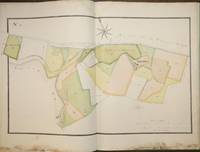
18140072711814. Quarter Vellum. Cloth Boards. Near Fine. Spectacular manuscript estate survey maps from early 19th Century. Folio 53 by 39 cm. 6 text pages followed by ten double paged maps all handsomely colored and detailed. The first nine maps are numbered 2 to 10 per table in front showing that notwithstanding the enumeration there is not a missing map. One map with extra fold-out flap addenda. An additional double-sided hand-colored map in the back inserted into the foliio and then two additional hand-colored survey maps by de la Marche or his son loose -- never bound in -- architectural sketch of the chateau footprint done in pen-and-ink -- two other smaller less visually exciting maps and some correspondence. Maps are colored in greens reds yellows and blues. The washes of color together with the obvious precision of the draftsmanship render these maps utilitarian in purpose originally pleasing to the eye and very decorative. Tiny vignettes of churches mark villages and forests are signified by dots representing trees as was the convention. This chateau belonged to M. François Louis Barrairon at the time. It is located in the Indre-et-Loire Department and is between and equidistant to Tours and Vendome. Condition: bottom of leaves stained and sometimes slightly chipped or chewed looking. A few other minor chips. A few un-obtrusive well-executed repairs of tears. unknown