4 437 résultats
1989782051989 Paris, Ministère de la Culture, 1989, grand in 8° broché, 155 pages.
23725Rouen, Lestringant, Paris, Picard, 1953, 1960, 1964, 1970. Quatre forts volumes in-8. Très bon état intérieur. Broché, couvertures imprimées, très bon état.
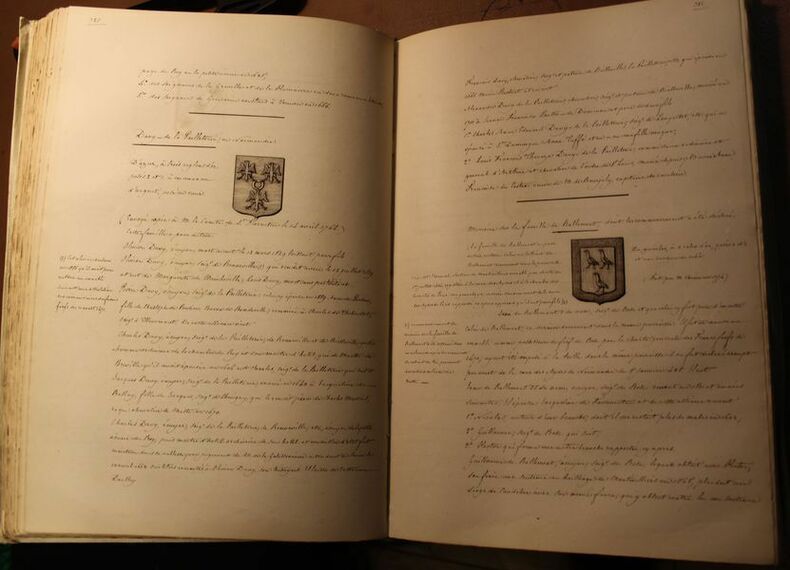
21430Manuscrit, 1862-1863. In-folio de 372 ff. De la bibliothèque Stéphano Marye de Merval, avec ex-libris. Vélin ivoire, dos lisse, titre calligraphié, tête dorée (Reliure de l'époque).
23734Rouen, Cagniard, 1890. Plaquette in-8 de 31 pages. Cachet du Journal de Rouen. Broché, dos renforcé à l'adhésif.
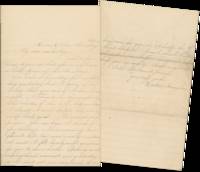
1909List3421Ohio Illinois Michigan and Ontario 1909. Seventy-four letters in thirty-seven envelopes mainly dating between 1885 and 1895. With two undated and one empty envelope. Conditions vary with a few letters having damage intersecting with significant amounts of text and others Near Fine. Overall excellent. A collection of letters mainly sent between Captain William Faragher 1842–1921 and his second wife Harriet Chamberlin 1853–1920 with several from Faragher’s children from his first marriage Burton 1872–1961 and Maude 1875–1952. Most letters are from Chamberlin to Faragher with fourteen from Faragher to Chamberlin.<br /> <br /> Faragher owned and captained several merchant ships in Lake Erie and Lake St. Clair—presumably sailboats as he frequently complains of having been stuck without wind. He also describes more severe weather out on the lake writing from St. Clair Michigan:<br /> <br /> “I am anxious to get down from here but as the day advanced the wind began to frisken and it began to snow hard and as it was freezing hard it had rained then snowed and then froze hard saturday night so the poor Venture was in a sad plight but she was in a worse one when we got to where we lay run as it breezed up fresh and the wind dead ahead the water was flying over her in all directions and froze wherever it fell and besides it had turned into a blinding snow storm but we had a certain point to make . she seemed as anxious to get to a place of safety as I did and as the boys say she got there and none too soon as it has been blowing a gale ever since and snowing and freezing but we are in the lee and at a good dock and are comfortable but oh the wind is whistling through the rigging .†November 20 1887<br /> <br /> In the 1880s steamships were increasing in popularity on the Great Lakes primarily because of sailboats’ susceptibility to both calm and weather; steamboats were bulky for their capacity and slow but more reliable whereas sailboats could carry overall more cargo.1 Generally steamers took packaged goods and passengers and sailboats mainly schooners took bulk cargo. The Great Lakes were the site of much shipping innovation; Faragher’s fleet was not yet behind the times but steam would overtake sail in the 1880s and 90s.<br /> <br /> Faragher’s cargo was mainly produce—apples and grapes—though he does mention picking up salt and other materials. His letters indicate that his business involved both shipping and mercantile aspects: he chose and bought the products shipped them to their destination and then also had to find and sell to customers. The grapes in particular seem to cause a lot of trouble:<br /> <br /> “We left Lorain Sunday morning early and had a nice trip to the Island got there at 4 PM bustled around monday morning and bought 400 baskets of grapes and had them all aboard by dark . it commenced to snow just as we got to Marine City bad bad omen for grapes but imagine my chagrin when I went up town and not a store or commission house wanted a grape folks were full of grapes and there was no sale for them and they said that I had got left and if the truth were known they were glad of it but its a cold day when I get left if trying will lit me out but one thing certain the weather and the lateness of the season were against me but you know I never cross a bridge before I get to it well we hauled up to our old Island Saturday morning and I sold out to my old friend . we had sold since 11 am 190 baskets of grapes . only half our cargo and at a good margin too. People would ask are you the man that was arrested here for selling grapes when told yes they seldom failed to buy but the strangest part was the number of ladies that came to buyâ€. October 28 1887<br /> <br /> Though he does not narrate the incident in which he was arrested for grape peddling—nor does it appear to have made the paper—he later mentions yet another grape-related debacle this time at Port Huron:<br /> <br /> “Sander and I went to town to sell the grapes today . when down came a city official and wanted to know if I had a license to sell . well I couldent sell another grape without paying 5.00 a day license that was a stormer you see the whole sale men were going to drive me out of the market . but they were not as sharp as they thought they were I went and gave a bill of sale of my whole cargo to a citizen here and he appointed one of his agents to sell the grapes†September 20 1888<br /> <br /> Faragher’s letters here do not discuss the financial state of his business but given Chamberlin’s statements it cannot have been all too positive. Chamberlin’s letters depict a woman struggling with her financial circumstances and with how the era’s expectations of her gender intersected with them. In one illustrative letter she writes:<br /> <br /> “A man drove by here Sat. asking for you. Ms. Lawler has given him her note to collect. He says the interest brings it to nearly fifty dollars. I told him I thought you could not meet it just at present but he said he must have the money and would give you just one week and if it was not paid then he would let the law settle it. Marvin and Laird are his lawyers. Mr. Laird is the one who helped get my money from father’s estate. I would not have them connected in this way about you for – O a great deal!! I have thought and planned till it seems as though my brain would burst. I have inquired about that law regarding taking any more married women as teachers. If Mr. Day would work for me it might perhaps be broken. There will be a vacancy in the Detroit building this fall. Will if I possibly can I want to commence teaching in Sept. The children would have to learn to do more about the house and with both of us earning it seems as though some of these harassing debts must be settled after a time. The frequent calls of men with bills against you have taken away all my pride and I believe I am humble enough to do most anything now.†July 11 1887<br /> <br /> In 1887 Ohio passed the Married Women’s Property Act which allowed married women to keep their own property separate from their husbands’—in fact Chamberlin occasionally mentions “her†money in her correspondence. At the same time the state’s Board of Education was debating passing an act that would not only ban school districts from hiring married women as teachers but also fire all the married women it then employed. Newspaper reporting at the time indicates that this measure was not particularly popular not the least because married women tended to be older and more experienced with the job.<br /> <br /> Chamberlin clearly perceives her role as a wife in a rather more progressive way at one point writing to Faragher that “a true wife†is “not a doll-baby to be kept in finery†N.d. after he had taken out a loan to send her money for a new hat. Throughout their correspondence Chamberlin is perhaps surprisingly open with Faragher about her opinions particularly on his work and their financial affairs; for instance:<br /> <br /> “I should like to examine your pocket-book after that $25 tax money left it. What are you going to live on up there while you are hunting for freight Sawdust won’t put any fat on your bones. Sailing up and down past Saginaw bay won’t prolong your life or lessen your grey hairs. What are you sailing for anyway For the sake of wearing yourself out and giving employment to two or three men and keeping the Root from rusting out I guess I am naughty!†May 25 1894<br /> <br /> She also frequently provides her opinion on whether and at what rate Faragher should sell his two other ships besides the Root the Venture and the Sassacus. She continues in the same letter:<br /> <br /> “I know I almost had a regular fight yesterday morning right there on the lounge. I wanted to do my housework and I couldn’t. I wanted to sew and I couldn’t sit up long for that. I wanted to help you and I couldn’t. I wanted to earn money and whereas I used to earn fifty-five cents for every hour I worked now I can not earn anything. Then if I could not do for self and family I wanted to make church and S.S. calls but I couldn’t walk for that.†<br /> <br /> Of course she was at that time prevented from these activities by her health not by gendered standards but she clearly had financial ambitions for herself. After her time as a regular school teacher Chamberlin taught at a Sunday school where she earned a few cents per student and in one letter reported having eighty-one students in a single session. <br /> <br /> Chamberlin also struggles with the expectations of her as step-mother to Faragher’s two children from his first marriage to Emma Humphrey 1848–1880. She writes:<br /> <br /> “I get so discouraged sometimes and it seems as though I am in the wrong place as mother. I think of Emma as my sister. I want to do as she would have me. I look upon my work as sacred. And yet sometimes I feel as though life was not worth living.†November 5 1886<br /> <br /> She frequently describes conflict with Burt who was then in his late teens to early twenties writing that she could not “have quite the very own mother-love for him†though she is “sure that Emma was not more conscientious in her desires to do right by him than I am†May 20 1891. As it still is today the role of step-mother was a difficult and frequently demonized one with the trauma of losing a mother and wife often in conflict with the feminine duty of maintaining perfect domestic harmony. In general Chamberlin seems to have been somewhat out of step with the feminine ideal of the time even telling Faragher in a letter describing the death of an acquaintance’s baby how glad she was to not have any children of her own.<br /> <br /> Overall a look at the private lives and difficulties of a middle-class Ohio household as despite the relative prestige of its head being a captain-owner it struggled with debt. Of interest to both historians of Great Lakes trade and those of women’s roles in the late nineteenth century.<br /> <br /> 1 Dina M. Bazzill “The Missing Link Between Sail and Steam: Steambarges and the Joys of Door County Wisconsin†East Carolina University Program in Maritime Studies Research Report no. 19 2007. unknown
200816638Paris, Castermann - le guide, 1996 ; in-8, 136 pp., broché, couverture illustr.
19586Rouen , Ed. Frère, 1840. In-8 de IV et 348 pages, avec trois cartes dépliantes ( Ière et 2ème routes de Paris au Havre, plan de Rouen et carte du département). Fines piqûres. Brochage bleu d'époque, 1ère de couverture illustrée. Dos cassé.
18005Paris, Hachette, 1865. In-12 de VIII et 504 pages. Demi-percaline verte, nombreux tampons de l'O.R.T.F., Radio-France.
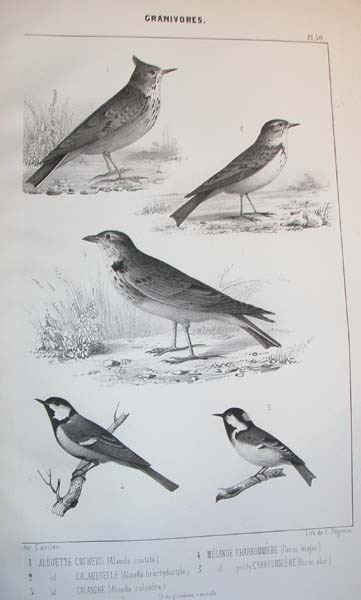
13814Grenoble, Bouteille, 1843. Deux volumes grand in-8 avec un tableau replié et 72 planches lithographiées d'oiseaux tirées sur papier vélin fort immaculé, dessinées par Victor Cassien et lithographiées par C. Pégeron. Rares rousseurs en début des tomes, planches très propres. Broché tel que paru, en bon état, non coupé.
21310Paris, Chez l'auteur, s.d. (circa 1720). In-folio, 27 tableaux d'armoiries sur des planches doubles montées sur onglets dont le beau titre gravé. Brochage d'époque tel que paru, à grandes marge. Couverture en papier marbré fort, planches montées sur onglets. Très bon état intérieur, dos parfaitement refait en papier marbré.
22442Paris, Chez l'auteur, s.d. (circa 1720). In-folio, 27 tableaux d'armoiries sur des planches doubles montées sur onglets dont le beau titre gravé (réenmargé ainsi que la dernière planche). Ex-libris manuscrit de Charles du Hamel, Vicomte de Breuil. Joint un dessin à la plume rehaussé de gouache représentant un cartouche surmonté du blason D'argent au chevron de gueules des Du Hamel avec leur devise "Tout ou rien" avec en son centre une partition de musique. Les armes des du Hamel sont reproduites à la planche 14. Joint également un dessin au crayon rehaussé (du XIX ème) en couleurs d'un blason d'alliance surmonté d'une couronne de marquis dont une branche est la famille Murat de Lestang (Rouergue, Dauphiné) avec des annotation manuscrites à la plume pour sa reproduction avec la signature au crayon : H. M (urat) de l'E (stang) ?. Le bas des planches a subi une mouillure à la pliure sur tout le recueil ayant donné lieu à des restaurations marginales. Bradel en demi-percaline orange du XIX ème siècle.
7439Rouen, Léon Gy, 1905. In-8 de 76 pages non coupées. Excellent état. Broché couverture imprimée en rouge et noir.
13460Paris, Vigot frères, 1935. In-8 de 279 pages orné de 65 croquis et dessins et de 44 photographies par l'auteur. Collection Documentaire de voyage et de vie au grand air. Excellent état intérieur. Broché, couverture imprimée noir et illustrée d'un dessin en vert dans un cadre noir, de deux marcheurs dans le site de Fontainebleau. Très bon état.
18420Sans nom ni lieu, [Hachette, 1893]. In-4 de 63 pages (paginées 161 à 224), illustrations. Bon état. Percaline verte d'époque, titre doré au premier plat, nombreux tampons de l'O.R.T.F., Radio-France.
13467Nemours, Vaillot, 1898. Grand in-8 de 168 pages avec 5 dessins in-texte et 6 hors-texte. Rousseurs sur les planches. Broché, couverture illustrée (défraîchie).
13430Nemours, Gervais-Hugot, 1877. In-8 de 238 pages et un feuillet de table. Très bon état intérieur à part une mouilluree affectant un dernier feuillet blanc. Broché, couverture grise imprimée en noir (rousseurs).
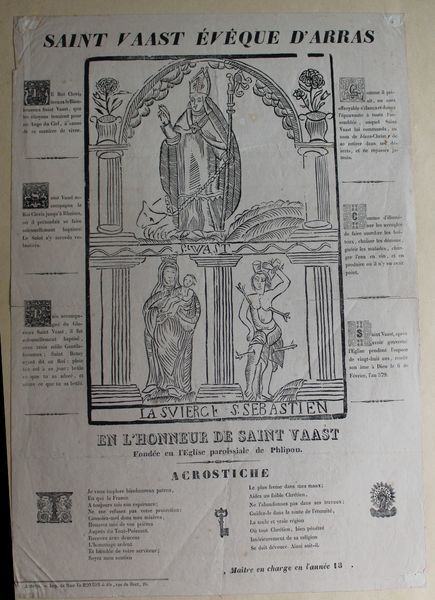
20427Les Andelys, Veuve Monton, s.d. (1918). Une feuille (45 x 30 cm), gravure sur bois représentant Saint Vaast audessus de La Vierge et de Saint Sébastien. Bon état, déchirure latérale réparée.
23733Sans lieu ni nom ni date (circa 1830). Plaquette in-8 de 32 pages. Broché, couverture de papier bleu muette.
21656Very Good. A Quintessential Artifact of the Interwar Florida Tourism Boom.<br /> A vibrant and structurally ambitious artifact of Depression-era boosterism capturing the Indian River region's pivot from a rural citrus hub to a premier 'New Deal' tourism destination. <br /> <br /> While many Florida guides of this period focused on the 'Gilded Age' glamour of the Gold Coast this 1936 booklet emphasizes the varied 'Working Man's Paradise'-blending sport fishing marsh hunting and high-yield citrus farming with the newly accessible culture of automobile travel. The multi-panel cover art is a standout specimen of mid-1930s commercial design utilizing the stylized simplified forms and saturated palettes of the interwar travel-poster movement. It provides a rare town-by-town survey of fifteen coastal localities during a period of significant regional identity formation.<br /> <br /> KEY FEATURES<br /> Design: Multi-panel color-litho cover in classic 1930s travel-poster style.<br /> Local Profiles: Granular coverage of 15 towns including Eau Gallie Grant Indialantic and Sebastian.<br /> Branding: Heavy focus on the 'Indian River Orange' as both a commodity and a cultural symbol.<br /> Visuals: 28 pages of photographs and stylized graphic panels typical of 1930s regional marketing.<br /> Rarity: Scarce; OCLC/WorldCat records only 6 institutional holdings.<br /> <br /> CONDITION: Very Good. The bold poster-style cover remains bright and highly presentable. There is a localized stain to the lower corner of the inside cover and first page though it does not affect the exterior graphics or the structural integrity. Otherwise a carefully handled clean example with only minor wrapper corner wear. HISTORICAL SIGNIFICANCE --<br /> The 1936 Indian River booklet marks the precise moment Florida transitioned from an agricultural frontier into a motorized tourist playground. Produced during the height of the Great Depression it uses "booster optimism" to sell a lifestyle of self-sufficiency citrus and cattle alongside modern leisure tarpon fishing and beach-going. It is a vital record of the 15 included towns-many of which were then merely small fishing villages or groves-capturing their landscape before the post-WWII development boom.<br /> <br /> Subjects: Indian River Florida Brevard County History Florida Citrus Industry 1930s Tourism WPA-Era Graphic Design Sport Fishing History Vero Beach Fort Pierce New Smyrna Florida Ephemera Travel Promotion Americana Regional History Trade Catalogues. unknown
Very Good Turkish, Ottoman (1500-1928) Original color map. Folded. Oblong atlas folio. (50 x 60 cm). In Ottoman script. [MAP of EAST ANATOLIA] Malatya - Divrigi, Mancinik, Adiyaman, Harput. Shows Malatya, Adiyaman and Kharpout region; Firat River (Euphrates), Yazi Düzü, Erguvan etc. Scale: 1/200.000. This is one the serie of the Bonn projection maps which are the first map series in modern techniques in Turkey and the Ottoman Empire. In order to produce these maps covering Turkish territory, Reconnaissance Branch was incorporated into The Mapping Commission. The maps were produced in the datum based on the latitude and longitude of Ayasofya Mosque in equal area Bonn Projection. The field works for the 123 sheets covering the country were conducted by 76 staff. The production was completed in 18 years starting from east west. Field works continued without stopping except in years 1914 and 1920. This map series called also reconnaissance maps contributed a lot to producing 1:25.000 scale maps. Hegira: 1332 = Gregorian: 1916. Not description on map-maker. According to Türkezer & Çobanoglu: History of Mapping in Turkey-1:200.000 Scale Maps, cartographer of this map is Kambay, Cemal.
1938220261Japan. 1938 -1942. Thirty-seven black and white photographs laid down in a Fuji Photo Film Co. Ltd album with fifteen black and white photographs loosely inserted sizes vary between 5 x 5.8cm to 16.5 x 11.3cm a number of photographs are missing Japanese captions neatly written on leaves 22.5 x 31cm 58pp. Last eleven leaves five photographs and the lower cover damp stained. Covers marked and chipped. Titled "Remembering Huzhou" this photographic album contains thirty-seven black and white photographs mounted within together with a further fifteen loose photographs inserted. Most of the images appear to have been taken while the compiler’s unit was stationed in southern China. The owner was most likely an infantry soldier posted to the Huzhou region around 1938. Although thirty-seven photographs now remain attached and fifteen loosely inserted it is evident that others have been removed possibly to obscure the owner’s identity. The surviving captions indicate the nature of the missing images. <br> <br>The photographs present a notably peaceful atmosphere during the period of occupation in the Guangdong and Huzhou areas with no depictions of conflict or fighting. The compiler evidently had access to a personal camera and developing facilities during his time in China. It appears that the unit may at one stage have been stationed on the campus of Sun Yat-sen University in Guangdong. Towards the end of the album a family photograph of four children on a beach is included. The captions throughout are often humorous and convey a sense of familiarity with the subjects. The inserted photographs extend the chronological range slightly dating to approximately 1942. . unknown
200810258, Paquet, 2001 ; in-4, 46 pp., cartonnage de l'éditeur. Eodéchirure haut de la coiffe et pliure bas du livre.
200810257, Paquet, 2001 ; in-4, 46 pp., cartonnage de l'éditeur. Eo.
200810256, Paquet, 2001 ; in-4, 46 pp., cartonnage de l'éditeur. Eo.
18186Paris, Occitania, 1926. In-8 de 204 pages, illustrations. Bon état intérieur. Toile rouge. Nombreux tampons de Radio France et ORTF. Couvertures conservées.