PLAN DE PARISBiblio.com
763 résultats
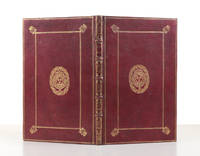
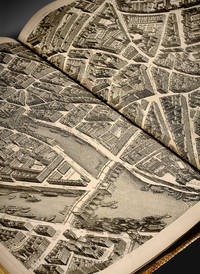
1739ABAA25-22<p>S.l. 1739.</p><p>Folio 558 x 443 mm bound in red morocco covers decorated with fleur-de-lys borders fleurs-de-lys in the corners coat of arms in the center spine ribbed and decorated with fleur-de-lys of various sizes stars and gilt fillets inner border decorated with fleurs-de-lys gilt edges. <em>Contemporary binding.</em></p><p>First issue of the most famous antique map of Paris called " plan de Turgot ".</p><p>James de Rothschild. 2312; Cohen 807.</p><p>It is composed of one plan of combination and of 20 engraved plates on double-page 800 x 515 mm representing the capital house by house in a panoramic view. " <em>We propose by making this engraved map to show at a glance all the buildings and all the streets of Paris</em> " informed the editor.</p><p>"This bird's eye map the widest of this sort ever tackled is known under the improper designation of 'Plan de Turgot'. It is composed besides the map of combination of twenty leaves that altogether form five ranks. Each leave as a surround of 79 centim. large on 50 high. The twenty assembled leaves thus form a square of about 316 centim. on 245 excluding the margin. This surface would bother more than one Parisian amateur whose allocation is way too narrow to have it in its cabinet.</p><p>The engraved title is at the bottom of the leaves 18 and 19 in the middle of a cartouche with a very circumvented shape surrounded with volutes and topped with the allegorical figure of the city of Paris resting on her shield.</p><p>This map takes usually the form of a large folio atlas; each leaf printed on thick paper is folded in two and glued on guard. It is said that most copies were bound at the time with more or less luxury to be distributed for free with no doubt to distinguished figures; all sheepskin or Levant morocco bindings are decorated in their center with the arms of Paris. Some copies were printed with wide margins.</p><p>This map ends the series of bird's eye maps and if after this period we still see some of those published it would be older maps copied or refreshed. Louis Bretez who drew it around 1734 derogated the generally admitted custom of positioning maps according to the noon mark because willing to give of Paris an image in front view he had to prefer with the model of previous geographers a system that would allow to see in front view the gates of our ancient churches so numerous still churches that for the most part had their facades directed westward. It is deplorable that the map as it was conceived wasn't created on an earlier date at least from a century. It would have been because of its dimensions of a much higher interest for the archaeologists of today.</p><p>The drawing ordered by Turgot was achieved in 1734; it represents thus the state of Paris at this time. Claude Lucas who engraved it is probably the one who worked on the maps of the districts of La Caille 1714 or perhaps his son.</p><p>The choice that was made of a bird's eye map must have led to huge costs…</p><p>The image of Paris represented here still offers I say it again a big appeal and documentation for archaeology. The few number of ancient buildings that have survived is so quickly diminishing day by day or is suffering from strange metamorphoses with the hideous mask of replastering so much that the Paris of Turgot threatened by our thousands of projects of alignment and expansion will soon have to be called in turn the 'old Paris' …. A. Bonnardot <em>Etudes archéologiques sur les anciens plans de Paris</em> pp. 199-203.</p><p>These plates remarkably engraved show in a vivid way the former layout in perspective of the Parisian sites residences and monuments.</p><p>Copy printed on thick paper illustrated with brilliant proofs preserved in a binding by Padeloup with the arms of Paris.</p><p>The title is engraved in the center of a blending of two plates. 1600 x 540 mm.</p><p><strong>FR</strong></p><p>S.l. 1739.</p><p>In-folio relié en maroquin rouge plats ornés d'une roulette fleurdelisée fleurs-de-lys aux angles armoiries au centre dos à nerfs orné de fleurs de lys de différentes tailles d'étoiles et de filets dorés coupes décorées roulette intérieure fleurdelisée tranches dorées. <em>Reliure de l'époque.</em></p><p>558 x 443 mm.</p><p><strong>Premier tirage du plus célèbre plan ancien de Paris dit Plan de Turgot.</strong></p><p>James de Rothschild. 2312 ; Cohen 807.</p><p>Il se compose d'un plan d'assemblage et de 20 planches gravées à double page 800 x 515 mm représentant la Capitale maison par maison en vue panoramique. " <em>On s'est proposé en faisant graver ce plan de faire voir d'un seul coup d'œil tous les édifices et toutes les rues qu'elle renferme</em> " avertit l'éditeur.</p><p>" Ce plan à vol d'oiseau le plus vaste en ce genre qu'on ait entrepris est connu sous la désignation impropre de 'Plan de Turgot'. Il se compose outre le plan d'assemblage de vingt feuilles qui réunies forment cinq rangs. Chaque feuille a d'encadrement 79 centim. De largeur sur 50 de hauteur. Les vingt feuilles réunies forment donc un carré d'environ 316 centim. Sur 245 non compris la marge. Cette surface embarrasserait plus d'un amateur parisien trop étroitement logé pour en garnir son cabinet.</p><p>Le titre gravé se trouve au bas des feuilles 18 et 19 au milieu d'un cartouche de forme très contournée entouré de volutes et surmonté de la figure allégorique de la ville de Paris appuyée sur son blason.</p><p>Ce plan forme le plus souvent un atlas grand in-folio ; chaque feuille tirée sur un papier fort est pliée en deux et collée sur onglet. Il paraitrait que la plupart des exemplaires furent reliés dans le temps avec plus ou moins de luxe pour être distribués gratuitement sans doute à tous les personnages éminents ; toutes les reliures en mouton ou en maroquin du Levant sont ornées au centre des armes de Paris. Il y a des exemplaires tirés sur grandes marges.</p><p>Ce plan termine la série des plans à vol d'oiseau et si passé cette époque on en voit paraitre encore quelques-uns de ce genre ce sont des plans plus anciens copiés ou rajeunis. Louis Bretez qui le dessina vers 1734 dérogea à l'usage généralement admis d'orienter les cartes selon la méridienne parce que voulant donner de Paris une image en élévation il dut à l'exemple des anciens géographes préférer un système qui permît de voir de face les portails de nos anciennes églises si nombreuses ncore églises qui pour la plupart avaient leur façade tournée vers l'occident. Il est à regretter que le plan tel qu'il a été conçu n'ait pas une date antérieure d'au moins un siècle. Il eût été à raison de sa dimension d'un bien haut intérêt pour les archéologues d'aujourd'hui.</p><p>Le dessin ordonné par Turgot était achevé en 1734 ; il représente donc l'état de Paris à cette époque. Claude Lucas qui le grava est le même sans doute qui travailla aux plans des quartiers de La Caille 1714 ou peut-être son fils.</p><p>Le choix qu'on fit du genre à vol d'oiseau dut entrainer des frais immenses…</p><p>L'image de Paris qu'il représente offre encore je le répète beaucoup d'attraits et de documents à l'archéologie. Le petit nombre de vieux édifices qui ont survécu disaparaît de nos jours si rapidement ou subit de si étranges métamorphoses sous le hideux masque du replâtrage que la Paris de Turgot en proie à nos mille projets d'alignements et d'agrandissements devra bientôt s'appeler à son tour le 'vieux Paris' …. A. Bonnardot <em>Etudes archéologiques sur les anciens plans de Paris</em> pp. 199-203.</p><p><strong>Ces planches d'une gravure remarquable montrent d'une façon très vivante la disposition ancienne en perspective des sites des demeures et des monuments parisiens.</strong></p><p><strong>Exemplaire imprimé sur papier fort orné de brillantes épreuves revêtu d'une reliure de Padeloup aux armes de la ville de Paris. </strong></p><p>Le titre est gravé au centre d'un assemblage de deux planches 1600 x 540 mm.</p> hardcover
174337021743. Woodcut royal arms on title. 1 p.l. 34 pp. Small folio cont. French red morocco panelled in gilt in the style of the “cabinet du Roi†gilt arms & ciphers Olivier 2495 fer 2 on covers with ciphers on spine a.e.g. Paris: de l’Imprimerie Royale 1743.<br/> <br/> First edition and very uncommon. This catalogue the splendid Han Fürstenberg — Otto Schäfer — Jacques Bemberg copy lists the plates made of the collections of the king including paintings medals royal chateaux fountains grottoes statues busts tapestries and jewels along with records of festivals entrances battles etc. etc. <br/> <br/> “Colbert understanding that engraving was the best means to disseminate and preserve knowledge of the undertakings of Louis XlV began to assemble a group of outstanding engravers. By 1660 they had achieved the stature of independent artists and by 1670 had become a special group under the protection of the king joined together at the Gobelins around Charles Le Brun and Sebastien Le Clerc. From 1660 André Félibien was charged with providing descriptions of maisons royales and Adam Van der Meulen and Israel Silvestre were sent to the newly conquered territories to make views of the principal chateaus and fortresses. Other commissions for the Cabinet du Roi included engravings by Chauveau of the king’s paintings at the Tuileries; copies of paintings and sculpture by Claude Mellan Rousselet and Audran in the galleries of the king; copies by Ronelet of the king’s collection of medals; and other works of art and architecture by Rousselet Silvestre Chauveau and Le Clerc. At the same time the Académie des Sciences began scholarly works commissioned by Colbert…Illustrators for these works were Abraham Bosse Sebastien Le Clerc who often made engravings for Claude Perrault Nicolas Bailly and L. de Châtillon… <br/> <br/> “From 1670 Colbert determined to join these engravings in a collection. He proposed that at the end of each year a temporary volume would be composed of all types of works with the text printed in French and Latin. At the end of ten or twelve years the collection would be subdivided by topics so that the king would have volumes separated into all the sciences and achievements of his reign… <br/> <br/> “A complete record of the king’s possessions was never achieved but the plan was continued by his successors. The engravings from the Cabinet du Roi were first published in a variety of sizes and separately. They were then collected into volumes according to Colbert’s plan but sporadically. In 1727 a new edition was published with additional plates and a catalogue. A third edition of twenty-three volumes with further additions and an index was issued in 1743. Later sets were formed with plates from various editions. The plates survive to the present day at the Chalcographie du Louvre.â€â€“Millard French Books 46. <br/> <br/> This catalogue was issued as a guide to the contents of the fifty sets of 956 plates of the 1743 edition which were prepared as gifts see Balayé La Bibliothèque Nationale des origines à 1800 pp. 226-27. Fine copy. unknown
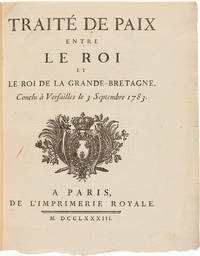
1783WRCAM34309Paris: de l'Imprimerie Royale 1783. 35pp. Quarto. Later marbled boards leather label. Very minor marginal dampstain throughout. Near fine untrimmed. The official French printing of the final treaty of peace between France and England in the American War of Independence concluded Sept. 3 1783 the same day as the final peace between the other powers in the conflict. Because of the French naval setbacks in 1782 the treaty resulted in little territorial loss for England and the powers returned each other's Caribbean possessions. Furthermore England's claims to Newfoundland were maintained and mutual fishing rights off the Canadian coast were agreed upon. The NUC and OCLC together locate nine copies of this scarce printing. DAVENPORT 171. SABIN 96557. OCLC 25450771 21984761. de l'Imprimerie Royale hardcover books
1731CLL-318Amsterdam, François Changuion, 1731 2 volumes in-12 de XLVIII, 290 pp. - (1) f., 291-645 pp., maroquin cerise, large dentelle dorée en encadrement sur les plats, dos lisses ornés de caissons à motifs de croisillons, de roulettes et filets dorés, coupes ornées et dorées, dentelle intérieure, doublures et gardes de tabis bleu ciel, tranches dorées (reliures de la fin du XVIIIe siècle).
1778AMO-4503A Paris, chez la veuve Duchesne, 1778 [de l'imprimerie de Claude Simon] [de l'imprimerie de Clousier]. 6 volumes in-8 (21,5 x 13,5 cm) de XVI-594, 600, 479, 462, 472 et 524-(3) pages. 1 portrait de l'auteur en frontispice et 2 figures d'après Marillier. Reliure de l'époque plein maroquin rouge à grain long, dos lisses richements ornés aux petits fers typiques de l'époque Directoire (1795-1799), pièces de titres (auteur et titre de chaque volume) en maroquin vert, roulette dorée en encadrement des plats et sur les coupes, doublures et gardes de papier marbré, encadrement intérieur de roulettes dorées, tranches dorées (reliure signée Bradel le Jeune, rue d'Ecosses, n°1, quartier Ste Geneviève, à Paris - avec son étiquette contrecollée au verso de la garde du premier volume). Impression sur papier fort à belles marges (grand papier). Excellent état de l'ensemble des volumes, reliures et intérieur. Très frais. Quelques infimes marques et ombres aux reliures qui sont néanmoins dans un splendide état de conservation.
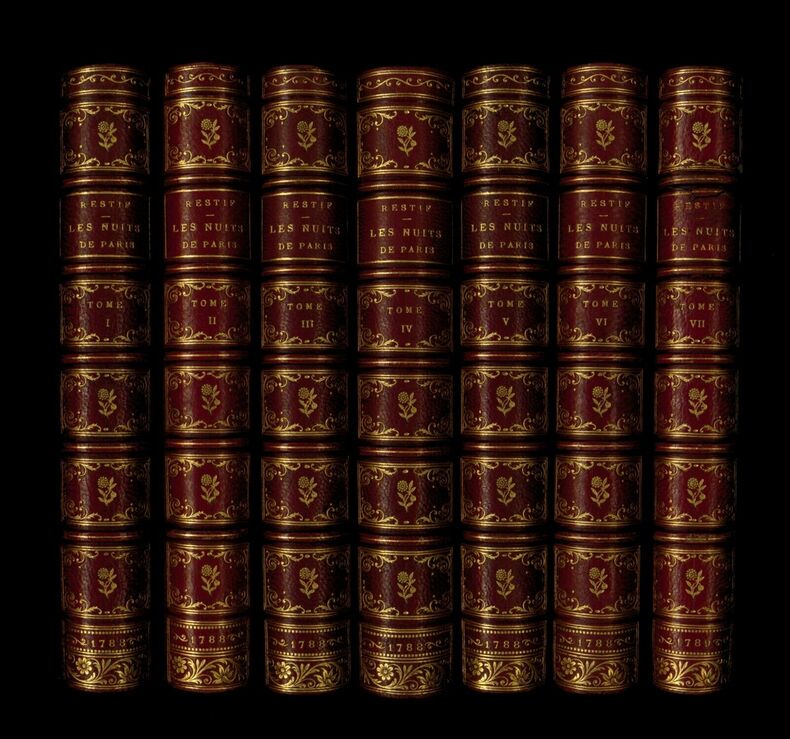
1788AMO-4495à Londres, et se trouve à Paris, chés les libraires nommés en tête du Catalogue, 1788-1789. [Parties 1 à 14]. 14 parties reliées en 7 volumes in-12 (18,2 x 11,2 cm - Hauteur des feuillets : 178 mm.). 3359-(1) pages (la dernière est mal chiffrée 2359). Pagination continue (avec erreurs de pagination - complet). Reliure demi-maroquin rouge à coins, dos à nerfs orné, tête dorée, non rogné (ébarbé). Reliure signée Belz-Niédrée (vers 1865-1875). Quelques légères usures aux reliures (coins frottés parfois légèrement émoussés, plats et coupes légèrement frottés, extrémités de quelques coiffes légèrement frottées, une petite déchirure du cuir recollée au dernier volume. Intérieur des volumes frais à très frais. Très séduisant état non rogné (relié sur brochure). Quelques figures sont plus ou moins courtes de marges et certaines ont été réenmargées au moment de la reliure. Collationné complet.
176420218Paris: Chez P. Alex. Le Prieur tomos 1 al 12 M. DCC.LXIV 1764 y 1771 y Chez P. Fr. Didot le jeune tomos 13 al 15 M.DCC.LXXIV 1774.- EN TOTAL SON 15 VOLS.: 1º con 2 h. 391 p. / 2º con 2 h. 439 p. y 6 láminas plegadas / 3º con 1 h. 479 p. y 12 láminas plegadas / 4º con CLXXIV232 p. y 4 láminas plegadas / 5º con 1 h 489 p. y 16 láminas plegadas / 6º con 1 h. 406 p. y 2 láminas plegadas / 7º con 1 h. 432 p. y 3 láminas plegadas / 8º con 1 h. 456 p. y 5 nláminas plegadas / 9º con 2 h. 516 p. y 11 láminas plegadas / 10º con 213 p. y 4 láminas plegadas / 11º con 2 h. 516 p. y 2 láminas plegadas / 12º con 2 h.388 p. y 2 láminas plegadas / 13º con XLVIII 431 p. y 9 láminas plegadas / 14º con 2 h. 534 p. 1 h. y 4 láminas plegadas / 15º con VIII 544 p. y 6 láminas plegadas Todas suman un conjunto de 89 láminas plegadas de anatomía e instrumental quirúrgico finamente grabadas al cobre; 8º menor 17 x 104 cm; Buena impresión sobre fuerte papel verjurado; Texto en francés; Plena Piel Epoca lomo cuajado en oro cortes pintados en rojo.- RARO. Las encuadernaciónes con ligeros roces en bordes y esquinasque han sido restaurados. Pequeñas faltas en las cabezas de las lomeras y los tejuelos de algunos tomos. Pero en conjunto la obra presenta un buen aspecto con el interior en excelente estado. Aunque los libros son de dos imprentas presentan un aspecto perfectamente uniforme. Según datos de la actual Académie Nationale de Chirurgie de Francia estas primeras Mémoires de l'Académie Royale de Chirurgie fueron publicadas entre los años 1743-1774. DESCRIPCION EXACTA DE FECHAS POR TOMOS: Paris Chez Le Prieur Tome I partie I 1764; Tome I partie II 1765; Tome I partie III 1743; Tomes IV V y VI 1768; Tomes VII VIII y IX 1771; Tomes X XI y XII 1768; Y Paris Chez P. Fr. Didot le jeune Tomes XIII XIV y XV 1774. CIRUGIA EN GENERAL Y TRAUMATOLOGIA Livre en français P. Alex Le Prieur y Fr. Didot le jeune hardcover
177156289Neuchatel, L'Imprimerie de la Société Typographique), 1771-83. 4to. Bound in 19 contemp. uniform full mottled calf. Raised bands. Gilt spines. Title-and tomelabels with gilt lettering. Spine-ends on nearly all volumes strenghtened. Stamp on title-pages. Each volume around 650 pp. With 508 fine engraved plates.
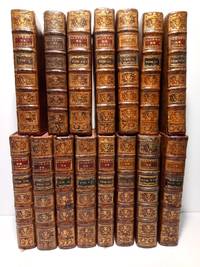
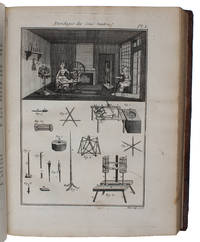
177156289Neuchatel L'Imprimerie de la Société Typographique 1771-83. 4to. Bound in 19 contemp. uniform full mottled calf. Raised bands. Gilt spines. Title-and tomelabels with gilt lettering. Spine-ends on nearly all volumes strenghtened. Stamp on title-pages. Each volume around 650 pp. With 508 fine engraved plates. <br/><br/><em>Second edition and the first 4to-edition was published in 19 volumes plus an additional volume by Jean Elie Bertrand where vol. 20 is an additional volume published much later 1799 - not present here - dealing with the art of printing. This importent collection of books on crafts was published by between 1761 and 1788. The full series comprises 113 parts cahiers in 27 folio volumes along with three supplements and "provide detailed accounts of a wide range of handcraft and manufacturing processes carried out in France at that time. The volumes are well-illustrated with precise engravings by Jean Elie Bertrand 1737-1779 a noted typographer from Neuchâtel where the printing was done. Many of them provide the background for shorter articles in Diderot's Encyclopedia which was appearing at much the same time. The project had its origin in request from Colbert in 1675 to the Academy Royal des Sciences for detailed accounts of various mechanic arts to be prepared and for new machines to be reported upon. This led to the formation of the Bignon Commission under Abbé Bignon. René-Antoine Ferchault de Réaumur 1683-1757 became editor soon after he joined the Academy. He inherited number of drawings the earliest prepared in 1693 and an illustrated manuscript on printing type and book binding which had been prepared in 1704. It was left to Réaumur's successor Duhamel du Monceau to bring about the publication of the series probably as the result of the competition from the Encyclopedia." Wikipedia.Brunet II618 ff. - Graesse II 367. </em> hardcover
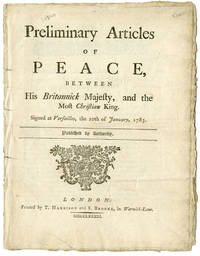
1783WRCAM20840London 1783. 14pp. Quarto. Antique half calf and marbled boards. Some minimal old ink underscoring else a near fine copy untrimmed. The first British publication of the terms of peace agreed upon between France and England after the American Revolution. The French had hoped to obtain more from England in the final peace settlement but De Grasse's catastrophic naval loss to Rodney in the Caribbean in 1782 weakened their position and the American commissioners forced their hand by coming to their own accord with the British on Nov. 30 1782. By this treaty the British cede Newfoundland fishing rights return St. Lucia and Tobago to France and France gives back Nevis Grenada St. Kitts Montserrat and St. Vincent to the British as well as territorial exchanges in India. This treaty was vital to the final resolution of the American Revolution since the United States was pledged to move with France as an ally and was not in a position to settle without her. The final treaties of all the warring powers were signed on Nov. 3 1783. DAVENPORT 169. AMERICAN CONTROVERSY 83-45. hardcover books
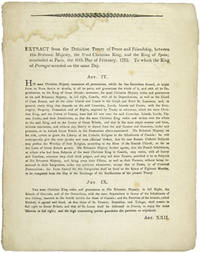
1784WRCAM34380Grenada: Printed by John Spahn 1784. 4pp. on a folio sheet folded once to quarto size. Splitting along most of the fold but the two leaves not detached. Stained along upper edge lightly tanned. Good. In a half morocco box. A very rare Grenada imprint printing extracts from the treaties which concluded the French and Indian War and the American Revolution especially those portions pertaining to Grenada and to Britain's guarantee of freedom of religion in her colonies. This proclamation was printed in Grenada by John Spahn and although undated was likely produced in 1784 following the news of Britain's re-acquisition of Grenada after the Treaty of Paris concluding the American Revolution. <br> <br> Four articles are reprinted from the Treaty of 1763 ending the French and Indian War: Article 4 passing all of Canada over to the British and ensuring freedom of religion to the former French subjects; Article 9 ceding Grenada the Grenadines St. Vincent Dominica and Tobago to the British and ensuring the same religious freedoms as those guaranteed to the former French subjects in Canada; and two articles pertaining to administrative matters. Four articles are also reprinted from the 1783 Treaty of Paris which ended the American Revolution: Article VII through which Britain ceded St. Lucia and Tobago to the French and in which the French guaranteed religious freedom to the Protestant inhabitants of the islands; Article VIII which gave Grenada the Grenadines St. Vincent's Dominica St. Christopher's Nevis and Montserrat and under which the British guaranteed religious freedom; and two other articles addressing legal and administrative questions. The third item reprinted is a proclamation by George III "given at Our Town of Fort Royal" in 1764 proclaims the sovereignty of British law on Grenada and the other recently acquired islands: "the laws of Great Britain are in force in this Island as far as the Nature and Circumstances of the Colony will permit; and that all other Jurisdictions Offices Commissions and Proceedings for the future not founded on those Our Laws of England are hereby declared to be absolutely determined utterly void and totally abolished." The Proclamation authorizes the calling of a General Assembly for the islands and gives the Governor General the power to institute laws and courts on the island until the legislature convenes. <br> <br> Printing on Grenada began as early as 1765 and continued through the French occupation of 1779-83. OCLC carries only one listing for John Spahn as a printer on Grenada - as publisher of the ST. GEORGE'S CHRONICLE AND GRENADA GAZETTE in 1800. Although the present extracts are undated it is most likely that they were printed shortly after the British regained control of Grenada in 1784. This document is not listed on OCLC nor are any Grenada imprints from the 1780s. A rare collection of treaty extracts carrying important information about the political and religious state of affairs in Grenada and the West Indies. Due to the humid climate in the area 18th-century imprints from the West Indies are virtually unobtainable. Printed by John Spahn unknown books
176651834P., Desnos & chez l'Auteur 1766 In-4, demi-basane brune, dos à nerfs, titre gravé, grand plan général dépliant et 34 planches sur double page, 28 ff.n.ch. de tables d. Petits frottements. Infimes rousseurs. Très bon exemplaire.
176256316Königsberg und Leipzig, Kanter (Berlin, Stettin, Leipzig, Rüdigern), 1762-75. 4to. Bound in 13 uniform contemp. full calf. Raised bands. Richly gilt spines. Titlelabels with gilt lettering. On all boards the gilt monogram on red background of King Christian VII. A stamp on title-pages. Around 6000 pp., 4 folded tables and 366 folded engraved plates (1 plate in xerox-copy). Occassionally a few minor brownspots, but fine and clean.
176256316Königsberg und Leipzig Kanter Berlin Stettin Leipzig Rüdigern 1762-75. 4to. Bound in 13 uniform contemp. full calf. Raised bands. Richly gilt spines. Titlelabels with gilt lettering. On all boards the gilt monogram on red background of King Christian VII. A stamp on title-pages. Around 6000 pp. 4 folded tables and 366 folded engraved plates 1 plate in xerox-copy. Occassionally a few minor brownspots but fine and clean. <br/><br/><em>First German edition of this importent collection of books on crafts which is a translation of "Descriptions des Arts et Métiers." published in French between 1761 and 1788. The full French series comprises 113 parts cahiers in 27 folio volumes along with three supplements and "provide detailed accounts of a wide range of handcraft and manufacturing processes carried out in France at that time. The volumes are well-illustrated with precise engravings by Jean Elie Bertrand 1737-1779 a noted typographer from Neuchâtel where the printing was done. Many of them provide the background for shorter articles in Diderot's Encyclopedia which was appearing at much the same time. The project had its origin in request from Colbert in 1675 to the Academy Royal des Sciences for detailed accounts of various mechanic arts to be prepared and for new machines to be reported upon. This led to the formation of the Bignon Commission under Abbé Bignon. René-Antoine Ferchault de Réaumur 1683-1757 became editor soon after he joined the Academy. He inherited number of drawings the earliest prepared in 1693 and an illustrated manuscript on printing type and book binding which had been prepared in 1704. It was left to Réaumur's successor Duhamel du Monceau to bring about the publication of the series probably as the result of the competition from the Encyclopedia." Wikipedia.Brunet II618 ff. only French editions - Graesse II 367 only the French editions. - Fromm 7040. </em> hardcover
178351809Imprimerie royale, 1782 1783 2 volumes grand in-folio demi-basane rel. post., 12- 112- 6- 154 pp. Portrait frontispice gravé par Saint Aubin d’après Cochin. 67 planches gravées par Tardieu, Duval, Germain & Berthault d'après Eustache de St Fare & Le Sage. Lég. mouillures marginales au second volume. Bon exemplaire.
177943565A Paris, au bureau de la Bibliothèque de France ; chez les Auteurs, 1779-1781. 3 vol. in-4 de XVI-C-384 pp., XXIV-414 pp. et 1 f.n.ch., XI-420 pp., veau blond, dos orné à nerfs, pièces de titre et de tomaison en maroquin rouge, triple filet doré sur les plats, chiffre au centre (reliure de l'époque).
176226629Berlin, Stettin und Leipzig, Johann Heinrich Rüdigern, 1762-75. 4to. Bound in 13 fine uniform full calf, raised bands, gilt backs. Remains of paperlabels on backs. Top of spine on one volume frayed. Small rubber stamp on titles. A few brownspots. A good copy. Having in all 374 (of 585) fine engraved plates (1 plate supplied in xerox-copy). Plates measure around 37x24cm.
176226629Berlin Stettin und Leipzig Johann Heinrich Rüdigern 1762-75. 4to. Bound in 13 fine uniform full calf raised bands gilt backs. Remains of paperlabels on backs. Top of spine on one volume frayed. Small rubber stamp on titles. A few brownspots. A good copy. Having in all 374 of 585 fine engraved plates 1 plate supplied in xerox-copy. Plates measure around 37x24cm. <br/><br/><em>First German edition of one of the main works of the 18th century in the fields of crafts and technology as it is a translation of the famous series "Description des Arts et Metiers" issued by Academie Royale des Sciences 1760-75. The French edition was published in folio. Band 1: Kohlenbrennen Lichtziehen Ankerschmieden Nadler Papiermacher. 31 plates and 1 table;Band 2: Eisenhämmer. Teil 1-2 Wachsziehen Pergamentmachen Leder-Vergoldung Schieferbrüche. 22 plates; Band 3: Eisenhämmer. Teil 3-4 Spielkartenherstellung Seidenfärberei Pappenmacher. 29 plates 1 plate supplied in xerox-copy; Band 4: Böttcherkunst Weißgerber Ziegelstreichen Zuckersieden Silber affinieren. 30 plates; Band 5: Messingherstellung Tuchmacherkunst Lohgerberei. 33 plates. Band 6: Tuchfrisierkunst Saffianleder-Herstellung Leder auf ungarische Art Weißgerber Hutmacher Dachdecker. 19 plates; Band Band 7: Tapetenweberei Kalkbrennerkunst Ziegelstreichen in Holland Ziegelhütten Ball- und Raquettenmacher. 30 plates and 1 table; Band 8: Perückenmacherkunst Müller Nudelmacher und Bäcker. 15 plates; Band 9: Schuster Schlösserkunst. 48 plates; Band 10: Steinkohlenbergbau Indigobereiter. 22 plates; Band 11: Eisenbergwerke und Hüttenwerke in der Steiermark Leimsiederei Fischerei Teil 1. 25 plates and 1 table; Band 12: Fischerei Teil 2. 50 plates; Band 13: Fischerei Teil 3 Porzellanherstellung. 23 plates and 1 engr. frontisp.; Band 14: Glasmalerei und Glasarbeiten. Mit 13 von 14 Tafeln; Band 15: Wollenzeugfabrikant. 17 plates; Band 16: Seifensider Leinwandhandel Schneiderhandwerk Leinenmanufaktur Tabaksmanufaktur. 27 plates; Band 17: Bleiarbeiter mathematische und astronomische Instrumente Baumwoll-Samtfabrikation. 38 plates; Band 18: Stickerkunst Siebmacher Riemer und Sattler mit Kutschenbau Drahtzieherei Stahlblattmacher. 51 plates Band 19: Schiffbaukunst. 18 plates and 1 engr. frontisp.;Band 20: Zinngießerkunst. 32 plates; Band 21: der Strumpfwirkerstuhl und sein Gebrauch. 14 plates. </em> hardcover
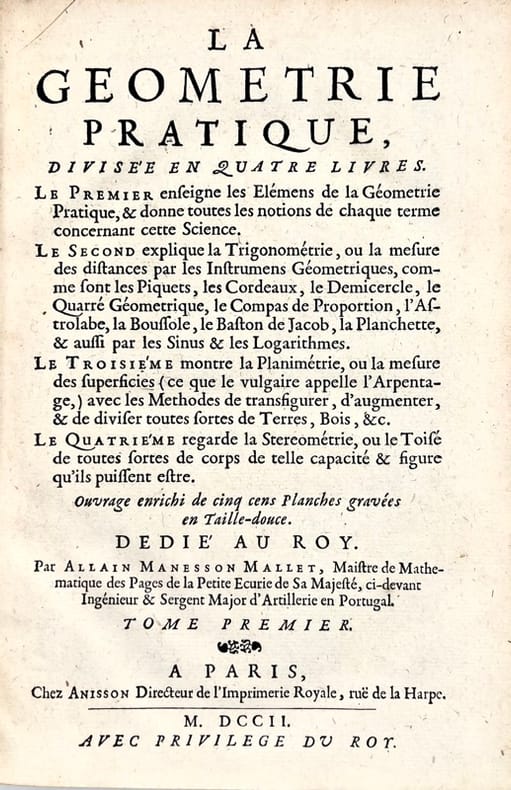
170243564Paris, Anisson, 1702. 4 tomes en 2 vol. in-8 carré de (24)-346-(2) pp., (12)-337 pp., (14)-359-(1) pp., (10)-281-(1) pp., veau havane, dos orné à nerfs, pièce de titre et de tomaison en maroquin rouge (reliure de l'époque).
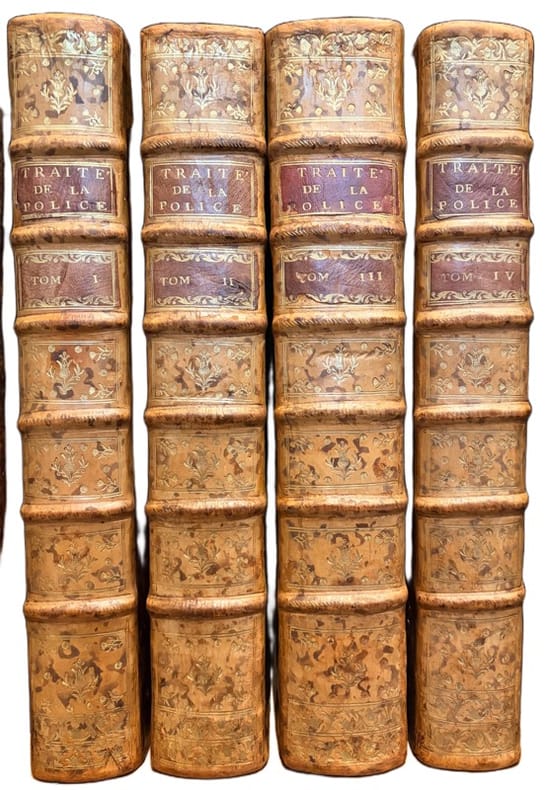
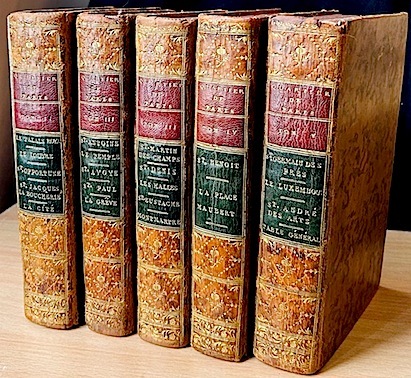
176515111A Paris, chez G. Desprez, 1765. 10 vol. in-12 de : tome I, XLIV-466 pp., 8 planches ; II. (4)-496 pp., 17 planches ; III. (4)-501 pp., avec 12 planches ; IV. (4)-482 pp., 19 planches ; V. (4)-487 pp., 10 planches ; VI. (4)-445 pp., 9 planches ; VII. (4)-422 pp., 7 planches ; VIII. (4)-466 pp., puis pp. chiffrées (345)-(340), 8 planches ; IX. [Environs de Paris]. VIII-536 pp., 4 planches ; X. Contenant la liste des rues, &c., la table générale des matières (4)-564 pp., veau marbré, dos orné à nerfs, filet doré d'encadrement sur les plats, fleurs de lys dorées en écoinçon, armes frappées au centre, tranches rouges (reliure de l'époque).
1785AUB-5589Paris, chez Hardouin, Libraire de S.A.S. Mme la Duchesse de Chartres / Gattey 1785. Nouvelle édition augmentée par l'Auteur de six Nouvelles expériences physiques et de nouvelles Gravures. Bel exemplaire relié, cartonnage orné d'époque, première garde avec armoirie (de Pury officier aux Gardes Prussiennes), 108 pages sur papier vergé avec annexes dont gavure de l'auteur par L.S. Thiery 1784, avis de l'auteur, 2 préfaces, discours préliminaire, table des matières, privilège du roi signé LEBEGUE, signé VALLEYRE jeune, Adjoint.
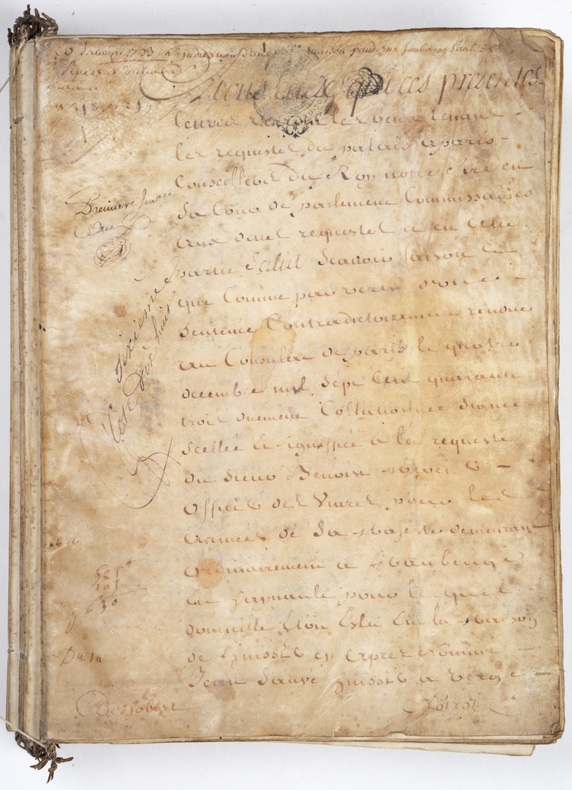
174315159, , 1743-1753. Manuscrit in-4 sur vélin de (164) ff. en 17 cahiers brochés à 23 lignes par page recto verso, cachets fiscaux de la Généralité de Paris en tête de page.
172244903A Paris, chez Jean & Pierre Cot; Michel Brunet ; Jean-François Hérissant, 1722-1738. 4 vol. in-folio de 19 ff.n.ch. 648-13 pp. 8 plans ; 5 ff.n.ch. (649 à) 1496-19 pp. ; 4 ff.n.ch. 1088-9 pp. ; 16 ff.n.ch. 794-XXXIX pp. 2 plans ; veau havane, dos orné à nerfs, pièces de titre et de tomaison en maroquin rouge (reliure de l'époque).
177215588Auteur, Lottin Paris 1772-75 5 vol. 5 vol. in-8 de 2 ff.n.ch. XXIV 216 pp. 79 pp. 56 pp. 58 pp. et 94 pp., 2 ff.n.ch. 64 pp. 2 ff.n.ch. 51 pp. 1 f.n.ch. 40 pp. 2 ff.n.ch. 94 pp. et 2 ff.n.ch. 94 pp., 3 ff.n.ch. 56 pp. 1 f.n.ch. 36 pp. 1 f.n.ch. 40 pp. 1 f.n.ch. 48 pp. et 1 f.n.ch. 138 pp., 3 ff.n.ch. 181 pp. 1 f.n.ch. et 1 f.n.ch. 234 pp. 1 f.n.ch., 3 ff.n.ch. 150 pp. 1 f.n.ch. 1 f.n.ch. 120 pp. 1 f.n.ch. 88 pp. et 92 pp. (table), plein veau fauve marbré de l'époque, dos lisse orné, pièces de titre et de tomaison, tranches rouges (accroc à la coiffe supérieure du tome V).
1783WRCAM20839London 1783. 10pp. printed in double-column format in parallel French and English. Small quarto. Dbd. Some old minor ink underscoring. Else very good. Untrimmed. In a half morocco box. The official English publication of the preliminary articles of peace between Spain and England. By this treaty an armistice was concluded Britain gave back the Floridas to Spain and Spain restored the Bahamas to England. AMERICAN CONTROVERSY 83-44. DAVENPORT 170. unknown books