PLAN DE PARISBiblio.com
48 115 résultats
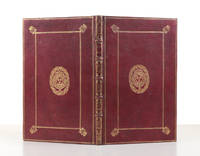
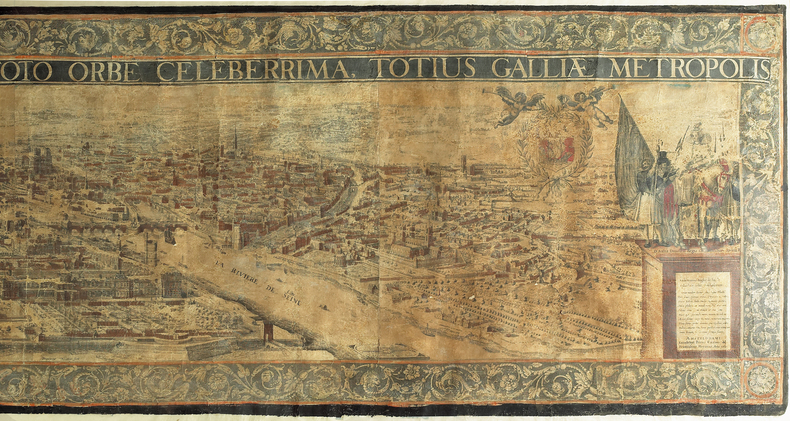
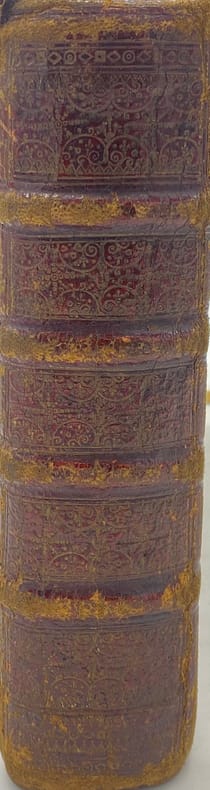
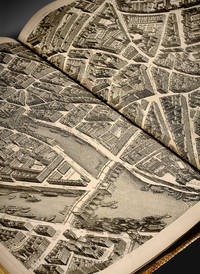
1739ABAA25-22<p>S.l. 1739.</p><p>Folio 558 x 443 mm bound in red morocco covers decorated with fleur-de-lys borders fleurs-de-lys in the corners coat of arms in the center spine ribbed and decorated with fleur-de-lys of various sizes stars and gilt fillets inner border decorated with fleurs-de-lys gilt edges. <em>Contemporary binding.</em></p><p>First issue of the most famous antique map of Paris called " plan de Turgot ".</p><p>James de Rothschild. 2312; Cohen 807.</p><p>It is composed of one plan of combination and of 20 engraved plates on double-page 800 x 515 mm representing the capital house by house in a panoramic view. " <em>We propose by making this engraved map to show at a glance all the buildings and all the streets of Paris</em> " informed the editor.</p><p>"This bird's eye map the widest of this sort ever tackled is known under the improper designation of 'Plan de Turgot'. It is composed besides the map of combination of twenty leaves that altogether form five ranks. Each leave as a surround of 79 centim. large on 50 high. The twenty assembled leaves thus form a square of about 316 centim. on 245 excluding the margin. This surface would bother more than one Parisian amateur whose allocation is way too narrow to have it in its cabinet.</p><p>The engraved title is at the bottom of the leaves 18 and 19 in the middle of a cartouche with a very circumvented shape surrounded with volutes and topped with the allegorical figure of the city of Paris resting on her shield.</p><p>This map takes usually the form of a large folio atlas; each leaf printed on thick paper is folded in two and glued on guard. It is said that most copies were bound at the time with more or less luxury to be distributed for free with no doubt to distinguished figures; all sheepskin or Levant morocco bindings are decorated in their center with the arms of Paris. Some copies were printed with wide margins.</p><p>This map ends the series of bird's eye maps and if after this period we still see some of those published it would be older maps copied or refreshed. Louis Bretez who drew it around 1734 derogated the generally admitted custom of positioning maps according to the noon mark because willing to give of Paris an image in front view he had to prefer with the model of previous geographers a system that would allow to see in front view the gates of our ancient churches so numerous still churches that for the most part had their facades directed westward. It is deplorable that the map as it was conceived wasn't created on an earlier date at least from a century. It would have been because of its dimensions of a much higher interest for the archaeologists of today.</p><p>The drawing ordered by Turgot was achieved in 1734; it represents thus the state of Paris at this time. Claude Lucas who engraved it is probably the one who worked on the maps of the districts of La Caille 1714 or perhaps his son.</p><p>The choice that was made of a bird's eye map must have led to huge costs…</p><p>The image of Paris represented here still offers I say it again a big appeal and documentation for archaeology. The few number of ancient buildings that have survived is so quickly diminishing day by day or is suffering from strange metamorphoses with the hideous mask of replastering so much that the Paris of Turgot threatened by our thousands of projects of alignment and expansion will soon have to be called in turn the 'old Paris' …. A. Bonnardot <em>Etudes archéologiques sur les anciens plans de Paris</em> pp. 199-203.</p><p>These plates remarkably engraved show in a vivid way the former layout in perspective of the Parisian sites residences and monuments.</p><p>Copy printed on thick paper illustrated with brilliant proofs preserved in a binding by Padeloup with the arms of Paris.</p><p>The title is engraved in the center of a blending of two plates. 1600 x 540 mm.</p><p><strong>FR</strong></p><p>S.l. 1739.</p><p>In-folio relié en maroquin rouge plats ornés d'une roulette fleurdelisée fleurs-de-lys aux angles armoiries au centre dos à nerfs orné de fleurs de lys de différentes tailles d'étoiles et de filets dorés coupes décorées roulette intérieure fleurdelisée tranches dorées. <em>Reliure de l'époque.</em></p><p>558 x 443 mm.</p><p><strong>Premier tirage du plus célèbre plan ancien de Paris dit Plan de Turgot.</strong></p><p>James de Rothschild. 2312 ; Cohen 807.</p><p>Il se compose d'un plan d'assemblage et de 20 planches gravées à double page 800 x 515 mm représentant la Capitale maison par maison en vue panoramique. " <em>On s'est proposé en faisant graver ce plan de faire voir d'un seul coup d'œil tous les édifices et toutes les rues qu'elle renferme</em> " avertit l'éditeur.</p><p>" Ce plan à vol d'oiseau le plus vaste en ce genre qu'on ait entrepris est connu sous la désignation impropre de 'Plan de Turgot'. Il se compose outre le plan d'assemblage de vingt feuilles qui réunies forment cinq rangs. Chaque feuille a d'encadrement 79 centim. De largeur sur 50 de hauteur. Les vingt feuilles réunies forment donc un carré d'environ 316 centim. Sur 245 non compris la marge. Cette surface embarrasserait plus d'un amateur parisien trop étroitement logé pour en garnir son cabinet.</p><p>Le titre gravé se trouve au bas des feuilles 18 et 19 au milieu d'un cartouche de forme très contournée entouré de volutes et surmonté de la figure allégorique de la ville de Paris appuyée sur son blason.</p><p>Ce plan forme le plus souvent un atlas grand in-folio ; chaque feuille tirée sur un papier fort est pliée en deux et collée sur onglet. Il paraitrait que la plupart des exemplaires furent reliés dans le temps avec plus ou moins de luxe pour être distribués gratuitement sans doute à tous les personnages éminents ; toutes les reliures en mouton ou en maroquin du Levant sont ornées au centre des armes de Paris. Il y a des exemplaires tirés sur grandes marges.</p><p>Ce plan termine la série des plans à vol d'oiseau et si passé cette époque on en voit paraitre encore quelques-uns de ce genre ce sont des plans plus anciens copiés ou rajeunis. Louis Bretez qui le dessina vers 1734 dérogea à l'usage généralement admis d'orienter les cartes selon la méridienne parce que voulant donner de Paris une image en élévation il dut à l'exemple des anciens géographes préférer un système qui permît de voir de face les portails de nos anciennes églises si nombreuses ncore églises qui pour la plupart avaient leur façade tournée vers l'occident. Il est à regretter que le plan tel qu'il a été conçu n'ait pas une date antérieure d'au moins un siècle. Il eût été à raison de sa dimension d'un bien haut intérêt pour les archéologues d'aujourd'hui.</p><p>Le dessin ordonné par Turgot était achevé en 1734 ; il représente donc l'état de Paris à cette époque. Claude Lucas qui le grava est le même sans doute qui travailla aux plans des quartiers de La Caille 1714 ou peut-être son fils.</p><p>Le choix qu'on fit du genre à vol d'oiseau dut entrainer des frais immenses…</p><p>L'image de Paris qu'il représente offre encore je le répète beaucoup d'attraits et de documents à l'archéologie. Le petit nombre de vieux édifices qui ont survécu disaparaît de nos jours si rapidement ou subit de si étranges métamorphoses sous le hideux masque du replâtrage que la Paris de Turgot en proie à nos mille projets d'alignements et d'agrandissements devra bientôt s'appeler à son tour le 'vieux Paris' …. A. Bonnardot <em>Etudes archéologiques sur les anciens plans de Paris</em> pp. 199-203.</p><p><strong>Ces planches d'une gravure remarquable montrent d'une façon très vivante la disposition ancienne en perspective des sites des demeures et des monuments parisiens.</strong></p><p><strong>Exemplaire imprimé sur papier fort orné de brillantes épreuves revêtu d'une reliure de Padeloup aux armes de la ville de Paris. </strong></p><p>Le titre est gravé au centre d'un assemblage de deux planches 1600 x 540 mm.</p> hardcover
174337021743. Woodcut royal arms on title. 1 p.l. 34 pp. Small folio cont. French red morocco panelled in gilt in the style of the “cabinet du Roi†gilt arms & ciphers Olivier 2495 fer 2 on covers with ciphers on spine a.e.g. Paris: de l’Imprimerie Royale 1743.<br/> <br/> First edition and very uncommon. This catalogue the splendid Han Fürstenberg — Otto Schäfer — Jacques Bemberg copy lists the plates made of the collections of the king including paintings medals royal chateaux fountains grottoes statues busts tapestries and jewels along with records of festivals entrances battles etc. etc. <br/> <br/> “Colbert understanding that engraving was the best means to disseminate and preserve knowledge of the undertakings of Louis XlV began to assemble a group of outstanding engravers. By 1660 they had achieved the stature of independent artists and by 1670 had become a special group under the protection of the king joined together at the Gobelins around Charles Le Brun and Sebastien Le Clerc. From 1660 André Félibien was charged with providing descriptions of maisons royales and Adam Van der Meulen and Israel Silvestre were sent to the newly conquered territories to make views of the principal chateaus and fortresses. Other commissions for the Cabinet du Roi included engravings by Chauveau of the king’s paintings at the Tuileries; copies of paintings and sculpture by Claude Mellan Rousselet and Audran in the galleries of the king; copies by Ronelet of the king’s collection of medals; and other works of art and architecture by Rousselet Silvestre Chauveau and Le Clerc. At the same time the Académie des Sciences began scholarly works commissioned by Colbert…Illustrators for these works were Abraham Bosse Sebastien Le Clerc who often made engravings for Claude Perrault Nicolas Bailly and L. de Châtillon… <br/> <br/> “From 1670 Colbert determined to join these engravings in a collection. He proposed that at the end of each year a temporary volume would be composed of all types of works with the text printed in French and Latin. At the end of ten or twelve years the collection would be subdivided by topics so that the king would have volumes separated into all the sciences and achievements of his reign… <br/> <br/> “A complete record of the king’s possessions was never achieved but the plan was continued by his successors. The engravings from the Cabinet du Roi were first published in a variety of sizes and separately. They were then collected into volumes according to Colbert’s plan but sporadically. In 1727 a new edition was published with additional plates and a catalogue. A third edition of twenty-three volumes with further additions and an index was issued in 1743. Later sets were formed with plates from various editions. The plates survive to the present day at the Chalcographie du Louvre.â€â€“Millard French Books 46. <br/> <br/> This catalogue was issued as a guide to the contents of the fifty sets of 956 plates of the 1743 edition which were prepared as gifts see Balayé La Bibliothèque Nationale des origines à 1800 pp. 226-27. Fine copy. unknown
3702Woodcut royal arms on title. 1 p.l. 34 pp. Small folio cont. French red morocco panelled in gilt in the style of the "cabinet du Roi" gilt arms & ciphers Olivier 2495 fer 2 on covers with ciphers on spine a.e.g. Paris: de l'Imprimerie Royale 1743. First edition and very uncommon. This catalogue the splendid Han Fürstenberg - Otto Schäfer - Jacques Bemberg copy lists the plates made of the collections of the king including paintings medals royal chateaux fountains grottoes statues busts tapestries and jewels along with records of festivals entrances battles etc. etc. "Colbert understanding that engraving was the best means to disseminate and preserve knowledge of the undertakings of Louis XlV began to assemble a group of outstanding engravers. By 1660 they had achieved the stature of independent artists and by 1670 had become a special group under the protection of the king joined together at the Gobelins around Charles Le Brun and Sebastien Le Clerc. From 1660 André Félibien was charged with providing descriptions of maisons royales and Adam Van der Meulen and Israel Silvestre were sent to the newly conquered territories to make views of the principal chateaus and fortresses. Other commissions for the Cabinet du Roi included engravings by Chauveau of the king's paintings at the Tuileries; copies of paintings and sculpture by Claude Mellan Rousselet and Audran in the galleries of the king; copies by Ronelet of the king's collection of medals; and other works of art and architecture by Rousselet Silvestre Chauveau and Le Clerc. At the same time the Académie des Sciences began scholarly works commissioned by Colbert.Illustrators for these works were Abraham Bosse Sebastien Le Clerc who often made engravings for Claude Perrault Nicolas Bailly and L. de Châtillon. "From 1670 Colbert determined to join these engravings in a collection. He proposed that at the end of each year a temporary volume would be composed of all types of works with the text printed in French and Latin. At the end of ten or twelve years the collection would be subdivided by topics so that the king would have volumes separated into all the sciences and achievements of his reign. "A complete record of the king's possessions was never achieved but the plan was continued by his successors. The engravings from the Cabinet du Roi were first published in a variety of sizes and separately. They were then collected into volumes according to Colbert's plan but sporadically. In 1727 a new edition was published with additional plates and a catalogue. A third edition of twenty-three volumes with further additions and an index was issued in 1743. Later sets were formed with plates from various editions. The plates survive to the present day at the Chalcographie du Louvre."-Millard French Books 46. This catalogue was issued as a guide to the contents of the fifty sets of 956 plates of the 1743 edition which were prepared as gifts see Balayé La Bibliothèque Nationale des origines à 1800 pp. 226-27. Fine copy. unknown books
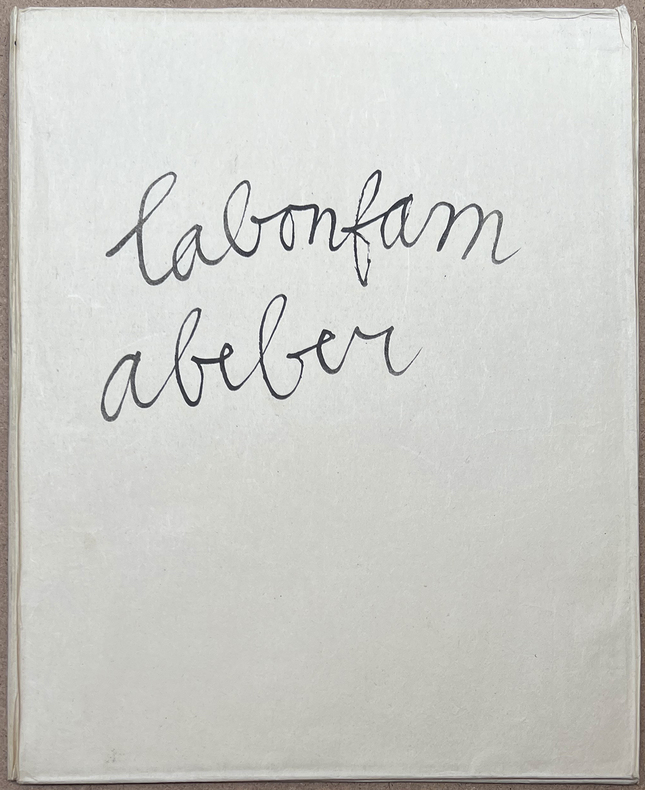
19503041[Paris, J. Dubuffet], 1950. 1 volume in-4 (28( x 22( mm), 36 pages + feuillets muets cousus d'un fil, le premier plat de la couverture rempliée portant le titre. - Édition originale du troisième livre de l'Art Brut entièrement réalisé par Jean Dubuffet. - Le texte autographe très provocateur, "porno-graphique", est calligraphié à l'encre lithographique sur papier report, il est orné de 6 ILLUSTRATIONS À PLEINE PAGE REPORTÉES SUR PIERRE LITHOGRAPHIQUE. L'ensemble du livre est tiré en lithographie. Ce texte en jargon phonétique et le style des illustrations montrent le souci de l'artiste d'un art en opposition avec les normes des syntaxes habituelles. Comme « Ler dla canpane » (1948) et « An vou a ia je » (1949), l'ouvrage est une forme de manifeste d'un art non culturel que Dubuffet nommait "Art Brut". Mariant l'écriture phonétique et argotique au dessin de graffitis obscènes, Dubuffet a réalisé un saisissant raccourci plastique et poétique, renvoyant autant aux peintures rupestres qu'à l'art "brut" des fous ou des prisonniers, tout en produisant un livre de la plus haute bibliophilie érotique. - Ce livre témoigne avec force du besoin de transgression des codes que ce genre implique et reflète bien l'œuvre de Dubuffet, synonyme de rejet et de subversion de toutes les valeurs esthétiques reconnues. - Tirage à 50 exemplaires sur papier d'Indochine sans numérotation (Étant donné la rareté de cet ouvrage, il est probable que le tirage fut moindre d'après plusieurs avis autorisés). - TRÈS BEL ENVOI DE JEAN DUBUFFET À MARCEL PÉJU DATÉ DU 14 JANVIER 1954 ET SIGNÉ (5 lignes à l'encre), «en souvenir et en l'honneur de notre longue et agréable conversation...» - Belle provenance : Collection Marcel Péju (18922-2005). Journaliste et intellectuel français, secrétaire général de la revue Les Temps Modernes de 1953 à 1962, puis par descendance acquis récemment de cette source.
LCS-18628Bel exemplaire, complet, finement relié par Cuzin. Paris, Jehan Dallier, 1549. [Suivi de]: C’est l’ordre et forme qui a este tenue au Sacre & Couronnement de treshaulte & tres illustre Dame, Madame Catharine de Medicis, Royne de France, faict en l’Eglise Monseigneur sainct Denys en France, le X. jour de juin. Paris, Jehan Dallier, 1549. Soit 2 ouvrages reliés en 1 volume in-4 de: I/ 41 ff. (mal numéroté 37) et (1) f.bl. entre les ff. 28 et 29, 9 gravures à pleine page dans le texte dont 1 dépliante et 2 gravures hors texte dont 1 dépliante, (1) f.bl.; II/ 11 ff. Cachet de bibliothèque sur le f. de titre. Relié en plein maroquin rouge janséniste, dos à nerfs, double filet doré sur les coupes, large roulette intérieure dorée, tranches dorées sur marbrures. Reliure signée Cuzin. 225 x 155 mm.
188641580Paris, , 1886-1932. 224 photographies glissées sous pochettes transparentes dans une boîte classeur grand in-4 (31 x 35 cm) de 65 feuilles, feuillets noirs intercalés, demi-maroquin brun, dos lisse orné et titré (Elbel libro).
LCS-18369Ouvrage édité à l’occasion du mariage de Madame Elisabeth de France avec l’Infant d’Espagne. Paris, Le Mercier, 1740. Grand in-folio de (1) f.bl., (1) f. de titre, 22 pp., (1) f.bl. et 13 gravures dont 8 sur double-page. Plein maroquin rouge, plats ornés d’une roulette fleurdelysée avec fleurs-de-lys aux angles, grandes armes au centre, dos à nerfs orné de fleurs-de-lys et d’étoiles dans les caissons, pièce de titre de maroquin havane, coupes décorées, roulette intérieure dorée, tranches dorées. Reliure de l’époque. 625 x 480 mm.
LCS-15649Précieux exemplaire, l’un des rares contenant la pièce en vers de 9 feuillets d’Etienne Pasquier. Paris, Denis du Pré, 1572.In-4 de 53 ff., (1), 9 gravures à pleine page dans le texte et une gravure dépliante hors texte ; 10 ff., 26, (2) ff. dont 1 bl., 9, (2) ff.bl., 6 gravures à pleine page dans le texte. Ex libris manuscrit sur le titre. Relié en plein veau brun granité, filet à froid encadrant les plats, dos à nerfs orné, coupes décorées, tranches mouchetées. Restaurations anciennes au dos. Reliure du début du XVIIIe siècle. 235 x 157 mm.
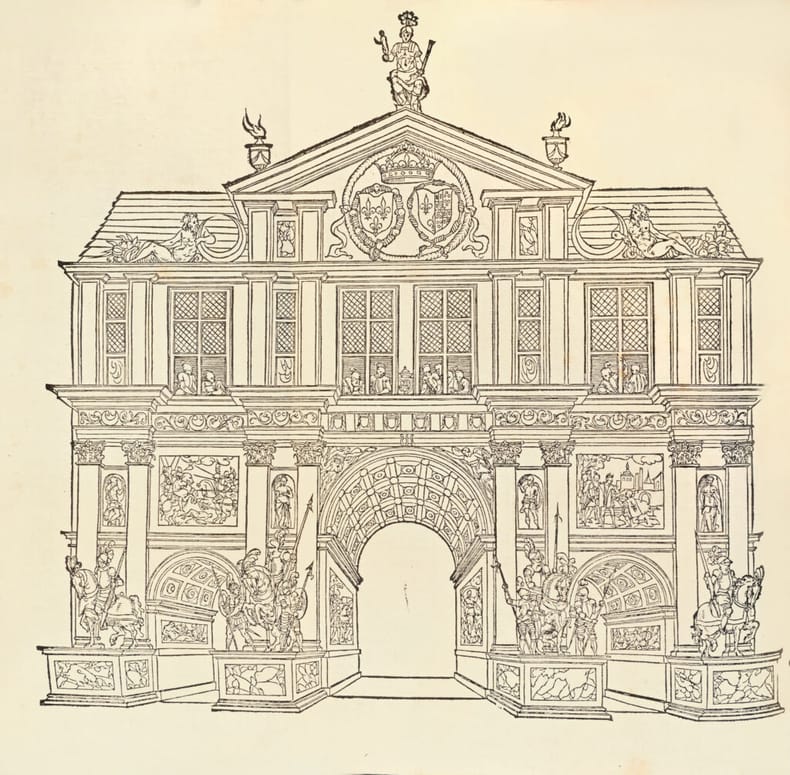
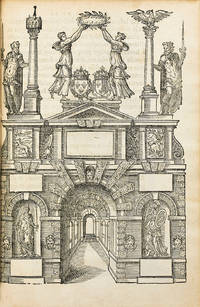
BIBLIO-LIVE-4-12Paris Denis du Pré 1572.<p>4to 235 x 157 mm of 53 ll. 1 9 full-page engravings in the text and one folding engraving out of pagination ; 10 ll. 26 2 ll. including 1 bl. 9 2 bl.ll. 6 full-page engravings in the text. Handwritten manuscript on the title. </p><p>Bound in full granite-like calf blind-stamped fillet on the covers spine ribbed and decorated mottled edges. Old restorations on the spine. <i>Early 18th century binding.</i></p><p>First edition of one of the most beautiful entries of the French Renaissance containing several plays by <i>Ronsard Antoine de Baïf Amadis Jamyn Jean Dorat Du Faur de Pibrac Pasquier</i>. in first edition.</p><p>Mortimer <i>French</i> 205-206; Rahir <i>Dutuit</i> 676; Picot <i>Rothschild</i> 3117; Brunet II 1001; Pichon 4897; Fairfax Murray <i>French</i> 152.</p><p><b>One of the beautiful French celebration books of the 16th century recounting the coronation of Queen Elisabeth of Austria wife of Charles ix and daughter of the Emperor Maximilian ii</b> which took place in the Abbey of Saint Denis as well as the entry of the sovereigns in the capital.</p><p>The work was written by the Parisian municipal magistrate<i> Simine Bouquet</i> who was charged by his colleagues at the city hall to organize the celebration and to coordinate the order of the decors; he had entrusted <i>Ronsard</i> and <i>Dorat</i> with the direction they decided the theme: the happy meeting between France and Germany. These two poets called in <i>Germain Pilon</i> for the sculptures in <i>Le Conte</i>for the carpentry's works and for the perspectives and the paintings in <i>Pierre d'Angers</i> andin<i> Nicolo dell'Abbate</i> the famous emulator of Fontainebleau's<i>Primaticcio.</i></p><p><b>The edition encloses 16 full-page woodcuts including 1 folding plate</b> made by the <i>precious stones cutter and engraver Olivier Codoré </i>abbreviated name according to Mariette of the valet and semi-precious stones engraver of the future Henry IV nicknamed <i>Coldoré</i> because of the abundance of necklaces he exhibited with pleasure.</p><p><b>The illustration depicts the ephemeral architectures triumphal arcs ivy and leaves cradles fountains…put on the royal cortege's way. </b>It is interesting as it is itself "<i>transformable</i>".</p><p>These ceremonies had been delayed for about ten years Charles IX being able to make his solemn entry in the capital only thanks to the recent Saint Germain peace conclusion on August 11th 1570 which put a temporary end to ten years of religious wars.</p><p><i>"The king's entry is illustrated with 10 figures including 9 that measure 200 x 140; the tenth bigger 208 x 212 depicts the perspective of the painting put place du Chatelet. These woodcuts offer similarities with those of the Entry of Henry II. The Entry of the Queen is illustrated with 6 woodcuts made each of two parts: the lower part is the exact reproduction of the corresponding figure of the King's entry; the upper part alone was re-engraved with different characters. The Queen having arrived 23 days after the king we had to keep the same decors and replace the allegories and inscriptions with other ones more suitable. All this decoration would be by Codoré as it is hinted in the privilege. According to Mariette Codoré would be the nickname of Fontenay Henry IV's semi-precious stones engraver."</i> Brun <i>Le Livre français illustré de la Renaissance</i> p. 181.</p><p>The volume encloses a mention of first state: the word<i>"vouloir"</i> l.34 v° wasn't added to line 7.</p><p>Brunet II 1001 mentions "<i>On some copies the page 'Simon Bouquet' is followed by a play in verse signed E. Pasquier Parisien entitled 'Au Roy Congratulation de la paix faicte par sa Majesté entre ses sujets l'onzieme jour d'Aoust 1570' 9 leaves</i>".</p><p>Our copy is one of the very few to include this play in verse by Pasquier.</p><p>The Queen being ill another celebration was held for her three weeks later. The same temporary architectures were used<i> but they were decorated with new allegorical figures.</i></p><p><b>A precious wide-margined and unwashed copy preserved in its 18th century binding. </b>Copies in ancient binding are rare most of them having been rebound –and washed at the same time– at the end of the 19th century.</p><p><br /></p><p><u>FR</u><br /></p><p>Paris Denis du Pré 1572.</p><p>In-4 de 53 ff. 1 9 gravures à pleine page dans le texte et une gravure dépliante hors texte ; 10 ff. 26 2 ff. dont 1 bl. 9 2 ff.bl. 6 gravures à pleine page dans le texte. Ex libris manuscrit sur le titre. Relié en plein veau brun granité filet à froid encadrant les plats dos à nerfs orné coupes décorées tranches mouchetées. Restaurations anciennes au dos. <i>Reliure du début du XVIIIe siècle</i>.</p><p>235 x 157 mm.</p><p><b>Edition originale de l'une des plus belles entrées de la Renaissance française contenant plusieurs dizaines de pièces de</b><i>Ronsard Antoine de Baïf Amadis Jamyn Jean Dorat Du Faur de Pibrac Pasquier</i>. <b>en édition originale.</b></p><p>Mortimer<i>French</i> 205-206 ; Rahir <i>Dutuit</i> 676 ; Picot <i>Rothschild</i> 3117 ; Brunet II 1001; Pichon 4897; Fairfax Murray <i>French</i> 152.</p><p><b>Un des beaux livres de fêtes français du XVIe siècle relatant le couronnement de la reine Elisabeth d'Autriche épouse de Charles IX et fille de l'Empereur Maximilien II </b>qui avait eu lieu à l'abbaye de Saint-Denis ainsi que l'entrée des souverains dans la capitale.</p><p>L'ouvrage est dû à l'échevin parisien <i>Simon Bouquet</i>que ses collègues de l'Hôtel de Ville avaient chargé d'ordonner la fête et de diriger l'agencement des décors ; celui-ci en avait confié la mise en scène à <i>Ronsard</i> et à <i>Dorat</i> qui en fixèrent le thème : l'heureuse rencontre de la France et de la Germanie. Ce sont ces deux poètes qui firent appel à <i>Germain Pilon</i> pour les sculptures à <i>Le Conte</i> pour les travaux de charpenterie et pour les perspectives et les peintures à <i>Pierre d'Angers</i> et à <i>Nicolo dell'Abbate</i> le célèbre émule du <i>Primatice</i> à Fontainebleau.</p><p><b>L'édition comporte 16 planches sur bois à pleine page dont une dépliante</b><b> </b>dues au <i>tailleur et graveur en pierres précieuses</i> <i>Olivier Codoré</i> nom abrégé selon Mariette du valet de chambre et graveur en pierres fines du futur Henri IV surnommé <i>Coldoré</i> à cause de l'abondance de colliers qu'il exhibait volontiers.</p><p><b>L'illustration figure les architectures éphémères arcs triomphaux berceaux de lierre et de feuillage fontaines. dressés sur le chemin du cortège royal.</b><b>Elle présente l'intérêt d'être elle-même " </b><i>à transformations</i> ".</p><p>Ces cérémonies avaient été retardées pendant une dizaine d'années Charles IX ne pouvant faire son entrée solennelle dans la capitale que grâce à la récente conclusion de la paix de Saint-Germain le 11 août 1570 qui mettait un terme provisoire à une décennie de guerres de religion.</p><p>" <i>L'entrée du roi est ornée de 10 figures dont 9 mesurent 200 x 140 ; la dizième plus grande 208 x 212 représente la perspective de la peinture dressée place du Chatelet. Ces bois offrent des similitudes avec ceux de l'Entrée de Henri II. L'Entrée de la reine est ornée de 6 bois formés chacun de deux parties : la partie inférieure est la reproduction exacte de la figure correspondantes de l'entrée du roi ; la partie supérieure seule a été regravée avec des sujets différents. La reine ayant fait son entrée 23 jours après celle du roi on avait dû conserver les mêmes décors et remplacer les allégories et inscriptions par d'autres mieux appropriées. Toute cette décoration serait de Codoré ainsi que le laisse entendre le privilège. Selon Mariette Codoré serait le surnom de Fontenay graveur en pierres fines de Henri IV.</i> " Brun <i>Le Livre français illustré de la Renaissance</i> p. 181.</p><p>Le volume comporte une remarque de premier tirage : le mot " <i>vouloir</i> " au f.34 v° n'a pas été ajouté à la ligne 7.</p><p>Brunet II 1001 mentionne " <i>A quelques exemplaires la page 'Simon Bouquet' est suivie d'une pièce en vers signée E. Pasquier Parisien intitulée 'Au Roy Congratulation de la paix faicte par sa Majesté entre ses sujets l'onzieme jour d'Aoust 1570' 9 feuillets</i> "</p><p><b>Notre exemplaire est l'un des très rares à posséder cette pièce en vers de Pasquier.</b></p><p>La reine étant souffrante une autre fête fut organisée en son honneur trois semaines plus tard. Les mêmes architectures éphémères furent employées <i>mais on les décora de nouvelles figures allégoriques</i>.</p><p><b>Précieux exemplaire grand de marges et non lavé conservé dans sa reliure du XVIIIe siècle. </b>Les exemplaires en reliure ancienne sont rares la plupart ayant été reliés à nouveau - et lavés par la même occasion – à la fin du XIXe siècle.</p> hardcover
1617LBW-982[Amsterdam, 1617]. En quatre feuilles jointes de 590 x 2240 mm ; encadré sous verre.
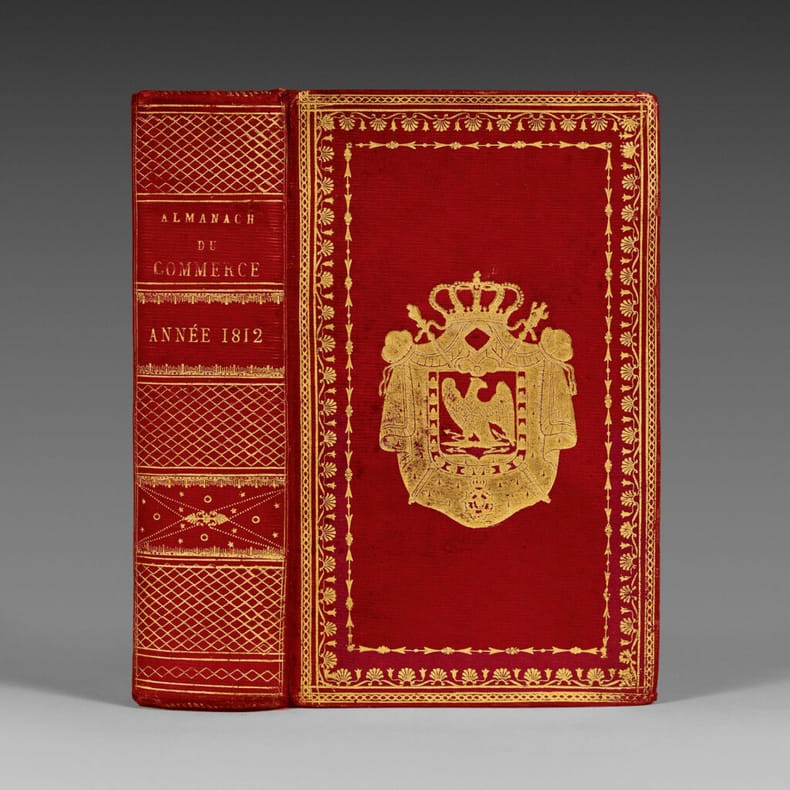
LCS-18198L’Almanach du Commerce pour l’année 1812 relié en maroquin rouge de l’époque aux armes de l’Empereur Napoléon Ier. Paris, chez J. de la Tynna, Propriétaire-Rédacteur, rue J. J. Rousseau, n° 20. In-8 de 1039 pp. Plein maroquin rouge, encadrement de filets et roulette dorés autour des plats, armoiries de l’Empereur Napoléon Ier au centre des plats, dos lisse richement orné, coupes décorées, doublures et gardes de tabis bleu, tranches dorées. Reliure armoriée de l’époque. 211 x 129 mm.
1654B66141654. small lower marginal tears at B1 2 and N2; some contemporary ink under linings; wide margin paper. Overall this rare work is in very good condition. . Binding: Contemporary full crushed brown morocco spine raised with six 6 bands; worn gilt title on two; compartments faded; all edges speckled red and green. Notes: Rare. Second augmented after the first edition published earlier the same year 1654. Text in Latin. Place printer or publisher are unidentified; printer’s device of: Troyes: Nicolas I Oudot’s heirs printer; <br>Three parts in one volume. <br>This is a rare edition of this early French astrological work printed the same year as its first edition. Some of the text especially relating to predictions was regarded exceedingly offensive immediately condemned leading to contents either to be removed or whole copies burned; the present second edition was published without the contentious contents i.e. volvelles making predictions about Islam its future development Christianity and England France and Spain; five 5 volvelles remain in this edition relating to Henry IV of France and constellations of the heavens at the time of creation.<br>Sotheby’s states: "The first two parts are attributed on their title-pages to a Francisci Alleius and comprise an explication of his 'new method of astrology' and comments and observations on 'the fate of the universe. ' The third part is a commentary on the preceding two sections by the Capuchin Yves de Paris who is presumed to be the true author of the entire work. Expurgated editions themselves very rare were printed in Paris in 1654-56 and Rennes in 1658."<br>While the contents give no indication of the publisher printer or place the printer’s device of Nicolas Oudot Troyes founder of the Bibliothèque bleue is engraved on the first title. <br>Caillet III 11557. Thorndike VIII 310ff. Peignot Dictionnaire des livres condamnés au feu II 204f. <br> Size: Folio 343x215mm. Illustration: Two illustrated titles with woodcut engraved printer’s devices the first depicting a flower filled basket the second a fruit filled bowl; woodcut engraved floral initials and head pieces at openings; moreover five astrological figures; of these twelve 12 are moveable parts and five 5 fixed; of the five three have retained their threaded marker. Provenance: Armorial bookplate on upper pasted endpaper. References: Brunet I 185; Caillet III 11557; Dorbon Bib. Estoterica 61; Houzeau and Lancaster 5217. Thorndike VIII 310ff. Peignot Dictionnaire des livres condamnés au feu II 204f. Pages: Ll: bl. vol I: 2 pp.12; vol II: pp.57 p.1; vol III: pp. 26; bl. Collation: e1-2 A1-C2; A1-N2 O1-3; A1-F2 G1; bl. with watermark Category: Book Religious Christianity; Book Europe France; Book Science & Technology; unknown
18161435761816. PARIS. Graphic Illustrations of the Most Prominent Features of the French Capital; with Characteristic Figures in the Foregrounds comprised in Twelve Stroke Engravings From Accurate Designs Taken in Paris during the Imperial Reign of Buonaparte. With Descriptive Notices and Interesting Anecdotes. 26 pp. illustrated with 12 double-page engravings. Folio 430 x 380 mm. bound in contemporary French three-quarter black morocco over marbled boards gilt title and floral vignettes on spine paper label with ms. number "20" on front cover and spine. London: Harper and Co. 1816. A fine copy of this extremely rare collection of views of Paris consisting of twelve artistically conceived views of Paris engraved by English artists. The large double-page engravings incorporate local Parisians participating in daily routines within the setting of each view. Panoramic views include: the Military School and the Church of the Invalides; View of Paris from the South Boulevard; View of Paris from Montmartre; South View of the Old and New Louvre; The Mint and The Façade of the Louvre; View of La Place de la Concorde; The Garden of the West Front of the Tuileries; Palace of the Tuileries Facing La Place du Carrousel; Garden of the Tuileries; The Luxembourg or Palais du Senat with the Gardens; The Elysian Fields Distant Gardens of the Tuileries; Entrance to Les Champs Élysées and La Place de la Concorde. Each plate is followed by two pages of text giving historical details and anecdotes about the site illustrated. Minor wear to outer edges of binding plates and text clean. Rare: OCLC lists 6 copies worldwide of which only one is held in America Bowdoin College. hardcover
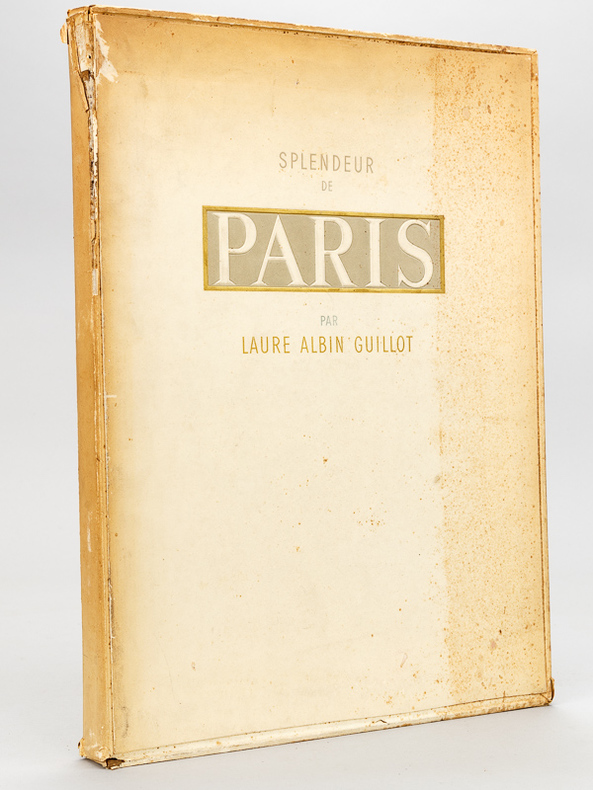
Un des 700 exemplaires numérotés (n° 312 imprimé pour Henri de S...), préface de Maurice Garçon, 1 vol. in-folio en feuilles sous emboîtage éditeur rigide, Ateliers d'Impressions et de Cartonnages d'Art, s.d. [ 1945 ], 3 ff. et 20 planches en héliogravure Remarquable exemplaire, dans un étui certes très usagé, mais enrichi d'un bel envoi de la photographe Laure Albin-Guillot ("avec les sentiments admiratifs et infiniment reconnaissants de Laure Albin-Guillot, 26 janvier 1946") et surtout dont chacune des 20 héliogravures a été signée au crayon par la photographe (et numérotée, de 1 à 20) ! Nos recherches ne nous ont pas permis de découvrir d'exemplaire comparable, les planches n'étant habituellement pas signées par l'artiste. Etui fort. usagé avec manques, rouss. au premier ff., les héliogravures sont en très bon état. - A very scarce copy, enriched with a beautiful handwritten dedication by the famous photographer Laure Albin-Guillot ("avec les sentiments admiratifs et infiniment reconnaissants de Laure Albin-Guillot, 26 janvier 1946" [ "with the admiring and infinitely grateful feelings of Laure Albin-Guillot, January 26th, 1946" ] ) ; Most importantly, it must be pointed out that each of the 20 heliogravures was signed with a pencil by the photographer (and numbered, from 1 to 20) ! Despite a thorough research, we could not find any record of another copy with such features, i.e.with all the plates that are signed by the artist. Slipcase of this copy is very damaged and with lacks). Foxings can be seen on first sheet, as well. Nevertheless, the prints are in very good condition. Français
228786S.l., s.d. (1654) in-8 oblong, maroquin vieux-rouge, dos à nerfs orné de caissons richement décorés, double encadrement de double filet doré sur les plats avec fleurons d'angle, tranches dorées (reliure de l'époque). Coiffes et nerfs frottés, coins très abîmés, plats salis, certaines planches défraîchies ou avec mouillures.
18312996Paris, Charles Gosselin, 1831 (imprimerie de Cosson) ; deux tomes in-8 réemboités dans une reliure romantique d'époque, plein veau glacé bronze, dos à nerfs plats décorés, fleurons romantiques dorés entre-nerfs, palette décorative dorée en pied, plats ornés d'un grand décor romantique à la plaque gravée, toutes tranches dorées, liseré bordeaux en bord des plats et des coiffes replié plus largement à l'intérieur avec roulette dorée et filet doré sur les coupes ; tome I ; (4) ff. (faux-titre, au verso Oeuvres de Victor Hugo et nom d'imprimeur, titre avec une vignette de Tony Johannot gravée sur bois par Porret, préface datée de mars 1831), 404 pp. ; tome II ; (1) f. (absence du faux-titre, titre avec une autre vignette de Tony Johannot gravée sur bois par Porret), 536 pp., fautes de pagination : les pages 491 et 495 sont paginées par erreur 391 et 395.
1862B6492Paris: Librairie maritime et scientifique Arthus Bertrand editeur. 1862. A near fine copy with one plate with marginal tears otherwise texts and plates are clean and crisp.<br><br>. Binding: Contemporary cloth rebacked in calf expertly title in gilt on spine spine with 4 raised bands. Notes: François-Edmond Paris 1806–1893 was a French admiral notable for his contribution to naval engineering during the rise of the steam for his books and for his role in organising the Musee national de la Marine.<br>Michel Charles Fichot 1817 - 1903 was a French painter designer illustrator and lithographer.<br>Hubert Clerget 1818 - 1899 was a French lithographer and painter.<br>Jules Gaildreau 1816-1898 was a draughtsman illustrator active in Paris.<br><br>This is the first and only edition of this beautifully illustrated work. It is an account of the 1861 visit to Jerusalem undertaken by the third French Squadron of the Mediterranean. This book is famous for the quality of its 12 hand-coloured plates including the Mosque of Omar and the El-Aqsa Mosque. François-Edmond Paris joined the French Navy in 1820 and took part in three great expeditions: the first under d’Urville abord the Astrolabe 1826-9 and two under Laplace on the Favorite 1829-32 and the Artemise 1837-40. In 1858 he was named rear-admiral and was given the command of the third French Squadron of the Mediterranean. Before publishing “Souvenirs de Jerusalem†Paris had already published two important folios on naval and marine architecture. The “Notes historiques'' provide a rich and fascinating complement to the plates providing not only historical references but also the author’s impressions as a visitor.<br><br><br> Size: Large Folio. Illustration: Illustrated with 14 full page finely coloured plates. References: Blackmer 1255; Röhricht 508. Category: Book Asia Middle East Holy Land; Book Plate Books Colour; Librairie maritime et scientifique Arthus Bertrand, editeur. hardcover
EN-136o.J. Lithographie, 1925, auf Velin, mit schwarzer Kreide betitelt ?La Fenêtre sur la Ville 1910? und signiert ?R Delaunay?. Darstellungsgröße 54,5:42 cm, Blattgröße 63,4:47,2 cm. Mit dem Trockenstempel ?Atelier R. Delaunay, 19 B Malesherbes, Paris? in der rechten unteren Blattecke. Mit Restaurierungen in den Blatträndern. Literatur: Loyer/Perussaux 4. ? Eines von 60 geplanten Exemplaren. Die Lithographie entstand in freier Nachempfindung der Gemälde ?Fenêtre sur la Ville? von 1910 und ?Les Fenêtres simultanées sur la Ville? von 1911.
18161435761816. PARIS. Graphic Illustrations of the Most Prominent Features of the French Capital; with Characteristic Figures in the Foregrounds comprised in Twelve Stroke Engravings From Accurate Designs Taken in Paris during the Imperial Reign of Buonaparte. With Descriptive Notices and Interesting Anecdotes. 26 pp. Illustrated with 12 double-page engravings. Folio 430 x 380 mm bound in contemporary French three-quarter black morocco over marbled boards gilt title and floral vignettes on spine paper label with ms. number "20" on front cover and spine. London: Harper and Co. 1816. A fine copy of this extremely rare collection of views of Paris consisting of twelve artistically-conceived views of Paris engraved by English artists. The large double-page engravings incorporate local Parisians participating in daily routines within the setting of each view. Panoramic views include: the Military School and the Church of the Invalides; View of Paris from the South Boulevard; View of Paris from Montmartre; South View of the Old and New Louvre; The Mint and The Façade of the Louvre; View of La Place de la Concorde; The Garden of the West Front of the Tuileries; Palace of the Tuileries Facing La Place du Carrousel; Garden of the Tuileries; The Luxembourg or Palais du Senat with the Gardens; The Elysian Fields Distant Gardens of the Tuileries; Entrance to Les Champs Élysées and La Place de la Concorde. Each plate is followed by two pages of text giving historical details and anecdotes about the site illustrated. Minor wear to outer edges of binding plates and text clean. Rare: OCLC lists 6 copies worldwide of which only one is held in America Bowdoin College. hardcover books
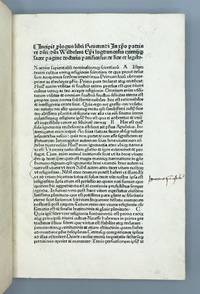
147511955Augsburg: Günther Zainer 1475. 19th-century gilt-ruled speckled calf J. Mackenzie; rubbed spine and red morocco label gilt crown neatly repaired red edges. <p> Editio Princeps of the first printed work of William of Auvergne c. 1180-1249 originally composed 1228-30 as part of his encyclopedic Magisterium divinale. In his youth William read widely in books of judicial astronomy magic and sorcery. HE WAS A FORERUNNER OF ROGER BACON AND ALBERTUS MAGNUS and "one of the first wave of thinkers in the Latin West to engage with the writings on natural philosophy and metaphysics by Greek Islamic and Jewish thinkers that had recently become available in Latin translations" Lewis et al. With these newly recovered works on the occult sciences he framed "a new philosophical vision of magic as applied knowledge" rather than demonic activity Hansen.<br /> He examines superstitions associated with i.a. the stars the elements images words names seasons new undertakings the finding of objects dreams alchemy gemstones minerals metals and seeing the future in children's fingernails. In good condition bookplate of the Bibliotheca Philosophica Hermetica.<br /> ¶Sarton Introduction to the History of Science II: 219; Lewis & Fischer "William of Auvergne" in The Stanford Encyclopedia of Philosophy Spring 2023 edd. Zalta & Nodelman online; Hansen "Bookish Magic" in Dictionary of the Middle Ages 8: 37; Quentin Naturkenntnisse und Naturanschauungen bei Wilhelm von Auvergne 19-21 & 58-60; ISTC ig00711000; Goff G-711.</p> Günther Zainer unknown
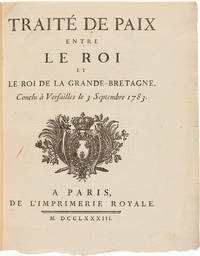
1783WRCAM34309Paris: de l'Imprimerie Royale 1783. 35pp. Quarto. Later marbled boards leather label. Very minor marginal dampstain throughout. Near fine untrimmed. The official French printing of the final treaty of peace between France and England in the American War of Independence concluded Sept. 3 1783 the same day as the final peace between the other powers in the conflict. Because of the French naval setbacks in 1782 the treaty resulted in little territorial loss for England and the powers returned each other's Caribbean possessions. Furthermore England's claims to Newfoundland were maintained and mutual fishing rights off the Canadian coast were agreed upon. The NUC and OCLC together locate nine copies of this scarce printing. DAVENPORT 171. SABIN 96557. OCLC 25450771 21984761. de l'Imprimerie Royale hardcover books
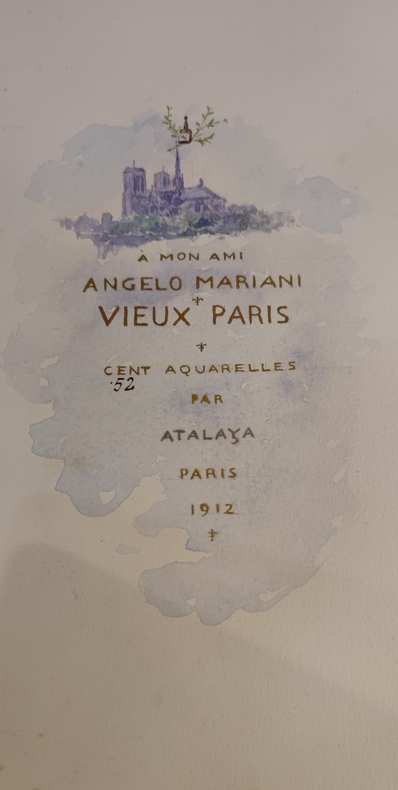
19061608in-4 (31 x 27 cm), reliure maroquin vert pomme, signée Noulhac, tranches dorées. Album in-4 (32 X 26 cm), contenant 52 étonnantes et fidèles aquarelles originales représentant les ponts de Paris signées et dédicacées à l'homme d'affaires Angelo Mariani, ami et commanditaire de l'artiste, auteur de ces aquarelles qui représentent fidèlement les ponts de Paris à la Belle Epoque. Chaque aquarelle (format 9 x 13,5 cm=) est légendée par le peintre, à la plume. Voici quelques Ponts : ALEXANDRE III - SULLY - PASSERELLE DES ARTS - PONT NEUF - PONT AU CHANGE - PONT NOTRE DAME - AUSTERLITZ - VIADUC D'AUTEUIL- PONT MIRABEAU - MARCHE AUX FLEURS - IENA - GRENELLE - PONT MARIE - ALMA - garigliano - PONT MIRABEAU - etc...
19123506Album in-4 (32 x 26cm), reliure maroquin noir, signée Noulhac, contenant 152 étonnantes et fidèles aquarelles représentant des rues de Paris de divers quartiers (16ème, 5ème, Ier, etc.), de format moyen de 9 x 15 cm, signées et dédicacées à l'homme d'affaires Angelo Mariani, ami et commanditaire de l'artiste, auteur de ces aquarelles. Ces aquarelles représentent fidèlement les endroits, les monuments et les rues de Paris et sont un témoignage artistique et historique précieux1912du Paris de la Belle-Epoque. Chaque aquarelle est légendée par le peintre, à la plume. (album protégé par un étui bordé) Quelques noms de rues : PASSY, AUTEUIL, RAYNOUARD, BOULAINVILLIERS, BERTON, RANELAGH, CHERNOVIZ, VAN LOO, SAINT-JACQUES, MAUBERT, ROLLIN, VIARMES, ARRAS, SAINT-BON, ASSOMPTION, MARRONNIERS, ARRAS, CITE, TEMPLE, ST DENIS, CHAILLOT, VIGES, ST NICOLAS DES CHAMPS, TURBIGO, FRANKLIN, GUSTAVE ZEDE, SINGER, GEOFFROY ST HILAIRE, BEETHOVEN, VIGNES, TEMPLE, FRANCS BOURGEOIS, etc.
194556982Un des 700 exemplaires numérotés (n° 312 imprimé pour Henri de S...), préface de Maurice Garçon, 1 vol. in-folio en feuilles sous emboîtage éditeur rigide, Ateliers d'Impressions et de Cartonnages d'Art, s.d. [ 1945 ], 3 ff. et 20 planches en héliogravure
A COMPLETE SET--PERHAPS UNIQUE--OF THE FOUR BOOKS PUBLISHED BY "INTER NOS" IN PARIS DURING WORLD WAR TWO, THE FIRST TWO OF WHICH WERE ISSUED DURING THE OCCUPATION. The first three are EXTREMELY RARE because of the tiny edition sizes (by the time the fourth was published, the Germans had surrendered, so a somewhat larger edition could be printed). While many livres d'artiste were printed in France under the Occupation, they were subject to Nazi censorship, and thus limited themselves to uncontroversial subject-matter. "INTER NOS", as the name implies ("among us", in Latin), was the only organization (in fact a small group of friends) that published clandestine livres d'artiste, with texts and illustrations depicting graphic sex and sadistic violence. *****(1) Edouard Peisson, "Hans le marin" (1943), with 22 origlnal etchings by Paul-Louis Guilbert. EDITION LIMITED TO 17 COPIES PRINTED ON FINE WOVE PAPER, OF WHICH THIS IS ONE OF ONLY FIVE "EXEMPLAIRES DE COLLABORATEURS" ("collaborators" in a positive sense, we must assume). THIS COPY WAS SPECIALLY PRINTED FOR EDOUARD PEISSON, THE AUTHOR. This copy includes a second suite of the 22 etchings in second (remarque) state, as well as a suite of the three "planches refusÈes" and an additional proof without text of one of the etchings. One of the subversive remarques features a small portrait of a German officer complacently smoking a cigarette, with the etched text, "26 MARS 1943 / 1.005e jour / DE L'OCCUPATION_". Folio. Loose as issued in original wraps, housed in a custom clamshell box. FINE AND BRIGHT. ******(2) FrÈdÈric Boutet, "Un scandale au XVIIIe siËcle" (1943), with 20 original etchings by Guilbert. EDITION LIMITED TO 17 COPIES PRINTED ON FINE WOVE PAPER, OF WHICH THIS IS ONE OF FIVE COPIES WITH A REMARQUE SUITE OF THE ETCHINGS AND TWO SIGNED ORIGINAL DRAWINGS. This copy additionally has two etchings justified "Èpreuve unique", a working proof of one of the etchings, two additional drawings, the "planche refusÈe", two signed letters from Guilbert, and a signed original drawing opposite the half-title. This book and the following one have an extremely unusual feature: many of the etchings in the suites are actually other versions of the etchings in the book, rather than merely other states (in other words, they were not printed from the same plate). In some cases, the etchings used in the book are "decent" and the etchings in the suites are most certainly not. Folio. Loose as issued in original wraps. Board chemise and slipcase. FINE AND BRIGHT. ONE COPY IN WORLDCAT (BN). *****(3) Pierre Louˇs, "La femme et le pantin" (1945: completed April 25, two weeks before VE Day), with 41 original etchings by Guilbert. EDITION LIMITED TO 30 COPIES PRINTED ON FINE BFK RIVES WOVE PAPER, OF WHICH THIS IS ONE OF 13 WITH THREE SUITES OF THE ETCHINGS AND TWO ORIGINAL DRAWINGS. This copy additionally has four drawings (in addition to the two announced in the justification); two additional proofs of etchings (including one signed and annotated "Èpreuve unique"); twelve pages of typographical proofs (including two with etchings); a proof of the title-page with an original drawing; and two additional proofs of the spine label. 4to. Loose as issued in original wraps. FINE AND BRIGHT, in the slightly worn original chemise and slipcase. NO COPIES IN WORLDCAT. EVEN THE BIBLIOTHEQUE NATIONALE DOESN'T HAVE THIS ONE. *****(4) Charles-ThÈophile FÈret, "Le manchot" (1945), with 21 original aquatints by Guilbert. Edition limited to 66 numbered copies beautifully printed on fine Arches wove paper, of which this is ONE OF TEN WITH AN ORIGINAL SIGNED GOUACHE PAINTING IN FULL COLOR. In this copy, the gouache is the preliminary design for the aquatint on p. 37. 4to. Loose as issued in original wraps, board chemise, and slipcase. A bit of light foxing, else FINE AND BRIGHT. Very rare. ******** COMPLETE SETS LIKE THIS ONE ARE OF THE GREATEST RARITY: EVEN THE INDIVIDUAL BOOKS ARE EXTREMELY RARE, AND I HAVE FOUND NO REFERENCE TO THE EXISTENCE OF ANY OTHER COMPLETE SET.