"THOMISSØN, HANS.Livre Rare Book
27 résultats
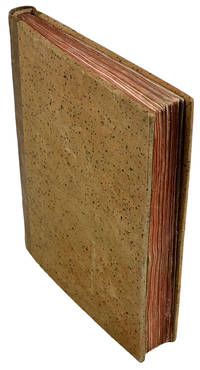
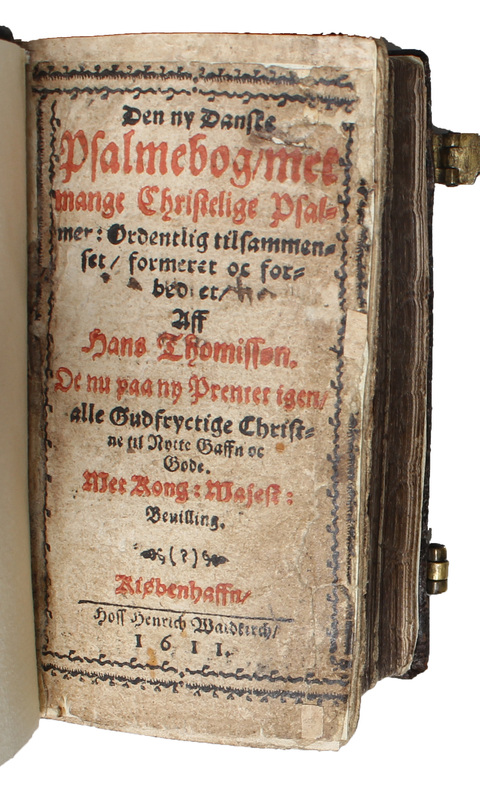
161158820Kiøbenhaffn, Henrich Waldkirch, 1611. 12mo (ca. 10 x 5,5, cm). Near contemporary black full calf with brass clasps. All edges beautifully and elaborately chiselled. New end-papers and title-page re-enforced et edges, from verso, no loss of text. 2nd leaf and 2nd leaf of Register with small marginal restorations, no loss of text. Apart from the small restorations, an exceptionally well preserved copy. Title-page printed in red and black, and many woodcut musical notes throughout. Title-page + pp. (XIII) - (XXX) (i.e. lacking the first three leaves of the preface - ""Fortalen""), 653, (11) pp. (= register). - I.e. a lovely copy only lacking the first 6 leaves (ff. (A)1-6) of the preface.Withbound at the end are the 18 first text-pages of ""En Bøn at bede om Morgenen"" (presumably also by Thomissøn, ca. 1600) - these 9 leaves are not in particularly good condition.
1635132<p>Exceedingly rare first edition</p><p>of Doni renowned landmark of music theory</p><p>The innovation of the "<em>Lyra Barberina</em>"</p><p>Only one copy sold at auction in the last 50 years</p><p>Doni Giovanni Battista.<em> Compendio del trattato de'generi e de'modi della musica. Di Gio. Battista Doni. Con un discorso sopra la perfettione de' concenti. Et un saggio a due voci di mutationi di genere e di tuono in tre maniere d'intauolatura: e d' vn principio di madrigale de principe ridotto nella medesima intauolatura. All'eminentiss. e reuerendiss. sig. il sig. cardinal Barberino. </em>In Roma : per Andrea Fei 1635.</p><p>4to 20 x 15 cm half vellum binding boards enriched with hand-colored paper pp. 40 171 1 signature †ⴠa-dⴠA-VⴠXⶠleaf b1 incorrectly numbered c1 xylographic decorations and headpieces on title page the coat of arms of Cardinal Francesco Barberini text in Latin and Greek.</p><p>At leaf Q3v: <em>Aggiunta con descrizione e rappresentazione in spartito dei cinque Modi o Tuoni generali denominati Dorio Frigio Lidio Iastio Eolio</em>; at leaf V1r: <em>Il principio d'un madrigale del Principe.</em></p><p>5 folding plates with musical notations</p><p>In his <em>Compendio</em> Doni is the first to theorise the introduction of elements of the ancient tonal system into contemporary musical practice and the need to return to the <em>Greek tonal system</em> an ancient music theory characterized by its use of tetrachords four-note scale segments various modes named after Greek regions like Dorian Phrygian and Lydian and the concept of octave species which describes different arrangements of whole and half steps within an octave.</p><p>His theories took up the themes that Vincenzo Galilei had expressed in his <em>Dialogo della musica antica e moderna</em>. He compared the moderns to the ancients concluding that apart from very few examples Monteverdi in particular true chromatic compositions do not exist. Very important in these works is the clear distinction that the author places between the madrigal genre and the recitative style following the reform of the <em>Camerata Fiorentina</em>.</p><p>Doni recognized the advancements made by his predecessors such as Mei 1573 and Salinas 1577 in understanding the Greek tonal system though he disagreed with some of their interpretations. He was critical of others like Glareanus whom he accused of falsely claiming to have revived Greek modes without properly engaging with the ancient Greek musical sources. Doni also dismissed Nicola Vicentino's attempts to revive the ancient chromatic and enharmonic genera as mistaken and useless.</p><p>A significant aspect of Doni's work was his interpretation of the <em>tonoi</em> and octave species based on close readings of the original Greek treatises. His analysis provided a basis for our contemporary understanding of these concepts.</p><p>Doni differentiated between tonos and mode drawing insights from Ptolemy's discussions on the modulation of tonos compared to melody. He highlighted how modulation in tonos involves altering the pitch of the voice throughout the melody while keeping the intervals suitable as opposed to changing only a part of the melody.</p><p>Additionally Doni credited Ptolemy with establishing the distances between the <em>tonoi</em> describing the specific intervals that separate various <em>tonoi</em> such as Dorian Phrygian Lydian and Mixolydian.</p><p>This understanding of the relationships between different <em>tonoi </em>was crucial in the historical study and interpretation of ancient Greek music theory.</p><p>One of Doni's significant innovations was his modification of the lyre an instrument he renamed the <em>Lyra Barberina</em> in honor of his patron Cardinal Francesco Barberini.</p><p>This instrument was intended to revive the ancient <em>Greek</em> <em>lyre</em> reflecting Doni's passion for connecting past and present musical traditions.</p><p>In the Appendix we find the Pedro de Heredia's madrigal <em>Passa la vita</em> on a text by Pope Urbanus VIII</p><p>One of the woodcuts in the book shows a violin fingerboard with a layout for the ancient Doric mode. Other woodcuts illustrate Greek tonalities and chromatic musical progressions.</p><p>Conditions: wormholes restored at last 40 leaves sometimes touching few letters some marks of use and light waterstains along the text.</p><p>References: Claude V. Palisca 1997. <em>Giovanni Battista Doni's Interpretation of the Greek Modal System</em>. The Journal of Musicology 151 3–18; RISM B VI.1 p. 272; Gregory p. 76; Gamba 1912; Damschroder & Williams p. 74.</p><p>Wider description and more images:</p><p>https://tinyurl.com/1635DONI-PDF</p> Andrea Fei