Charles GOUNODBiblio.com
182 résultats
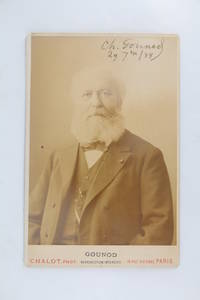
188888513Paris: s. n. 1888. Fine. s. n. Paris 1888 11 x 15 cm Une photographie Original photograph depicting Charles Gounod full face. Vintage gelatin silver print mounted on cardboard produced by photographer Isidore Alphonse Chalot at 18 rue Vivienne Paris. Autograph inscriptions in black then blue ink on the verso by the recipient A. Lasserre inspector at the Opéra Garnier: ""Portrait de Ch. Gounod signé le soir de la 926eme représentation de Faust samedi 29 septembre 1888 A. Lasserre."" Additional handwritten note in pencil in the right margin of the verso: 1867e représentation de Faust le 28 septembre 1929. Printed stamp at foot of the verso: ""Maison Martinet Albert Hautecoeur 18 bd des Capucines."" Charles Gounods dated autograph signature to upper right corner of the photograph : ""Ch. Gounod 29 7bre / 88."" leaux "" s. n. unknown
0486283496New. Brand new and still unused unknown
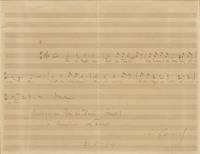
395518 measures in treble clef notated in black ink on a portion of a 14-stave rastrum-ruled album leaf 177 x 233 mm. With text in French in Gounod's hand commencing "Il etait un Roi du Thulé" Marguerite's melancholy aria from Act III. <br /> <br /> Identified in the composer's hand at foot: "Ballade du Roi de Thulé . à Monsieur Lebert. Ch. Gounod" and dated 26 August 1869.<br /> <br /> Slightly faded; browned; creased at central vertical fold; portions of leaf slighty lightened; margins of verso reinforced with brown paper tape. Faust an opera in five acts to a libretto by Jules Barbier and Michel Carré after Carré's Faust et Marguerite and Johann Wolfgang von Goethe's Faust Part I in the French translation by Gérard de Nerval was first performed in Paris at the Théâtre Lyrique on 19 March 1859 in a version with spoken dialogue; recitatives were added in 1860 and a ballet and couplets for Méphistophélès were added for a new production in 1869. <br /> <br /> "The historical importance of Faust is that it sounded a new note in French music. The conventional pomposities of the grand opera which then dominated the stage were superseded by a more intimate and poetic approach. The fashion Gounod set was one of conversational exchange rather than declamation." James Harding: Gounod p. 114.<br /> <br /> "Faust remains one of the landmarks of French 19th-century opera full of variety and with an underlying sensuality that saved it from the sentimentality and banality to which Gounod's later works especially his oratorios often descended in his quest for inspired simplicity." Robert Orledge in Grove Music Online<br /> <br /> A considerable success at its premiere the work was one of the most frequently performed works at the Opéra and one the staples of the international repertory. unknown
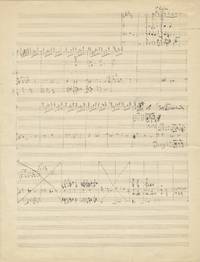
39978One bifolium 272 x 347 mm. 4 pp. Notated in black ink on 26-stave rastrum-ruled paper. Unsigned and undated.<br /> <br /> With significant corrections cancels etc.<br /> <br /> Slightly worn and browned; small tear to blank outer margin of first leaf repaired; horizontal crease; short split to head and tail of spine.<br /> <br /> In very good condition overall. Music unlocated but very likely from a sacred vocal work with orchestra. <br /> <br /> The first page contains 16 measures of music on 8-line staves the uppermost stave marked with the key signature of 5 sharps in a contrapuntal style incorporating stretto technique whereby a melody is restated in overlapping fashion in two or more voices. <br /> <br /> The second page contains 28 measures including four cancelled measures with music still visible on 4- and 5-line staves with a sharp-key signature as in the first page and passages of high-register 8th notes most likely for violin; the uppermost stave is designated "1e. Basson." <br /> <br /> The third page contains 21 measures on an 8-line stave being an alternate iteration of the material from the first page; the final 4 measures which are cancelled contain tremolo string material similar to the second page. <br /> <br /> The upper portion of the fourth and final page contains 8 measures of music similar to the first and third pages in a stretto character but with a new key signature of 3 flats. <br /> <br /> With 2 measures of music also with 3 flats to lower portion of final page. <br /> <br /> Gounod's interest in sacred music and counterpoint was awakened in his youth and continued for the span of his career. "Gounod arrived at the French Academy in Rome at the end of January 1840. Little there sustained his musical interest. He excoriated performances of operas by Donizetti Bellini and Mercadante composers he later characterized as mere 'vines twisted around the great Rossinian trunk without its vitality and majesty' and unable to match that composer's spontaneous melodic gifts. Gounod was however genuinely moved by performances of Palestrina at the Cappella Sistina and more generally by the cultural legacy of Rome in the other arts a legacy he felt that musicians could ill afford to ignore. His Roman experience laid the foundation for the stark comparison he drew in his aesthetics between on the one hand a universally appealing combination of beauty truth and Christianity and on the other egoism artifice and insularity. He described stile antico counterpoint as a selfless analogue to Michelangelo's frescoes issuing from pure Faith." Steven Huebner in Grove Music Online<br /> <br /> A fine example of a Gounod working manuscript in the composer's elegant hand displaying how he skillfully wove together counterpoint orchestration and compositional structure; well worthy of further study. unknown
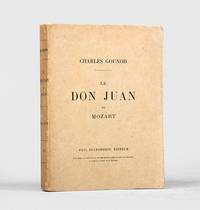
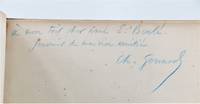
1890142346Paris: Paul Ollendorff 1890. A fine "Banquet Years" association First edition an exceptional presentation copy to the proprietor of the famed Montmartre cabaret Le Chat Noir inscribed on the half-title "À Monsieur Rodolphe. Salis Hommage de l'auteur Ch. Gounod". This work a study of Mozart's Don Juan reveals its particular importance to Gounod and its continuing influence on his life and work: "The score. has had an influence on my whole life akin to a revelation; it was and has remained for me a kind of embodiment of dramatic and musical faultlessness; I consider it a work without a flaw of uninterrupted perfection" our translation. The connection between Gounod and a famous Parisian cabaretier may seem a surprising one at first but the composer had a very close relationship with Le Chat Noir contributing critical work to the establishment's weekly magazine; Ravel Satie Massenet and Fauré were also keen supporters of the cabaret. Also significantly themes from Gounod's Faust were used by Albert Tinchant when he arranged the score for La Tentation de Saint Antoine a shadow play - "féerie à grand spectacle en 2 actes et 40 tableaux" - based on Flaubert's book and designed by painter-designer Henri Rivière who developed these "ombres chinoises" for which Le Chat Noir became famous. Gounod's "Ronde du veau d'or" accompanies part three of the tableau L'Avarice entitled "La Bourse" and music from the final scene of Faust is employed for the "Apothéose". Octavo. Unopened in original cream printed stiff paper wrappers. Wrappers just a little rubbed very occasional spotting to the text an excellent copy. Nicolai"La Tentation de Saint-Antoine au Chat Noir : un exemple de collaboration multidisciplinaire" in Flaubert revue critique et génétique 21 2019. unknown
18803465831880. 5 pages signed by the composer on the cover page. Folio. Blue cloth folder. Bookplate of Dr. Max Thorek and hsi usual stamp on the last page of ms. 5 pages signed by the composer on the cover page. Folio. With a copy of the printed score tipped in. unknown
186782010Paris: Choudens 1867. Fine. Choudens Paris S.d 1867 19 x 28 cm relié Roméo et Juliette - Opera score in 5 acts by J. Barbier et M. Carré Choudens Paris n.d 1867 19x28cm bound. First edition. Opera in five acts based on the play Romeo and Juliet by William Shakespeare music by Charles Gounod for voice and piano and libretto by Jules Barbier and Michel Carré. Contemporary red half shagreen color restored gilt spine glazed calico boards double ruled in gilt central gilt initials of Ernest Beulé on the first board moiré silk endpapers with some spotting and staining to the margins first original cover preserved all edges gilt strictly contemporary binding. Rare inscription signed by Charles Gounod to archaeologist Ernest Beulé. Choudens hardcover