246 résultats
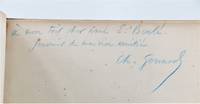
186782010Paris: Choudens 1867. Fine. Choudens Paris S.d 1867 19 x 28 cm relié Roméo et Juliette - Opera score in 5 acts by J. Barbier et M. Carré Choudens Paris n.d 1867 19x28cm bound. First edition. Opera in five acts based on the play Romeo and Juliet by William Shakespeare music by Charles Gounod for voice and piano and libretto by Jules Barbier and Michel Carré. Contemporary red half shagreen color restored gilt spine glazed calico boards double ruled in gilt central gilt initials of Ernest Beulé on the first board moiré silk endpapers with some spotting and staining to the margins first original cover preserved all edges gilt strictly contemporary binding. Rare inscription signed by Charles Gounod to archaeologist Ernest Beulé. Choudens hardcover
18803465831880. 5 pages signed by the composer on the cover page. Folio. Blue cloth folder. Bookplate of Dr. Max Thorek and hsi usual stamp on the last page of ms. 5 pages signed by the composer on the cover page. Folio. With a copy of the printed score tipped in. unknown
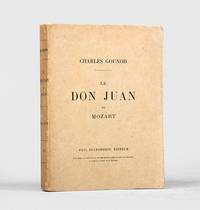
1890142346Paris: Paul Ollendorff 1890. A fine "Banquet Years" association First edition an exceptional presentation copy to the proprietor of the famed Montmartre cabaret Le Chat Noir inscribed on the half-title "À Monsieur Rodolphe. Salis Hommage de l'auteur Ch. Gounod". This work a study of Mozart's Don Juan reveals its particular importance to Gounod and its continuing influence on his life and work: "The score. has had an influence on my whole life akin to a revelation; it was and has remained for me a kind of embodiment of dramatic and musical faultlessness; I consider it a work without a flaw of uninterrupted perfection" our translation. The connection between Gounod and a famous Parisian cabaretier may seem a surprising one at first but the composer had a very close relationship with Le Chat Noir contributing critical work to the establishment's weekly magazine; Ravel Satie Massenet and Fauré were also keen supporters of the cabaret. Also significantly themes from Gounod's Faust were used by Albert Tinchant when he arranged the score for La Tentation de Saint Antoine a shadow play - "féerie à grand spectacle en 2 actes et 40 tableaux" - based on Flaubert's book and designed by painter-designer Henri Rivière who developed these "ombres chinoises" for which Le Chat Noir became famous. Gounod's "Ronde du veau d'or" accompanies part three of the tableau L'Avarice entitled "La Bourse" and music from the final scene of Faust is employed for the "Apothéose". Octavo. Unopened in original cream printed stiff paper wrappers. Wrappers just a little rubbed very occasional spotting to the text an excellent copy. Nicolai"La Tentation de Saint-Antoine au Chat Noir : un exemple de collaboration multidisciplinaire" in Flaubert revue critique et génétique 21 2019. unknown
1858257<p>Gounod Charles François <i>Le Médecin Malgré Lui Comédie en 3 Actes de Molière Arrangé en Opéra-Comique par MM Jules Barbier & Michel Carré. Musique de Charles Gounod Partition Piano et Chant.</i>Paris: Colombier Éditeur rue Vivienne No. 6 1858. 27.5 cm x 18 cm iv ; 190 pages. In-8vo. Original green wrapper bound-in. Bound in half blue goatskin with gold lettering on the spine over blue marbled boards. Slight wear to corners binding otherwise very good. Internally pristine printed on heavy paper wrapper slightly chipped. Engraved title page. First edition C 2097 Columbier. Signed and inscribed in ink by Gounod at the top of the title page: "à mon ami Léon Leroy : Souvenir affecteux. Ch. Gounod." </p> Sold with an ALS of presentation from Gounod to Léon Leroy dated "Samedi 5 février /70". The text is: " Mon cher ami Il y a huit jours que j'ai <u>votre </u>médecin … Et le mien aussi – car je viens d'être malade et je sors de mon lit. C'est pourquoi je n'ai pu mettre la main sur votre addresse dont la copie était dans mes papiers. Voulez-vous avoir la bonté de faire prendre mon souvenir chez mon concierge Il y est déposé par bande à votre nom --- à vous Ch. Gounod. " "My dear friend It has been eight days since I had your doctor --- and my own as well – since I came to be sick and I left my bed. It's why I have not been able to put my hand on your address which was in my papers. Would you have the goodness to come and get my souvenir from my concierge It is deposited in a wrapper in your name. Yours Ch. Gounod." Léon Leroy was a distinguished clarinetist and a member first in Paris then later in New York of the <i>Société Moderne pour Instruments</i>à <i>Vent and a soloist with the Garde Republicaine Band in Paris. </i><i>Le Médecin Malgré Lui </i>was Gounod's third opera dating from 1858. Colombier, Éditeur, rue Vivienne, No. 6 books
395518 measures in treble clef notated in black ink on a portion of a 14-stave rastrum-ruled album leaf 177 x 233 mm. With text in French in Gounod's hand commencing "Il etait un Roi du Thulé" Marguerite's melancholy aria from Act III. <br /> <br /> Identified in the composer's hand at foot: "Ballade du Roi de Thulé . à Monsieur Lebert. Ch. Gounod" and dated 26 August 1869.<br /> <br /> Slightly faded; browned; creased at central vertical fold; portions of leaf slighty lightened; margins of verso reinforced with brown paper tape. Faust an opera in five acts to a libretto by Jules Barbier and Michel Carré after Carré's Faust et Marguerite and Johann Wolfgang von Goethe's Faust Part I in the French translation by Gérard de Nerval was first performed in Paris at the Théâtre Lyrique on 19 March 1859 in a version with spoken dialogue; recitatives were added in 1860 and a ballet and couplets for Méphistophélès were added for a new production in 1869. <br /> <br /> "The historical importance of Faust is that it sounded a new note in French music. The conventional pomposities of the grand opera which then dominated the stage were superseded by a more intimate and poetic approach. The fashion Gounod set was one of conversational exchange rather than declamation." James Harding: Gounod p. 114.<br /> <br /> "Faust remains one of the landmarks of French 19th-century opera full of variety and with an underlying sensuality that saved it from the sentimentality and banality to which Gounod's later works especially his oratorios often descended in his quest for inspired simplicity." Robert Orledge in Grove Music Online<br /> <br /> A considerable success at its premiere the work was one of the most frequently performed works at the Opéra and one the staples of the international repertory. unknown
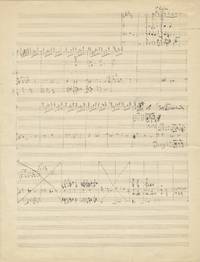
39978One bifolium 272 x 347 mm. 4 pp. Notated in black ink on 26-stave rastrum-ruled paper. Unsigned and undated.<br /> <br /> With significant corrections cancels etc.<br /> <br /> Slightly worn and browned; small tear to blank outer margin of first leaf repaired; horizontal crease; short split to head and tail of spine.<br /> <br /> In very good condition overall. Music unlocated but very likely from a sacred vocal work with orchestra. <br /> <br /> The first page contains 16 measures of music on 8-line staves the uppermost stave marked with the key signature of 5 sharps in a contrapuntal style incorporating stretto technique whereby a melody is restated in overlapping fashion in two or more voices. <br /> <br /> The second page contains 28 measures including four cancelled measures with music still visible on 4- and 5-line staves with a sharp-key signature as in the first page and passages of high-register 8th notes most likely for violin; the uppermost stave is designated "1e. Basson." <br /> <br /> The third page contains 21 measures on an 8-line stave being an alternate iteration of the material from the first page; the final 4 measures which are cancelled contain tremolo string material similar to the second page. <br /> <br /> The upper portion of the fourth and final page contains 8 measures of music similar to the first and third pages in a stretto character but with a new key signature of 3 flats. <br /> <br /> With 2 measures of music also with 3 flats to lower portion of final page. <br /> <br /> Gounod's interest in sacred music and counterpoint was awakened in his youth and continued for the span of his career. "Gounod arrived at the French Academy in Rome at the end of January 1840. Little there sustained his musical interest. He excoriated performances of operas by Donizetti Bellini and Mercadante composers he later characterized as mere 'vines twisted around the great Rossinian trunk without its vitality and majesty' and unable to match that composer's spontaneous melodic gifts. Gounod was however genuinely moved by performances of Palestrina at the Cappella Sistina and more generally by the cultural legacy of Rome in the other arts a legacy he felt that musicians could ill afford to ignore. His Roman experience laid the foundation for the stark comparison he drew in his aesthetics between on the one hand a universally appealing combination of beauty truth and Christianity and on the other egoism artifice and insularity. He described stile antico counterpoint as a selfless analogue to Michelangelo's frescoes issuing from pure Faith." Steven Huebner in Grove Music Online<br /> <br /> A fine example of a Gounod working manuscript in the composer's elegant hand displaying how he skillfully wove together counterpoint orchestration and compositional structure; well worthy of further study. unknown
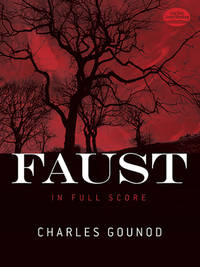
0486283496New. Brand new and still unused unknown
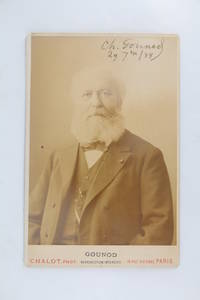
188888513Paris: s. n. 1888. Fine. s. n. Paris 1888 11 x 15 cm Une photographie Original photograph depicting Charles Gounod full face. Vintage gelatin silver print mounted on cardboard produced by photographer Isidore Alphonse Chalot at 18 rue Vivienne Paris. Autograph inscriptions in black then blue ink on the verso by the recipient A. Lasserre inspector at the Opéra Garnier: ""Portrait de Ch. Gounod signé le soir de la 926eme représentation de Faust samedi 29 septembre 1888 A. Lasserre."" Additional handwritten note in pencil in the right margin of the verso: 1867e représentation de Faust le 28 septembre 1929. Printed stamp at foot of the verso: ""Maison Martinet Albert Hautecoeur 18 bd des Capucines."" Charles Gounods dated autograph signature to upper right corner of the photograph : ""Ch. Gounod 29 7bre / 88."" leaux "" s. n. unknown
36231Oblong folio 175 x 264 mm.<br /> <br /> 30 measures in total notated on both sides of the leaf the initial 13 measures in black ink the following 17 in purple pencil possibly a continuation of the same work. <br /> <br /> With several deletions and "Notes manuscrites de Ch. Gounod" in pencil to upper right margin.<br /> <br /> Slightly worn and browned; cut from a larger leaf. "Gounod wrote in most of the major genres of his day sacred and secular. That his reputation began to wane even during his lifetime does not detract from his place among the most respected and prolific composers in France during the second half of the 19th century." Steven Huebner in Grove Music Online. unknown
36231Oblong folio 175 x 264 mm.<br/><br/>30 measures in total notated on both sides of the leaf the initial 13 measures in black ink the following 17 in purple pencil possibly a continuation of the same work. <br/><br/>With several deletions and "Notes manuscrites de Ch. Gounod" in pencil to upper right margin.<br/><br/>Slightly worn and browned; cut from a larger leaf. "Gounod wrote in most of the major genres of his day sacred and secular. That his reputation began to wane even during his lifetime does not detract from his place among the most respected and prolific composers in France during the second half of the 19th century." Steven Huebner in Grove Music Online. unknown books
188127462Paris 1881. 279 x 198 mm. Signed by the artist in pencil at lower left. A very good impression on laid paper. <br /> <br /> Remnants of hinges to upper corners of verso. Béraldi: Les Graveurs du XIXe Siècle Paris: 1885-92 XI-188. <br /> <br /> Faust an opera in five acts to a libretto by Jules Barbier and Michel Carré after Carré's Faust et Marguerite and Johann Wolfgang von Goethe's Faust Part I in the French translation by Gérard de Nerval was first performed in Paris at the Théâtre Lyrique on March 15 1859. <br /> <br /> "Faust became particularly important to the French musical establishment at the end of the century. A work by a winner of the Prix de Rome that could claim to be thoroughly modern and personal in style at its première and go on to international stages was a significant enhancement to the musical prestige of a French operatic culture previously dominated by Meyerbeer and the none-too-easily exportable genre of opéra comique. Its national value was enhanced because after some initial assessments as 'Wagnerian' Gounod's compositional voice in Faust was heard as important in the definition of a 'French' musical aesthetic." Steven Huebner in Grove Music Online. <br /> <br /> Renouard 1845-1924 was a noted painter and engraver whose works are held at the Louvre the Opéra Museum etc. unknown
188127462Paris 1881. 279 x 198 mm. Signed by the artist in pencil at lower left. A very good impression on laid paper. <br/><br/>Remnants of hinges to upper corners of verso. Béraldi: Les Graveurs du XIXe Siècle Paris: 1885-92 XI-188. <br/><br/>Faust an opera in five acts to a libretto by Jules Barbier and Michel Carré after Carré's Faust et Marguerite and Johann Wolfgang von Goethe's Faust Part I in the French translation by Gérard de Nerval was first performed in Paris at the Théâtre Lyrique on March 15 1859. <br/><br/>"Faust became particularly important to the French musical establishment at the end of the century. A work by a winner of the Prix de Rome that could claim to be thoroughly modern and personal in style at its première and go on to international stages was a significant enhancement to the musical prestige of a French operatic culture previously dominated by Meyerbeer and the none-too-easily exportable genre of opéra comique. Its national value was enhanced because after some initial assessments as 'Wagnerian' Gounod's compositional voice in Faust was heard as important in the definition of a 'French' musical aesthetic." Steven Huebner in Grove Music Online. <br/><br/>Renouard 1845-1924 was a noted painter and engraver whose works are held at the Louvre the Opéra Museum etc. unknown books
7116viii 32 pp. 8vo 212 x 138 mm. modern aubergine cloth a little sunned title on upper cover. Paris: Félix & Regnault-Delalande 1824.<br/> <br/> A rare sale catalogue issued by the prolific expert Regnault-Delalande 1762-1824 describing the painter’s extensive collection. This copy is printed on large paper and begins with a valuable biography of the artist. Gounod 1758-1823 was a pupil of Lépicié; his first appearance at the Paris Salon was in 1799. His son Charles became a famous musician and composer.<br/> <br/> 192 lots. The catalogue describes paintings by S. Bourdon Chardin van Dyck Gounod La Tour Miel and Rembrandt; drawings by Bouchardon Ant. Carracci Cochin fils van Dyck Gounod Greuze Jordaens Le Brun N. Poussin Raphael C. J. Vernet etc.; prints by G. & B. Audran Bartolozzi Callot Earlom Morghen Nanteuil Porporati Rembrandt C. Vernet etc. The print suites and books include the works of Palladio Scamozzi Perrault Newton Barbault Bartoli Piranesi etc. We also find the standard art historical books and artistic treatises of the 18th century.<br/> <br/> Fine copy. In the characteristic binding of the Bibliothèque Heim and with the library’s stamp on verso of title. <br/> <br/> ⧠Lugt 10600. Oxford Art Online. unknown
7116viii 32 pp. 8vo 212 x 138 mm. modern aubergine cloth a little sunned title on upper cover. Paris: Félix & Regnault-Delalande 1824. A rare sale catalogue issued by the prolific expert Regnault-Delalande 1762-1824 describing the painter's extensive collection. This copy is printed on large paper and begins with a valuable biography of the artist. Gounod 1758-1823 was a pupil of Lépicié; his first appearance at the Paris Salon was in 1799. His son Charles became a famous musician and composer. 192 lots. The catalogue describes paintings by S. Bourdon Chardin van Dyck Gounod La Tour Miel and Rembrandt; drawings by Bouchardon Ant. Carracci Cochin fils van Dyck Gounod Greuze Jordaens Le Brun N. Poussin Raphael C. J. Vernet etc.; prints by G. & B. Audran Bartolozzi Callot Earlom Morghen Nanteuil Porporati Rembrandt C. Vernet etc. The print suites and books include the works of Palladio Scamozzi Perrault Newton Barbault Bartoli Piranesi etc. We also find the standard art historical books and artistic treatises of the 18th century. Fine copy. In the characteristic binding of the Bibliothèque Heim and with the library's stamp on verso of title. ❧ Lugt 10600. Oxford Art Online. hardcover books
251361 page ca. 76 x 187 mm. Four measures of an Adagio for organ with pedals in E-flat major in 4/4. Notated in black ink on three printed staves. <br/><br/>A note in black ink to verso signed Comte Élie de "Palys" explains that this autograph of Gounod has been "given by M. de Lassus his son-in-law to Mme Porteau." With rectangular blindstamp to upper left corner. <br/><br/>Very lightly foxed and stained; creased at central fold. "Best known today as the composer of the opera Faust and an Ave Maria descant to the first prelude of J.S. Bach's Das wohltemperirte Clavier Gounod wrote in most of the major genres of his day sacred and secular. That his reputation began to wane even during his lifetime does not detract from his place among the most respected and prolific composers in France during the second half of the 19th century." Steven Huebner in Grove Music Online. unknown books
186725608Paris: Choudens PN A.C. 1411. 1867. Large octavo. Quarter red pebbled cloth with marbled boards titling gilt to spine. 1f. recto decorative lithographic title by Barbizet printed in light purple verso blank 1f. recto dedication "A Sa Majesté Charles XV Roi de Suède de Norvège" printed in blue verso blank 1 named cast list and index 2-303 i blank pp. Lithographed.<br /> <br /> Named cast includes Carvalho Daram Duclos Michot Puget Laurent Barré Laveissière Troy jeune Troy Cazaux Wartel and Neveu. <br /> <br /> Publisher's handstamp to lower margin of title.<br /> <br /> Binding slightly worn rubbed and bumped; hinges split; endpapers browned. Some dampstaining to inner margins; occasional splitting creasing and small tears. First Edition first issue. <br /> <br /> Roméo et Juliette was first performed at the Théâtre Lyrique in Paris on 27 April 1867. The opera was "Gounod's most spectacular immediate success. Coming as it did during the Exposition Universelle of 1867 when Paris was invaded by visitors from the provinces and abroad the opera drew full houses for many consecutive nights. It started its rapid conquest of foreign stages at Covent Garden on 11 July 1867 and before the end of the year had been seen at major centres in Germany and Belgium." Steven Huebner in Grove Music Online. Choudens [PN A.C. 1411.] unknown
186025602Paris: Choudens A.C. 738. 1860. Large octavo. Quarter dark brown morocco with pebbled paper boards raised bands on spine in ruled compartments with titling and publication date gilt marbled endpapers original publisher's illustrated lithographic upper wrapper bound in. 1f. recto title verso blank i named cast list and table of contents 2-132 pp. Engraved.<br/><br/>With composer's autograph inscription signed "Ch. Gounod" in brown ink to head of title: "à mon bon ami Hasselmans - souvenir bien amical" with Hasselmans's handstamp to upper corner of upper wrapper. <br/><br/>Named cast includes Carvalho A. Faivre Roger and Balanqué.<br/><br/>Small publisher's oval handstamp to lower outer corner of title.<br/><br/>Binding slightly worn rubbed and bumped with small scratches to upper; upper wrapper somewhat soiled and creased. Title browned; some foxing and offsetting; occasional creasing or splitting at inner margins; publisher's handstamp faded. First Edition of the original version. Lesure p. 108. <br/><br/>The first performance of La Colombe took place at the Théatre de Bade in Baden-Baden on August 3 1860 under the direction of Edouard Bénazet; an expanded version of the opera was staged at the Opéra-Comique in Paris in 1866. <br/><br/>Gounod may have inscribed this copy for Josef H. Hasselmans 1814-1902 a Belgian conductor harpist and violinist. Hasselmans "became first violinist with the orchestra of the Théâtre Royal Antwerp and later its conductor. His career continued at Strasbourg where he conducted the orchestra of the Théâtre Municipal and in 1854 he became the first director of the Strasbourg Conservatoire. He was a respected teacher as well as a creditable conductor and may be remembered for two major schools of double-action harp playing which stemmed from his tutelage." Alice Lawson Aber-Count in Grove Music Online. Choudens [A.C. 738.] unknown books
186725608Paris: Choudens PN A.C. 1411. 1867. Large octavo. Quarter red pebbled cloth with marbled boards titling gilt to spine. 1f. recto decorative lithographic title by Barbizet printed in light purple verso blank 1f. recto dedication "A Sa Majesté Charles XV Roi de Suède de Norvège" printed in blue verso blank 1 named cast list and index 2-303 i blank pp. Lithographed.<br/><br/>Named cast includes Carvalho Daram Duclos Michot Puget Laurent Barré Laveissière Troy jeune Troy Cazaux Wartel and Neveu. <br/><br/>Publisher's handstamp to lower margin of title.<br/><br/>Binding slightly worn rubbed and bumped; hinges split; endpapers browned. Some dampstaining to inner margins; occasional splitting creasing and small tears. First Edition first issue. <br/><br/>Roméo et Juliette was first performed at the Théâtre Lyrique in Paris on April 27 1867. The opera was "Gounod's most spectacular immediate success. Coming as it did during the Exposition Universelle of 1867 when Paris was invaded by visitors from the provinces and abroad the opera drew full houses for many consecutive nights. It started its rapid conquest of foreign stages at Covent Garden on 11 July 1867 and before the end of the year had been seen at major centres in Germany and Belgium." Steven Huebner in Grove Music Online. Choudens [PN A.C. 1411.] unknown books
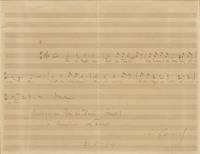
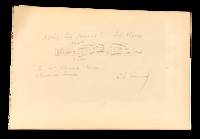
3802No Binding. Near Fine. Two bars for violin on hand-drawn stave with holograph tempo marking. Titled at the top by Gounod "Après les jeunes!. Les vieux!." Signed Ch. Gounod at the bottom and inscribed in French to the recipient. Beautiful 12 1/4" x 8 1/4" paper which shows some toning and a few pencil marks from previous framing. Comes with a glossy 7" x 5" photo of the composer. The French composer Charles Gounod 1818-1893 was particularly famous for his operas including Faust and Roméo et Juliette which are still widely performed today. His other output included shorter works both instrumental and vocal and church music including his setting of Ave Maria to Bach's Prelude #1 in C. unknown
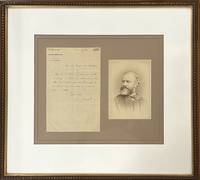
1855244941Paris 1855. 1 pp. pen and ink on Écoles Communales letterhead. Letter 8 1/4 x 5 1/4 in. Frame 14 1/2 x 18 1/4 in. Light edgewear and creasing faint offset. Mounted and framed with photographic portrait. 1 pp. pen and ink on Écoles Communales letterhead. Letter 8 1/4 x 5 1/4 in. Frame 14 1/2 x 18 1/4 in. Gounoud writes in praise of "the new Solfege in three progressive lessons that you have just published" noting its usefulness to music teachers in the instruction of modern music. unknown books
18611063994to. Paris: Choudens 1861. 4to. iv 248 pp. lithographed piano-vocal score. Contemporary rebacked quarter black morocco black cloth boards paneled in blind backstrip lettered and ruled in gilt marbled endpapers. Corners bumped and frayed some discoloration to boards otherwise very good. § Third edition first issue title page inscribed by Gounod: “À mon excellente amie Madame Des Michels souvenir de ma profonde et respectueuse amitié Ch. Gounod.†His most poplar opera with libretto by J. Barbier and M. Carre first performed as an opera comique with spoken dialogue on 19 March 1859 at the Theatre-Lyrique Paris. The recitatives were added for a production at Strasbourg in April 1860 and a piano score of the opera version was published that year. The present score published according to Hopkinson in 1861 has added tempo markings and shows a cut from the Choeur de sorcieres in Act V. The libretto by Barbier and Carre is based on Goethe but focuses on the love story between Faust and Marguerite. Loewenberg 939. Choudens hardcover books
1855244941Paris 1855. 1 pp. pen and ink on Écoles Communales letterhead. Letter 8 1/4 x 5 1/4 in. Frame 14 1/2 x 18 1/4 in. Light edgewear and creasing faint offset. Mounted and framed with photographic portrait. 1 pp. pen and ink on Écoles Communales letterhead. Letter 8 1/4 x 5 1/4 in. Frame 14 1/2 x 18 1/4 in. Gounoud writes in praise of "the new Solfege in three progressive lessons that you have just published" noting its usefulness to music teachers in the instruction of modern music. unknown
18611063991861. Paris: Choudens 1861. <br /> <br /> 4to. iv 248 pp. lithographed piano-vocal score. Contemporary rebacked quarter black morocco black cloth boards paneled in blind backstrip lettered and ruled in gilt marbled endpapers. Corners bumped and frayed some discoloration to boards otherwise very good.<br /> <br /> § Third edition first issue title page inscribed by Gounod: "À mon excellente amie Madame Des Michels souvenir de ma profonde et respectueuse amitié Ch. Gounod." His most poplar opera with libretto by J. Barbier and M. Carre first performed as an opera comique with spoken dialogue on 19 March 1859 at the Theatre-Lyrique Paris. The recitatives were added for a production at Strasbourg in April 1860 and a piano score of the opera version was published that year. The present score published according to Hopkinson in 1861 has added tempo markings and shows a cut from the Choeur de sorcieres in Act V. The libretto by Barbier and Carre is based on Goethe but focuses on the love story between Faust and Marguerite. Loewenberg 939. unknown
330767framed. very good. Hand-written letter from French composer Charles Gounod. Written in french the letter is framed with an etched portrait image of Gounod. Envelope is included on the back side of the frame. Circa 1850. Please inquire for more information.<br/> <br/> Charles Gounod was a French composer. He wrote twelve operas of which the most popular has always been Faust 1859; his Romeo e Juliette 1867 also remains in the international repertory. He composed a large amount of church music many songs and popular short pieces including his "Ave Maria" an elaboration of a Bach piece and "Funeral March of a Marionette".<br/> <br/> unknown
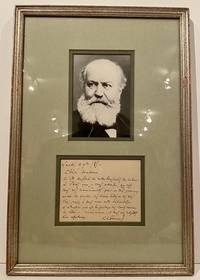
21844Paris 185. 4 1/2'" x 3 1/2' autograph note together with a 3 1/2" x 4 7/8" photograph of the composer. Handsomely framed 10" x 15" and double-matted in shades of green. <br /> <br /> In the note dated Monday September 9 185 Gounod emotionally writes in French 'Dear Madam In the midst of all the hustle and bustle attendant upon my return to Paris I am writing to you literally "in flight" to thank you for your very gracious parcel of four of the beautiful residents pheasants or partridges of your woods. You think of everyone with that impeccable sensitivity that is the hallmark of hearts such as yours. Once again I thank you. Sincerely Ch. Gounod' Here Gounod make reference to a line in La Fontaine's "Le Corbeau et le Renard' 'Le Vous êtes le Phénix des hôtes de ces bois.'. unknown