1 000 résultats
RO50047280CHOUDENS. NON DATE. In-Folio. En feuillets. Etat d'usage, Couv. défraîchie, Dos fané, Intérieur acceptable. 5 pages de partitions. Premier plat illustré en noir et blanc. A Madame Conneau. Dos renforcé avec du papier. Poésie de J. Barbier.. . . . Classification Dewey : 780.26-Partitions
RO50056393CHOUDENS. NON DATE. In-Folio. En feuillets. Etat d'usage, Tâchée, Dos abîmé, Rousseurs. 5 pages de partitions. Poésie de J. Barbier. A Monsieur Conneau. Tampon sur le premier plat ainsi que sur la première page. Dos renforcé. Premier plat illustré en noir et blanc.. . . . Classification Dewey : 780.26-Partitions
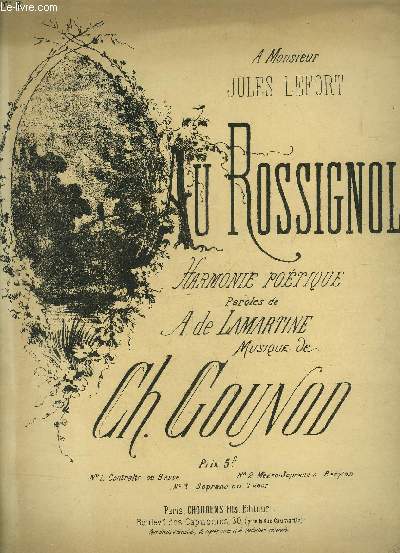
RO50064750Choudens fils. Non daté. In-Folio. Broché. Bon état, Couv. partiel. décollorée, Dos satisfaisant, Intérieur frais. 7 pages de partitions en noir et blanc.. . . . Classification Dewey : 780.26-Partitions
50932asking him if he "would do the attached petition the honour of your valued support and of your favourable recommendation to the Governor of the Bank of France" and if so to leave it "with your concierge. I will collect it tomorrow morning" and ending with his "respectful devotion to your ladies" 2 sides 8vo. no place 4th April light pin marks from the former enclosure unknown
395518 measures in treble clef notated in black ink on a portion of a 14-stave rastrum-ruled album leaf 177 x 233 mm. With text in French in Gounod's hand commencing "Il etait un Roi du Thulé" Marguerite's melancholy aria from Act III. <br /> <br /> Identified in the composer's hand at foot: "Ballade du Roi de Thulé . à Monsieur Lebert. Ch. Gounod" and dated 26 August 1869.<br /> <br /> Slightly faded; browned; creased at central vertical fold; portions of leaf slighty lightened; margins of verso reinforced with brown paper tape. Faust an opera in five acts to a libretto by Jules Barbier and Michel Carré after Carré's Faust et Marguerite and Johann Wolfgang von Goethe's Faust Part I in the French translation by Gérard de Nerval was first performed in Paris at the Théâtre Lyrique on 19 March 1859 in a version with spoken dialogue; recitatives were added in 1860 and a ballet and couplets for Méphistophélès were added for a new production in 1869. <br /> <br /> "The historical importance of Faust is that it sounded a new note in French music. The conventional pomposities of the grand opera which then dominated the stage were superseded by a more intimate and poetic approach. The fashion Gounod set was one of conversational exchange rather than declamation." James Harding: Gounod p. 114.<br /> <br /> "Faust remains one of the landmarks of French 19th-century opera full of variety and with an underlying sensuality that saved it from the sentimentality and banality to which Gounod's later works especially his oratorios often descended in his quest for inspired simplicity." Robert Orledge in Grove Music Online<br /> <br /> A considerable success at its premiere the work was one of the most frequently performed works at the Opéra and one the staples of the international repertory. unknown
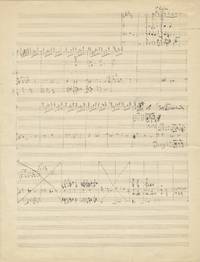
39978One bifolium 272 x 347 mm. 4 pp. Notated in black ink on 26-stave rastrum-ruled paper. Unsigned and undated.<br /> <br /> With significant corrections cancels etc.<br /> <br /> Slightly worn and browned; small tear to blank outer margin of first leaf repaired; horizontal crease; short split to head and tail of spine.<br /> <br /> In very good condition overall. Music unlocated but very likely from a sacred vocal work with orchestra. <br /> <br /> The first page contains 16 measures of music on 8-line staves the uppermost stave marked with the key signature of 5 sharps in a contrapuntal style incorporating stretto technique whereby a melody is restated in overlapping fashion in two or more voices. <br /> <br /> The second page contains 28 measures including four cancelled measures with music still visible on 4- and 5-line staves with a sharp-key signature as in the first page and passages of high-register 8th notes most likely for violin; the uppermost stave is designated "1e. Basson." <br /> <br /> The third page contains 21 measures on an 8-line stave being an alternate iteration of the material from the first page; the final 4 measures which are cancelled contain tremolo string material similar to the second page. <br /> <br /> The upper portion of the fourth and final page contains 8 measures of music similar to the first and third pages in a stretto character but with a new key signature of 3 flats. <br /> <br /> With 2 measures of music also with 3 flats to lower portion of final page. <br /> <br /> Gounod's interest in sacred music and counterpoint was awakened in his youth and continued for the span of his career. "Gounod arrived at the French Academy in Rome at the end of January 1840. Little there sustained his musical interest. He excoriated performances of operas by Donizetti Bellini and Mercadante composers he later characterized as mere 'vines twisted around the great Rossinian trunk without its vitality and majesty' and unable to match that composer's spontaneous melodic gifts. Gounod was however genuinely moved by performances of Palestrina at the Cappella Sistina and more generally by the cultural legacy of Rome in the other arts a legacy he felt that musicians could ill afford to ignore. His Roman experience laid the foundation for the stark comparison he drew in his aesthetics between on the one hand a universally appealing combination of beauty truth and Christianity and on the other egoism artifice and insularity. He described stile antico counterpoint as a selfless analogue to Michelangelo's frescoes issuing from pure Faith." Steven Huebner in Grove Music Online<br /> <br /> A fine example of a Gounod working manuscript in the composer's elegant hand displaying how he skillfully wove together counterpoint orchestration and compositional structure; well worthy of further study. unknown
36231Oblong folio 175 x 264 mm.<br /> <br /> 30 measures in total notated on both sides of the leaf the initial 13 measures in black ink the following 17 in purple pencil possibly a continuation of the same work. <br /> <br /> With several deletions and "Notes manuscrites de Ch. Gounod" in pencil to upper right margin.<br /> <br /> Slightly worn and browned; cut from a larger leaf. "Gounod wrote in most of the major genres of his day sacred and secular. That his reputation began to wane even during his lifetime does not detract from his place among the most respected and prolific composers in France during the second half of the 19th century." Steven Huebner in Grove Music Online. unknown
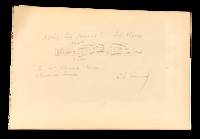
3802No Binding. Near Fine. Two bars for violin on hand-drawn stave with holograph tempo marking. Titled at the top by Gounod "Après les jeunes!. Les vieux!." Signed Ch. Gounod at the bottom and inscribed in French to the recipient. Beautiful 12 1/4" x 8 1/4" paper which shows some toning and a few pencil marks from previous framing. Comes with a glossy 7" x 5" photo of the composer. The French composer Charles Gounod 1818-1893 was particularly famous for his operas including Faust and Roméo et Juliette which are still widely performed today. His other output included shorter works both instrumental and vocal and church music including his setting of Ave Maria to Bach's Prelude #1 in C. unknown
409395From the Bart Auerbach Collection. 2 pages 12mo integral blank leaf in French. A charming social note: "I have had no news of you since the immediate reply I made to your letter. Did you not receive that reply I told you as plainly as possible but I asked you at the same time to tell me the probable date of the wedding." BA. unknown
1884244944n.p. Paris 23 May 1884. 2 pp. pen and ink on folded sheet. With envelope. 8vo. Fine. 2 pp. pen and ink on folded sheet. With envelope. 8vo. Gounod sends his regrets that he cannot locate a verse play of Tourneux's father and complains of his heavy work load "I am snowed under with requests from the Committees and I can't accept even one more. My whole life goes into it and I devote all my time to it unknown
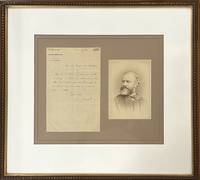
1855244941Paris 1855. 1 pp. pen and ink on Écoles Communales letterhead. Letter 8 1/4 x 5 1/4 in. Frame 14 1/2 x 18 1/4 in. Light edgewear and creasing faint offset. Mounted and framed with photographic portrait. 1 pp. pen and ink on Écoles Communales letterhead. Letter 8 1/4 x 5 1/4 in. Frame 14 1/2 x 18 1/4 in. Gounoud writes in praise of "the new Solfege in three progressive lessons that you have just published" noting its usefulness to music teachers in the instruction of modern music. unknown
1882244942n.p. Paris September 26th 1882. 2 pp. pen and ink on folded sheet. With envelope. 8vo. Old ink stain else near fine. 2 pp. pen and ink on folded sheet. With envelope. 8vo. Gounod overwhelmed by work writes "Please kindly excuse me but I am worn out! Everyday from the morning to the evening the countless appointments and summonses fight over my life: I don't even have time to face my correspondence! So more work. . Kindly let me know with a note the reason of your visit: if it is possible for me to help you I will do it . unknown
1855244941Paris 1855. 1 pp. pen and ink on Écoles Communales letterhead. Letter 8 1/4 x 5 1/4 in. Frame 14 1/2 x 18 1/4 in. Light edgewear and creasing faint offset. Mounted and framed with photographic portrait. 1 pp. pen and ink on Écoles Communales letterhead. Letter 8 1/4 x 5 1/4 in. Frame 14 1/2 x 18 1/4 in. Gounoud writes in praise of "the new Solfege in three progressive lessons that you have just published" noting its usefulness to music teachers in the instruction of modern music. unknown books
1882244942n.p. Paris September 26th 1882. 2 pp. pen and ink on folded sheet. With envelope. 8vo. Old ink stain else near fine. 2 pp. pen and ink on folded sheet. With envelope. 8vo. Gounod overwhelmed by work writes "Please kindly excuse me but I am worn out! Everyday from the morning to the evening the countless appointments and summonses fight over my life: I don't even have time to face my correspondence! So more work. . Kindly let me know with a note the reason of your visit: if it is possible for me to help you I will do it . unknown books
1884244944n.p. Paris 23 May 1884. 2 pp. pen and ink on folded sheet. With envelope. 8vo. Fine. 2 pp. pen and ink on folded sheet. With envelope. 8vo. Gounod sends his regrets that he cannot locate a verse play of Tourneux's father and complains of his heavy work load "I am snowed under with requests from the Committees and I can't accept even one more. My whole life goes into it and I devote all my time to it unknown books
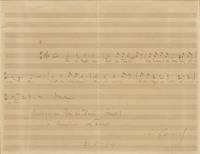
36231Oblong folio 175 x 264 mm.<br/><br/>30 measures in total notated on both sides of the leaf the initial 13 measures in black ink the following 17 in purple pencil possibly a continuation of the same work. <br/><br/>With several deletions and "Notes manuscrites de Ch. Gounod" in pencil to upper right margin.<br/><br/>Slightly worn and browned; cut from a larger leaf. "Gounod wrote in most of the major genres of his day sacred and secular. That his reputation began to wane even during his lifetime does not detract from his place among the most respected and prolific composers in France during the second half of the 19th century." Steven Huebner in Grove Music Online. unknown books
251361 page ca. 76 x 187 mm. Four measures of an Adagio for organ with pedals in E-flat major in 4/4. Notated in black ink on three printed staves. <br/><br/>A note in black ink to verso signed Comte Élie de "Palys" explains that this autograph of Gounod has been "given by M. de Lassus his son-in-law to Mme Porteau." With rectangular blindstamp to upper left corner. <br/><br/>Very lightly foxed and stained; creased at central fold. "Best known today as the composer of the opera Faust and an Ave Maria descant to the first prelude of J.S. Bach's Das wohltemperirte Clavier Gounod wrote in most of the major genres of his day sacred and secular. That his reputation began to wane even during his lifetime does not detract from his place among the most respected and prolific composers in France during the second half of the 19th century." Steven Huebner in Grove Music Online. unknown books
330767framed. very good. Hand-written letter from French composer Charles Gounod. Written in french the letter is framed with an etched portrait image of Gounod. Envelope is included on the back side of the frame. Circa 1850. Please inquire for more information.<br/> <br/> Charles Gounod was a French composer. He wrote twelve operas of which the most popular has always been Faust 1859; his Romeo e Juliette 1867 also remains in the international repertory. He composed a large amount of church music many songs and popular short pieces including his "Ave Maria" an elaboration of a Bach piece and "Funeral March of a Marionette".<br/> <br/> unknown
RO50013833Au ménestrel. XXème. In-4. En feuillets. Etat d'usage, Plats abîmés, Dos satisfaisant, Déchirures. 5 pages. Ornements couleur en couverture. Bandes adhésives.. . . . Classification Dewey : 780.26-Partitions
RO50043573AU MENESTREL / HEUGEL ET CIE. XIX° SIECLE. In-Folio. Broché. Etat d'usage, Plats abîmés, Dos abîmé, Quelques rousseurs. 9 pages de partitions. Premier plat illustré en couleur. Chanté par Mme Miolan-Carvalho. Plats désolidarisés. Tampon sur le premier plat. Nombreuses déchirures.. . . . Classification Dewey : 780.26-Partitions
RO50058930AU MENESTREL / HEUGEL & CIE. NON DATE. In-8. En feuillets. Etat d'usage, Tâchée, Dos satisfaisant, Intérieur acceptable. 2 pages de partitions non paginées. Tampon de l'éditeur sur le premier plat. Paroles françaises de Paul Bernard.. . . . Classification Dewey : 780.26-Partitions
RO50049502AU MENESTREL / HEUGEL & CIE. NON DATE. In-Folio. En feuillets. Etat passable, Plats abîmés, Dos abîmé, Non coupé. 5 pages de partitions. Nombreuses déchirures altérant parfois la lecture. Dos et quelques déchirures renforcés avec de l'adhésif. Premier plat illustré en noir et blanc. Annotation au crayon de couleur sur la première page.. . . . Classification Dewey : 780.26-Partitions
RO50042946AU MENESTREL / HEUGEL ET CIE. NON DATE. In-Folio. Broché. Bon état, Couv. légèrement passée, Dos satisfaisant, Papier jauni. 7 pages de partitions. Transcrite pour piano par Charles Gounod à son ami A. Goria. Chanté par Miolan-Carvalho. Premier plat illustré en couleur. Tampon sur le premier plat et sur la page 2.. . . . Classification Dewey : 780.26-Partitions
RO50057868AU MENESTREL / HEUGEL & CIE. NON DATE. In-Folio. En feuillets. Etat d'usage, Couv. légèrement passée, Coiffe en pied abîmée, Intérieur acceptable. 5 pages de partitions. Premier plat illustré en couleur monochrome.. . . . Classification Dewey : 780.26-Partitions
RO50043572AU MENESTREL / HEUGEL ET CIE. XIX° SIECLE. In-Folio. Broché. Etat d'usage, Plats abîmés, Dos abîmé, Quelques rousseurs. 5 pages de partitions. Premier plat illustré en couleur. Tampon sur le premier plat. Nombreuses déchirures.. . . . Classification Dewey : 780.26-Partitions