Luis Violin PereiraBiblio.com
Embryology: Updates and Highlights on Classic Topics
A9789535104650Hardback. New. hardcover

The Saint Bookstore · Royaume-Uni121,27 £GB≈ 138,47 €
35 résultats
2005200-04246Ensemble Mirable 2005-11-20. audioCD. Good. Good condition CD with case and notes. Looks like an interesting title! Ensemble Mirable unknown
A9789535104650Hardback. New. hardcover
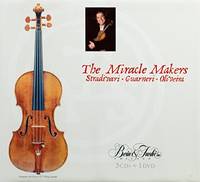
19982411150075Bein & Fushi Inc 1998-01-01. Hardcover. Very Good. 10x8x0. From the library of noted artist and violin luthier Alfredo Halegua. Hardcover and dust jacket. Good binding and cover. Shelf wear. Small tears to jacket. Clean unmarked pages. viii 88 pages : illustrations music ; 34 cm 3 audio discs digital ; 4 3/4 in. <br> This is an oversized or heavy book which requires additional postage for international delivery outside the US. Bein & Fushi, Inc hardcover
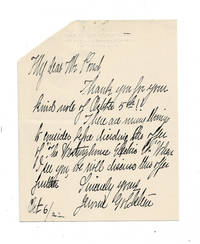
1922100211<p>Philadelphia October 6 1922. 1922. Very good. - Over 25 words penned on 6-3/8 inch high by 5-1/8 inch wide "1509 Locust Street Inc. Post Graduate School of Music and the Fine Arts" stationery with an integral attached blank leaf. Responding to a letter by the American impressario and lecture manager James B. Pond Jerome Goldstein thanks him for his note about the offer to appear on The Westinghouse Electric and Mfg. Co.'s radio program. "There are many things to consider before deciding. When I see you we will discuss this further". Signed in full "Jerome Goldstein". There are staple holes to the top edge and the top left corner has been clipped. There is an indentation and paper clip stain to the top of the attached blank leaf. Very good with a retained copy of James B. Pond's letter.</p><p>RARE.</p><p>The classical violinist Jerome Goldstein was a member of The Philadelphia Orchestra from 1917 to 1921 under Stokowski. Goldstein performed the premiere of Charles Ives' "Second Violin Sonata" on March 18 1924 in New York's Aeolian Hall accompanied by the pianist Rex Tillson. He performed with Bela Bartok during the composer's 1926 tour of the United States. Goldstein also played Henry Cowell's "Solo for Violin" at the Carnegie Chamber Hall" on April 21 1930.</p> [Philadelphia], October 6, 1922.
BN116207Sinful Souls <br/><br/>Sinful Souls unknown
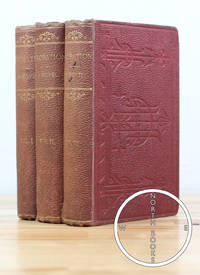
187929849London: Richard Bentley and Son 1879. Hardcover. First Edition First Impression. 4.5 x 7in. 277pp.; 308pp.; 335pp. Publisher's blind-stamped cloth boards with gilt titling. All 3 volumes are in VERY GOOD condition showing typical shelf rubbing of the extremities spines and endpapers lightly toned over-opened in several places throughout otherwise the bindings are strong and tight the texts are clean and unmarked and the boards remain distinct. As pictured. Richard Bentley and Son hardcover
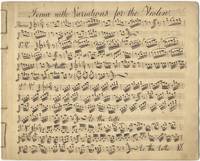
183040871England 1830. Pierre Rode 1774-1830; Sir Henry Rowley Bishop 1786-1855; Adalbert Gyrowetz 1763-1850; Anon. Copyist musical manuscript. Oblong folio 245 x 305 mm. Sewn. Notated in black and brown ink on 14-stave rastrum-ruled paper. 10 pp. <br /> <br /> Contains five variation sets for violin by various composers:<br /> <br /> 1 Tema with Variations for the Violin. 3 pp. <br /> Nine variations on a waltz-like theme in F major. Following each variation the scribe indicates "tutti" or "to the tutti" indicating that these variations may have been performed with an ensemble of musicians. Unlocated.<br /> <br /> 2 Bishop Sir Henry Rowley 1786-1855 and Anon<br /> Variations from Home Sweet Home. 2 pp.<br /> Five variations on Rowley's well-known song. Bishop was an English composer who "in his day he enjoyed a commanding reputation as the guardian of the best traditions of English song and for a time he kept English opera alive almost single-handed. Yet he is now remembered for little but the song Home Sweet Home." Nicholas Temperley and Bruce Carr in Grove Music Online<br /> <br /> 3 Rode Pierre 1774-1830<br /> Theme with Variations for the Violin. 2 pp. <br /> Four variations originally published as a solo for violin accompanied by a second violin viola and cello. "At the height of his career Rode was the most finished representative of the French violin school. Having assimilated Viotti's Classical approach he imbued it with characteristically French verve piquancy and a kind of nervous bravura. His artistic growth took place during the revolutionary decade and it is not surprising that his music is akin to that of Cherubini and Méhul and the operas of the 1790s; there is declamatory pathos martial dash and melting cantilena. His gift for lyrical often melancholy melody which represents a prominent trend in French music of this period made his music particularly attractive to German early Romantic composers. . At the height of his career Rode was the most finished representative of the French violin school. Having assimilated Viotti's Classical approach he imbued it with characteristically French verve piquancy and a kind of nervous bravura. His artistic growth took place during the revolutionary decade and it is not surprising that his music is akin to that of Cherubini and Méhul and the operas of the 1790s; there is declamatory pathos martial dash and melting cantilena. His gift for lyrical often melancholy melody which represents a prominent trend in French music of this period made his music particularly attractive to German early Romantic composers. . His innate gifts as a teacher are demonstrated in his 24 Caprices which balance the musical and technical needs of the student and have become an indispensable part of the violin curriculum." Boris Schwarz revised by Clive Brown in Grove Music Online<br /> <br /> 4 Gyrowetz Adalbert 1763-1850 <br /> Variations. 3 pp.<br /> Eight variations on a Tyrolean folksong popular at the time and the subject of numerous variation sets. Gyrowetz was a noted Bohemian composer and conductor.<br /> <br /> 5 Rossini Gioachino 1792-1868<br /> Variations from the Tanti Palpiti. 2 pp.<br /> Five variations. The composer's Di tanti palpiti was the subject of variation sets by celebrated composers including Paganini Giuliani and Gelinek. Unlocated.<br /> <br /> Several small stains mainly to blank margins; minor soiling to final page mainly affecting its eight blank staves. These variations by the composers represented in the present manuscript are virtuosic incorporating rapid scales and arpeggios passages in double stops and bariolage. unknown
182046029Paris Crochard 1820. No wrappers. In "Annales". In "Annales de Chimie et de Physique Par MM. Gay-Lussac et Arago" Tome XIV Juin issue pp. 113-222. Entire issue offered with halftitlepage to vol. 14. Savart's paper: pp. 113-172 and 3 folded engraved plates. Plates with some scattered brownspots. <br/><br/><em>First printing of a pioneer paper on the acoustics of the violin and on the construction of the Trapezoidal Fiddle."In his earliest work Savart gave the first explanation of the function of certain parts of the violin. To learn how vibrations are transmitted from the strings to the rest of the instrument he induced vibrations in a free wood plate by passing a vibrating string over a bridge at its center; he also used Chladni’s sand-pattern technique to observe the resulting nodal lines. Savart showed that the bridge transmits the string’s vibrations; that the plate can be made to vibrate at any frequency; and that the corresponding mode is a modification of an unforced mode. He demonstrated that the sound post also serves to transmit vibrations and he explained that it therefore should not be placed under a nodal line. Thinking that symmetry and regularity would produce the best tone Savart built a trapezoidal violin with rectangular sound holes. When the instrument was played before a committee that included Biot the Composer Cherubini and other members of the Academy of Sciences and the Académie des Beaux-Arts its tone was judged as extremely clear and even but somewhat subdued."DSB.The issue also contains Eilhard Mitscherlich' famous paper in the first French version "Sur la Relation qui existe entre la forme cristalline et les proportions chimiques" pp. 172-190. </em> unknown
184729822Paris: Aubert & Cie 1847. 215 x 220 mm. sheet size 346 x 253 mm. Printed on wove paper. Signed by the artist in the stone.<br /> <br /> Some foxing; remnants of paper mounting tape to verso. Aubert & Cie unknown
182046032Paris Crochard 1820. Uncut with orig. printed wrappers Juin-issue. In "Annales de Chimie et de Physique Par MM. Gay-Lussac et Arago" Tome XIV Juin issue pp. 113-222. Entire issue in orig. wrappers. Savart's paper: pp. 113-172 and 3 folded engraved plates. <br/><br/><em>First printing of a pioneer paper on the acoustics of the violin and on the construction of the Trapezoidal Fiddle."In his earliest work Savart gave the first explanation of the function of certain parts of the violin. To learn how vibrations are transmitted from the strings to the rest of the instrument he induced vibrations in a free wood plate by passing a vibrating string over a bridge at its center; he also used Chladni’s sand-pattern technique to observe the resulting nodal lines. Savart showed that the bridge transmits the string’s vibrations; that the plate can be made to vibrate at any frequency; and that the corresponding mode is a modification of an unforced mode. He demonstrated that the sound post also serves to transmit vibrations and he explained that it therefore should not be placed under a nodal line. Thinking that symmetry and regularity would produce the best tone Savart built a trapezoidal violin with rectangular sound holes. When the instrument was played before a committee that included Biot the Composer Cherubini and other members of the Academy of Sciences and the Académie des Beaux-Arts its tone was judged as extremely clear and even but somewhat subdued."DSB.The issue also contains Eilhard Mitscherlich' famous paper in the first French version "Sur la Relation qui existe entre la forme cristalline et les proportions chimiques" pp. 172-190. </em> unknown