477 résultats
196076141Couverture souple. Broché. 40 pages. Légèrement défraîchi. 27 x 34 cm.
24 cm, ril. edit. illustrata, p. 47, 2 ill. e una tavola 8 tavole tecniche del violino Stradivarius più volte ripiegate allegate in tasca
19946053Editions du Relié 1994 213 pages in8. 1994. Broché. 213 pages.
brossura I Sette Haiku per violino e pianoforte di Enrico Renna sono composizioni musicali nate da suggestioni e strutture derivate da altrettanti haiku di poeti giapponesi dei secoli XVII - XIX, i maestri Basho, Buson, Joso, Issa e Sute-jo. La relazione tra i brani poetici e quelli musicali è strettissima e si articola a vari livelli: cellulare, strutturale, psicologico, emozionale. La scelta del numero dei brani coincide con la struttura interna degli stessi componimenti poetici e dalla simbologia che li contraddistingue. Gli strumenti musicali sono utilizzati in maniera tradizionale e come puri oggetti sonori. I linguaggi sono eminentemente eterogenei, senza preclusioni linguistiche riconducibili a koiné prestabilite.
24 cm, br. ill, sovracop. ill, p. 147, alcune foto
4 Vol. In-4 pag. 32+43+7+58.Firma d'app.in cpt PROG 15954 CATT_ATT 26
23 cm, br. editoriale, p. 302, alcune tavole fuori testo
1920M33722London, Edward Arnold 1920 104pp.ill.with examples, cloth, signed with dedicace by the author, VG
104pp.ill.with examples, cloth, signed with dedicace by the author, VG
brossura Perché impiegare tanto tempo per esser capaci di eseguire un brano? Un metodo rapido per suonare il violino adatto a tutti. Questo studio vi permetterà in pochi passi di utilizzare subito le quattro dita su ogni corda. Delle guide colorate vi aiuteranno durante i primi approcci alla lettura delle note mentre le immagini vi illustreranno l'impostazione del violino e dell'arco. Nozioni tecniche e teoriche di base vi renderanno autonomi in poco tempo per poter suonare le prime melodie.
<p>24,5x17 cmbrossura di p. 8 con ritratto disegnato da P. Serra Zanetti alla cop. congiudizi della critica di giornali di tutta Italia dal 1929 al 1933. con le critiche del 1934Allegata velina di aggiornamento. Piega al margine della brossura</p>
27051P.- LAFFILE,LAFFILE,n°1029,15p.in4 broché,texte frais 35 cm..; partitions bien gravées.
8 pages. Clean and unmarked with light wear. A quality copy Sheet music
Bosworth SD (vers 1900), In-12 broché, 34 pages. Couverture un peu brunie. Bon état.
in-12, 262 p., illustrations hors texte N&B, notes Papier jauni sinon bel exemplaire [CA32-3]
182046032Paris Crochard 1820. Uncut with orig. printed wrappers Juin-issue. In "Annales de Chimie et de Physique Par MM. Gay-Lussac et Arago" Tome XIV Juin issue pp. 113-222. Entire issue in orig. wrappers. Savart's paper: pp. 113-172 and 3 folded engraved plates. <br/><br/><em>First printing of a pioneer paper on the acoustics of the violin and on the construction of the Trapezoidal Fiddle."In his earliest work Savart gave the first explanation of the function of certain parts of the violin. To learn how vibrations are transmitted from the strings to the rest of the instrument he induced vibrations in a free wood plate by passing a vibrating string over a bridge at its center; he also used Chladni’s sand-pattern technique to observe the resulting nodal lines. Savart showed that the bridge transmits the string’s vibrations; that the plate can be made to vibrate at any frequency; and that the corresponding mode is a modification of an unforced mode. He demonstrated that the sound post also serves to transmit vibrations and he explained that it therefore should not be placed under a nodal line. Thinking that symmetry and regularity would produce the best tone Savart built a trapezoidal violin with rectangular sound holes. When the instrument was played before a committee that included Biot the Composer Cherubini and other members of the Academy of Sciences and the Académie des Beaux-Arts its tone was judged as extremely clear and even but somewhat subdued."DSB.The issue also contains Eilhard Mitscherlich' famous paper in the first French version "Sur la Relation qui existe entre la forme cristalline et les proportions chimiques" pp. 172-190. </em> unknown
182046029Paris Crochard 1820. No wrappers. In "Annales". In "Annales de Chimie et de Physique Par MM. Gay-Lussac et Arago" Tome XIV Juin issue pp. 113-222. Entire issue offered with halftitlepage to vol. 14. Savart's paper: pp. 113-172 and 3 folded engraved plates. Plates with some scattered brownspots. <br/><br/><em>First printing of a pioneer paper on the acoustics of the violin and on the construction of the Trapezoidal Fiddle."In his earliest work Savart gave the first explanation of the function of certain parts of the violin. To learn how vibrations are transmitted from the strings to the rest of the instrument he induced vibrations in a free wood plate by passing a vibrating string over a bridge at its center; he also used Chladni’s sand-pattern technique to observe the resulting nodal lines. Savart showed that the bridge transmits the string’s vibrations; that the plate can be made to vibrate at any frequency; and that the corresponding mode is a modification of an unforced mode. He demonstrated that the sound post also serves to transmit vibrations and he explained that it therefore should not be placed under a nodal line. Thinking that symmetry and regularity would produce the best tone Savart built a trapezoidal violin with rectangular sound holes. When the instrument was played before a committee that included Biot the Composer Cherubini and other members of the Academy of Sciences and the Académie des Beaux-Arts its tone was judged as extremely clear and even but somewhat subdued."DSB.The issue also contains Eilhard Mitscherlich' famous paper in the first French version "Sur la Relation qui existe entre la forme cristalline et les proportions chimiques" pp. 172-190. </em> unknown
ill., br. Un metodo per violino pratico e moderno che raccoglie gli aspetti fondamentali della didattica violinistica più recente. Ideale per il triennio delle Scuole Secondarie Inferiori con Indirizzo Musicale. La gradualità delle tecniche principali è assicurata da esercizi specifici. Lo studio delle scale è distribuito nell'arco delle 3 parti in cui è diviso il libro, partendo da quelle più semplici sul violino, fino a quelle più difficoltose per tecnica e lettura. La maggior parte degli esercizi sono in forma di brani musicali attinti da un ampio e variegato repertorio per forme, generi e provenienza storica e geografica: brani di musica classica, moderna, tradizionale, etnica, da film, leggera. Per stimolare e motivare lo studio dello strumento attraverso la pratica della musica d'insieme, ognuno dei 20 capitoli si conclude con un brano in duo (anche con pianoforte), trio o quartetto di archi, e inoltre, la maggior parte degli esercizi sono in forma di duetto allievo/insegnante e allievo/allievo. Agli esercizi di tecnica e ai brani si alternano consigli di "ginnastica" per la corretta postura, attività che invitano alla creatività e accendono la curiosità verso il violino e la musica, informazioni e brani da suonare relativi ai principali periodi storici musicali. Il libro è corredato di tracce mp3 scaricabili dal sito dell'editore eseguite al violino dall'autrice: un'ottima sollecitazione, oltre che un aiuto, allo studio individuale.
199128385BIS, 1991. BIS-CD-517 CD CD
Edizione dei primi del novecento di 40 melodie e studi progressivi per lo studio del violino tratti dall'opera 31 di Sebastian Lee riviste da Hugo Becker. In buone condizioni. Brossura editoriale in buone condizioni generali con usure e strappi ai margini e dorso. Legatura in buone condizioni. All'interno le pagine si presentano in buone condizioni con rare fioriture. In folio. Dim. 31x23,5 cm. Pp. 27.musical score of early 20th century of 40 melodies and progressive studies for the study of violin from the work 31 by Sebastian Lee revised by Hugo Becker. In good conditions. Editorial cover in good general conditions with wearings and tears in the edges and spine. Binding in good conditions. Inside pages are in good conditions with occasional foxings. In folio. Dim. 31x23,5 cm. Pp. 27.
171011328Paris 1710 veau brun, dos à nerfs, armes sur les plats et nom du possesseur ( Charon). grand in-4,
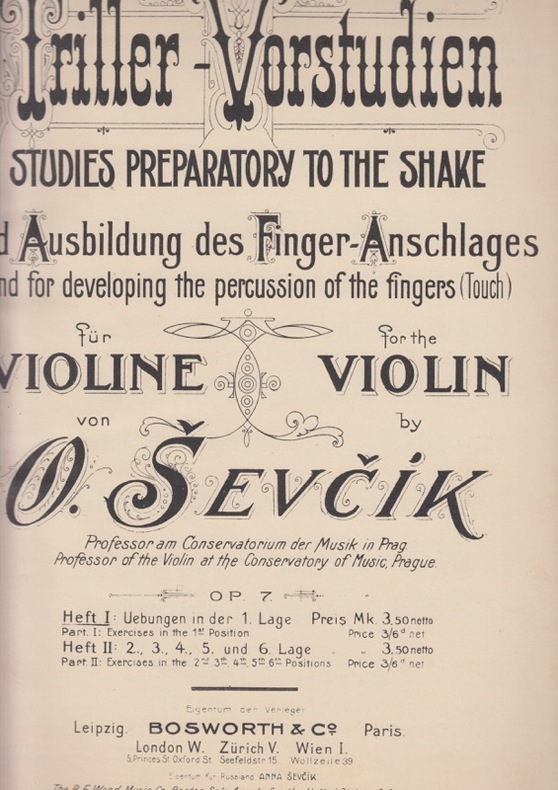
24947IN FOLIO percaline rouge editeur,Texte en français, russe et italien Leipzig, Bosworth & Cie N°307, Début XXe siècle, OPUS 7 : 27+31 p; OPUS 8: 23p.; OP 9: 21 pages reliées + couvertures imprimées, B&Co.4289-90-91-92 Très bon état
1 Vol. In-4 gr cart.editoriale. Firma d'app.al front pag. 164 compl PROG 17484 CATT_ATT 28