Untersteiner AlfredoMareMagnum

477 résultats
<p>15 cm, rilegatura in tela, tit. al piatto e dorso, tagli colorati, p. viii, 228, 64 di catalogo editoriale, firmetta cancellata</p>
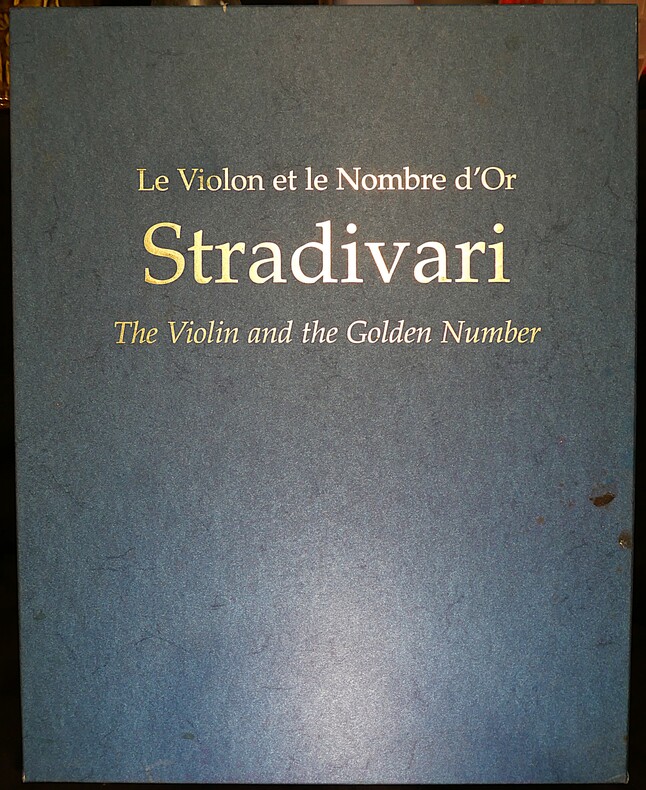
20053cb5in4 broché, 163pp, nombreux dessins et schémas. 12 planches rhodoid représentant les moules des Stradivarius grandeur nature accompagnées de 12 calques correspondant, avec calculs géométriques en rapport avec le nombre d'or. Le tout dans un grand coffret bleu à titres dorés
15449Genève, Ch. Grasset 1945, 200x130mm, 208pages, broché. Bel exemplaire.
48 pages. Part 2 of a course for individual or class instruction providing training in solo and ensemble playing. This book is for Violin A and B. Average external wear. Contents clean and unmarked. Binding intact. A sound copy. Book
1 Vol. In-4 gr pag. 28 PROG 17483 CATT_ATT 28
19887386Paris Filipacchi 1988 GRAND In-8 323 pp, traduit de l'anglais par Christian Gauffre, photographies en noir hors-texte, couvertures illustrées
brossura
182046032Paris Crochard 1820. Uncut with orig. printed wrappers Juin-issue. In "Annales de Chimie et de Physique Par MM. Gay-Lussac et Arago" Tome XIV Juin issue pp. 113-222. Entire issue in orig. wrappers. Savart's paper: pp. 113-172 and 3 folded engraved plates. <br/><br/><em>First printing of a pioneer paper on the acoustics of the violin and on the construction of the Trapezoidal Fiddle."In his earliest work Savart gave the first explanation of the function of certain parts of the violin. To learn how vibrations are transmitted from the strings to the rest of the instrument he induced vibrations in a free wood plate by passing a vibrating string over a bridge at its center; he also used Chladni’s sand-pattern technique to observe the resulting nodal lines. Savart showed that the bridge transmits the string’s vibrations; that the plate can be made to vibrate at any frequency; and that the corresponding mode is a modification of an unforced mode. He demonstrated that the sound post also serves to transmit vibrations and he explained that it therefore should not be placed under a nodal line. Thinking that symmetry and regularity would produce the best tone Savart built a trapezoidal violin with rectangular sound holes. When the instrument was played before a committee that included Biot the Composer Cherubini and other members of the Academy of Sciences and the Académie des Beaux-Arts its tone was judged as extremely clear and even but somewhat subdued."DSB.The issue also contains Eilhard Mitscherlich' famous paper in the first French version "Sur la Relation qui existe entre la forme cristalline et les proportions chimiques" pp. 172-190. </em> unknown
182046029Paris Crochard 1820. No wrappers. In "Annales". In "Annales de Chimie et de Physique Par MM. Gay-Lussac et Arago" Tome XIV Juin issue pp. 113-222. Entire issue offered with halftitlepage to vol. 14. Savart's paper: pp. 113-172 and 3 folded engraved plates. Plates with some scattered brownspots. <br/><br/><em>First printing of a pioneer paper on the acoustics of the violin and on the construction of the Trapezoidal Fiddle."In his earliest work Savart gave the first explanation of the function of certain parts of the violin. To learn how vibrations are transmitted from the strings to the rest of the instrument he induced vibrations in a free wood plate by passing a vibrating string over a bridge at its center; he also used Chladni’s sand-pattern technique to observe the resulting nodal lines. Savart showed that the bridge transmits the string’s vibrations; that the plate can be made to vibrate at any frequency; and that the corresponding mode is a modification of an unforced mode. He demonstrated that the sound post also serves to transmit vibrations and he explained that it therefore should not be placed under a nodal line. Thinking that symmetry and regularity would produce the best tone Savart built a trapezoidal violin with rectangular sound holes. When the instrument was played before a committee that included Biot the Composer Cherubini and other members of the Academy of Sciences and the Académie des Beaux-Arts its tone was judged as extremely clear and even but somewhat subdued."DSB.The issue also contains Eilhard Mitscherlich' famous paper in the first French version "Sur la Relation qui existe entre la forme cristalline et les proportions chimiques" pp. 172-190. </em> unknown
182046029(Paris, Crochard, 1820). No wrappers. In ""Annales"". In ""Annales de Chimie et de Physique, Par MM. Gay-Lussac et Arago"" Tome XIV, Juin issue, pp. 113-222. (Entire issue offered with halftitlepage to vol. 14). Savart's paper: pp. 113-172 and 3 folded engraved plates. Plates with some scattered brownspots.
182046032Paris, Crochard, 1820. Uncut with orig. printed wrappers (Juin-issue). In ""Annales de Chimie et de Physique, Par MM. Gay-Lussac et Arago"" Tome XIV, Juin issue, pp. 113-222. (Entire issue in orig. wrappers). Savart's paper: pp. 113-172 and 3 folded engraved plates.
6892textes de Roger Baschet,Luc Bérimont,Mario Bois,José Bruyr, Jacques Bureau,Hélène Cadou etc.harmonisés par pierre Hiégel.In folio reliure éditeur pleine toile écrue,titre en noir,en long,au dos,titre en noir er le premier plat Faux-titre,titre,394 pages sur papier couché,texte sur 2 colonnes,Nombreuses illustrations,dans le texte,pleine page,en noir et en couleurs.Les éditions de l’Illustration 1967.Quelques petites rousseurs sur le premier plat,sinon très bon état
brossura È il 3° volume del Metodo Suzuki dedicato al violino, pubblicato in una nuova edizione. I temi di studio affrontati sono, in particolare: il progresso attraverso l'ascolto musicale, la tonalization, l'intonazione accurata, lo studio del fraseggio. Sono inclusi esercizi per il vibrato.
ril. È il 2° volume del Metodo Suzuki dedicato al violino, pubblicato in una nuova edizione. I temi di studio affrontati sono, in particolare: lo sviluppo della sensibilità musicale del bambino, l'ottenimento di un bel suono, l'intonazione accurata, la corretta postura e la giusta tenuta dell'arco.
ril. È il 3° volume del Metodo Suzuki dedicato al violino, pubblicato in una nuova edizione. I temi di studio affrontati sono, in particolare: il progresso attraverso l'ascolto musicale, la tonalization, l'intonazione accurata, lo studio del fraseggio. Sono inclusi esercizi per il vibrato.
26751l'AUTEUR - Paris :,[s.d.]In-fol.2p.; ENVOI autographe AUTEUR coupé,trés rare
1920M33722London, Edward Arnold 1920 104pp.ill.with examples, cloth, signed with dedicace by the author, VG
104pp.ill.with examples, cloth, signed with dedicace by the author, VG
1970123312Couverture souple. Broché. 24 x32 cm. 12 pages.
1970123310Couverture souple. Broché. 24 x32 cm. 66 pages.
1970123311Couverture souple. Broché. 24 x32 cm. 53 pages.
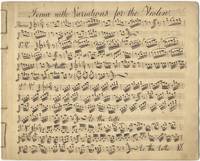
183040871England 1830. Pierre Rode 1774-1830; Sir Henry Rowley Bishop 1786-1855; Adalbert Gyrowetz 1763-1850; Anon. Copyist musical manuscript. Oblong folio 245 x 305 mm. Sewn. Notated in black and brown ink on 14-stave rastrum-ruled paper. 10 pp. <br /> <br /> Contains five variation sets for violin by various composers:<br /> <br /> 1 Tema with Variations for the Violin. 3 pp. <br /> Nine variations on a waltz-like theme in F major. Following each variation the scribe indicates "tutti" or "to the tutti" indicating that these variations may have been performed with an ensemble of musicians. Unlocated.<br /> <br /> 2 Bishop Sir Henry Rowley 1786-1855 and Anon<br /> Variations from Home Sweet Home. 2 pp.<br /> Five variations on Rowley's well-known song. Bishop was an English composer who "in his day he enjoyed a commanding reputation as the guardian of the best traditions of English song and for a time he kept English opera alive almost single-handed. Yet he is now remembered for little but the song Home Sweet Home." Nicholas Temperley and Bruce Carr in Grove Music Online<br /> <br /> 3 Rode Pierre 1774-1830<br /> Theme with Variations for the Violin. 2 pp. <br /> Four variations originally published as a solo for violin accompanied by a second violin viola and cello. "At the height of his career Rode was the most finished representative of the French violin school. Having assimilated Viotti's Classical approach he imbued it with characteristically French verve piquancy and a kind of nervous bravura. His artistic growth took place during the revolutionary decade and it is not surprising that his music is akin to that of Cherubini and Méhul and the operas of the 1790s; there is declamatory pathos martial dash and melting cantilena. His gift for lyrical often melancholy melody which represents a prominent trend in French music of this period made his music particularly attractive to German early Romantic composers. . At the height of his career Rode was the most finished representative of the French violin school. Having assimilated Viotti's Classical approach he imbued it with characteristically French verve piquancy and a kind of nervous bravura. His artistic growth took place during the revolutionary decade and it is not surprising that his music is akin to that of Cherubini and Méhul and the operas of the 1790s; there is declamatory pathos martial dash and melting cantilena. His gift for lyrical often melancholy melody which represents a prominent trend in French music of this period made his music particularly attractive to German early Romantic composers. . His innate gifts as a teacher are demonstrated in his 24 Caprices which balance the musical and technical needs of the student and have become an indispensable part of the violin curriculum." Boris Schwarz revised by Clive Brown in Grove Music Online<br /> <br /> 4 Gyrowetz Adalbert 1763-1850 <br /> Variations. 3 pp.<br /> Eight variations on a Tyrolean folksong popular at the time and the subject of numerous variation sets. Gyrowetz was a noted Bohemian composer and conductor.<br /> <br /> 5 Rossini Gioachino 1792-1868<br /> Variations from the Tanti Palpiti. 2 pp.<br /> Five variations. The composer's Di tanti palpiti was the subject of variation sets by celebrated composers including Paganini Giuliani and Gelinek. Unlocated.<br /> <br /> Several small stains mainly to blank margins; minor soiling to final page mainly affecting its eight blank staves. These variations by the composers represented in the present manuscript are virtuosic incorporating rapid scales and arpeggios passages in double stops and bariolage. unknown
9788545000945FORUM. new. A presente obra Ǹ fruto da disserta��o de Mestrado em Direito do Estado pela Universidade Federaldo Paranǭ. Nela o Professor Tarso Cabral Violin realiza uma anǭlise cr�tica do ideǭrio do 'terceiro setor' no contexto do neoliberalismo e do gerencialismo e aprofunda o tema das parcerias entre a Administra��o P�blica e as entidades da sociedade civil sem fins lucrativos criticando as ONGs que de contEstadoras passaram em sua maioria a ser 'parceiras' do Estado como substitutas dele informando os questionamentos que existem quanto ao pr��prio termo 'terceiro setor' defendendo a sociedade civil organizada mas n�o como autor responsǭvel pelas quest��es sociais. Baseando-se em autores como Antonio Gramsci Carlos Nelson Coutinho Carlos Monta��o Celso Ant�nio Bandeira de Mello Romeu Felipe Bacellar Filho Cǭrmen L�cia Antunes Rocha Maria Sylvia Zanella Di Pietro S�lvio Lu�s Ferreira da Rocha Boaventura de Souza Santos entre outros o autor estuda o Estado a sociedade civil os servi��os sociais o princ�pio da subsidiariedade a Administra��o P�blica patrimonialismo burocracia e gerencialismo o Estado ampliado gramsciano os movimentos sociais e por fim esmi���a temas jur�dicos como as pessoas jur�dicas de direito privado sem fins lucrativos associa����es funda����es etc. entidades paraestatais organiza����es sociais organiza����es da sociedade civil de interesse p�blico OSCIPs parcerias com o 'terceiro setor' contratos administrativos conv�nios contratos de gest�o e termos de parceria a rela��o entre as licita����es e o 'terceiro setor' a terceiriza��o e a privatiza��o via 'terceiro setor' e a Ordem Social da Constitui��o. Portanto a presente obra Ǹ essencial para os estudiosos do 'terceiro setor' seja em seu aspecto jur�dico ou n�o assim como para os interessados no Direito Administrativo principalmente em temas como as licita����es e os acordos de vontade firmados entre a Administra��o P�blica e o 'terceiro setor'. A 3� edi��o alǸm de atualizada trata da nova Lei das Organiza����es da Sociedade Civil OSC a Lei 13.019/2014 assim como comenta a Decis�o do STF na ADIn 1.923 sobre a Lei das Organiza����es Sociais Lei 9.637/98. Em 2011 o autor foi honrado com a indica��o pela Secretaria Nacional de Justi��a do MinistǸrio da Justi��a e com o convite da Secretaria Geral da Presid�ncia da Rep�blica para participar como debatedor do Simp��sio Internacional Marco Regulat��rio das Organiza����es da Sociedade Civil que foi o embri�o da Lei das OSC. FORUM unknown
Hardcover w/dust jacket, 189 pages, first printing. Owner signature otherwise VG/G [EN-1]