4 427 résultats
9244Editions Corrêa. 1947. In-8°, reliure pleine toile, couverture conservée. 163 pages. E.O.
9243Editions Corrêa. 1946. In-8°, reliure pleine toile, couverture conservée. 20 planches hors texte. 281 pages. E.O.
9245Editions des Deux-Rives. 1950. Grand in-8°, reliure pleine toile, couverture conservée. 283 pages. E.O.
9242Editions Corrêa. 1945. In-8°, reliure pleine toile, couverture conservée. 172 pages. E.O.
9246Editions Robert Laffont. 1954. Grand in-8°, reliure pleine toile. Nombreuses photos hors texte. 366 pages. E.O.
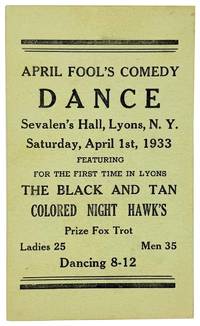
193345554Lyons NY: Sevalen's Hall 1933. Very Good . Lyons NY: Sevalen's Hall 1933. Broadsheet palm card; printed promotional card 12.8x7.5cm for an "April Fool's Comedy Dance" in the New York Hamlet featuring the Colored Night Hawk's sic band; advertisements for Lyons Soda Spa to verso. Light rubbing and a couple smudges; Very Good or better. <br /> <br /> Drummer Boots Ward's band was variously called the Colored Night Hawks or simply the Night Hawks and sprang from its Worcester Massachusetts antecedent "Mamie Moffett and Her Five Jazz Hounds" which was headed by Worcester's "First Lady of Jazz." A lovely record of small town Depression-era good times when tickets went for 25 cents to the ladies and 35 to the men. . Sevalen's Hall unknown
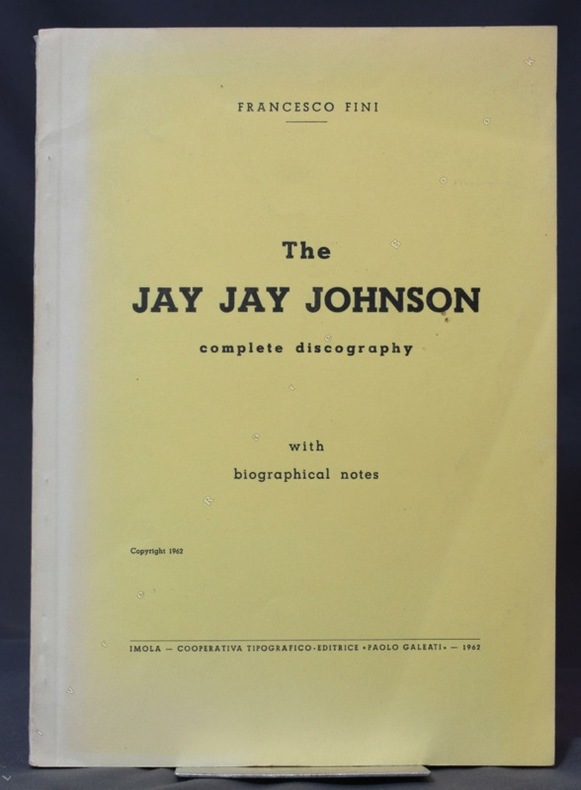
19628971Imola, Cooperativa tipografico editrice "Paolo Galeati", Modern jazz discographies serie, 1962. Brochure in-8 brochée de 24 pages imprimées au seul recto, couverture jaune. Dos insolé.
200803901Paris, Eds, 1986 ; in-4, 44 pp., cartonnage de l'éditeur. Eo bas de coiffe abimé plus 4 plat taché.
200809313Paris, Eds, 1984 ; in-4, 44 pp., cartonnage de l'éditeur. Eo dédicacée et numéroté; page onduler.
GF14929Dessin original à l'encre de chine sur calque signé - format 13,5 x 10,5 -
192550606New York: A. Koenigsberg 648 Broadway ca. 1925. 8vo. 12 pp. Photo illustrated throughout colour-tinted centerfold. Colour-illustrated softcovers model wearing a stylish hat printed in red & black stapled as issued sewn through punch hole at head of spine w/ gold silk braid slight shelfwear 1 very small closed tear at fore-edge front cover still VG copy. First edition of this very scarce and beautiful catalogue of hat frames and hat bases for millinery shops during the 1920s. The company could supply for hat designers Zibeline hatters plush hats Lyons Velvet Brims Satins Velours Ribbon bound fur and felt hats as well as millinery supplies and hat boxes. Koenigsberg b. 1889 emigrated from England in 1889 to New York where he worked as a furrier for many years with his father Wolf before setting up his own successful millinery supply shop and 4200 square foot factory which successfully operated until the Great Depression. After his shop closed Koenigsberg moved into selling pin ball machines. No copies located in Worldcat; See: New York State Industrial Bulletin of the Department of Labor 1921 Vol. 1 p. 171. A. Koenigsberg, 648 Broadway, paperback
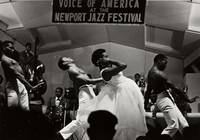
1958List1514New York 1958. Silver Gelatin Photograph measuring 8 ½ x 11 ½ inches with Schatt’s marks verso with his notation “Vintage ‘58†in ink. A fine example fine contrast. A striking image of Eartha Kitt and her band performing at the 1957 Newport Jazz Festival taken by the prolific photographer Roy Schatt perhaps best known for his photographs of James Dean. This is a vintage example likely printed in 1958 from the “1958†and “Vintage†marks to verso. We find no other record of this specific image only a similar image from Kitt’s performance taken by Schatt. unknown
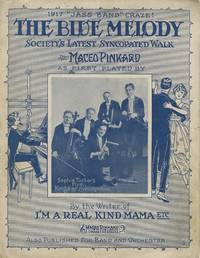
1917List3667Omaha Nebraska: Maceo Pinkard Music Publisher 1917. Folio sheet music 11 x 14 inches 3 pp. plus cover. Light edge wear and small creases; a couple tiny tears to margins very good with strong color and excellent internal condition. An early jazz-era composition by the important African American songwriter Maceo Pinkard 1897–1962 issued from his short-lived Omaha publishing venture during the first years of the national “jass band†craze. The cover advertises the piece as a “1917 ‘Jass Band’ Craze!†and features a photograph of Sophie Tucker’s Five Kings of Syncopation the ensemble associated with the immensely popular vaudeville star Sophie Tucker during the years immediately preceding American entry into the First World War.<br /> <br /> Pinkard born in Blue Springs Nebraska emerged as one of the most important Black popular songwriters of the early twentieth century. As a teenager he worked in Nebraska theaters and dance orchestras before forming a publishing firm in Omaha while still barely twenty years old. His early Midwestern publications—including pieces such as “The Blue Melodyâ€â€”show him operating within the ragtime and syncopated dance music tradition that was evolving into early jazz. Within a few years Pinkard relocated to Chicago and New York where he became a major Tin Pan Alley figure later composing standards such as “Sweet Georgia Brown†1925. The piece is respectfully dedicated to “Sophie Tucker’s 5 Kings of Syncopation†reflecting Tucker’s role as one of the most influential vaudeville singers of the 1910s. The interior advertisement reproduces a sample chorus of Pinkard’s hit “I’m a Real Kind Mama†another early jazz-age success associated with Tucker’s repertoire. Maceo Pinkard Music Publisher unknown
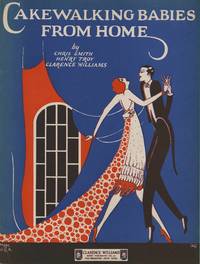
1924List3678New York City: Clarence Williams 1924. Folio measuring 12 x 9 inches 5 pp. With an attractive period style illustration by Sydney Leff with his printed signature in the lower right corner. Fine condition. A very scarce surviving example of the sheet music for "Cakewalking Babies from Home" a cornerstone early jazz-blues composition issued through Clarence Williams’s publishing enterprise at the moment when New Orleans–derived ensemble practice was reshaping American popular music. Written by Williams with Chris Smith and Henry Troy the piece bridges late ragtime syncopation and emerging small-group jazz textures. Though widely disseminated through performance and recording it appears to have circulated only sparingly as domestic sheet music.<br /> <br /> The song achieved lasting fame through the celebrated 1924 New York recording sessions by the Clarence Williams Blue Five Okeh 8256 featuring Eva Taylor vocal Louis Armstrong cornet Sidney Bechet soprano saxophone Clarence Williams piano and Buddy Christian banjo; a landmark early small-ensemble performance often cited for its dynamic Armstrong–Bechet interplay and its role in defining early jazz ensemble language.12 Circulating widely among classic blues singers vaudeville performers and musicians within Williams’s publishing network and the TOBA circuit the composition reflects the porous boundary between theatrical blues dance music and emerging jazz repertory in mid-1920s Harlem and Chicago. As noted in Smithsonian jazz educational materials “the roots of jazz are heard clearly… in ‘Cake Walking Babies from Home’â€.3<br /> <br /> Despite its well-documented performance and recording history institutional holdings of the sheet music itself appear extremely limited. We locate a single copy at the Stanley King Jazz Collection at Oberlin with none presently recorded in OCLC.<br /> <br /> 1 Brian Rust Jazz records 1897–1942 Arlington House Publishers 1978.<br /> 2 Tom Lord Jazz Discography Lord Music Reference Inc. 1992.<br /> 3 “Act 3. New York Introduction: 1924–1925†Smithsonian Louis Armstrong Education Kit https://amhistory.si.edu/jazz/education/Act3.pdf. Clarence Williams unknown
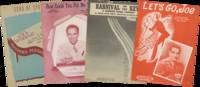
1949List3677New York City: Edwards Music Co. and others 1949. Ten pieces of sheet music see full inventory below. Overall Near Fine. A representative group of sheet music publications by Willie “The Lion†Smith one of the defining architects of Harlem stride piano and a central transitional figure between ragtime-era keyboard traditions and modern jazz performance. Active in New York during the formative decades of twentieth-century jazz Smith developed a powerful pianistic approach combining rhythmic authority harmonic sophistication and improvisational independence becoming widely regarded as a “musician’s musician†and an influential mentor to figures including Duke Ellington.1<br /> <br /> Emerging from the uptown New York scene shaped by pianists such as James P. Johnson and Luckey Roberts Smith helped define the stride style that grew from ragtime into a more expansive jazz idiom frequently performing at Harlem rent parties and participating in competitive “cutting contests†that tested virtuosity and improvisational skill. Smith also published sheet music producing piano solos novelty songs and popular compositions. Offered here are ten pieces reflecting the breadth of his printed output including collaborative songs and published folios issued by firms such as Leo Feist Edwards Music Co. Mills Music and Joe Davis. In his 1964 memoir Smith recalled hearing in everyday life “another weird but musical sound… that I can still hear in my head.â€2<br /> <br /> Uncommon on the market we find only four first edition copies of Smith sheets available at the time of writing with most of these not available. <br /> <br /> Titles include:<br /> <br /> “Between Sharps and Flats An Unusual Piano Soloâ€. Willie Lion Smith. New York: Edwards Music Co New York 1949. 5 pp. Fine condition. <br /> <br /> “Curfew Time in Harlem Novelty Songâ€. Willie The Lion Smith and Neil Laurence. New York: Joe Davis Inc New York 1938. 3 pp. Near fine with minimal wear. <br /> <br /> “Echo of Springâ€. Willie The Lion Smith. New York: Leo Feist Inc New York 1946. 6 pp. Fine condition. <br /> <br /> “How Could You Put Me Down†Willie The Lion Smith with James P. Johnson and Mitchell Parish. New York: Mills Music Inc 1945. 5 pp. Fine condition. <br /> <br /> “Karnival on the Keys A Modern Piano Fantasyâ€. Willie Lion Smith. New York: Edwards Music Co New York 1945. 5 pp. Fine condition. <br /> <br /> “Let’s Go Joeâ€. Cab Calloway Willie Lion Smith and Jack Palmer. New York: Rytvoc Inc 1942. 3 pp. Fine condition. <br /> <br /> “Let’s Mop It Mop! Mop!â€. Jack Edwards Fred Norman and Willie Lion Smith. New York: Edwards Music Co 1942. 3 pp. Fine condition. <br /> <br /> “Modern Piano Solos†folio. Willie The Lion Smith. New York: Leo Feist Inc 1939. 26 pp. Very good plus with a small chip to front wrap. <br /> <br /> “Rippling Watersâ€. Willie The Lion Smith. New York: Leo Feist Inc New York 1939. 5 pp. Fine condition. <br /> <br /> “Sneak Away Piano Soloâ€. Willie The Lion Smith. New York: Mills Music Inc 1937. 5 pp. Fine condition.<br /> <br /> 1 “Willie ‘The Lion’ Smith: Stride Piano Master†NPR’s ‘Jazz Profiles’ June 11 2008 https://www.npr.org/2008/06/11/91365108/willie-the-lion-smith-stride-piano-master.<br /> 2 Willie Smith Music on My Mind: The Memoirs of an American Pianist Doubleday: 1964. Edwards Music Co. and others unknown
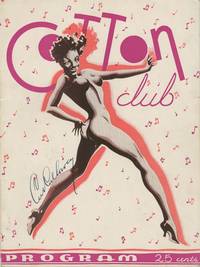
1938List3674New York City 1938. Small folio 12 x 9 inches 16 unnumbered pages. Signed boldly by Calloway on the front cover above the leg of the dancer in the illustration. Near Fine. An illustrated program for the Cotton Club from 1937/1938 with photographs of Cab Calloway the Nicholas Brothers and Mae Johnson in addition to information about the Club’s fifth edition of their Cotton Club Parade though this is a larger program. This copy documents the Midtown Manhattan iteration of the Cotton Club which moved from Harlem to Broadway and 48th Street in 1936 after the Harlem location closed following the Harlem riot of 1935. The new venue attempted to reproduce the earlier club’s formula of elaborate revues combining jazz orchestras chorus lines and specialty dancers in large-scale stage productions such as the Cotton Club Parade. While the performers remained overwhelmingly African American—including Calloway’s orchestra and many of the dancers—the audience at the club continued to be largely white reflecting the segregated entertainment culture of the period. This arrangement had long been criticized by Harlem writers and intellectuals; Langston Hughes writing during the Harlem Renaissance famously described the Cotton Club as a “Jim Crow club for gangsters and monied whitesâ€1 objecting to the racial restrictions placed on patrons even as Black musicians and dancers provided the entertainment. The Midtown Cotton Club continued presenting revues and broadcasts through the late 1930s but ultimately closed in 1940 bringing an end to one of the most famous nightclubs associated with the Harlem Renaissance and the swing era.<br /> <br /> Not in OCLC though see 951748496 for a shorter four page program for the fifth edition of the Cotton Club Parade published in 1938 and held at East Carolina University.<br /> <br /> 1 Langston Hughes “When the Negro was in Vogue†in The Big Sea Alfred A. Knopf 1940. unknown
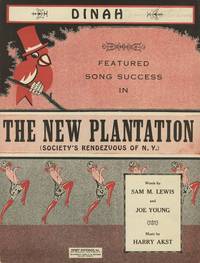
1925List3672New York City: Henry Waterson Inc 1925. Folio illustrated wraps. 5 pp. Fine condition. A striking Jazz Age sheet music issue and likely first edition for “Dinah†the widely popular song composed by Harry Akst with lyrics by Sam M. Lewis and Joe Young here promoted as a “Featured Song Success†from The New Plantation Society’s Rendezvous of N.Y. a Harlem revue-style theatrical production. The revue was advertised as an all-Black production reopening the Plantation Cabaret at 50th Street and Broadway featuring prominent performers including blues singer Ethel Waters alongside Will Vodery’s Parisian Orchestra Josephine Baker Bessie Allison Leonard Harper Jimmy Ferguson and the Plantation beauty chorus.1 “Dinah†would go on to become one of the most enduring standards of the decade. Multiple versions were published in 1925 this one in June and though we are not able to establish definitive priority we guess that this is the first edition. Very scarce with three copies found institutionally at the Francis G. Spencer collection at Baylor University BYU and the British Library reference collection. <br /> <br /> 1 “Ethel Waters Is Featured In New Plantation Revue†The New York Age June 20 1925 6. Henry Waterson, Inc unknown
201010317Paris, Garancière Jazz, 1986 ; in-8, 123 pp., cartonnage de l'éditeur. Bon état - traduit de l'anglais par Corine Derblum.
201503645Paris, Fayard Roman, 2009 ; in-8, 649 pp., br. Très bon état - broché.
201010312Paris, Garancière Jazz, 1986 ; in-8, 127 pp., cartonnage de l'éditeur. Bon état - traduit de l'anglais par Paul Couturiau.
201010316Paris, Garancière Jazz, 1986 ; in-8, 123 pp., cartonnage de l'éditeur. Bon état - traduit de l'anglais par Corine Derblum.
201010313Paris, Garancière Jazz, 1986 ; in-8, 128 pp., cartonnage de l'éditeur. TRÈS BON ÉTAT - Traduit de l'anglais par Paul Couturiau.
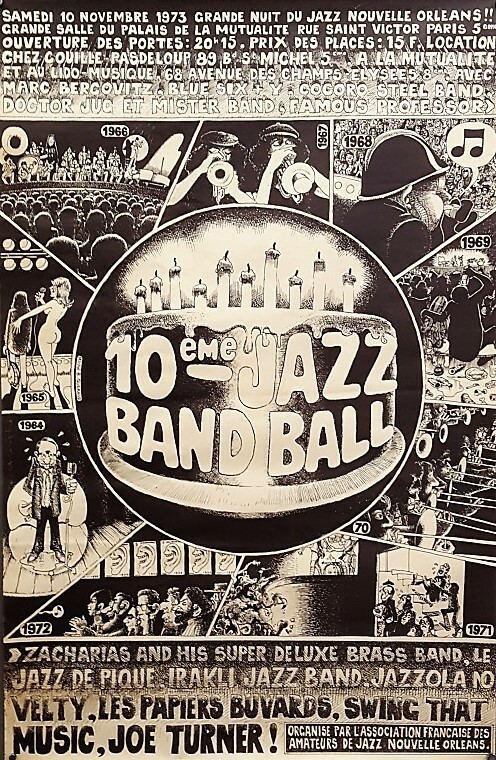
1473Impression en offset. 1973. Dim: 61,5 x 40 cm.
1992B2991Genève, Éditions Zoé, 1992 ; in-8, 142 pp., broché. Bon état.