53 résultats
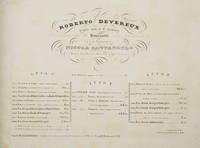
185331257Napoli: Successori della Ditta Girard e Co. PNs 3616-31 3872-3 4292-4 1853. Oblong folio. Vellum-backed and edged boards with burgundy cloth laid down initials "C.G." gilt to upper titling to spine stamped in black original yellow publisher's printed wrappers bound in. 1f. recto title verso blank 8 pp. Sinfonia 3-150 pp. Each number with separate caption title and pagination. Engraved.<br/><br/>Endpapers watermarked with a fleur-de-lis. With priced catalog "Opere Teatrali Intere" to upper wrapper listing works by Bellini Donizetti Rossini Verdi et al. composed through 1853 and with list of pieces with individual prices and plate numbers to title.<br/><br/>From the collection of Italian conductor vocal coach and close associate of Puccini and Mascagni Luigi Ricci 1893-1981.<br/><br/>Binding slightly worn bumped and scuffed. Light browning to title; minimal foxing throughout primarily confined to margins. First Edition of the revised version later issue. Inzaghi IN. 61 pp. 180-2. The first edition of Roberto Devereux was revised by Girard with the changes Donizetti made for the 1838 performance in Paris PNs 4292-4. This later issue has "Successori della Ditta" added to the title indicating that it was issued shortly after Girard's imprint changed in 1853. <br/><br/>Roberto Devereux to a libretto by Salvadore Cammarano after François Ancelot's tragedy Élisabeth d'Angleterre 1829 was first performed in Naples at the Teatro S Carlo on October 28 1837.<br/><br/>"The portrait of Queen Elizabeth I in Roberto Devereux is the most imposing of Donizetti's representations of that character who also appears in Elisabetta al castello di Kenilworth and Maria Stuarda and the role must rank as one of the great acting and singing opportunities in the bel canto repertory. Musically the score has much to commend it. As in other Donizetti operas the first act moves in a rather leisurely manner with a sequence of full arie di sortita; the pace accelerates to a dramatic climax in a briefer Act 2; then Act 3 like that of Lucia is a sequence of three powerful scenes."<br/><br/>"Particularly impressive are Elizabeth's entrance aria the duet for Sarah and Essex the trio-finale to Act 2 the Prison Scene of Essex and Elizabeth's aria-finale. Everywhere the score shows the sure hand of a composer in control of his materials. The powerful prelude to the Prison Scene recalls the opening of Act 2 of Fidelio. Elizabeth's final Larghetto 'Vivi ingrato' is a fine example of a melody developing in a long emotional arc of searing poignancy and of Donizetti's sensitive response to the expressive colour of the words." William Ashbrook in Grove Music Online.<br/><br/>Ricci was an important figure in the transmission of 19th century traditions passed on to him by noted baritone Antonio Cotogni 1831-1918 whom he accompanied from the age of 12. He was active as a vocal coach at the Accademia Nazionale di Santa Cecilia where he taught amongst many others Sesto Bruscantini Anna Moffo Rosalind Elias Ezio Flagello Peter Lindroos and Martti Wallén. Successori della Ditta Girard e Co. [PNs 3616-31, 3872-3, 4292-4] unknown books
185071300New York: William Hall & Son 1850. Paperback. Good. Sheet Music 6p. Disbound removed from a bound volume. 34cm. Substantial foxing and browning mainly around edges. Color lithographed illustration of an impossibly thin-waisted Jenny Lind in period costume on front cover. Cover title: Jenny Lind in the Opera of La Fille de la Regiment. The music which was taken from the opera is copyrighted 1845 but the copyright date on the cover is 1850. <br/><br/> William Hall & Son paperback books
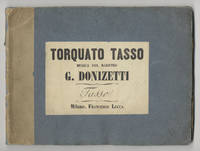
183336254Milano: F. Lucca PNs 900 904 905 912 e 913 914 and 915 1833. Oblong folio. Original blue wrappers with publisher's large ivory printed title label to upper. Engraved. Uncut. With text in Italian. On high quality paper.<br/><br/>Contains the following 6 complete numbers all with secondary pagination:<br/>- Scene e Duetto. In un etasi che uguale. 19 i blank pp. secondary pagination 49-67. PNs 900 L900L.<br/>- Duetto. Colei Safronia. 17 i blank pp. secondary pagination 87-103. PNs 904 P904P z904z. <br/>- Seguito del finale primo. Torquato! mira. Il Fratel t'invia 35 i blank pp. secondary pagination 104-138. PNs 905 n905n.<br/>- Scena e duetto. Poco dunque ti pare. 13 i blank pp. secondary paginatio 183-197. PNs 912 e 913 R912-913R R913R.<br/>- Sei mia . 34 pp. secondary pagination 198-231. PN 914.<br/>- Perche dell'aure in sen Gran scena ed aria. Eseguita dal Sigr. Giorgio Ronconi. 27 i blank pp. secondary pagaination 232-258. PNs 915 Z915Z.<br/><br/>Upper portion of first page of many numbers blank where title imprint etc. would be added for subsequent commercial publication.<br/><br/>Wrappers slightly worn and soiled spine reinforced with dark ivory tape. Minor internal browning; edges dusty. CPM Vol. 17 p. 259. Bergamo catalogue 80 complete plate nos. 897-915. Inzaghi 46. <br/><br/>A "melodramma semiserio" in three acts to a libretto by Jacopo Ferretti after Giovanni Rosini's Torquato Tasso and to a lesser degree Carlo Goldoni 's Tasso Johann Wolfgang von Goethe 's Tasso and Byron 's The Lament of Tasso Donizetti's Torquato Tasso was first performed in Rome at the Teatro Valle on 9 September 1833.<br/><br/>"Eleonora's expressive sortita 'Io l'udia nei suoi bei carmi' and her duet with the poet that follows 'Colei Sofronia' are notable passages. The finest music in the score however comes in the last act with Tasso's Larghetto 'Perché dell'aure in sen' leading into a touching dialogue with chorus; this culminates in a mournful cantabile to form the lyric section of the tempo di mezzo and is followed by an elegiac cabaletta in C major. As in Anna Bolena Donizetti here expanded the structure of the aria-finale to fill out an entire scene." William Ashbrook in Grove Music Online.<br/><br/>One of the earliest publications issued by Lucca. [F. Lucca] [PNs 900, 904, 905, 912 e 913, 914 and 915] unknown books