13 résultats
196635996Barcelona:: Ediciones Destino. Very Good in Very Good dust jacket. 1966. Hardcover. Text is in Spanish. Ancora y Delfin 57. Sixth printing thus. Small stain on fore edge else very good in a very good dust jacket. . Ediciones Destino, hardcover books
1982244887Zamora: Museo Provincial 1982. Paperback. 44p. wraps very good condition color & black and white illustrations 6.5x9.25 inches. Museo Provincial paperback books
196613012Barcelona: Ediciones Destino 1966. Small 8vo. 213 3 pp. <br><br>Colección Áncora y Delfin volumen 107. Cuarta edición. Publisher's cloth. Bookplate on front pastedown. Near-fine; in a slightly chipped good dust jacket. Ediciones Destino hardcover books
2006708762Woodstock NY: Overlook Press. 2006. Advance Reading Copy. Very Good in wrappers. Unless otherwise noted our first editions are first printings. First Edition. Softcover. Very Good. Overlook Press paperback books
195913008Barcelona: Ediciones Destino 1959. Small 8vo. 236 1 pp. <br><br>Colección Áncora y Delfin 168. Primera edición. Publisher's cloth. Bookplate on front pastedown. Very good; in a slightly chipped dust jacket with paper shelving label on spine. Ediciones Destino hardcover books
19651326449New York: Alfred A. Knopf Inc 1965. Hardcover. Oblong Octavo; unpaginated; G/G-; green spine with ivory text; dust jacket has mildly sunned spine; minor chips to corners and spine; lightly smudged exterior; cloth shows slight soiling to exterior; some rubbing wear to edges; strong boards; text block shows slight tone to exterior edges; pictorial endpapers; previous owner's name to front endpaper; interior clean; illustrated;. 1326449. FP New Rockville Stock. Alfred A. Knopf, Inc hardcover books
195027855Paris: Heugel PN 7879 1950. Octavo. Printed wrappers. 2ff. 132 pp. <br/><br/>Slightly browned. A modern reprint. <br/><br/>"The decisive advance in Delibes' career came with the ballet Coppélia ou La fille aux yeux d'émail played at the Opéra on 2 May 1870. Based on E.T.A. Hoffmann it has remained one of the best loved of all classical ballets and shows Delibes' musical gifts at their most appealing." Hugh Macdonald in Grove Music Onlilne. Heugel [PN 7879] unknown books
188028527Paris: Au Ménestrel Heugel et Fils PN H. 5065 1880. Large octavo. Original publisher's red cloth-backed dark ivory wrappers illustrated by Barbizet. 1f. decorative half-title 1f. decorative title printed in light purple and gold 1f. notes on first performance named cast list and contents 353 i blank pp. Some leaves unopened.<br/><br/>Named cast includes Talazac Taskin Bibaut-Vauchelet Engally Mirane Dalbret A. Maris Grivot E. Gourdon and Troy.<br/><br/>Wrappers slightly worn; several small chips to margins. Remnants of small label to upper margin of half-title; small publisher's rectangular handstamp to title; first two signatures mostly detached; minor damage and small labels to lower outer margin of last five leaves. First Edition second issue.<br/><br/>Jean de Nivelle an immediate success in 1880 "combines a weightier tone after the manner of Meyerbeer and Lalo with a disconcertingly light style in such pieces as 'Moi! j'aime le bruit de bataille'. The chorus 'Nous sommes les reines d'un jour' is set to shifting time signatures and a modal melody of striking originality." Hugh Macdonald in Grove Music Online. Au Ménestrel, Heugel et Fils [PN H. 5065] unknown books
196143645London: Hamish Hamilton 1961. First U.K. Edition. Octavo 19cm.; publisher's simulated cloth in pictorial dust jacket; 190pp. Short closed tear at top edge of rear jacket spine edge rear panel a bit dust-soiled corners bumped else a Very Good tight copy in like jacket. Translation of "El Camino" the author's third and best known novel first published in 1950 and set in a rural Castilian village. Delibes a prominent member of the Generation of '36 fought on the Nationalist side during the Spanish Civil War a fact not mentioned in the author biography printed on the upper jacket panel. Hamish Hamilton unknown books
605465"Leo Delibes" in black fountain pen ink on stiff pale blue card. Monday morning n.d. 4 5/8" x 3 1/2" 1 leaf recto and verso. Text in French. Fine. Referring to an opera arrangement. Signed by Authors. No Binding. Fine. unknown books
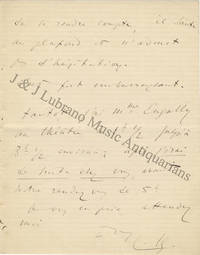
233083 pp. of a bifolium. Small octavo. Dated "Thursday morning." In French with translation. <br/><br/>Delibes would like to see his friend to discuss some issue of importance. He also mentions several prominent musical figures in Paris: the baritone Jacques Bouhy; Philippe Gille the co-librettist of Delibes's opera Lakmé; Halanzier a director at the Paris Opera; and Léon Carvalho director of the Opéra-Comique. <br/><br/>"In spite of everything Carvalho wants all the same to go ahead and at full steam. When one speaks to him of waiting. he jumps to the ceiling and does not accept any hesitation. This is very embarrassing." <br/><br/>Slightly worn and creased. "Outside the theatre for which Delibes wrote nearly all his music his most notable work was as a composer of choruses now undeservedly neglected. His output of songs was relatively small and that of instrumental and church music almost negligible. His cantata Alger 1865 attracted much attention at the time but has lain in obscurity since. Despite his poor record at the Conservatoire his workmanship was of the highest order; he had a natural gift for harmonic dexterity and a sure sense of orchestral colour and nothing in his music is out of place. He was a disciplined composer and it is tempting to see in the exquisite pastiche dances that he composed in 1882 for Hugo's Le roi s'amuse not just a sharp ear for style but a genuine feeling for the world of 17th-century French classicism later to be espoused with such ardour by Saint-Saëns d'Indy and Debussy." Hugh Macdonald in Grove Music Online. unknown books
271293 pp. of a bifolium. Ca. 161 x 102 mm. Dated "Sunday." On ivory paper. In French with translation.<br/><br/>Delibes discusses a business venture with "our millionaire." He had hoped to see his correspondent the day before at a session of the Exposition jury or a soirée wasn't able to join him at the Opéra-Comique and asks him to give his regards to "Madame Gonzien."<br/><br/>". On Friday I went to meet our millionaire. You have been very kind to him and what I told him about you could only confirm this good impression. But personally he doesn't want to do anything; this is an absolutely firm stance. Only his brewery could benefit from the success of the thing. But he is the principal sponsor and shareholder and promised to 'push the wheel' in your desired direction. "<br/><br/>Slightly worn and soiled; creased at folds; small ink stain to second page affecting one word. "Delibes's workmanship was of the highest order; he had a natural gift for harmonic dexterity and a sure sense of orchestral colour and nothing in his music is out of place. He was a disciplined composer and it is tempting to see in the exquisite pastiche dances that he composed in 1882 for Hugo's Le roi s'amuse not just a sharp ear for style but a genuine feeling for the world of 17th-century French classicism later to be espoused with such ardour by Saint-Saëns d'Indy and Debussy." Hugh Macdonald in Grove Music Online. unknown books
233364 pp. of a bifolium. Small octavo. Dated Monday evening December 5 between 1883 and 1891. On ivory paper with black borders. In French with translation.<br/><br/>Having returned to Paris Delibes is anxious for news of the second run of his opera Lakmé. Because his correspondent's letter was delivered to the wrong address he has had to seek information elsewhere. Unfortunately another audience member has told him that the tenor and "basse chantante" have weak voices. Delibes suggests they replace the latter with a certain "Monsieur Schmidt" in order to increase ticket sales. In January he and his correspondent will discuss his opera Le Roi l'a dit which premiered at the Opéra-Comique on May 24 1873.<br/><br/>"Unfortunately a more recent letter.tells me that our tenor is always weak as well as the 'basse chantante' i.e. high lyric bass and that the whole weight of the performance rests on Madame Alice Verheyden who alone has some success in the work. I add that these reports do not come from her husband!"<br/><br/>Slightly soiled and foxed; creased at folds. "Delibes's workmanship was of the highest order; he had a natural gift for harmonic dexterity and a sure sense of orchestral colour and nothing in his music is out of place. He was a disciplined composer and it is tempting to see in the exquisite pastiche dances that he composed in 1882 for Hugo's Le roi s'amuse not just a sharp ear for style but a genuine feeling for the world of 17th-century French classicism later to be espoused with such ardour by Saint-Saëns d'Indy and Debussy." Hugh Macdonald in Grove Music Online.<br/><br/>Lakmé is considered the composer's masterpiece. It offers more than just a fine vehicle for a star soprano; the two principal male characters Nilakantha and Gérald are firmly drawn and the music is melodic picturesque and theatrically strong. The opera was first performed at the Opéra-Comique Salle Favart in Paris on April 14 1883. <br/><br/>Delibes's correspondent Miral was perhaps the director of the Théâtre Municipal de Nancy. If this is the case it is quite likely that the production mentioned in this letter took place there. unknown books