Camille SAINT-SAENSBiblio.com
47 résultats
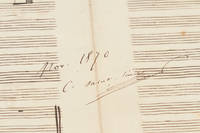
1870877761870. Fine. An exceedingly rare Saint-Saëns unpublished score novembre 1870 33.20 x 24.50 cm un bifeuillet Unpublished and signed autograph score by Camille Saint-Saëns. Two pages of handwritten music for solo voice and piano on an oblong bifolium with twenty staves. Autograph inscription on the first page signed by Saint-Saëns with his signature and date ""Nov. 1870"" appearing again on the second page. Trace of vertical fold with a tiny tear along the fold a small marginal tear on 1 cm of the first page without damage to the manuscript. An exceptional unpublished autograph manuscript of a Persian melody for voice and piano composed by Camille Saint-Saëns during the Siege of Paris in November 1870 enriched with a autograph inscription: 'A Geneviève Bréton / Hommage de respectueux dévouement' To Geneviève Bréton / In homage with respectful devotion signed and dated on the second page 'Nov 1870 C. Saint Saëns'. The lyrics of the piece were directly inspired by its dedicatee the fiancée of the painter and tenor Henri Regnault 'the most musical of all the painters' Saint-Saëns École buissonnière translation by Edwin Gile Rich who was the first performer of several other Mélodies persanes. Geneviève Bréton a cultured and passionate woman was a fixture in the literary and artistic salons of her time surrounded by composers painters and the young Parnassian poets of her generation. Saint-Saëns likely met her through his friend the orientalist painter Henri Regnault a Prix de Rome laureate with whom she fell madly in love in Italy in 1867. A handsome young man already celebrated for his art Regnault also fascinated Saint-Saëns with his 'exquisite tenor; voice . alluring in its timbre and irresistible in its attractiveness just as he was himself' as the composer would later recall in 1913. Regnault premiered several of his compositions: 'In 1868 Regnault was the first to embody the role of Samson in the second act of the celebrated opera Samson et Dalila created during a private evening performance. Saint-Saëns renewed their collaboration by entrusting the artist with two of the Mélodies persanes composed for tenor voice.' Manon Bertaux. The Mélodies persanes op. 26 based on verses by the Parnassian poet Armand Renaud consist in their published version of three works for tenor Sabre en main Au Cimetière Tournoiement and three for contralto La Brise La Splendeur vide La Solitaire. They form one of Saint-Saëns's most famous cycles and belong to the golden age of French mélodie. This manuscript for voice and piano with its ardent colourful tone can unquestionably be linked to this set of melodies begun in June 1870 and sold by Saint-Saëns to his publisher Hartmann shortly afterwards. However Manon Bertaux's research has shown that 'the composer sold Hartmann an incomplete cycle having composed his final melodies at the beginning of the Siege of Paris from September onward"". Dated November 1870 our melody - as far as we know unknown to biographers and musicologists - is one of those composed in the midst of the Franco-Prussian war: 'Serving as a National Guard during the Siege of Paris Saint-Saëns continued his activities as a musician and composer alongside his duties guarding the ramparts'. It appears that both the text and music of this composition remained entirely unpublished and were never sent to Hartmann. For his part the painter Henri Regnault enlisted as a maverick also risked his life in an attempt to break the siege much to the dismay of Geneviève who confided her worries in her now famous diary Ramsay 1985. The young lovers had finally become engaged after years of opposition from the young woman's mother. Saint-Saëns likely offered this exquisite melody to Geneviève as a betrothal gifta radiant piece of warmth for the anxious young woman and here is the first of its two verses: « Ka-douja la chanteu-se Au manteau noir Qu'on trouve sous l'y-eu-se Quand unknown
187087776novembre 1870 | 33.20 x 24.50 cm | un bifeuillet
184539089Paris: Chlendowski 1845. Bertall. A UNIQUE SET OF BON-A-TIRER PROOFS B.A.T.s many signed by Bertall of the wood-engravings used in Balzac's "Petites misères de la vie conjugale" one of the truly great 19th-century French illustrated books. This set includes 60 proofs on Chinese paper of which 36 are SIGNED by Bertall to confirm his approval of the final image and one of which features a small ink sketch. There is no record of any other impressions of any of these prints on Chinese paper or of any signed impressions on any paper at all. Generally in excellent condition although a few are creased or spotted. 12.5 x 12 cm and smaller. UNIQUE AND IMPORTANT. IT IS EXTREMELY UNUSUAL TO FIND HAND-SIGNED PRINTS EARLIER THAN 1875. <br/><br/> Chlendowski unknown
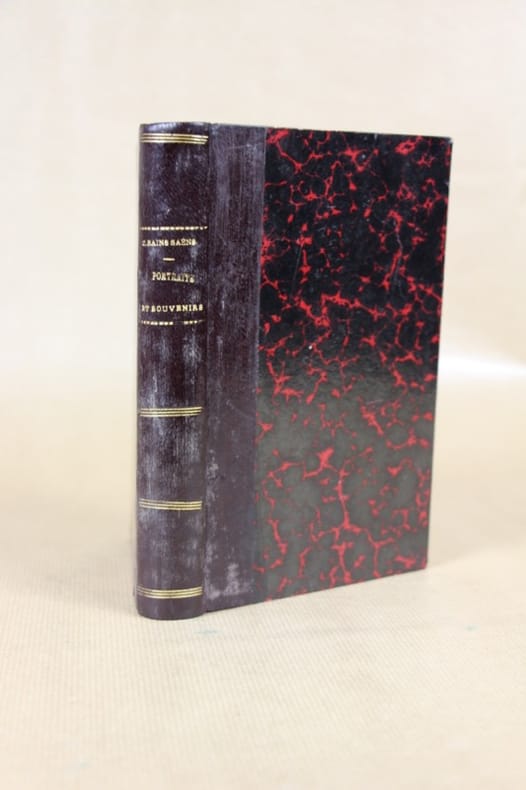
1882550551 vol. in-12 reliure de l'époque demi-basane marron, Calmann-Lévy, Ancienne Maison Michel Lévy Frères, Paris, 1890, 2 ff., 131 pp. ; Librairie Sandoz et Fischbacher, G. Fischbacher, Paris, 1882, 220 pp.
1890GF357951890 Paris - Calmann - Lévy - 1890 - 1 volume in8 de 131 pages - Reliure demi toile verte - Bel exemplaire -
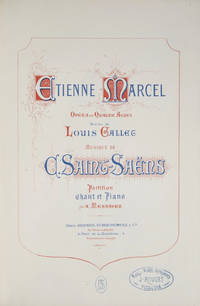
187926260Paris: Durand Schoenewerk PN D.S. & Cie. 2551 1879. Large octavo. Half mid-blue cloth with marbled boards speckled edges marbled endpapers. 1f. dedication 1f. decorative title printed in red and blue 1f. engraved frontispiece portrait of Etienne Marcel by G. Fraipont after A. de Neuville 1f. named cast list 1f. table of contents 365 i blank pp.<br /> <br /> Named cast includes Delrat Stéphanne Plançon De Grave Echetto Baron Nerval Reine Mézeray Amélie Luigini Legénisel Bonnefond Morfer and Frédéric.<br /> <br /> Publisher's and vendor's handstamps to lower blank margin of title.<br /> <br /> Binding very slightly worn and rubbed; minor soiling and wear to outer edge. Occasional very light soiling not affecting music. A very attractive copy overall. First Edition. Ratner II p. 99.<br /> <br /> First performed at the Grand Theatre in Lyons on 8 February 1879. <br /> <br /> Saint-Saens and Gallet took as subject matter for their historical drama the life of Etienne Marcel hero of the 1358 popular rebellion during the regency of the Dauphin Charles. The subject held contemporary resonance in the rebuilding of Paris following the destruction of the Commune. Durand Schoenewerk [PN D.S. & Cie. 2551] unknown
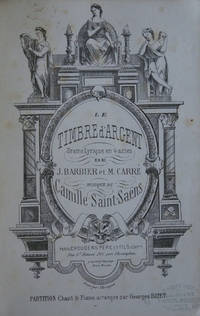
187726236Paris: Choudens Père et Fils PN A.C. 3558. 1877. Large octavo. Quarter contemporary green calf with textured green paper boards rules and titling gilt to spine. 1f. title within decorative borders engraved by J. Bourgeois 1f. dedication to Albert Libon by the composer 1 named cast list for the first performance and table of contents 2-304 pp. Text in French.<br /> <br /> With vendor's handstamp to lower margin of title and printer's note to the lower margin of table of contents "Paris Imp. Fouquet. Baudon Gr.".<br /> <br /> Binding slightly worn rubbed and bumped. Slightly browned; occasional light stainiing; many leaves with light to moderate foxing or mold especially to margins. First Edition of the first version. Ratner II p. 73.<br /> <br /> Le Timbre d'argent to a libretto by Jules Barbier and Michel Carré was first performed at the Théâtre Lyrique in Paris on February 23 1877.<br /> <br /> "Composed in 1864-5 for the Théâtre Lyrique Paris the opera was kept from the stage first by the theatre's bankruptcy then by the Franco-Prussian War and was not played until 1877. In the meantime Saint-Saëns had recomposed the dialogue to form a grand opera version which was not played until 1913. The music is enormously fluent and versatile . There are some bold scenic ideas including a theatre seen from the back of the stage and some fanciful transformations. It seems no coincidence that the opera's 18 performances in 1877 exactly coincided with Offenbach's first concentrated labours on Les contes d'Hoffmann." Hugh Macdonald in Grove Music Online. Choudens Père et Fils [PN A.C. 3558.] unknown
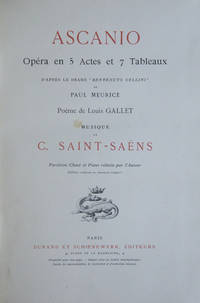
189026255Paris: Durand et Schoenewerk PN D.S. 4025 1890. Large octavo. Quarter contemporary black morocco with textured red paper boards rules and titling gilt to spine marbled endpapers. 1f. half-title 1f. illustration of a scene from the opera 1f. title i facsimile of 2 medallions under which the text "Benvenuto fecit" is printed i note regarding the mise en scène i named cast list for the first performance ii table of contents i blank 391 i blank pp. Text in French. <br /> <br /> With publisher's handstamp to lower outer corner of half-title. Supplement "Annexe" to pp. 388-391.<br /> <br /> Binding slightly worn rubbed and bumped; partially split at joints. Slightly browned; scattered foxing heavier to some leaves; several corners slightly creased. With occasional performance markings including accidentals slurs and breath marks in pencil. First Edition of the first version. Ratner II p. 205.<br /> <br /> Ascanio to a libretto by Louis Gallet after Paul Meurice's play Benvenuto Cellini was first performed at the Paris Opéra on 21 March 1890. <br /> <br /> "Composed in 1887-8 Ascanio makes a grand opera of a play of intrigue set in Paris in 1539. Meurice whom Saint-Saëns knew well had collaborated with Alexandre Dumas père on his novel Benvenuto Cellini published in 1843 and had fashioned a successful play from the story in 1852. To avoid confusion with Berlioz's opera the title was changed even though Cellini is still the principal character in the drama and a scene in the play where Cellini runs out of metal when casting a statue was not included. The choice of an episode from Cellini's life that took place in France at the court of François I satisfied Saint-Saëns' longstanding desire to base his operas on French history and by casting the third act as a fête at Fontainebleau a departure from Meurice's play he found an opportunity for an extensive divertissement of 12 dances very much in the spirit and to some extent in the style of French Baroque opera." Hugh Macdonald in Grove Music Online. Durand et Schoenewerk [PN D.S. 4025] unknown
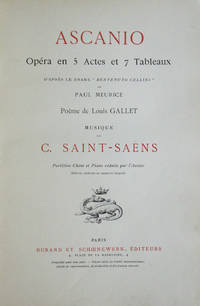
189026602Paris: Durand et Schoenewerk PN D.S. 4025 1890. Large octavo. Quarter contemporary red morocco with marbled boards raised bands on spine in decorative compartments gilt marbled endpapers. 1f. half-title 1f. illustration of a scene from the opera 1f. title i facsimile of 2 medallions under which the text "Benvenuto fecit" is printed i note regarding the mise en scène i named cast list for the first performance ii table of contents i blank 391 i blank pp. <br /> <br /> With publisher's partial handstamp to lower outer corner of half-title. Supplement "Annexe" to pp. 388-391.<br /> <br /> Binding slighty worn rubbed and bumped. Minor foxing. Contemporary musical notation somewhat smudged.<br /> <br /> An attractive copy overall. First Edition of the first version. Ratner II p. 205.<br /> <br /> Ascanio to a libretto by Louis Gallet after Paul Meurice's play Benvenuto Cellini was first performed in Paris at the Opéra on March 21 1890. <br /> <br /> "Composed in 1887-8 Ascanio makes a grand opera of a play of intrigue set in Paris in 1539. Meurice whom Saint-Saëns knew well had collaborated with Alexandre Dumas père on his novel Benvenuto Cellini published in 1843 and had fashioned a successful play from the story in 1852. To avoid confusion with Berlioz's opera the title was changed even though Cellini is still the principal character in the drama and a scene in the play where Cellini runs out of metal when casting a statue was not included. The choice of an episode from Cellini's life that took place in France at the court of François I satisfied Saint-Saëns' longstanding desire to base his operas on French history and by casting the third act as a fête at Fontainebleau a departure from Meurice's play he found an opportunity for an extensive divertissement of 12 dances very much in the spirit and to some extent in the style of French Baroque opera." Hugh Macdonald in Grove Music Online. Durand et Schoenewerk [PN D.S. 4025] unknown
188379419Paris: Durand 1883. hardcover. good. Vocal score. Personal binding of an early edition. Minor marks to covers internal pages in good condition. French text. Da Capo Vocal Scores Section PAS 23/12/2018 Durand hardcover
188311358Opéra en 4 Actes. Poème de Léonce DETROYAT et Armand SILVESTRE. Traduction allemande de Hermann Wolff. Traduction italienne de A. de Lauzières. Partition Chant et Piano par Léon Delahaye. Musique de Camille Sain-Saens.Edition originale. Paris, A. Durand & Fils, 1883 - 384 pp. Titre illustré.Belle reliure à la bradel demi-maroquin bleu à coins. Dos lisse orné et doré. Tête dorée. Couverture illustrée conservée. Très rares rousseurs. Très bon état. Format in-4°(29x21).
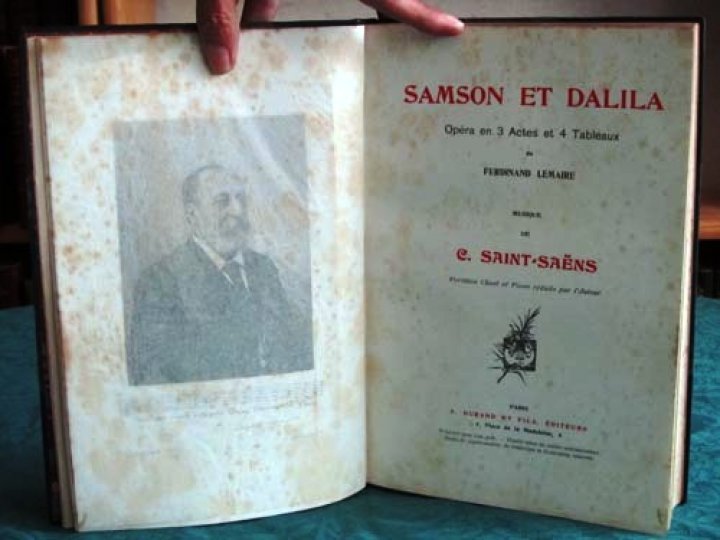
189211368Opéra en 3 Actes et 4 Tableaux de Ferdinand Lemaire. Partition Chant et Piano réduite par l'auteur. Musique de Saint-Saens.Paris, A. Durand et Fils, 1892. Portrait-frontispice de Saint-Saëns par Dujardin et Wittmann.Très belle reliure à la bradel demi-maroquin bleu à coins. Dos lisse orné et doré. Tête dorée. Quelques légères et rares rousseurs. Bon état. Format in-4°(28x19).
189326018Paris: A. Durand et Fils PN D. & F. 4642 1893. Octavo. Quarter contemporary red calf with textured red paper boards titling and initials "A.G." gilt to spine marbled endpapers. 1f. title printed in black and red 1f. frontispiece drawing by F. Marcotte of the "Scène de l'apparition" from Act 2 of the opera 1f. named cast list 1f. table of contents 145 i blank pp. Transfer. Text in French.<br /> <br /> Publisher's monogrammatic handstamp to lower left corner of blank final page. Cast list with names of the singers for the first performance including Sibyl Sanderson.<br /> <br /> Binding slightly worn and rubbed; head of spine slightly chipped. First Edition. Ratner II p. 224.<br /> <br /> Phryné to a libretto by L. Augé de Lassus was first performed at the Opéra-Comique in Paris on 24 May 1893. A. Durand et Fils [PN D. & F. 4642] unknown
1877LCI-21581877 1 344[pp] 1877 Paris E. Plon & Cie 1877 1 in -8 reliure toile avec coins
1900131877Paris, A. Durand & fils, Choudens, au Ménestrel 1900 3 volumes en 1. In-folio 35,5 x 28,5 cm. Reliure demi-basane bordeaux, dos lisse, 77-73-23 pp. Exemplaire en bon état.
1885RO40238802Calmann Lévy, Paris. 1885. In-12. Relié. Etat d'usage, Couv. convenable, Dos satisfaisant, Quelques rousseurs. 318 pages. Auteur, titre et filets dorés sur le dos. Etiquette de code sur le dos. Tampons et annotations de bibliothèque sur le 1er plat et en page de titre. Fort tampon d'éditeur en page de faux-titre. Premiers feuillets légèrement déchirés (Gardes, Titre, Introduction).. . . . Classification Dewey : 782.1-Théâtre musical, opéra
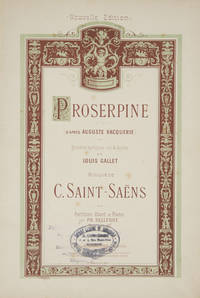
188726020Paris: Durand & Schoenewerk PN D. S. 3714 1887. Octavo. Half contemporary red morocco with marbled boards titling gilt to spine marbled endpapers. 1f. title with decorative borders in orange and light green by L. Denis printed by Delanchy & Cie. in Paris 1f. named cast list with decorative borders in blue bronze and purple 1f. table of contents in purple 245 i blank pp. Lithographed. Text in French.<br /> <br /> Publisher's monogrammatic handstamp to lower right corner of title. Cast list includes the names of the singers for the first performance. <br /> <br /> With small bookseller's label to lower corner of upper pastedown.<br /> <br /> Binding slightly worn rubbed and bumped; partially split at joints. Slightly browned; several leaves with repairs to inner margins not affecting music; pp. 9-16 misbound. First Edition of the first version. Ratner II p. 170. <br /> <br /> Proserpine to a libretto by Louis Gallet after August Vacquerie was first performed at the Opéra Comique Favart on 14 March 1887. Durand & Schoenewerk [PN D. S. 3714] unknown
189229584Paris: A. Durand & Fils PN D.S. 3714 1892. Large octavo. 1f. recto title printed in sepia within decorative border by L. Denis printed in sepia and light green verso blank 1f. recto named cast list verso blank 1f. recto index verso blank 234 pp. <br /> <br /> Title and three following leaves with early Parisian handstamp somewhat blurred. First leaves slightly foxed; scattered light foxing; final leaves slightly creased. Ratner II p. 10.<br /> <br /> "Like Mozart to whom he was often compared Saint-Saëns was a brilliant craftsman versatile and prolific who contributed to every genre of French music. He was one of the leaders of the French musical renaissance of the 1870s." Sabina Teller Ratner et al. in Grove Music Online. A. Durand & Fils [PN D.S. 3714] unknown
1890127816Paris, Calmann Lévy 1890 In-12 18 x 11 cm. Reliure demi-chagrin vert, dos à nerfs ornés de filets dorés, XXXI-318 pp., table. Exemplaire en bon état.
1885RO80200172DURAND & SCHOENEWERK. 1885. In-4. Relié. Bon état, Couv. convenable, Dos satisfaisant, Intérieur frais. 120 pages de partitions - tampons sur la page de titre - tâches brunes sur la page de titre - plats et contre plats jaspés - titre, auteur dorés sur le dos.. . . . Classification Dewey : 780.26-Partitions
1900134553Paris, Société d'Edition Artistique, sd 1900 In-12 demi-basane brune, dos lisse, filets dorés, couverture sup. conservée, VIII- 243 pages. Mention de mille. Bon exemplaire.
188917333Paris Durand et fils 1889 in-4, br. titre, 19pp.
1900M82718Paris, Pierre Lafitte s.d. [+/-1900] 349pp.richement illustré, 37cm., reliure toile verte d'éditeur avec titre et décorations dorées aux plats et au dos (charnière inférieure peu abimé en bas), tranches dorées, bon état, [traite e.a. sur Palestrina, Lulli, J.-S.Bach, Haendel, Rameau, Haydn, Gluck, Mozart, Beethoven, Grétry, Méhul, Boiledieu, Schubert, Spontini, Weber, Herold, etc.], M82718
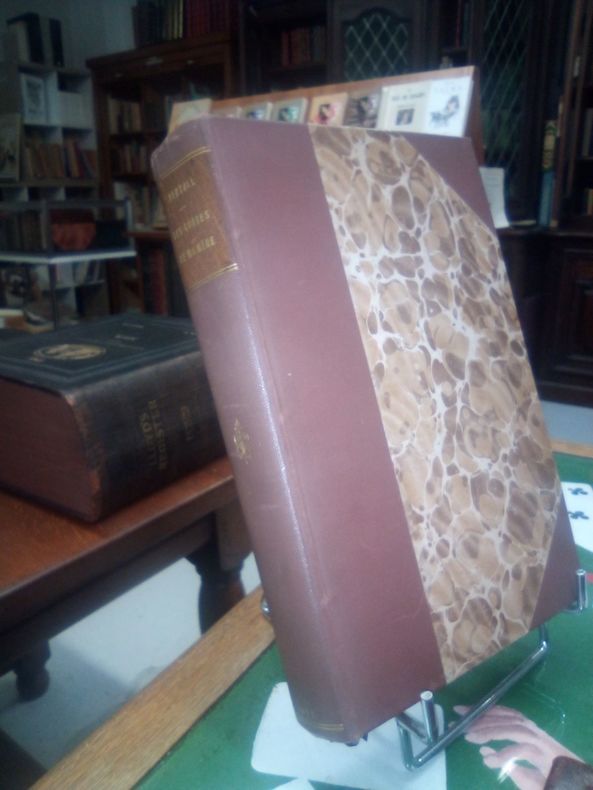
1875023155Paris E. PLON et Cie 1875 un fort volume in-4°, (6) pp. (avec le frontispice) 652 pp. Reliure de l'époque en demi-chagrin rouge, dos à cinq nerfs orné de l'auteur, du titre et de caissons à feuillage dorés, plats de percaline rouge ornés de filets estampés, toutes tranches dorées, gardes moirées. (volume légèrement frotté, petite tâche d'encre au premier plat). Édition illustrée de nombreux dessins, gravés sur bois, dans et hors-texte du caricaturiste BERTALL. Édition originale. Ex-libris. Gouttière " lingot ". Intérieur très frais.
1876023154Paris E. PLON et Cie 1876 un fort volume in-4°, (6) pp. (avec le frontispice) 667 pp. Reliure de l'époque en demi-chagrin rouge, dos à cinq nerfs orné de l'auteur, du titre et de caissons à feuillage dorés, plats de percaline rouge ornés de filets estampés, toutes tranches dorées, gardes moirées. (volume légèrement frotté, petite marque de pliure angulaire à une dizaine de feuillets). Édition illustrée de nombreux dessins en noir & blanc, gravés sur bois, dans et hors-texte du caricaturiste BERTALL. " La Vie Hors de Chez Soi " fait suite à " La Comédie de Notre Temps ", comme l'indique les trois étoiles de tomaison frappées au bas du dos. Plusieurs chapitre de la troisième partie du volume sont consacrés aux Pyrénées Édition originale. Ex-libris. Gouttière " lingot ". Intérieur très frais.