429 résultats
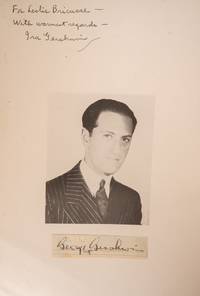
06559New York: Gershwin Publishing Corporation 1935. A Presentation Copy to Leslie Bricusse from Ira Gershwin <br /> With a George Gershwin Signature<br /> As George and Ira so aptly put it "Who could ask for anything more"<br /> <br /> GERSHWIN George. The Theatre Guild Presents Porgy and Bess. Music by George Gershwin. Libretto by Dubose Heyward. Lyrics by Dubose Heyward and Ira Gershwin. Settings by Sergei Soudeikine Orchestra Conductor Alexander Smallens Production directed by Rouben Mamoulian. New York: Gershwin Publishing Corporation 1935.<br /> <br /> First edition. Inscribed by Ira Gershwin: "For Leslie Bricusse-With warmest regards-Ira Gershwin."<br /> With an additional clipped signature of George Gershwin mounted beneath the portrait.<br /> <br /> Large quarto 12 1/16 x 9 1/8 inches; 306 x 232 mm. iv 559 1 blank pp. <br /> <br /> Publisher's stiff gray wrappers front cover lettered in black black spine near fine. Chemised in a maroon cloth folder housed in a quarter brown calf slipcase spine with five shallow raised bands decoratively ruled and lettered in gilt in compartments.<br /> <br /> A copy of exceptional resonance presented by Ira Gershwin to his friend and fellow lyricist Leslie Bricusse - one of the most accomplished figures in twentieth-century popular music. Bricusse was the recipient of two Academy Awards a Grammy and eight Ivor Novello Awards and was inducted into the American Songwriters' Hall of Fame - only the fourth Englishman so honored after Noël Coward John Lennon and Paul McCartney.<br /> <br /> His work spans more than forty musical shows and films including Stop the World - I Want to Get Off The Roar of the Greasepaint The Smell of the Crowd Doctor Dolittle and Willy Wonka and the Chocolate Factory and includes such enduring songs as "What Kind of Fool Am I" "Feeling Good" "Goldfinger" and "Pure Imagination" recorded by artists ranging from Frank Sinatra to Michael Bublé. Their friendship well documented and longstanding places this inscription within a genuine circle of artistic exchange rather than a formal or casual presentation.<br /> <br /> The libretto by DuBose Heyward is drawn from his 1925 novel Porgy and subsequent stage adaptation preserving the rhythms and cadences of life in Charleston's Catfish Row while shaping them into a dramatic structure of unusual cohesion for American musical theater. Heyward's text augmented by lyrics from both himself and Ira Gershwinprovided George Gershwin with a literary and emotional framework of rare depth allowing the score to move fluidly between operatic form spiritual blues and popular song. The result is one of the few American stage works in which music and text are so fully integrated as to justify Gershwin's own insistence that Porgy and Bess be regarded as an opera rather than a musical.<br /> <br /> Provenance: From the collection of Leslie Bricusse assembled over several decades with the close guidance of David Brass who first met Bricusse in 1968 and remained a trusted advisor and friend until his death in 2021.<br /> <br /> This direct and personal provenance - linking creator recipient and the dealer who helped form the collection - gives the volume a narrative strength rarely encountered in the market. New York: Gershwin Publishing Corporation, 1935 unknown
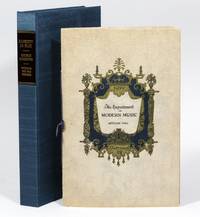
19242957New York: Aeolian Hall 1924. First edition. Very Good. ORIGINAL PROGRAM FOR THE FIRST PERFORMANCE OF GERSHWIN'S RHAPSODY IN BLUE. About six weeks before the premiere of Rhapsody in Blue George Gershwin was shooting pool at the Ambassador Billiard Parlor on Broadway and 52nd Street when his brother Ira entered the hall carrying an early edition of the New York Tribune. Ira proceeded to read an article from the paper announcing a new experimental music concert organized by bandleader Paul Whiteman. In this concert Ira continued a piece by George Gershwin would be performed. Adrian Symphony Orchestra<br /> <br /> This was news to Gershwin who had been asked some months earlier by Whiteman to contribute a piece but had turned down the request believing the several months not enough time. And now Gershwin had only six weeks. Whiteman as it turned out had decided to include Gershwin’s name after learning his musical nemesis—Vincent Lopez—would be releasing a similar concert series. Whiteman knew Gershwin’s name would bring his concert more coverage and went ahead with the inclusion hoping to propel his concert above Lopez’s Adrian Symphony Orchestra.<br /> <br /> Understanding Whiteman’s difficult position Gershwin agreed to write the piece planning to begin work during an upcoming train ride from New York to Boston where he was headed for an out-of-town preview for a new musical of his. Gershwin later claimed that the sounds of this train hitching and roaring down the track inspired the thematic division of his score into five themes: Ritornello Train aptly named Stride Shuffle and Love. Gershwin hoped to harness the energy of modern machinery in this piece to convey the hustle and bustle of city life. Adrian Symphony Orchestra; Dotsey<br /> <br /> As Gershwin later commented on his writing process:<br /> <br /> “I set to work composing with unwonted rapidity. No set plan was in my mind – no structure to which my music would conform. The rhapsody as you see began as a purpose not a plan. I tried to conceive the composition as a whole. I heard it as a sort of musical kaleidoscope of America – of our vast melting-pot of our unduplicated national pep of our blues our metropolitan madness.†Dotsey<br /> <br /> Gershwin himself had been raised in close contact with the diverse musical traditions of the Lower East Side exposed to the competing influences of Russian Eastern European African American and popular American music. Resultantly he decided that a mixture of jazz classical in conjunction with the rhythmic and thematic implements of almost all these styles was the perfect medium for portraying the city’s kaleidoscopic bustle. Adrian Symphony Orchestra<br /> <br /> Rhapsody in Blue received mixed reviews upon its release. The New York Times noted the piece displayed “extraordinary talent†and public opinion was largely positive. Still many critics felt that Rhapsody in Blue lacked focus calling it a string of disconnected themes. Hebblethwaite Adrian Symphony Orchestra<br /> <br /> Much of this confusion stemmed from the genuinely innovative fusion at the heart of Rhapsody in Blue. As mentioned Gershwin took classical form and infused it with the varied musical influences of his youth—blues ragtime Jewish folk music and Harlem jazz. To some extent Gerswhin’s intention was to write these genres in a way which concentrated their essence within small segments of a classical concerto as a more culturally dominant format of music. Though some viewed these borrowings as derivative of their original cultural contexts Gershwin’s usages of Klezmer-like arrangements for example nonetheless represented a groundbreaking expansion of popular music enabling the usage of non-classical genres in dominant American culture. Adrian Symphony Orchestra; Dotsey<br /> <br /> Later reflecting on his work Gershwin wrote about his usage of Jazz:<br /> <br /> “There had been so much chatter about the limitations of jazz not to speak of the manifest misunderstandings of its function. Jazz they said had to be in strict time. It had to cling to dance rhythms. I resolved if possible to kill that misconception with one sturdy blow.†Dotsey<br /> <br /> Although Gershwin hoped to expand the possibilities of jazz he failed to credit the African American traditions that clearly inspired him claiming in this program that jazz “sprang into existence ten years ago from nowhere in particular.†In this way Gershwin’s Great American kaleidoscope remained incomplete.<br /> <br /> Despite being one of the most famous works of the 20th century audiences will never know exactly what the original performance sounded like. Pressed for time Gershwin improvised many of the solo parts himself. This program is one of the very few surviving records of that original performance. Although enough programs were printed for a 1100 seat hall only a few examples survive. No copies exist at auction and there are only three institutional holdings— at the New York Public Library the George and Ira Gershwin Collection at the Library of Congress and the Center for Popular Music at Middle Tennessee State University. <br /> <br /> Rhapsody in Blue is loud dramatic and undeniably iconic—but few if any living people remember the sensation and sound of its improvised premiere. Very few material records have been preserved. This program offers a rare opportunity to relive the texture of that historic moment. <br /> <br /> The show’s program provides biographies of Whiteman’s collaborators. The biography of Gershwin reads as follows:<br /> <br /> “Mr. Gershwin has written a “Rhapsody in Blue†which he has consented to play accompanied by the orchestra. He is capable of everything from “Swanee†to “A Stairway to Paradiseâ€: from “Ingenue Baby†and “Virginia†to “Do It Again.†Delicacy even dreaminess is a quality he alone brings into Jazz music. Gershwin’s sense of variation in rhythm of shifting accents of emphasis and color is faultless. He has moreover an insatiable curiosity about everything connected with his work and for that matter with music in general. He is learning and he is not forgetting and being one of the youngest of the composers he is actually one of the brightest hopes of our popular music.â€<br /> <br /> Further descriptions of Gershwin’s Rhapsody in Blue:<br /> <br /> “This is the first rhapsody written for solo instrument and modern orchestra. Prophesy being not the function of an annotator it may be said that the importance of the rhapsody quite apart from its own value must depend to an extent upon its being kept alive in a repertoire—and there is no organization to do this unless the present concert is as its conductor hopes only the beginning of a series. Gershwin is a close student of music and a listener; yet there is not a derivative phrase in his work. He has composed a rhapsody and has chosen to build it out of materials known to him: the rhythms of popular American music the harmonies produced by American jazz bands. None of the thematic material has been used before; the rhapsody is not a pastiche. The structure is simple and it resembles concertos written by pianists in what seems at first the predominance of the single instrument. Mr. Gershwin’s manuscript is complete for the piano. The orchestral treatment was developed by Mr. Grofé.<br /> <br /> The rhapsody is a free development of almost all of Gershwin’s qualities alluded to in the earlier pages of this program. It has a little more crispness a shade more of jazz and a shade less of gentleness than some of his compositions; there is more of “A Stairway to Paradise†than of “Do It Againâ€; and this is natural in a composition intended specifically for jazz orchestra.<br /> <br /> Those who care for jazz will naturally be grateful to Mr. Whiteman for urging Mr. Gershwin to compose this Rhapsody. He had had it in mind for some time but had no intention of going to work upon it until the announcement was made that the Rhapsody would be played at this concert. For those who remain skeptical another test-case may be provided. It is not inconceivable that an intelligent conductor of a symphony orchestra may want to play the rhapsody; it would probably need re-scoring but the saxophone which has been used ever since Meyerbeer in serious music need not be exiled.â€<br /> <br /> The program also includes photos of Mr. Whiteman and his band alongside collaborators such as Gershwin and Victor Herbert.<br /> <br /> Provenance: With signature and Yale address of "Frederick Ullman" in pencil on back. Anecdotally later gifted by Ira Gershwin's wife Lenore to her vocational nurse and caretaker; appearing on the market now for the first time. <br /> <br /> New York: Aeolian Hall 1924. Concert program measuring 9.5 x 6.25 inches. 12 pages in original decorated textured grey wrappers; side-stitched with original blue cord. Housed in custom silk box. Abrasion to text at bottom of page 1 with loss of a few words. Wrappers in a remarkable state of preservation; very clean and fresh with some light rubbing to cover decoration corresponding to the textured ridges on cover. <br /> <br /> EXCEEDINGLY RARE: We find no records at auction and three institutional holdings only: at the New York Public Library the George and Ira Gershwin Collection at the Library of Congress and the Center for Popular Music at Middle Tennessee State University. Aeolian Hall unknown
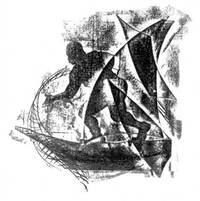
2013CNAP098bSan Francisco: The Arion Press 2013. Hardcover. New. Kara Walker. Quarto 12-5/8 by 9-3/4 inches 136 pages. Prints editioned by Derrière L’Etoile Studio NYC under the supervision of Maurice Sanchez. Bound with red leather spine and printed cotton sides in slipcase. Edition of 400 numbered and signed copies for sale. Additional suite of four lithographs different from the images in the book signed and numbered by the artist. This artist book of Porgy & Bess the libretto by DuBose Heyward and Ira Gershwin is the occasion for Kara Walker’s first series of lithographs. The book contains 16 lithographs with another four images not in the book in a separate portfolio. <br /> <br /> Porgy & Bess has been controversial since its premiere in 1935; Kara Walker is known for her controversial art on themes of race violence and American history. In her Artist’s Statement she says of the characters: "they’ve become archetypes of another no less grand drama that of: ‘American Negroes drawn up by white authors and retooled by individual actors amid charges of racism and counter charges of high-art on stage and screen in the face of social and political upheaval over generations." <br /> <br /> This fraught status along with memories of her mother’s reaction to a cast recording led her to render them in a straightforward way "…more an homage to the feeling of the music. And to that feeling I had as a child of a heavy atmosphere hanging around a timeless act of love."<br /> <br /> ___POSTAGE: International customers please note that additional postage may apply as the standard does not always cover costs; please inquire for details.<br /> <br /> ___Swan's Fine Books is pleased to be a member of the ABAA ILAB and IOBA and we stand behind every book we sell. Please contact us with any questions you may have we are here to help. The Arion Press hardcover
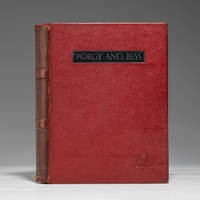
19351246541935. First Edition. Signed. GERSHWIN George. Porgy and Bess. An Opera in Three Acts. By George Gershwin. Libretto by DuBose Heyward. Lyrics by DuBose Heyward and Ira Gershwin. Production Directed by Rouben Mamoulian. New York: Random House 1935. Folio original full red morocco raised bands black leather label on front cover top edge gilt. Housed in a custom clamshell box. $48500.Deluxe limited edition of the piano-vocal score of Porgy and Bess number 103 of only 250 copies signed by George Gershwin Ira Gershwin DuBose Heyward and director Rouben Mamoulian additionally inscribed by Gershwin to his lover Kay Swift who was intimately involved in the composition of the piece: For Kay / Best / George / Nov. 1 1935. According to Ohl best their code word for love allowed them to be discreet.This deluxe edition of the piano-vocal score according to Fuld no orchestral score has ever been published was published in 1935 the year of Porgy and Bess premiere almost simultaneously with the first edition and is boldly signed on the limitation page at the rear by George and Ira Gershwin and the other principal creators of Porgy and Bess: librettist DuBose Heyward and director Rouben Mamoulian. Fuld 539. The recipient Kay Swift met Gershwin in 1925. A highly educated beauty of prominent social position she was not yet known as a songwriter her first big hit would be in 1929 with ""Can't We Be Friends"". ""If one measures by the dedication of his Song-Book to her his generous gifts of paintings manuscripts and other keepsakes that betokened affection plus the many hours he spent with her Gershwin obviously had a special place in his heart for Kay Swift With Kay Gershwin probably came as close to settling down with one woman as he ever did"" Schwarz 190. Swift was extensively involved with the composition of Porgy and Bess almost from the beginning: Swift was Gershwin's guest at the premiere of the play version by Heyward's wife. When composing the operamuch of which occurred at a cottage on Swift's country estateSwift was often in her words Gershwin's ""soundboard"" for new ideas. ""'He'd call me and tell me to rush over to play the orchestra part of a song. He couldn't sing. Neither could Ira. But we'd all sing Ira's or DuBose Heyward's lyrics sounding like a chorus of crows Each day as the work grew a few of usBill Daly his close friend and favorite conductor and myself Ira of course and DuBose Heyward who wrote the libretto as well as some of the lyrics were probably present much of the time. It was thrilling to hear the themes develop the recitatives build into such an inevitable part of the score that they flowed as naturally as spoken words would. The whole sparkled with a fantastic quality of imagination She also had an even more direct part in the opera's development. In addition to listening singing and playing the work in progress Swift sometimes notated portions of pieces for Gershwin evidently to expedite his later work on the compositions. He believed she wrote faster and more neatly than she could."" Extensive portions of the original manuscript now in the Gershwin collection at the Library of Congress are in Swift's hand demonstrating ""her role as an assistant to the composer and signify the trust he must have placed in her and her notational and musical abilities"" Ohl 95-96. During actual production Swift attended most rehearsals and was present at many of the casting decisions. After the preview run in Boston it was clear that the four-hour opera was too long so ""Gershwin Mamoulian composer Alexander Steinert and Kay Swift walked the Boston Common in the early hours of the morning deciding which portions to cut""; one month later at the premiere in New York ""Swift was seated between George and Ira"". Later Swift would deliver lectures throughout the country as part of the promotion of Porgy and Bess. ""Ira recalled that she had memorized the entire 559-page score and would be illustrating songs from it at the piano"" Ohl 97-98. ""After her yeoman's effort during Porgy and Bess he presented her with a leather-bound autographed score the present copy that reads simply 'Tosic Kay. Best. George.' 'Best' their code word for 'love' allowed them to be discreet"" Ohl 115. Interior fine spine somewhat toned light rubbing to spine ends. A near-fine copy with an extraordinary association. hardcover