18 résultats
192787646Paris: Calmann-Levy 1927. paperback. very good. Correspondance Punliee Par Julien Tiersot. 380pp. 12mo printed wrappers. Paris: Calmann-Levy 1927.<br/><br/> Calmann-Levy unknown books
193547615NY: Tudor 1935. New Edition. 8vo pp. xxiii 533 xiii. Index. Illustrated. Translated from the french by Rachel Holmes and Eleanor Holmes. Annotated and the translation revised by Ernest Newman. Marfoon cloth stamped in gilt on the spine. A little pencil marking o/w a VG tight copy in worn dj. Tudor unknown books
197529481New York: Edwin F. Kalmus 1975. Large octavo. Original publisher's green printed wrappers. 189 pp.<br/><br/>Wrappers slightly worn; spine slightly faded and stained. Edwin F. Kalmus unknown books
1956043312New York: Alfred A. Knopf 1956. 1st Edition. Translated and edited with an introduction and notes by Jacques Barzun at the request of the Berlioz Society. xviii 376 v p. original black cloth. Alfred A. Knopf unknown books
188029519New York: G. Schirmer PN 2376 1880. Large octavo. Original publisher's decorative green wrappers printed in black and red. 1f. recto decorative title verso blank 1f. recto content verso blank 236 pp. Text in english and French.<br/><br/>Wrappers slightly worn; upper partially detached; spine split and torn with portions lacking. Some signatures split or splitting. Hopkinson 54D q.<br/><br/>In four parts to a libretto by the composer and Almire Gandonnière after Gérard de Nerval 's French translation of Johann Wolfgang von Goethe's Faust Le Damnation de Faust was first performed in concert in Paris at the Opéra-Comique Salle Favart on December 6 1846 and as a fully staged opera in five acts by Raoul Gunsbourg for the Monte Carlo Opéra on February 18 1893. G. Schirmer [PN 2376] unknown books
189029521Paris: Choudens Fils PN A. C. 987 1890. Large octavo. Full black cloth titling gilt to spine. 1f. recto title verso blank 1f. recto cast list and contents verso blank 179 i blank pp.<br/><br/>Binding slightly worn rubbed bumped and cockled. Minor pencil annotation to contents. A re-issue of the first edition variant of ca. 1864. Hopkinsin 64B a. Choudens Fils [PN A. C. 987] unknown books
190044275Boston: Elias Howe 1900. New edition revised corrected augmented. Large 8vo pp. 257. Translated from the French by Mary Cowden Clarke. Owner's signature on tile same stamps on front pastedown and first page. Dark blue cloth stamped in gilt. Hinges tender cover somewhat spotted and worn. Good. Elias Howe unknown books
197029520Paris: Choudens PN A. C. 11312 1970. Large octavo. Original publisher's light grey illustrated wrappers printed in dark red. 1f. recto title verso blank 1f. recto notes on first performance named cast list and contents verso blank 117 ii blank 120-129 ii blank 132-257 i blank pp.<br/><br/>Named cast includes Delna Agussol Beauvais Mathieu Mrs. Lucas Renaud Douaillier Chambon Delpouget Péloga Paty Cabillot Flahaut and Hanauer. <br/><br/>Small handstamp to lower margin of upper wrapper; spine slightly creased. Upper edges slightly damaged. A facsimile of the second version published by Choudens in 1899. Hopkinson 64B c. <br/><br/>First performed in Paris at the Théâtre National de l'Opéra on November 15 1899 under the direction of Bertrand and Gailhard. Choudens [PN A. C. 11312] unknown books
187528523Leipzig: J. Rieter-Biedermann PN 818 1875. Large octavo. Half dark brown cloth with marbled boards original publisher's printed wrappers with titling within decorative border bound in. 1f. title 3-118 pp. Text in French and German. <br/><br/>Minor tears to lower margin of upper wrapper. Slightly browned. Hopkinson 39D d. <br/><br/>". in some respects Berlioz's most interesting solutions to issues of operatic style are to be found in Roméo et Juliette Friar Laurence's scene and the superb finale which follows may be compared with the best in Meyerbeer." D. Kern Holoman in Grove Music Online. J. Rieter-Biedermann [PN 818] unknown books
1956WRCLIT32130New York: Knopf 1956. Large octavo. Publisher's three-quarter morocco spine gilt extra t.e.g. First edition. About fine in lightly scuffed slipcase. To all appearances a presentation binding. Knopf unknown books
1972238928Paris: Flammarion 1972. hardcover. very good. Text edited and presented by Pierre Citron. Three volumes. 835pp. 797pp & 595pp. 12mo printed black cloth; neat ownership signature front free endpaper of volume 2. Paris: Flammarion 1972 1975 1978. A very good set.<br/><br/> Volume I: 1803-1832. Volume II: 1832-1842. Volume III: 1842-1850<br/><br/> Flammarion unknown books
13455EDINBURGH EBS 1951. EDINBURGH, EBS, 1951 unknown books
18552667651855. unbound. 1 page 5.25 x 8 inches no place no date circa 1855 in full: "Bonjour! Je suit mort mais ca commence a ailler. "H. Berlioz." Minor spotting with mounting remnants on verso. Very good condition.<br/><br/> French composer noted as the Father of modern Orchestration.<br/><br/> unknown books
13739Used; Like New/Used; Like New. A short autograph letter from the French Romantic composer addressed to the French journalist music critic and music publisher Léon Escudier and thanking him for a "superb and warm" article about his works. Translated from the French in full: "My dear Escudier I believe it was Leon who was the author I came to shake your hand and thank you for the superb and warm article. There has rarely been written on my compositions something which is so remarkable in its insights and which has made me so happy. Yours H. Berlioz." 1 p. with an additional cover page addressed to Escudier. No place no date. One tear some small chips smudges and toning; overall in very good condition. 4.25 x 5 inches 10.5 x 13 cm. Together with a later sepia postcard portrait of the composer 5 x 7 inches 12.5 x 17.7 cm.<br style="">In 1837 together with his brother Marie Escudier and Jules Maurel Leon Escudier founded the weekly La France musicale as well as a music publishing company. In December 1860 he founded the journal L'Art musical.<br> unknown books
354342 pp. of a bifolium. Octavo. Dated "31 Juillet" no year. To an unidentified male correspondent. On lined paper. In French with translation.<br/><br/>Berlioz apologizes for not being able to edit his article on Bortnyansky with which he hopes his correspondent will be satisfied.<br/><br/>"The fragment of musical criticism which I wanted to add to the item on Bortnianski is in the hands of Mr. M. Levy's printer who is at present bringing out a book which contains this article. It is impossible for me - since the printer is not in Paris - to rework my manuscript. Therefore be good enough to be satisfied with the Russian article; it is accurate on the whole and it would be difficult for me to redo a study on Bortnianski and Emperor of Russia's singers that is already done." <br/><br/>The composer/critic goes on say that he would be happy for extracts of the article to appear in L'Illustration and in a postscript asks his correspondent to send him a copy of the periodical in which his article appears. <br/><br/>Slightly worn; creased at folds and very slightly overall. Dmitri Stepanovich Bortnyansky 1751-1825 was a Ukrainian singer composer and music director active in Russia. "During the 19th century Bortnyansky choral concertos and hymns gained popularity across Western Europe; some copies of concertos preserved in the library of the Hofkapelle in Vienna date from as early as 1780. Berlioz who heard the concertos in Russia in the 1840s praised the 'incredible freedom' of their approach to choral sonority Les soirées de l'orchestre Paris 1852 and included Bortnyansky's music in several of his own concerts in Paris." Marika Kuzma in Grove Music Online<br/><br/>"Berlioz stands as the leading musician of his age in a country-France-whose principal artistic endeavour was then literary and in an art-music-whose principal pioneers were then German. In many senses the Romantic movement found its fullest embodiment in him yet he had deep Classical roots and stood apart from many manifestations of that movement. His life presents the archetypal tragic struggle of new ideas for acceptance to which he gave his full exertions as composer critic and conductor. And though there were many who perceived greatness in his music from the beginning his genius only came to full recognition in the 20th century." <br/><br/>"Berlioz's views were presented regularly to readers of the Paris press . He published three collections of criticism: Les soirées de l'orchestre 1852 Les grotesques de la musique 1859 and A travers chants 1862. In his feuilletons he wrote of new operas and singers .; his opinion on momentous occasions was of crucial interest for example at the première of Le prophète in 1849. He reviewed most of the concerts of the Société des Concerts; he wrote of new instruments and musical gadgets of his own impressions of music abroad and of important musicians visiting France; he wrote biographical notices of Gluck Beethoven Spontini Méhul and himself; he wrote fiction and fantasy often with a critical purpose; he wrote serialized treatises on orchestration and conducting. There are in short few facets of musical practice of the time untouched in his feuilletons . In general Berlioz's opinions are trenchant and clearly expressed." Hugh Macdonald in Grove Music Online. unknown books
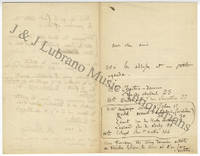
232892 pp. of a bifolium. Octavo. Dated ca. late October 1864-1865. In French with translation. <br/><br/>An important letter in which Berlioz includes information for the first playbill of a projected concert performance of excerpts from his grand opera Les Troyens. He lists the names and addresses of the singers who are to appear: Mme. Anne Charton-Demeur Mlle. Palmyre Wertheimber Mr. Jules Montjauze Mr. Louise-Émile Wartel Mr. Péront Mr. Legrand and Mlle. Estagel. He also mentions a Mr. Prosper Bagier likely the director of the Théâtre-Italien in Paris. Finally he includes a number of special woodwind and percussion instruments that must be added to the orchestra. <br/><br/>"Here are the addresses and a short agenda. You will find the last five artists at the Théâtre Lyrique on evenings when they play Violetta. You will include the names of the artists only later in order not to upset Mr. Bagier."<br/><br/>Slightly worn and stained; creased at folds. Berlioz was the leading French composer conductor and critic of his age. "In many senses the Romantic movement found its fullest embodiment in him yet he had deep Classical roots and stood apart from many manifestations of that movement. His life presents the archetypal tragic struggle of new ideas for acceptance. and though there were many who perceived greatness in his music from the beginning his genius only came to full recognition in the 20th century." Hugh Macdonald in Grove Music Online.<br/><br/>Although Berlioz finished Les Troyens in 1858 it was not performed in its complete form until years after his death in 1890. The première of Acts 3-5 which included several of the singers mentioned in this letter occurred at the Théâtre Lyrique in Paris on November 4 1863. The performance mentioned in this letter may have taken place in late 1864 or 1865. "Violetta" i.e. the French version of Verdi's La Traviata enjoyed 102 performances at the Théatre Lyrique between October 27 1864 and 1865. The intended recipient of this letter was perhaps Georges Hainl 1807-1873 conductor of the Paris Opéra and the Société des Concerts du Conservatoire from 1863 until 1872. unknown books
13288Used; Like New/Used; Like New. Scarce AMQS from the important French romantic composer and shaper of the modern orchestra mounted together with a cdv portrait photograph without photographer's imprint. Berlioz has penned six measures from the "Love Scene" of his Roméo et Juliette indicated as "Adagio" and boldly signed below the the music. Dated perhaps in another hand at the lower left: Paris 1861. Toned else fine. AMQS measuring approx. 18 x 5 cm the full presentation measuring 29.5 x 21 cm. <br style="">In Roméo et Juliette 1839 Berlioz revisits his passion for Shakespeare and by extension for the woman whose renditions of Juliet and Ophelia had completely captivated him more than a decade earlier Harriet Smithson. By the time he composed Roméo Berlioz' love for her had become harsh reality: He was married to Harriet but the match had proven unsuccessful and the two were effectively separated.  But Berlioz had seen Romeo and Juliet at the Odéon during the 1827 Shakespeare season and had found himself overwhelmed writing that "more experiences of that kind would have killed me." Berlioz conducted the first three performances of Roméo et Juliette in Paris in November and December 1839. After hearing a performance of the work in Vienna in January 1846 he revised it thoroughly and conducted the premiere of this final version in Prague on April 17 1846. In his Memoirs Berlioz wrote that the "Love Scene" was his favorite among his works and described the fevered period during which he had composed Roméo et Juliette: "Oh the ardent existence I lived during that time! I struck out boldly across that great ocean of poetry caressed by the wild sweet breeze of fancy under that fiery sun of love that Shakespeare kindled. I felt within me the strength to reach the enchanted isle where the temple of pure art stands under a clear sky. It is not for me to determine whether I succeeded."<br style=""><br style=""><br style=""> unknown books
233541 page. Folio. In French with translation. <br/><br/>Berlioz outlines fees for musicians singers and tuners and costs for rehearsals composition and copying associated with the premiere of the work. <br/><br/>Slightly worn; creased at folds; a few very small holes as a result of ink oxidation. Berlioz was the leading French composer conductor and critic of his age. <br/><br/>"In many senses the Romantic movement found its fullest embodiment in him yet he had deep Classical roots and stood apart from many manifestations of that movement. His life presents the archetypal tragic struggle of new ideas for acceptance. and though there were many who perceived greatness in his music from the beginning his genius only came to full recognition in the 20th century." Hugh Macdonald in Grove Music Online. <br/><br/>Berlioz's Requiem the Grande Messe des Morts was first performed on December 5 1837 at St. Louis des Invalides on the occasion of the funeral of General Danrémont. <br/><br/>"Berlioz admits that when the chance of composing a Requiem came his way he fell on it like a man possessed. The opportunity was a philanthropic commission set up by Gasparin Minister of the Interior in order to re-establish the prestige of sacred music and Berlioz was the first to receive such a commission. It was briskly composed in a fever of inspiration in the summer of 1837 but as is the way with bureaucratic patronage the performance was cancelled for political reasons after Berlioz had gone to the expense of copying the parts and engaging performers. Only after urgent appeals and persistent complaints was an excuse found for staging the performance after all: the death of a French general in the war of conquest in Algeria. So the Requiem was first heard in the church of the Invalides. in a ceremony of pomp and grandeur which the French do with particular style. It was a stirring public occasion and although it was marred for Berlioz by the conductor Habeneck taking a pinch of snuff at the most dramatic entry of the Tuba mirum the truth of the anecdote is disputed it signified for him the blessing of official approval and the wider knowledge in Parisian circles of how powerful and novel his music was. No one was left in any doubt of the force and originality of Berlioz's genius." Macdonald: Berlioz pp. 33-34. unknown books