Berlioz, HectorBiblio.com
539 résultats
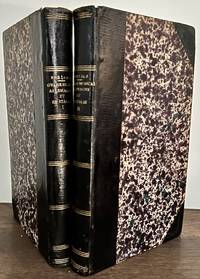
184423701Paris: Jules Labitte 1844. First Edition. Hardcover. Three quarter gilt lettered black morocco marbled boards and marbled endpapers. 2 Vols. Very good. 422 370 pages. 21.5 x 13 cm. It was this period in his life 1840's Berlioz spent much of his time making music outside France. He struggled to make money from his concerts in Paris and learning of the large sums made by promoters from performances of his music in other countries he resolved to try conducting abroad. His extensive German tour in twelve German cities received enthusiastic receptions. The German public was better disposed than the French to his innovative compositions and his conducting was seen as highly impressive. He extravagantly praised Beethoven's symphonies and Gluck's and Weber's operas and scrupulously refrained from promoting his own compositions. One quire in Vol. I toned balance of interior clean and bright. Text in French. Jules Labitte hardcover
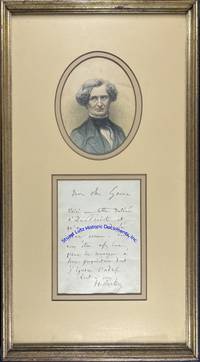
5622LOUIS-HECTOR BERLIOZ 1803-1869. Berlioz was a French composer and conductor of the Romantic movement.ALS. 1pg. N.d. N.p. An autograph letter signed H Berlioz. Berlioz wrote a brief missive in French asking the recipient to pass along a letter. My dear Garcia Here is a letter addressed toand that was addressed to me by accident. Will you be good enough to return it to his landlord whose address I dont know. All to you H Berlioz. It is matted and framed with a color engraving of Berlioz. In fine condition. unknown
18571053<p><b>BERLIOZ Hector 1803-1869 French composer. </b>An 11-line ALS to "Monsieur" signed "H. Berlioz." 1 full p. 8vo. N. p. Paris 30 December 1857. </p><p>Berlioz writes to an unnamed correspondent about what he wrote as music critic for the <i>Journal des Débats</i> 17 November in reply to M. Benoît Jouvin's comments in <i>Figaro. </i>According to the Hector Berlioz website Berlioz had written about the first production of <i>Margot </i>a comic opera in three acts at the Théâtre Lyrique 5 November 1857 by Jules-Henri Vernoy de Saint-Georges and Adolphe de Leuven music by Antoine-Louis Clapisson and also wrote there about "Inauguration de la salle Beethoven. CONCERT D'OUVERTURE." Berlioz writes about a response from Jouvin the publisher of <i>Figaro</i> a man about whom it has been said always left the theater irritated. Berlioz writes: "It is in the Journal des Debats of November 17th that I have replied to the few lines that Mr. Jouvin has published in the Figaro. But as regards to the article that he wrote in answer to my reply I did not have to answer it and I did not do so. Many thanks for all the gracious things for me contained in your letter receive my best feelings." From 1834 to 1863 Berlioz wrote more than 400 contributions to the prestigious and influential Paris paper the <i>Journal des Débats</i> which represent rather less than half of his entire output as music critic. Apparently unpublished and not one of his well over 3000 letters found in his <i>Correspondance </i> <i>général</i> 1972-2003. Very good with edges slightly browned and three edges very slightly rough. </p><br />
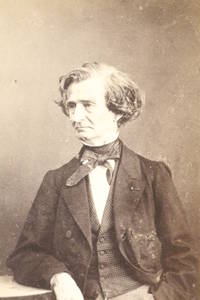
186073029Paris: Nadar 1860. Fine. Nadar Paris s. d. circa 1860 6.50 x 10.30 cm une photographie Original albumen photograph carte-de-visite format mounted on card from Nadar studio 35 boulevard des Capucines. Manuscript annotations on verso. A copy of this photograph is held in the Music Department of the Bibliothèque Nationale de France. Nadar unknown
197337118New York: Vienna House Inc. As New. 1973. Paperback. 0844301140 . FREE UPGRADE to Courier/Priority Shipping Upon Request IN STOCK AND IMMEDIATELY AVAILABLE FOR SHIPMENT - AS NEW THE TEXT BLOCK IS PRISTINE CLEAN UNMARKED AND IN EXCELLENT CONDITION - -- with a bonus offer-- . Vienna House, Inc. paperback
188894091Librairie De L Art. As New. 1888. Paperback. FREE UPGRADE to Courier/Priority Shipping Upon Request - IN STOCK AND IMMEDIATELY AVAILABLE FOR SHIPMENT - AS NEW THE TEXT BLOCK IS PRISTINE CLEAN UNMARKED AND IN EXCELLENT CONDITION - - Text in French. 338 pages. -- with a bonus offer-- . Librairie De L Art paperback
20031<b>BERLIOZ HECTOR.</b> 1803-1869. French composer; creator of <i>Harold in Italy</i> <i>Symphonie Fantastique</i> and other masterpieces. ALS. <i>"Hector Berlioz"</i>. 2pp. 4to. Paris October 9 1834. To l'intendant general de la liste civile. In French with translation.<p><i>"I am planning to give three concerts over the course of next November. The Salle des Menus Plaisirs which you have been kind enough to make available to me several times in the past is really the only venue in Paris that lends itself to these kinds of musical events. So I request that you will grant me permission to hold mine there. These concerts just like the ones I gave last years would take place on Sundays at 2 in the afternoon. With all my respect dear General Intendant your humble servant…"</i></p><p>The 1830s were difficult for Berlioz. Bereft of the recognition he craved and unable to earn a steady income from composing he worked as a critic for several journals and newspapers and accepted the few commissions that came his way. Nevertheless he produced a number of works including the symphony <i>Harold en Italie</i>which premiered on November 23 1834 about a month and a half after writing our letter at the Paris Conservatoire then housed in the Salle des Menus Plaisirs a theater attached to the Hôtel des Menus-Plaisirs and the venue for most of Berlioz's symphonic works. <i>Harold en Italie</i> based on Byron's narrative poemso captivated Italian violinist and composer Niccolo Paganini for whom it was written that in 1838 he presented Berlioz with a gift of 20000 francs. Several weeks before the premiere the Paris Conservatoire was also the venue for another Berlioz program on November 9 which included his <i>Symphonie fantastique</i> as well as the first performances of <i>Sara la baigneuse</i> version H69A and <i>la Belle voyageuse. </i>A plaque outside the Salle du Conservatoire commemorates Berlioz's performances there.</p><p>Our letter was written from 34 rue de Londres Berlioz's home between 1834 and 1836. </p><p>Docketed in the top margin. Folded and slightly creased; a very early letter and as such uncommon.</p><br /><br /><br />
354342 pp. of a bifolium. Octavo. Dated "31 Juillet" no year. To an unidentified male correspondent. On lined paper. In French with translation.<br /> <br /> Berlioz apologizes for not being able to edit his article on Bortnyansky with which he hopes his correspondent will be satisfied.<br /> <br /> "The fragment of musical criticism which I wanted to add to the item on Bortnianski is in the hands of Mr. M. Levy's printer who is at present bringing out a book which contains this article. It is impossible for me - since the printer is not in Paris - to rework my manuscript. Therefore be good enough to be satisfied with the Russian article; it is accurate on the whole and it would be difficult for me to redo a study on Bortnianski and Emperor of Russia's singers that is already done." <br /> <br /> The composer/critic goes on say that he would be happy for extracts of the article to appear in L'Illustration and in a postscript asks his correspondent to send him a copy of the periodical in which his article appears. <br /> <br /> Slightly worn; creased at folds and very slightly overall. Dmitri Stepanovich Bortnyansky 1751-1825 was a Ukrainian singer composer and music director active in Russia. "During the 19th century Bortnyansky choral concertos and hymns gained popularity across Western Europe; some copies of concertos preserved in the library of the Hofkapelle in Vienna date from as early as 1780. Berlioz who heard the concertos in Russia in the 1840s praised the 'incredible freedom' of their approach to choral sonority Les soirées de l'orchestre Paris 1852 and included Bortnyansky's music in several of his own concerts in Paris." Marika Kuzma in Grove Music Online<br /> <br /> "Berlioz stands as the leading musician of his age in a country-France-whose principal artistic endeavour was then literary and in an art-music-whose principal pioneers were then German. In many senses the Romantic movement found its fullest embodiment in him yet he had deep Classical roots and stood apart from many manifestations of that movement. His life presents the archetypal tragic struggle of new ideas for acceptance to which he gave his full exertions as composer critic and conductor. And though there were many who perceived greatness in his music from the beginning his genius only came to full recognition in the 20th century." <br /> <br /> "Berlioz's views were presented regularly to readers of the Paris press . He published three collections of criticism: Les soirées de l'orchestre 1852 Les grotesques de la musique 1859 and A travers chants 1862. In his feuilletons he wrote of new operas and singers .; his opinion on momentous occasions was of crucial interest for example at the première of Le prophète in 1849. He reviewed most of the concerts of the Société des Concerts; he wrote of new instruments and musical gadgets of his own impressions of music abroad and of important musicians visiting France; he wrote biographical notices of Gluck Beethoven Spontini Méhul and himself; he wrote fiction and fantasy often with a critical purpose; he wrote serialized treatises on orchestration and conducting. There are in short few facets of musical practice of the time untouched in his feuilletons . In general Berlioz's opinions are trenchant and clearly expressed." Hugh Macdonald in Grove Music Online. unknown
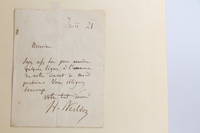
188876843Paris: Librairie de l'art 1888. Fine. Librairie de l'art Paris 1888 24.50 x 32.50 cm relié First edition one of 30 numbered copies on Japan paper deluxe issue. Work illustrated with 14 original lithographs by Adolphe Fantin-Latour printed on China paper as well as 12 portraits of Hector Berlioz 3 plates hors-texte and 122 engravings facsimiles of autographs caricatures. Binding in full red morocco spine with five raised bands gilt rolls on headcaps endpapers and pastedowns of combed paper fine engraved bookplate mounted on one pastedown gilt dentelle border on pastedowns covers preserved all edges gilt double gilt fillets on edges perfect contemporary binding signed Cuzin. Our copy is enhanced with an autograph note signed by Hector Berlioz mounted on an endpaper: ""Jeudi 21 / Monsieur soyez assez bon pour accorder quelques lignes à l'annonce de notre concert de mardi prochain. Vous obligerez beaucoup votre tout dévoué H. Berlioz."" ""Thursday 21st / Sir please be so kind as to grant a few lines to the announcement of our concert next Tuesday. You would greatly oblige your most devoted H. Berlioz."" Fine copy perfectly established and enhanced with an autograph note signed by Hector Berlioz. Librairie de l'art hardcover
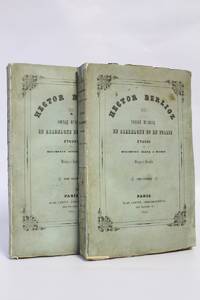
184462537Paris: Jules Labitte 1844. Fine. Jules Labitte Paris 1844 14.50 x 22.50 cm 2 volumes brochés sous chemises et étuis Rare first edition of Hector Berlioz's first book. Some restorations to the top spine-end volume label on the spine of the second volume not fully visible boards strengthened or lined first board of the first volume some stains on the first boards of both volumes. Fine condition inside almost without any foxing. Our copy is housed in green half shagreen chemises and slipcases marbled paper boards slipcases lined with the same shagreen gilt titles and dates on the spine. Rare. Jules Labitte hardcover
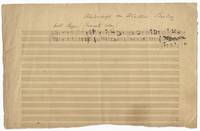
393097 measures notated in black ink on one side of the leaf. Several notes crossed out and a final passage rewritten. 1 leaf. Oblong folio 268 x ca. 170 mm.<br /> <br /> A first draft of a polyphonic theme. Identified in German in contemporary manuscript at head: "Handschrift von Hector Berlioz Erste Skizze. Benvenuto Cellini."<br /> <br /> Some wear and browning; slightly creased at folds; lower edge unevenly trimmed. The present manuscript not recorded in Holoman.<br /> <br /> Benvenuto Cellini an opéra semi-seria in two acts to a libretto by Léon de Wailly and Auguste Barbier assisted by Alfred de Vigny was based on the memoirs of Benvenuto Cellini. Set in 16th century Rome during the papacy of Clement VII the work premiered in Paris on 10 September 1838 at the Opéra and was produced in a revised version in Weimar at the Grossherzogliches Hoftheater on 20 March 1852 and with further revision in three acts on 17 November 1852.<br /> <br /> "Whether it originated as a serious or a comic opera the result in all its many versions is a compound a characteristic blend of idealism and farce grandeur and wit breadth and vivacity. Berlioz poured into Benvenuto Cellini every drop of invention and feeling at his command in a torrent of notes that make up a long and very lively opera and its heterogeneity so baffling to Parisians in 1838 and Londoners in 1853 is one of its main virtues." Macdonald: Berlioz p. 106. <br /> <br /> "Berlioz stands as the leading musician of his age in a country France whose principal artistic endeavour was then literary in an art music whose principal pioneers were then German. In many senses the Romantic movement found its fullest embodiment in him yet he had deep Classical roots and stood apart from many manifestations of that movement. His life presents the archetypal tragic struggle of new ideas for acceptance to which he gave his full exertions as composer critic and conductor. And though there were many who perceived greatness in his music from the beginning his genius only came to full recognition in the 20th century. . <br /> <br /> In Berlioz's own words Benvenuto Cellini 'contains a variety of ideas an energy and exuberance and a brilliance of colour such as I may perhaps never find again.' " Hugh Macdonald in Grove Music Online<br /> <br /> While musical quotations in Berlioz's hand are not rare his sketchleaves are very rare to the market; we have located only one example at auction in over 30 years. unknown
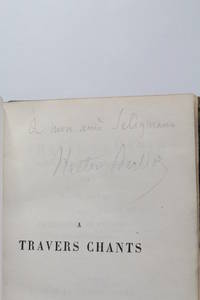
186271549Paris: Michel Lévy frères 1862. Fine. Michel Lévy frères Paris 1862 12.50 x 19 cm relié First edition. Half shagreen binding spine with five raised bands with gilt decorations date at foot marbled paper covers original soft front cover preserved. Rare and precious signed autograph inscription by the composer: à mon ami Seligmann - Hector Berlioz ""to my friend Seligmann - Hector Berlioz"" Hippolyte-Prosper Seligmann 1817-1882 cellist and composer was an active member of the Philharmonic Society founded by Berlioz in 1849. Provenance: R. & B. L. library with his bookplate pasted on the back of the first endpaper. Michel Lévy frères hardcover
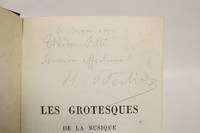
185968513Paris: A. Bourdilliat & Cie 1859. Fine. A. Bourdilliat & Cie Paris 1859 11.50 x 18 cm reliure de l'éditeur Les Grotesques de la musique The Musical Madhouse A. Bourdilliat & Cie Paris 1859 11.5 x 18 cm publisher's original binding First edition. Publisher's green cloth spine and boards ruled in blind yellow endpapers and pastedowns pastedowns soiled edges spotted. A little light foxing. A rare and handsome autograph inscription signed by Hector Berlioz in pencil to title: ""à mon ami Théodore Ritter souvenirs affectueux"" Théodore Ritter son of composer Eugène Prévost was Berlioz's student for whom he composed a piano arrangement of L'Enfance du Christ The Childhood of Christ Berlioz inscriptions are rare and highly sought-after. A. Bourdilliat & Cie hardcover
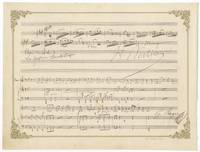
3929115 measures titled and signed below the music: "Thème e Bal e La Symphonie Fantastique. H. Berlioz." Undated but ca. 1840-1850. The complete main theme of the second movement "Un Bal" carried by the violins in measures 38 to 54 of the full score. 1 leaf. Notated in dark brown ink within decorative dark gold borders on Lard-Esnault paper. Oblong quarto 227 x 300 mm. <br /> <br /> With:<br /> - ROGER Gustave-Hippolyte 1825-1879. Autograph musical quotation signed "G. Roger" being a 12-measure song for voice and piano commencing "d'autiens tu beau miage" to lower portion of recto. <br /> <br /> With to verso:<br /> - ADAM Adolphe 1803-1856. Autograph musical quotation signed "Ad. Adam" being a 16-measure waltz for piano<br /> - HALÉVY Fromental 1799-1862. Autograph musical quotation signed "F. Halévy" being a 22-measure work for piano titled "Suite" "The composition of the 'Symphonie fantastique' was a momentous event in Berlioz's career his first full-scale masterpiece and equally momentous in the history of music as the first unequivocal declaration of romantic ideas in style and musical language and its echo has pervaded all music of passion and personal experience to this day . Of Harriet Smithson's identity as the 'beloved' portrayed by an 'idée fixe' in the form of an obsessive theme that recurs in all the movements there can be no question." MacDonald: Berlioz p. 18.<br /> <br /> A unique artifact incorporating a rare quotation from one of the most outstanding works of the symphonic repertoire of the Romantic period the whole uniting Berlioz with three important French musical figures of the mid-19th century. unknown