471 résultats
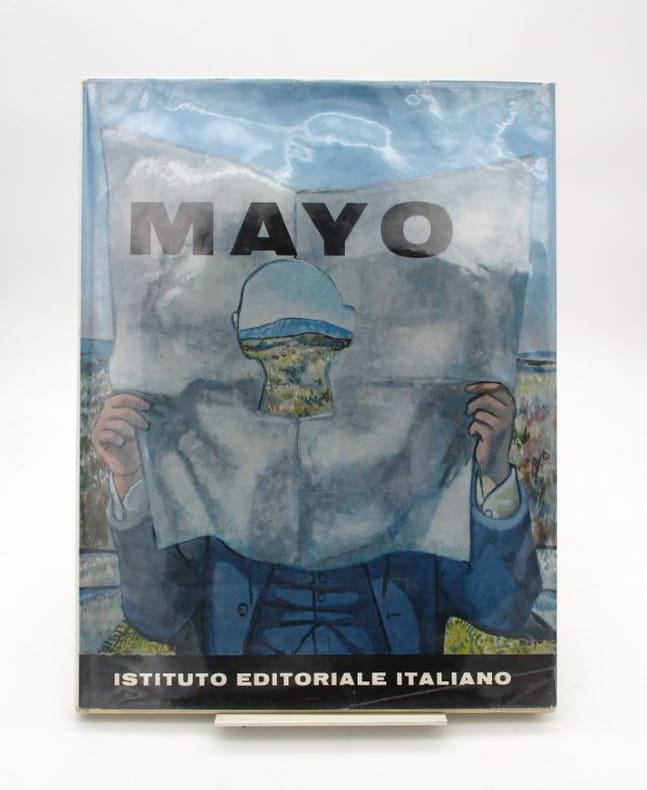
1968002316Milan Istituto editoriale italiano 1968 In-4 Cart. toilé, jaquette illustr.
18933Milan, Istituto editoriale italiano, 1968. In-folio, 93 pp., cartonnage éditeur de toile jaune, jaquette originale illustrée, rhodoïd (restaurations des petites déchirures marginales de la jaquette).
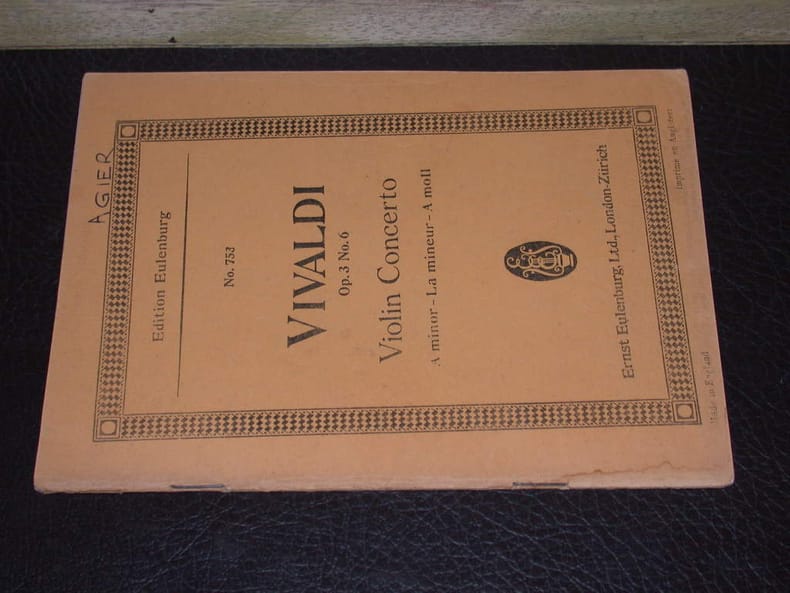
9902Ernst eulenburg (n° 753) 20 pages in12. Sans date. Agrafé. 20 pages.
1975RO30020918"EDITIONS LITO PARIS Collection ""La ronde des animaux"". 1975. In-12. Cartonnage d'éditeurs. Bon état, Couv. convenable, Dos satisfaisant, Intérieur frais. Environ 16 pages illustrées de dessins en couleur hors et dans le texte.. . . . Classification Dewey : 843.0692-Livres d'enfants"
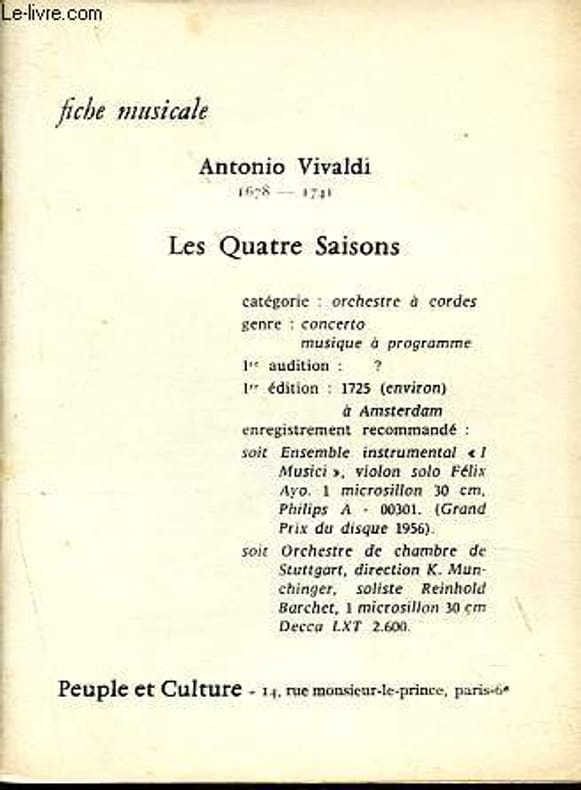
1957R200133435Peuple et culture. 1957. In-12. Broché. Etat d'usage, Livré sans Couverture, Agrafes rouillées, Quelques rousseurs. 31 pages, quelques phrases musicales dans le texte, une page dépliante en fin d'ouvrage - coins frottés, papier jauni.. . . . Classification Dewey : 780.92-Musiciens, concertistes
20691FIRENZE,1868,IN8 broché,8p.
RO50037970PETERS. non daté. In-4. Broché. Bon état, Couv. convenable, Dos satisfaisant, Intérieur frais. 8 pages et 12 pages. 2 Partitions. Une partition pour Violon solo et une partition pour Piano avec accompagnement Violon.. . . . Classification Dewey : 780.26-Partitions
RO50038232PETERS N° 4379. non daté. In-4. Broché. Bon état, Couv. convenable, Dos satisfaisant, Intérieur frais. 8 pages + 15 pages. 2 Partitions. Une partition pour Violon solo et une partition pour Violon avec accompagnement Piano.. . . . Classification Dewey : 780.26-Partitions
14390London/Zurich, Ernst Eulenburg Ltd, Edition Eulenburg n° 787, sans date (no date), 1 volume in-12 broché (softcover), 16 pp. Partition. GOOD CONDITION. BON ETAT.
14652London/Zurich, Ernst Eulenburg Ltd, Edition Eulenburg n° 754, sans date (no date), 1 volume in-12 broché (softcover), 16 pp. Partition. GOOD CONDITION. BON ETAT.
14690London/Zurich, Ernst Eulenburg Ltd, Edition Eulenburg n° 753, sans date (no date), 1 volume in-12 broché (softcover), 20 pp. Partition. GOOD CONDITION. BON ETAT.
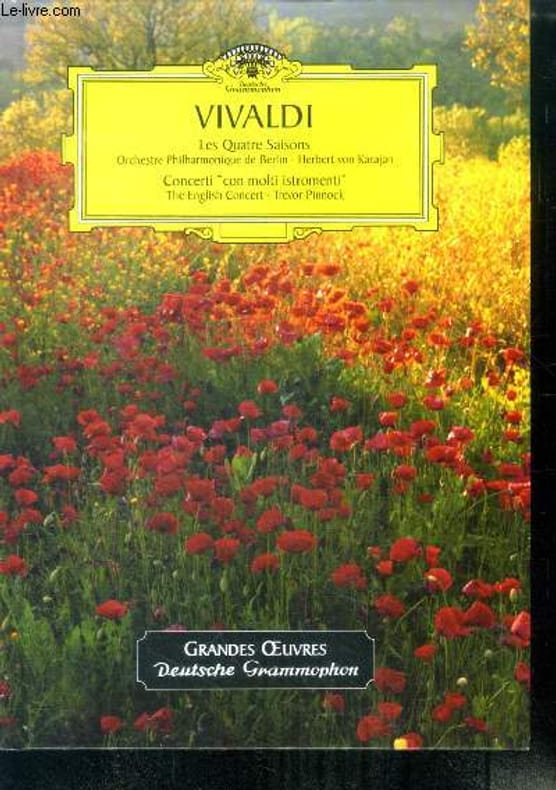
2012RO40053481Deutsche grammophon grandes oeuvres. 2012. In-4. Relié. Bon état, Couv. convenable, Dos satisfaisant, Intérieur frais. 47 pages illustrées en couleurs et noir et blanc + 2 CD audio.. . . . Classification Dewey : 781.68-Musique classique
1976RO40086131Lito. 1976. In-8. Broché. Etat d'usage, Couv. légèrement passée, Dos frotté, Intérieur bon état. Env. 10 pages illustrées de dessins en couleur. Annotation sur le 1er plat.. . . . Classification Dewey : 28.5-Enfantina
500277213Sans date.
21401für zwei Hörner solo Streicher Fagott ad lib. Und Basso continuo. Sammelmappe 22 Seiten und 3 lose Notenfaltblättter dies ist ein regulär ausgesondertes Bibliotheksexemplar aus einer wissenschaftlichen Bibliothek keine Markierungen/Anmerkungen Einband in Transparentschutzfolie das Buch ist gut erhalten für zwei Hörner solo, Streicher, Fagott ad lib. Und Basso continuo unknown
17241502Libretto <b>Giustino dramma per musica da recitarsi nel Teatro</b> dell'illustrissimo Sig. Federico Capranica el carnevale dell'anno 1724: Roma: Bernabo 1724. Sonneck 568; Sartori 12373.<br /><br /><b>Giustino</b> is a major opera. It shows Vivaldi on the verge of modernizing his style while summingup the most individual achievements of his earlier years. <i>The rare libretto contains stage directions and much that is not in the original score.<br /></i><br /><i>Pagination</i>: Leaf of title bearing a woodcut of a lion holding a globe verso blank; 2pp. Dedication; 1p. Argomento; 1p. Prostesta and imprimatur; 1p. Mutazioni di setting in Constantinopoli by Alessandro Mauri Veneziano; 1p. Interlocutori and composer of D. Antonio Vivaldi. Text pp. 9- 68; <i>Collation:</i> A-B12 C10. Minor dampstains at bottom margin else clean and very good throughout. <br /><br />8vo. Contemporary brown Roman morocco highly gilt smooth spine with repeated floral and shell ornaments. Arms of Mattei family on each cover. Shield with griffin seated wearing a crown above which are three angels holding a large crown. Tulips and circular rose ornaments. Light rubbing. Red silk pastedowns with similar designs missing front and rear flyleaf. <br /><br />Opera in three acts on the life of the Byzantine emperor Justin I with text based on the 1683 libretto of Nicolò Beregan 1627-1713 which had been adapted for Vivaldi by Pietro Pariati 1665-1733 and perhaps Antonio Maria Lucchini ca. 1690-before 1730. The opera dramatizes the life Justin I Latin: Flavius Iustinus Augustus; 450-527 Emperor of the Eastern Roman Empire from 518 to 527. <br /><br />Much is made of Guistino's rise from a peasant to the rank of commander of the palace guard and then to emperor. This semi-factual history is interwoven with a love story as is required for an opera as well as a fanciful genealogical construction that finds Giustino to be the son of noble parents instead of peasants. Giustino is a major opera. It shows Vivaldi on the verge of modernizing his style while summing up the most individual achievements of his earlier years. <br /><br />The rare libretto contains stage directions and much that is not in the original score. Vivaldi may have lived continuously in Rome between 1723 and 1724 where his operatic career reached one of its peaks with his setting of Pariati's Giustino for the Teatro Capranica in the carnival season of 1724 Strohm qtd. in Heartz 194. <br /><br />Vivaldi spent as little as 6-8 weeks writing the score during the months of December 1723 and January 1724 prior to the first staging at the end of January or early February. Vivaldi must have been familiar with the range of all the main singers and must have worked with the librettist at length Strohm 10. <br /><br />According the musicologist Reinhard Strohm the libretto along with an original autograph score still in existence are the two final authorities for the study and possible reconstruction of Vivaldi's Giustino. He writes that the printed libretto of 1724 "must have appeared only a few days before the first night and it must have aimed at reproducing the text precisely as it was sung. . . . Although the libretto differs in many major and minor details from the autograph score it does not reflect a different stage of revision. Both originated and were used simultaneously . . . their divergences result from the different function and intended readership" 63. <br /><br />Strohm adds the libretto for the audience aimed to print not only the recited text but also to provide an explanation of the stage sets. Furthermore the libretto was to present the text in an orthographically correct literary fashion whereas the text within the musical score was not read by the public only heard. "Therefore the score lacks stage directions and many details of punctuation which were not necessary for the performers. The libretto is a literary text of the opera which its author hoped to transmit—through the act of printing—to a wider readership" 72. Thus there are a great many differences between the score and the libretto. For Giustino Vivaldi borrowed a good deal of material from earlier operas and instrumental works to construct his score including music from "La Primavera" section of Le quattro stagioni. This distinctive music according the Strohm suggests the "arrival of spring evokes an awakening within Giustino" 57. Because a Roman carnival opera is a gay affair Giustino did not deal with Justin's historical activities as a ruthless persecutor of Christian dissidents including the Monophysites and the Arians. <br /><br />Nevertheless Giustino was a success. A report comes from the German flautist Johann Joachim Quantz: "The newest thing that I have heard was the so-called Lombardi style that was hitherto entirely unknown to me and that Vivaldi introduced a short time before in his operas in Rome and which enchanted the citizens to such a degree that they scarcely wish to hear anything that is not similar to this style" qtd. in Strohm 6. The original version of Giustino was produced in Venice at the Teatro San Salvador in 1683. The Venetian lawyer Nicolò Berengan an accomplished writer created the original libretto for the composer Giovanni Legrenzi 1626-1690. The opera premiered on February 12 1683. It is the story of Justin I defending the empire against its enemies. As a result of his heroism he is subsequently crowned as co-emperor and married to Eufemia the emperor's sister. <br /><br />The main characters are all historical figures although several events are blended into one story with a view of respecting Aristotelian unities of time place and action. 2For several decades following its 1683 premiere Giustino was one of the most widely performed works in Italy. Giustino was reset numerous times with the text based on Berengan's and Pariatti's text. Sartori 12359-12374 lists libretti from Napoli Genova Milano Bologna Lucca Roma Verona Modona and Vicenza all before the 1724 Roman setting for Vivaldi. Also of note is the 1737 version in London with music by Handel. Locations: OCLC: Morgan Library of Congress. <br /><br />References: Heartz Daniel. Music in European Capitals: The Galant Style 1720-1780 2003; Laurance Rita. "Antonio Vivaldi Giustino opera in 3 acts RV 717" description. AllMusic. https://www.allmusic.com/composition/giustino-opera-in-3-acts-rv-717-mc0002447350; Rosand Ellen. Opera in Seventeenth-Century Venice: The Creation of a Genre 2007: "In other seasons Faustini managed to convince a variety of noblemen and a canon to turn author: Counts Zaguri and Nicolo Beregan in 1660 and 1661 respectively and Dott. Cristoforo Ivanovich in 1663" 188; Strohm Reinhard. Giustino by Antonio Vivaldi: Introduction Critical Notes and Critical Commentary 1991: A facsimile of this original score along with separate booklet of notes is included with the original libretto. <br /><br />Provenance: Arms of Mattei Conti family<br /> Roma: Bernabo, 1724. hardcover books
1959020783Milano: Ricordi 1959. 89p. music original stiff wrappers quarto format. Ricordi unknown books
1984WRCLIT77610New York: Targ Editions 1984. Quarto. Cockerell paper over boards printed label fore and bottom edges untrimmed. Fine in slightly torn plain glassine wrapper. First edition of Snodgrass's translation printed in parallel with the Italian text and including sections of the score. One of 150 copies printed at the Grenfell Press on Barcham Green paper in Centaur and Arrighi types signed by the translator. Laid in is a press announcement with a brief signed greeting from Targ. Targ Editions hardcover books
1984227035New York: Targ 1984. Limited. hardcover. fine/very good. Printed throughout in red & black. Small vignette portrait on title. 29pp. Short slim 4to marbled boards with paper label plain glassine wrapper a bit chipped at edges; uncut edges. New York: Targ Editions 1984. A fine copy in a very good dust wrapper.<br/><br/> A beautifully printed book -- one of 150 copies signed in red by W.D. Snodgrass.<br/><br/> Targ unknown books
1971159980Roma: SAFI: Societa Internazionale per le Arti Figurative 1971. Hardcover. VG- Hinges are loosening a tad perhaps as a hazard of size; otherwise only slightly aged. Gray cloth gilt letters on spine and front cover 147 pp. 78 BW illus. 22 tipped-in color plates. Text is in Italian and English. Showcases artwork by Italian artist Mario Padovan b. 1927. With texts by Cesare Vivaldi and Lisetta Belotti. Although more than 70 examples of his work enhance the texts the main catalogue presents 22 pieces in full-color on full pages. Includes brief artist chronology and bibliography. #459 of 1000 copies. Uncommon. SAFI: Societa Internazionale per le Arti Figurative hardcover books
196235762Bologna Italy 1962. Hardbound. VG with translator's gift inscription. Blue cloth in cardboard slipcase and clear acetate cover. 764 pp. with a few illustrations from the 1835 edition. An Italian transalation of Virgil. hardcover books
151762289Paris: François Regnault 1517. Title printed in red and black with printer's woodcut device elephant and monogram; text in black letter with criblé initials. a-y8Z2. 186 leaves misfoliated i-clii cliii-clxxviii. 1 vols. Small 8vo. Nineteenth-century floral-patterened boards. Printer's device on title page tinted in an early hand title slightly soiled otherwise a pleasant crisp copy. Title printed in red and black with printer's woodcut device elephant and monogram; text in black letter with criblé initials. a-y8Z2. 186 leaves misfoliated i-clii cliii-clxxviii. 1 vols. Small 8vo. Lovely example of this popular devotional first printed in Lyon 1503 and several times thereafter through the early part of the 16th century. Regnault the Parisian printer first printed it in 1508. Rare -- Not in OCLC; not in RLIN; not in Adams; the only copies we have found were in the British Library and Bibliothèque Nationale François Regnault unknown books
1511401752Paris: Jean Barbier for François Regnault 1511. From the Collection of Arthur & Charlotte Vershbow. 4to 142 x 210 mm. Title printed in red and black 7 metalcut illustrations and borders. Contemporary English limp blind-tooled calf boards removed early manuscript pastedowns preserved; cloth folding case. Back cover detached. Provenance: early manuscript annotations extensive at beginning and end; William Morris 1834-1896 Kelmscott House bookplate his sale Sotheby's 5 December 1898 lot 1092 to Chadwick for £6 15s.; John Camp Williams bookplates his sale American Art Association 6 November 1929 lot 1156; purchased from Thomas Taylor 1978. Third edition. The 1507 first edition printed at Saluzzo by Giacomo de' Circhi and Sisto Somasco and the Lyons 1508 edition of Étienne Gueynard both employed woodcuts. In Barbier's edition for Regnault up to one dozen small metal plates combined to form each of the large subjects and frames in the final composite images. The subjects include the Descent from the Cross the Dance of Death and representations of saints. Giovanni Lodovico Vivaldi whose name appears on the verso of the title-page above Andreas de Soncino's preface dedicates the work to the Marquess of Salluzzo Ludovico II 1438-1504 and his second wife Marguérite de Foix. A Dominican monk and professor of theology from Mondovi Vivaldi moved to Lombardy to act as their adviser and confessor. His collaboration in this text with Bernardino Dardano represents a "defining link between theological and humanistic culture in print" Vinay L'umanesimo subalpino nel secolo XV 1935 p.107. See Harvard/Mortimer French 552 the Lyons edition. Renouard Imprimeurs & Libraires Parisiens du XVIe siècle 185. <br/><br/> Jean Barbier for François Regnault hardcover books
2-74005Roma appresso Luigi Zannetti 1599 folio cm. 32 x 22 rilegato in piena pergamena moderna muta marca tipografica xilografica al frontespizio 153 cc. di testo stampate solo al verso; testo inquadrato in filetto tipografico con capolettere e finali xilografici a fronte di 153 cc. stampate solo al recto con meravigliose tavole calcografiche a piena pagina una pagina di Errata. Prima del frontespizio compaiono il frontespizio architettonico con il Cristo al centro inciso in rame dell'“Evangelicae historiae imagines.†del Nadal Antuerpiae 1593 e 2 cc. con epistola al lettore e indice italiano “Tavola delle meditationi che respondono all'imagini della vita di Christo secondo l'ordine del Historia Evangeliaâ€. La copia fa dunque parte della tiratura convenzionalmente indicata “C†cfr. ICCU. L'apparato iconografico di straordinaria fattura è stato concepito dal Nadal pare sotto la supervisione diretta del Loyola comunque sia si trattava di un progetto decisivo per i gesuiti ed è stato in gran parte inciso dietro pagamento di una somma altissima da Anton Jan e Jerome Wierix che erano tra i più celebri incisori del tempo su disegni di Marten de Vos Bernardo Passeri e altri. Forti restauri ai margini bianchi del frontespizio architettonico e delle ultime 5 cc.; peraltro carta lievemente e uniformemente brunita rade e leggere fioriture ma buona copia completa. Edizione originale dell'adattamento in lingua italiana del Vivaldi. Graesse IV 649. unknown
199170233Italy: G. Ricordi & C. 1991. hardcover. very good. Full score with critical notes. 2 volume set one hardback and one paperback in very good condition. Slipcase in very good condition minor marks and wear. Foxing to early and rear pages and page block edges of both volumes text mostly clean. Binding on paperback 'Critical Notes and Critical Commentary' volume tight spine fine. Binding on hardcover score volume still very good spine slightly cocked and faded. Da Capo Opera Full Scores Section Cathal 08/19 PAS 3/9/2019 G. Ricordi & C. hardcover