908 résultats
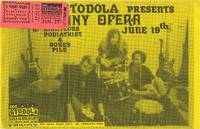
1992167709Chicago: Club Stodola 1992. Vintage poster for a performance by bands 3 Penny Opera Righteous Podiatrist and Boney Pile circa 1980s at Chicago's Club Stodola. Stapled to the top left corner of the poster are four tickets for the event noting a date of June 19. Poster folded twice and addressed for mailing on the verso with a postmarked date of June 10 1992. <br /> <br /> Located on Chicago's north side Club Stodola was a neighborhood Polish bar-turned-music-club in the 1980s and 1990s that frequently hosted punk bands.<br /> <br /> 17 x 11 inches folded twice vertically. Tickets 5.25 x 2.25 inches. Generally Near Fine. Club Stodola unknown
1927D12058Milan 1927. Ephemera. Very Good. Broadside advertisements for the performance of "Piccolo Harem" at Teatro Manzoni 4 large printed in color; 7 handwritten letters by Costa 5 of them signed with content related to the drama; 78-pp. typescript of the play in French "Petit Harem" signed by Costa; and 7 contemporary newspapers containing reviews. Condition is VG or better. The broadsides are particularly striking -- some flattened creases from folding but boldly designed and colors remain bright would display nicely. <br/><br/> unknown
194952974New York:: Metropolitan Opera House October 9 1949. original printed wrappers. . Some light creasing and use to the wrappers. 8vo. Boldly signed by Margot Fonteyn on the first text page of the program. Metropolitan Opera House, unknown
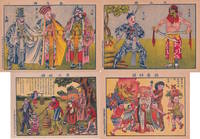
219368Tianjin.: 毓順成 芳記. Yushuncheng fangji. Early 20th Century. Four handbills showing popular images two 13.2 x 18.4 are images of characters from Peking Opera and two 12.2 x 16.5cm depict themes important in Chinese society at the time. Text in traditional Chinese characters. Light even browning tiny closed tears at margin of one sheet repaired with washi. Very good. Chinese opera characters in the style of traditional woodblock prints were popular in the late Qing dynasty and early Republican period. Handbills of characters from Beijing opera were sold as collectible items that also helped to familiarise people with the characters of different operas; their costumes make up weapons and names. In this case there are two characters from the opera 白水灘 on one handbill and three characters from the opera 落馬湖 on the other. <br> <br>Images with social themes also made popular handbills especially in places such as Tianjin where the influence of foreigners was pronounced. In 福壽財源 we see an immortal carrying a peach of longevity surrounded by images of fertility - a young woman and boys carry fruit and flowers as well as other items symbolic of wealth - a coin a vase gold ingots and so on probably issued for New Year. <br> <br>The final handbill of the four 娶大媳婦 tells the tale of a girl of eighteen married to a boy of seven. The Chinese custom of marrying a young boy to an older girl adopted into the family is thus open for discussion - everyone in the image clearly has a different opinion of the situation; from the young husband the older farmer in the background and the two men in long scholars robes to the modern young man in a western suit with leather shoes as well as the girl herself. The practice of adopting a girl to bring up as a future wife for a male child was made illegal in 1949. The text mentions some of the ways in which the girl would be expected to help in her adoptive family's home. . 毓順成 芳記. [Yushuncheng fangji] hardcover
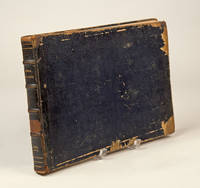
36029Includes works of Battista 5 Donizetti 6 Mercadante 7 Pacini 1 Petrella 1 and Verdi 1. With contemporary mansucript index to front free endpaper. <br /> <br /> Contents:<br /> BATTISTA Vincenzio 1823-1873<br /> Ermelinda Dramma lirico in Quattro Atti di Domenico Bolognese. Monaco: Orlando e C. after 1850.<br /> - Duetto Signor Capitano. PN 599. 19 pp. <br /> - Coro alla danza. PN 600. 14 pp. <br /> - Terzettino Febo ei vieni. PN 606. 8 pp. <br /> - No. 13. Scena e Romanza. Partenopeo. PN 12093. 4 pp. <br /> <br /> Anna La Prie. Tragedia lirica di Nicola Leoncavallo. Napoli: Fabricatore e Co. ca. 1845. <br /> - Scena e cavatina Alboix. PN 105. 10 pp. <br /> <br /> DONIZETTI Gaetano 1797-1848<br /> La Favorita Melodramma tragico in 4 atti Posto in musica pel Real teatro di Parigi. Napoli: Girard e Ci. ca. 1844.<br /> - Aria O mio Fernando. PN 5181. 9 pp. <br /> - Scena e Duetto Ah moio bene un Dio t'invia. PN 5185. 12 pp. <br /> - Quartettino Deh paventa il furor. PN 5197. 4 pp. <br /> - Scene e Duetto Ah va t'invo la e questa. PN 5184. 13 pp. <br /> <br /> Maria di Rohan Melodramma tragico in tre atti di S. Cammarano . Riduzione per Canto con accompo. di Pianoforte di C. Czerny. Milano: Giovanni Ricordi 1843<br /> - N: 14. Scena e Freghier . No osoalzarcilumi! PN 14914HH. 6 pp. <br /> - Scena e Ballata . Cavalieri che veggio. Napoli: F. Fabricatore e C.; Palermo: R. Zerega. PN 146 ca. 1845. 7 pp. <br /> <br /> MERCADANTE Saverio 1795-1870<br /> Violetta Opera semiseria in 4 Atti . Rappresentata per la prima volta nel Teatro Nuovo di Napoli li 10 Gennajo 1853. Napoli: Partenopeo ca. 1856-60. <br /> - No. 22. Rondo Finale. PN 10756. 10 pp. <br /> <br /> Virginia Tragedia Lirica in tre atti di S. Cammarano . Rappresenta per la prima volta nel R. Teatro S. Carlo di Napoli il 7 Apr. 1866. Napoli: T. Cottrau ca. 1866.<br /> - No. 10. Preghiera di Virginia. PN 14610. 4 pp. <br /> - No. 14. Terzetto di Virginia Appio ed Icilio. PN 14614. 8 pp. <br /> <br /> Stratira opera tragica in tre Atti. Esuguita nel R. Teatro di S. Carlo li 8 Gennajo 1853. Poesie di Domenico Bolognese. Napoli: Partenopea ca. 1866. <br /> - No. 3. Scena e cavatina Cassandro. PN 10757. 15 pp. <br /> - No. 14. Romanza Cassandro. PN 10758. 4 pp. <br /> <br /> Orazi e Curiaze Tragedia lirica in 3 atti di S. Cammarano. Posta in musica per il Teatro di S. Carlo ov'é stata rappresentata á 10 Novembre 1846. Napoli: Girard ca. 1846<br /> - No. 2. Scena Romanza e Cavatina. PN 7555. 14 pp. <br /> - No. 13. Scena Preghiera ed Aria Finale. PNs 7565 7560 7567. 13 pp. Later issue of ca. 1856-60. <br /> <br /> PACINI Giovanni 1796-1867<br /> Malvina di Scozia. Opera in 3 acts<br /> Grande Scena Preghiera ed aria. L'orror mi rese immobile. Napoli: Fabricatore e C. PN 725 ca. 1852. 19 pp. <br /> <br /> PETRELLA Errico 1813-1877<br /> Elena di Tolosa. Melodramma in tre Atti. Eseguito nel R. Teatro del Fondo li 112 Agosto 1852. Poesia di Domenico Bolognese. Napoli: Successori della Ditta Girard ca. 1852. <br /> - No. 6. Duetto. Dembra mesta! . male! male! PN 10466. 14 pp. <br /> <br /> VERDI Giuseppe 1813-1901<br /> Rigoletto. Melodramma di F.M. Piave. Milano: Giovanni Ricordi after 1852<br /> - No. 9. Scena ed Aria "Coro nome che'il mio cor." PN N23079N. 7 i list of publisher's plate numbers for excerpts of piano-vocal piano 2-hands and piano 4-hands pieces pp. <br /> <br /> Oblong folio. 19th century black leather-backed boards. <br /> <br /> Binding somewhat worn and abraided; joints split. Occasional minor wear and soiling; some small tears. In very good condition overall. An interesting collection of scarce mostly Neapolitan imprints in all likelihood associated with contemporary performances. unknown
19-4478San Francisco; SF Opera 1993. Glossy BW Photograph. 8 x 10 inches. Very Good. San Francisco Opera sticker for set design for Puccini’s “Turandot†on back of photo. Orange dot torn corner of SF Opera sticker on one copy. San Francisco; SF Opera (1993). unknown
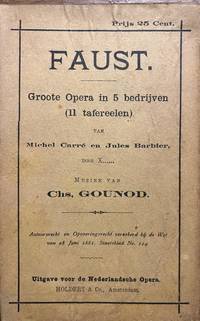
R1166-013Original paper binding on yellow paper some discoloration and folds but further in good condition. Songtext printed on paper 16 x 10 cm.Klassik Stitung Weimar. Herzogin Anna Amalia Bibliothek dates this song at around 1881 in Worldcat catalogue.Liedtekst - Songtext - Song - Lied - Opera Faust unknown
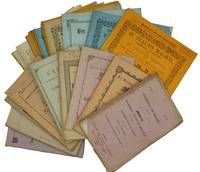
1873360111873. GOUNOD<br /> Faust. Opera 5 felvonásban. Göthe Után irták Barbier Gyula és Carré Mih. Forditotta Ormai. Zenéje Gounod Károlytól. Pest: Nyomatott Emich Gusztáv 1864. <br /> Octavo. Plain dark pink wrappers. 35 pp.<br /> Faust was Performed in Hungary for the first time on 2 September 1863. <br /> <br /> MEYERBEER<br /> Proféta. Nagy opera öt felvonásban. Irta Scribe. Forditotta Egressy Bèni ès Szerdahelyi. Zenéjét szerzé Meyerbeer. Pest: Nyomatott Herz Jánosnál 1856.<br /> Octavo. Plain light green wrappers. 3 pp.<br /> Le Prophete was performed in Hungary for the first time on 11 June 1850.<br /> <br /> MEYERBEER<br /> Hugonotok. Nagy opera öt felvonásban. Irta Scribe. Forditotta Nádaskai Lajos. Zenéjét Mayerbeer!. Pesten: Nyomatott Lukács Lászlónál 1852.<br /> Octavo. Plain ivory wrappers. 48 pp. <br /> Les Huguenots was performed in Hungary for the first time on 6 November 1852. <br /> <br /> THOMAS<br /> Mignon. Regényes dalmü 3 felvonásban. Göthe "Meister Vilmos Tanuló Évei" czimü regénye után irták Carré es Barbier. Forditotta Ormai Ferencz. Zenejét szerzé Thomas Ambrus. Pest: Kiadja Pfiefer Ferdinand 1873.<br /> Octavo. Original publisher's light blue wrappers with titling within decorative border. 36 pp.<br /> Mignon was performed in Hungary for the first time on 20 September 1873.<br /> <br /> WAGNER<br /> Tannhäuser; és a Wartburgi Dalnok Verseny Regényes dalmü 3 felvonásban. Szövegét s zenéjét irta Wagner Richard. Magyarra forditotta Ãbrányi Kornél. Pest: Kiadja Pfiefer Ferdinánd 1871.<br /> Octavo. Original publisher's light blue wrappers with titling within decorative border. 20 pp.<br /> Tannhäuser was performed in Hungary for the first time on 11 March 1871.<br /> <br /> Wrappers slightly worn and soiled. Some browning and foxing. From the first or early performances of these operas in Hungary. unknown
29868Image size ca. 212 x 142 mm. sheet size 321 x 190 mm. <br /> <br /> The design depicts a man dressed in an exotic Egyptian costume deocrated with numerous armlets anklets necklace earrings headdress etc. Executed in watercolour and gold paint on heavy wove paper. <br /> <br /> Slightly worn; browning to outer edges from old mat; remnants of mounting paper to verso. unknown
30832Executed in ink pencil gouache and silver paint on wove paper. Unsigned but with monogrammatic handstamp to lower left corner. With annotations in ink in Russian relative to various parts of the costume. 13.125" x 8.75" 332 x 222 mm.<br /> <br /> Slightly worn and soiled; some edge tears and repairs; upper right corner with erasure resulting in minor paper loss. Korovine designed costumes for productions of Russian operas including Borodin's Prince Igor Mussorgsky's Khovanshchina and Rimsky-Korsakov's Sadko and Le Coq d'Or.<br /> <br /> "Konstantine Korovine is one of the most famous of Russia's twentieth-century stage designers . He made his debut as a theatrical painter in 1885 when he executed the sets and costumes for the production of Snegurochka at Savva Mamontov's Private Opera after Vasnetsov's designs and thereafter he emerged rapidly as an independent stage designer - decorating according to one souce 80 operas 37 ballets and 17 dramas during his lifetime. Korovine brought to the Russian stage a vibrancy and richness that was lacking in the traditional Imperial theaters . He felt more at ease when called upon to design operas and ballets treating of Russian history and legend such as Prince Igor Sadko and The Golden Cockerel and he designed sets and costumes for such spectacles at home and abroad." Bowlt: Russian Stage Design Scenic Innovation 1900-1930 from the Collection of Mr. & Mrs. Nikita D. Lobanov-Rostovsky pp. 175-176. Provenance: MacDougall Arts Ltd. London auction June 9 2011 lot 413 catalogue p. 17. unknown
183836247Girard: Naples 1838. Oblong quarto. Contemporary quarter dark brown calf with green textured paper boards decorative dark brown leather label to upper with "Costanza Angelillo" gilt spine in decorative compartments gilt. Occasional secondary pagination.<br /> <br /> Contains:<br /> Pacini Giovanni 1796-1867<br /> Merope Grand Opera . arrangé pour Piano solo. PNs 8867-8879. Ca. 1848. 1f. recto title verso blank 1 list of subscribers as of 24 December 1847 18 numbers in piano score with occasional text. Subscribers include Filippo Angelillo in all likelihood related to Costanza Angelillo owner of the volume. Merope in 3 acts to a libretto by Cammarano after Voltaire was first performed in Naples at the Teatro S Carlo on 25 November 1847.<br /> <br /> Pacini<br /> Saffo . Souvenirs. Choeur de femmes. Musical manuscript. 1f. recto title on light green paper verso blank 6 pp.<br /> <br /> Donizetti Gaetano 1797-1848<br /> Roberto Devereux . Représenté au théâtre Royal de St. Charles le 28 Octobre 1837 . L'opéra entier . D.2.50. . 1er -2ème cahier. 1f. recto title verso blank 3-19 i blank; 1f. recto title verso blank 18 pp. PNs 3939-3943. Ca. 1838.<br /> <br /> Donizetti<br /> No. 8. Cavatine PN 6045. Ca. 1843. 6 pp. 1f. From Don Pasquale.<br /> <br /> Donizetti<br /> Linda di Chamounix Nouvel opéra . arrangé pour piano solo. 1f. recto title verso blank. Cavatine O luce di quest' anima Ajoutée à Paris pour Mme. Persiani-Tacchinardi et chantée à Naples par Mme. Tadolini. 4 pp. PN 5863; No. 14 Air Final du 2ème Acte de Linda . A consolarmi affrettati Chanté par Mme. Tadolini. 8 pp. PN 5685. Ca. 1840. 2 numbers in total.<br /> <br /> Donizetti<br /> Lucia di Lammermoor. No. 4. Duo chanté par Mme. Tacchinardi et par Duprez. 9-18 pp. PN 3953; Grand opéra . arrangé par piano solo. 1f. recto title verso blank 9-15 i blank pp. PN 3962. Ca. 1838. 2 numbers in total.<br /> <br /> Verdi Giuseppe 1813-1901<br /> I Due Foscari. No. 14 Choeur d'Introduction Allagioia. 4 pp. PN 6884; No. 2 Cavatine de Jacopo Dal più remoto esilio Chantée à Naples par Fraschini. 10 pp. PN 6875; No. 3 Choeur et Cavatine de Lucrezia Tu al cui sguardo Chantée à Naples par Mme. Bishop. 7 i blank pp. PN 6876; No. 6 Duo de Lucrezia et du Doge Tu pur lo sai Chanté à Naples par Mme. Bishop et Coletti. 9 i blank pp. PN 6879/ Ca. 1845. 4 numbers in total.<br /> <br /> Verdi<br /> Ernani . arrangé pour piano solo. 1f. recto title on light blue paper within decorative border verso blank. No. 12 Suite et Stretta No vendetta. 4 pp. PN 6647; No. 14 Duo final d'Ernani et de Silva Esci a te scegli segimi. 9 i blank pp. PN 6604; No. 15. Air final de Mme. Toldi Se crudele il cor mostrai. 4 pp. PNs 4312 3222; No. 3 Cavatine tyrolienne de Mme. Toldi In questo semplice. 7 i blank pp. PNs 4302 3221. 4 numbers in total.<br /> <br /> Bellini Vincenzo 1801-1835<br /> I Puritani. No. 18 Duo Il rival salvar tu dei Chanté Par Tamburini et Lablache. 12 pp. PNs 4167 2765. Ca. 1842. 1 number in total.<br /> <br /> Mercadante Saverio 1795-1870<br /> l Giuramento. . arrangé pour piano solo. 1f. recto title listing the 21 numbers in the opera verso blank No. 4. Quatuor Vicino a chi si adora. 5 i blank pp. PN 4115. Ca. 1847. 1 number in total.<br /> <br /> Binding very slightly worn rubbed and bumped. Occasional light foxing. A clean wide-margined copy overall. An attractively-bound collection. Naples unknown
194158323New York: Reynal & Hitchcock 1941. 8vo. 8 304 pp. Illustrated title page w/ illust. of the soprano aria Caro nome from Verdi’s Rigoletto as well as larger facsimile plate of the sheet music. Tan cloth purple lettering minor shelfwear slightly cocked w/ d.j. Art Deco cover art of looming house & yellow lettering minor chipping head of spine minor creasing & edgewear still a VG/VG copy. First edition of this La Grande Oregon author’s first mystery set against the backdrop of the murder of an imperious coloratura soprano. After being lured out of retirement and joining the Monte Calvo Opera Company based in San Francisco California the opera diva is killed by a knitting needle at Lucifer’s Pride a half-finished castle in the Columbia River Gorge. Meyers who was an avid singer opera aficionado modeled his murdered soprano after the great Luisa Tetrazzini 1871-1940 and the “Lucifer’s Pride†castle built for her as a would-be wedding present on the famed Maryhill Museum dedicated in 1926 by Queen Marie of Romania and opened in 1940. Hubin I p. 570. Reynal & Hitchcock, hardcover
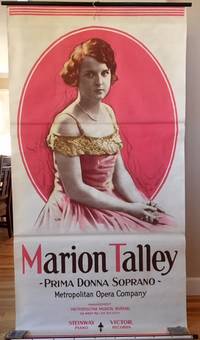
192451696New York NY; Hollywood CA; Taos NM: Underwood & Underwood Anderson Lumiere Guard Vitaphone Studios Metropolitan Music Bureau 1924-1927. Twenty seven items. With 24 photographs 3 sized 3.5 x 5.5 in.; 6 sized 5 x 7.75 in.; 1 w/ colour-tinted blue sized 7.25 x 9.5 in.; 16 sized 8 x 10 in.; many w/ annotations dating the photos in pencil some of the press photos and studio photos stamped on versos with attached newsreel information blurbs many w/ text in negative at lower corner of image; 1 very large colour lithograph poster printed on linen showing the young opera star seated and colours of pink gold and black sized 40 x 80 in. w/ wood bars at upper & lower for hanging some minor creasing from rolling but in Fine condition; and TLS from Lawrence H. Smith at Underwood & Underwood Inc. News Picture Division to Miss Marion Talley. These photographs and giant lobby poster provide splendid artifacts for the lavish attention paid to a young star at the beginning of her career during the Jazz Age. The very large poster is a beautiful example of colour lithography showing her demurely seated against a pink lozenge background with advertisements at the foot of the poster for Steinway Piano and Victor Records. Marion Talley 1906-1983 was the daughter of a telegraph operator for the Missouri Pacific Railroad and by 15 she was appearing in the Kansas City Grand Opera Company of Mignon by Abroise Thomas and quickly became a local celebrity often performing benefit concerts. She studied with music teacher Frank LaForge famed soprano composer who maintained a close relationship with the Metropolitan Opera and was placed under contract in 1925 by Giulio Gatti-Casazza at age 19 becoming the youngest principal female performer in the Met’s history to that point. Her debut performance was Feb. 17 1926 as Gilda the daughter of the title character in Verdi’s Rigoletto. The press photos show her surrounded by the many flowers she received in the 18 encores her performance on stage meeting the opera diva Ernestine Schumann-Heinck d. 1936 as well as her appearance on radio with Marguerite D’Alvarez and Giovanni Martinelli singing Home! Sweet Home!. In addition she also starred in the first Vitaphone short sound films released in 1926 with Don Juan starring John Barrymore and another Vitaphone short performing “Bella figlia dell’amore†from Rigoletto but the critics were savage criticizing her performances and her lack of appeal on camera. During this period she traveled extensively to Europe and through the southwest as evidenced by the series of photos showing her in Taos with the burros young Native American children and adults in regalia as well as her automobile. The photo of the young star by Samuel Lumiere 1878-1971 is a very nice example of his portrait work during the height of the 1920s when he was under contract to shoot celebrities for the Chicago Tribune. See: Barrios A Song in the Dark: The Birth of the Musical Film pp. 20-29; Vitaphone Marks 80th Anniversary Vitaphone News The Vitaphone Project Vol. 8 No. 1 2006; Crafton The Talkies: American Cinema’s Transition to Sound 1926-1931 1999. Underwood & Underwood, Anderson, Lumiere, Guard, Vitaphone Studios, Metropolitan Music Bureau, unknown
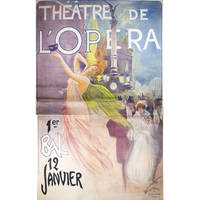
188019742<p><strong>Superb huge lithographed poster for a ball at the Opéra Garnier by painter and poster artist Edouard Charles Lucas 1866-1925 aka Charle Lucas.</strong></p> Impr. Chardin 17 passage Daudin
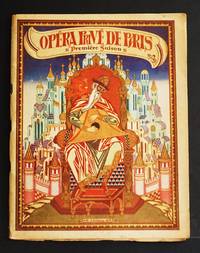
192920354Paris: Opéra Privé de Paris 1929. Good/No Dust Jacket As Issued. <br /> RUSSIAN MODERNISM REBORN ON THE PARISIAN STAGE.<br /> A visually striking Première Saison program documenting the post-Diaghilev continuation of Russian operatic and theatrical culture in interwar Paris. Issued by the newly founded Opéra Privé de Paris in 1929 this richly illustrated production program for Rimsky-Korsakov's 'Tsar Saltan' preserves the artistic language of the Ballets Russes through tipped-in color costume and scenic designs after Ivan Bilibin and Alexandre Korovine.<br /> <br /> Founded immediately following the death of Sergei Diaghilev the Opéra Privé de Paris sought to sustain the creative energy of Russian émigré theater in Western Europe. This production united performers designers and musicians associated with the Russian diaspora transforming Pushkin's fairy-tale opera into a vivid expression of émigré modernism transplanted into the cultural life of Paris.<br /> <br /> PHYSICAL DESCRIPTION: Quarto format approximately 9.5 × 12.5 inches. Stapled illustrated wraps with full-color chromolithographic cover after Ivan Bilibin. Illustrated with six tipped-in color chromolithographs of costume designs after Bilibin executed from stage maquettes by Alexandre Korovine together with two additional tipped-in scenic plates and a tipped-in color portrait of Madame Maria Kousnezoff-Massenet by Nicolas Kousnezoff. Numerous illustrated period advertisements throughout including several full-page advertisements.<br /> <br /> CONDITION: One advertisement leaf detached but present. Plates remain vivid and visually strong with only light handling wear to the wraps. Staples sound. A well-preserved and unusually attractive example of interwar Parisian opera ephemera. Première Saison issue.<br /> <br /> Première Saison programs of the Opéra Privé de Paris survive in comparatively small numbers particularly examples retaining the full suite of tipped-in color plates after Ivan Bilibin. Comparable illustrated programs from this short-lived company appear only intermittently in the market especially in near-complete condition. HISTORICAL SIGNIFICANCE -<br /> The Opéra Privé de Paris was co-directed by the Russian soprano Maria Kousnezoff-Massenet and functioned as an important cultural bridge for displaced Russian artists after the Revolution. Though short-lived the company preserved important elements of Russian operatic staging and Ballets Russes visual identity during a transitional moment in European theater history.<br /> <br /> Ivan Bilibin's influence on Russian stage aesthetics remained profound well into the twentieth century and his designs for productions such as 'Tsar Saltan' helped define the visual mythology of Russian folklore on the international stage.<br /> <br /> This program captures a pivotal moment in the evolution of Russian theatrical modernism after the dissolution of the Ballets Russes. Following Diaghilev's death in 1929 Russian émigré artists in Paris sought new institutional forms through which to continue the aesthetic innovations that had transformed European stage culture during the previous two decades.<br /> <br /> The production of Rimsky-Korsakov's 'Tsar Saltan' adapted from Pushkin's fairy-tale poem provided an ideal vehicle for this visual and musical continuity. The decorative richness of Ivan Bilibin's folkloric imagery combined with the scenic interpretation of Alexandre Korovine preserves the highly ornamental stage language that became synonymous with Russian theatrical design in the early twentieth century.<br /> <br /> Beyond its theatrical importance the program also presents a vivid portrait of interwar Parisian cultural life. Its advertisements portraiture typography and chromolithographic inserts collectively illustrate the commercial and artistic environment surrounding Russian émigré performance culture in France between the wars.<br /> <br /> SUBJECTS: Ballets Russes Legacy Ivan Bilibin Stage Design Russian Émigré Art Paris Theater History Rimsky-Korsakov Tsar Saltan Interwar Opera Culture Russian Opera In Paris Chromolithographic Illustration Illustrated Performance Programs Opera Ephemera Theater History Russian Modernism Illustrated Programs. Opéra Privé de Paris unknown
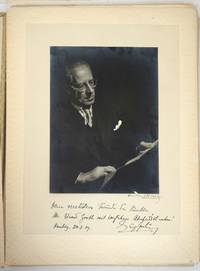
1949293881949. Good overall. An impressive collection of post W.W.II German opera stars dancers & directors and the stunning sets from the Hamburg Opera Ensemble. The 1st page is a dedication of farewell to Edward Groth US Consul General dated 24th May 1949. Groth had a long career in the Foreign Service including Consul in Afghanistan and India. <br /> <br /> Photographs of vocalists dancers directors - many signed - include: Günther Rennert staging director Arthur Grüber Günter Hertel Martina Wulf Theo Herrmann Ilse Koegel Helene Werth Lore Hoffman Hedy Gura Sigmund Roth Peter Markworth Hermann Mendt Nikola Eva Poser Rudolf Zerber Adolph Meyer-Bremen Johannes Drath Elfriede Wasserthal Richard Holm Irma Handler Cornelia Händel Elisabeth de Freitas and Danelies Rothenberger Otti Tenzel Bico von Larsky and several others signed and unsigned but unidentified. = signed. <br /> <br /> There are 20 programs for operas performed between April 1946 Die Entfuhrung aus dem Serail to April 1949 Raskolnikoff. Opera programs include: Tosca La Traviata Peter Grimes Othello Carmen Barber of Seville La Boheme Rigoletto and many others.<br /> <br /> Many of the performers were known through Europe. The portfolio starts with photo portraits which someone has annotated with sticky notes then includes many 1 sheet programs laid down and superb photographs of elegant sets for the varying operas. <br /> <br /> Fabric covered card covers cream cloth no title 38pp stiff card each page with 1 2 3 or 4 b&w photos later pages with programs from various operas dating 1946-1949. 38 portraits many silvertone 53 set photographs 20 programs for a total of 111 pieces. Photos varying in size 24 4 1/2 x 3.1/2" 42 6 329387/8 x 4 ¼" 20 5 ½ x 3 3/8" 4 9 3/8 x 7 1/8" and 20 programs all laid down on heavy card stock. Covers marked and dusty internally clean.<br /> <br /> Considering the Opera House was almost completely destroyed during the war this is a remarkable record of the Hamburg Opera and their artists. unknown
AQ25079vs.: vs. c. 1820s-1930s 12mo 8vo and quarto. The majority preserved within original publisher's wrappers. An extensive archive of theatrical publications and ephemera emanating from the recently dispersed library of Howth Castle County Dublin seat of the Gaisford-St. Lawrence family comprised of theatre programmes and libretti representing productions spanning from the late 1820s up to the 1930s both domestic and Continental in origin. The 94 individual publications comprehend: Eight playscripts and libretti printed in Paris between including an 1828 edition of Théaulon and Choquart's comic vaudeville Monsieur Jovial ou l'huissier-chansonnier 1827 and an 1882 issue of Charles Gounod's five-act opera Faust set to a French libretto by Jules Barbier and Michel Carré from Carré's play Faust et Marguerite. 15 Italian productions variously printed at Rome Milan Florence and Naples in the latter half of the nineteenth century including an 1848 Neapolitan edition of Verdi's four-act opera Nabucodonosor composed to an Italian libretto by Temistocle Solera first performed at La Scala in Milan 9th March 1842; and a programme to accompany the first performance of Verdi's Attila at La Fenice in Venice 17th March 1846. An Italian language edition printed at Barcelona in 1845 of Jacopo Ferretti's libretto Eran due or son tre 1834. 70 theatre programmes operas and Italian-language libretti printed in London spanning the century between the 1830s and 1930s including: 15 issued in the 1870s as a part of 'Davidson's Musical Opera-Books' series published in conjunction with performances at 'London's Italian Opera Houses' of productions of inter alia Rossini's The Barber of Seville Bizet's Carmen and Mozart's Don Giovanni and The Magic Flute each with a parallel English translation and 'the music of the principal airs'. The first appearance in print of the libretti for five Gilbert and Sullivan productions: Patience 1881 Princess Ida 1884 The Mikado 1885 The Yeomen of the Guard 1888 and Utopia 1893. A magazine-programme for a run of performances at the Shaftesbury Theatre in 1926 of J. M. Barrie's Peter Pan; or the Boy Who Wouldn't Grow Up 1904 - a production with which Barrie was directly involved - with Dorothy Dickson in the lead role. A run of 12 programmes for the 1925/26 1926/27 seasons at the The Old Vic including 11 productions of Shakespeare's plays all notably featuring leading Shakespearean actor Baliol Holloway d. 1967. Notable members of the Gaisford-St. Lawrence family included Thomas Gaisford 1789-1855 English classical scholar sometime curator of the Bodliean Library Regius Professor of Greek at Oxford and Dean of Christ Church. Gaisford’s eldest son Thomas Gaisford of Offington Sussex 1816-1898 British Army officer married in 1859 as his second of three wives Lady Emily St Lawrence d. 1868 eldest daughter of the third Earl of Howth. Their eldest surviving son Royal Navy officer Julian Charles Gaisford-St Lawrence 1862-1932 succeeded in 1909 his uncle the fourth and last Earl of Howth and came to reside at Howth Castle in Co. Dublin. A rare opportunity to acquire an ephemeral archive which not only exemplifies the theatrical passions of a single family across least three generations but documents the evolution of nineteenth century stage production charts the popular progress of Italian-language libretti in both Britain and on the Continent and exhibits the situation of English theatre prior to the post-war dominance of television and film. . [vs.], [c. 1820s-1930s] unknown
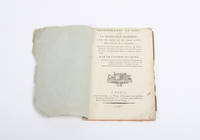
17913005370Paris: l'Auteur 1791. Some small tears and damage. A very good copy. Octavo; original condition stitched in plain blue-grey wrappers. <p><p>First edition of one of the most popular operas of the Revolution depicting the down-trodden villagers of the Moon after the arrival of the glamorous aviator Nicodème bringing news of events in France via Montgolfier balloon. Although this was an era of tremendous advances in stagecraft as the theatres of Paris and London vied with each other for the most stupendous effects Beffroy's lunar setting and the use of space travel by hot-air balloon was highly unusual. </p> <p>Beffroy de Reigny 1757-1811 was a successful journalist and dramatist usually writing under the nom-de-plume of "Cousin Jacques." His most important works were written in the period immediately following the French Revolution and he was fond of using lunar society to satirise the French as can be seen in his burlesque journal Les Lunes and its successor the Courrier des planètes.</p> <p>This is one of several Paris editions of the same year another appeared in Avignon and a "third" edition of 1797 is also recorded the last with subtle but pessimistic changes to the text. As the title confirms the opera was first performed in November 1790 running for over four hundred performances.</p> </p> . l'Auteur unknown
1989159645San Francisco: San Francisco Opera 1989. Vintage flyer advertising a costume sale by the San Francisco Opera SFO on April 22-23 1989 at the War Memorial Opera House.<br /> <br /> The SFO has held costume sales nearly every year for the last few decades frequently leading to lines stretched around the block. The SFO's costume sales serve not only to clear items from productions no longer performed to make room for new costumes but to generate much needed additional income for the arts organization. In recent years the SFO has begun holding their annual costume sale online.<br /> <br /> 8.5 x 11 inches on goldenrod paper. Very Good plus with light creasing overall and two small bruises on the bottom edge. San Francisco Opera unknown
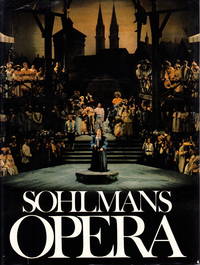
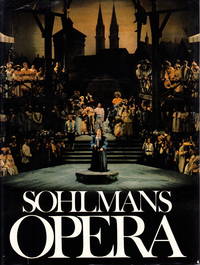
114642Stockholm Sohlmans förlag 1981. Stor 8:o. 511 1 s. Rikt illustrerad. Förlagsband med skyddsomslag. Ur Rolf Mallanders bibliotek. Fortfarande det bästa operalexikonet. Elsa-Britt Sjöstedt har översatt frÃ¥n den engelska Phaidon-upplagan 1978 och Hans Ã…strand har författat ett antal nya artiklar till denna upplaga. OriginalutgÃ¥va 1977 i Milano med titel â€L’ Opera: Repertorio della lirica dal 1597†unknown
109862Stockholm Sohlmans förlag 1981. Stor 8:o. 511 1 s. Rikt illustrerad. Förlagsband med skyddsomslag. Fortfarande det bästa operalexikonet. Elsa-Britt Sjöstedt har översatt frÃ¥n den engelska Phaidon-upplagan 1978 och Hans Ã…strand har författat ett antal nya artiklar till denna upplaga. OriginalutgÃ¥va 1977 i Milano med titel â€L’ Opera: Repertorio della lirica dal 1597†unknown
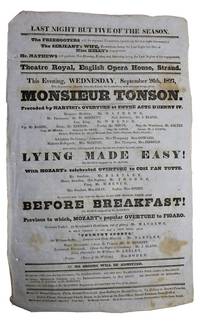
1827AQ21248London: S. G. Fairbrother 1827. Single leaf broadside. All edges uncut. Some spotting very short tear to one margin. An apparently unrecorded playbill advertising a staging at the English Opera House of William Moncrieff's 1794-1857 popular Monsieur Tonson a two-act farce first performed in 1821 with Mary Anne Goward 1805-1899 in the lead female role. In 1829 Goward married actor Robert Keeley 1793-1869 who also appears on the present bill as part of a 'new musical farce' Before Breakfast! Two further comic pieces were a part of the night's proceedings the performances interspersed with the overtures to Mozart's Cosi Fan Tutte and Figaro. . Dimensions 215 x 350 mm. S. G. Fairbrother unknown
1390455432.Gpaperback. Good. Access codes and supplements are not guaranteed with used items. May be an ex-library book. paperback
139035606X.Gpaperback. Good. Access codes and supplements are not guaranteed with used items. May be an ex-library book. paperback
0266005985.Gpaperback. Good. Access codes and supplements are not guaranteed with used items. May be an ex-library book. paperback