2 075 résultats
NOTE0127Kassel Bärenreiter 1968. 4°. XXIII 247 S. OLn. leicht angestaubt Ecken etwas lädiert Schnitt ein wenig fleckig Bindung gelockert. = Sämtliche Werke Abteilung III: Italienische Opere serie und Opernserenaden Band 8. Kassel, Bärenreiter 1968. unknown
1020556099.Ghardcover. Good. Access codes and supplements are not guaranteed with used items. May be an ex-library book. hardcover
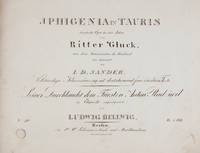
181241214Berlin: Schlesinger's Buch= und Musikhandlung Unter den Linden No. 34. PN 50 1812. Oblong folio. Contemporary dark brown mottled calf-backed marbled boards with oval label titled in manuscript to upper. 1f. recto title verso blank 3 "Personen" and incipits 4-123 i blank pp. <br /> <br /> Provenance<br /> Noted American harpsichordist Louis Bagger 1926-2024<br /> <br /> Binding worn rubbed and bumped. Very occasional minor soiling to blank lower margins; occasional minor showthrough; small stains to title with small circular publisher's handstamp to inner margin. Hopkinson 46Ca. <br /> <br /> Gluck's work is a tragedy in four acts to a libretto by Nicolas-François Guillard after Guymond de la Touche's Iphigénie en Tauride itself based on Euripides's work of the same name. <br /> <br /> "Iphigénie en Tauride was the crowning achievement of Gluck's career a result of the combination of his lifelong experience as an opera composer and a libretto which is arguably the best he ever set." Jeremy Hayes in Grove Music Online<br /> <br /> It was first performed in Paris at the Opéra on 18 May 1779 "with excellent singers; Rosalie Lavasseur sang Iphigénie Larrivée Oreste Legros Pylade and Moreau Thoas. . The opera had a great success immediately and even Grimm wrote of it - I do not know whether this is melody but perhaps it is something better. When I hear Iphigénie I forget I am at the opera; I seem to be listening to a Greek tragedy with music by Lekain and Mlle Clarion. It was the crowning point of Gluck's career. Guillard had provided an excellent libretto more classical than Goethe's poem less Christian and more ruthless; and Gluck had seized on the contrast between Scythians and Greeks upon the perfectly dramatic figures of Iphigenia and Orestes and had produced a work which both re-created a part of Greek tragedy and at the same time foretold a new world." Cooper: Gluck p. 258. Schlesinger's Buch= und Musikhandlung, Unter den Linden No. 34. [PN 50] unknown
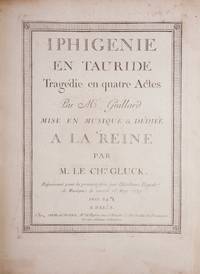
178340425Paris: Des Lauriers without PN 1783. Folio. Modern quarter dark red morocco with marbled boards black leather title label to spine gilt. i recto title verso blank i "Catalogue de Musique du fond de Des Lauriers Md. de Sapier rue St. Honoréa Paris" i dedication 211 i blank pp. Engraved throughout. <br /> <br /> With a short article from Marmontel's Mémoires laid down to blank verso of title in English translation regarding the opera's reception history. <br /> <br /> Occasional staining soiling and foxing to blank margins; small stain and hole under lowermost system of p. 65; blank upper outer margin of title through p. 7 dampstained; stain and minor loss to lower margin of pp. 18-22. In very good condition overall. Third edition unrecorded variant. Hopkinson 40A e. Wotquenne 46 pp. 215-16. Lesure p. 239 different issue. BUC p. 386. RISM G2816. <br /> <br /> "Iphigénie en Tauride was given on May 18 1778 with excellent singers; Rosalie Lavasseur sang Iphigénie Larrivée Oreste Legros Pylade and Moreau Thoas . The opera had a great success immediately and even Grimm wrote of it - I do not know whether this is melody but perhaps it is something better. When I hear Iphigénie I forget I am at the opera; I seem to be listening to a Greek tragedy with music by Lekain and Mlle Clarion. It was the crowning point of Gluck's career. Guillard had provided an excellent libretto more classical than Goethe's poem less Christian and more ruthless; and Gluck had seized on the contrast between Scythians and Greeks upon the perfectly dramatic figures of Iphigenia and Orestes and had produced a work which both re-created a part of Greek tragedy and at the same time foretold a new world." Cooper: Gluck p. 258. <br /> <br /> While Marie-Antoinette is not actually mentioned on the title she was the queen to whom the work is dedicated. Des Lauriers [without PN] unknown
180940434Bonn: Chez N. Simrock PN 609 1809. Oblong folio. Quarter black leather with gilt rules mid-brown cloth boards spine in compartments gilt with titling gilt marbled edges. 1f. recto title verso cast list 3-149 pp. Text in French and German. Engraved throughout. <br /> <br /> With contemporary signature of former owner "Mappes" to upper outer corner of free front endpaper with handstamp of August Kuby in Munich below; "Amalie Mappes" to upper outer corner of title.<br /> <br /> Binding worn rubbed bumped and slightly stained. Occasional soiling; small ink stains browning and foxing to blank margins; small loss to lower outer corner of p. 27. First Edition. Hopkinson p. 41 40F. Wotquenne 40. RISM G2753 and GG2753 no copies in the U.S. <br /> <br /> Iphigenie en Aulide was first performed in Paris at the Opéra on 19 April 1774. <br /> <br /> "Judging from contemporary accounts such as the memoirs of Mannlich the several months of rehearsals for Iphigénie en Aulide must have been quite a spectacle with the irascible 60-year-old composer struggling to reform the bad habits of the singers and players of the Académie Royale to teach them his new opera. However the première of Iphigénie en Aulide in April 1774 was a triumph but the run of performances was interrupted by the death of Louis XV a month later. All the theatres closed and during the period of mourning Gluck quickly revised Orfeo ed Euridice and made a French version of the opera with a translation of the text by Pierre Louis Moline." Jeremy Hayes in Grove Music Online. Chez N. Simrock [PN 609] unknown
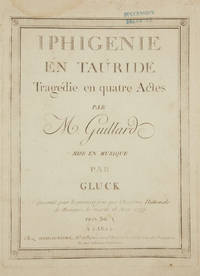
179536809Paris: Des Lauriers 1795. Folio. Quarter dark green calf with green cloth boards spine in decorative compartments gilt titling gilt marbled edges. 1f. recto title verso blank 1f. recto publisher's catalogue verso blank 211 pp. Engraved. <br /> <br /> Occasional performance markings in blue pencil.<br /> <br /> Some browning foxing and soiling; light dampstaining to upper portion of leaves; final leaves slightly creased at lower outer corners; small handstamp to upper margin of title. Second Edition. Hopkinson 46 A c the present copy is presumably from an earlier issue without plate number and with fewer items in the catalogue. Loewenberg 371. Sonneck p. 56. Lesure p. 239. BUC p. 386. RISM G2816. <br /> <br /> With this opera "Gluck foreshadowed most clearly the musical achievement of Wagner. For it was not until Iphigenie en Tauride that he contrived a balance between musical and dramatic interest which was of its school a perfect one . Iphigenie en Tauride is the one indisputable masterpiece produced by Gluck the one composition which can be measured against the very highest productions in its own or any other branch of musical expression." Cooper: Gluck p. 260. Des Lauriers unknown
NOTE0073Paris Chez Sieber Rue de filles St. Thomas No.21. entre les rues Richelieu et Vivienne. PlNr. 3. um 1795. Gr.4°. 2 Bl. 298 gest. S. Hldr. d. Zt. Rücken u. Kanten stärker berieben. Rechts unten mit kleinem Wurmbefall der ersten 55 Bl. ausserhalb des Plattenrandes. Sehr sauberer Abzug fast fleckenfrei. Hopkinson 40A i; nicht in CPM. Bibliographisch nicht nachgewiesene Übernahme der dritten Auflage des Werks von Des Lauriers rue St.Honore durch den Verlag Sieber. Die ursprüngliche Verlagsangabe wurde mit einem bedruckten Papierstreifen überklebt. Sonst ist unser Exemplar mit Hopk. 40Ai ident eingebundenes Katalogblatt Preis PlNr. Früher Partitur-Druck von den Platten der Originalausgabe. Paris, Chez Sieber, Rue de filles St. Thomas No.21. entre les rues Richelieu et Vivienne. (PlNr. 3.) [um 1795]. unknown
1024053555.Ghardcover. Good. Access codes and supplements are not guaranteed with used items. May be an ex-library book. hardcover
1356126669.Ghardcover. Good. Access codes and supplements are not guaranteed with used items. May be an ex-library book. hardcover
1986Q-0793598125G. Schirmer Inc 1986-10-31. paperback. New. In shrink wrap. Looks like an interesting title! G. Schirmer, Inc paperback
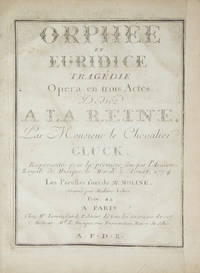
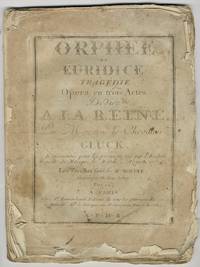
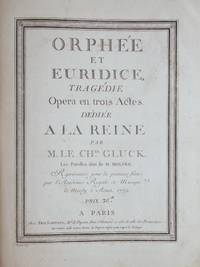
177429643Paris: Lemarchand 1774. Folio. 19th century quarter dark brown leather-backed marbled boards spine in decorative compartments gilt titling gilt. 1f. recto title verso publisher's catalogue 1f. recto dedication verso argument 217 pp. <br /> <br /> With an inscription signed by the Canadian conductor Wilfrid Pelletier 1896-1982 to Italian conductor Tullio Serafin 1878-1968 dated New York 1928 to front flyleaf.<br /> <br /> Bass figurings added in manuscript to pp. 10-12 Act I scene 1; final page of music signed by the publisher Lemarchand. <br /> <br /> Binding worn; edges rubbed; spine split at joints and hinges; chipped at head and tail. Slightly worn and browned; title soiled with outer edge reinforced with paper tape; some minor staining; several repairs to inner margins; occasional small holes. First Edition variant issue. Hopkinson 41Af. Wotquenne 41. Lesure p. 240. RISM G2852 not distinguishing among issues. <br /> <br /> First performed in Vienna at the Burgtheater on 5 October 1762 in Italian to a libretto by Ranieri de' Calzabigi and in Paris at the Opéra on 2 August 1774 in French to a libretto by Pierre Louis Moline after Calzabigi.<br /> <br /> "The classical orientation of Calzabigi evident in Orfeo ed Euridice from the moment the curtain rose on the almost archaeologically recreated ancient funerary ritual e.g. the threefold calling of the name of the deceased coloured the entirety of his collaboration with Gluck. Despite the ambiguous attributions of the prefaces signed by the composer it is clear that Gluck largely shared his librettist's classical enthusiasms . It is revealing that Gluck sought out subject matter from Greek tragedy independently of Calzabigi after the latter's departure from Vienna - most probably with his inner conviction mixing with a desire to exploit the goût grec then prevailing in France . Calzabigi's poetry was almost completely devoid of metaphors and similes and placed a mere three characters in a fluid context of dances and choruses or both simultaneously. The action was reduced to essentials: a demonstration of the persuasive powers of music and a cautionary tale on the dangers of curiosity with Orpheus bewailing the loss of his wife already as the curtain rose. Gluck's approach as composer was no less radical particularly in his near-complete elimination of coloratura and of opening ritornellos in the solo numbers. Above all the opera was remarkable in its emphasis on continuity which was achieved chiefly through the enchaining of harmonically open-ended sections of music and through the complete avoidance of recitativo semplice in favour of orchestrally accompanied recitatives so as to avoid sharp contrasts of texture with the set pieces. This continuity and the nearly syllabic vocal writing were calculated to prevent applause and thus also to promote the audience's absorption in the spectacle." Bruce Alan Brown and Julian Rushton in Grove Music Online. Lemarchand unknown
19563222DEUTSCHE GRAMMOPHON GESELLSCHAFT 07/1956. 1. hardcover. Sung in German! DEUTSCHE GRAMMOPHON GESELLSCHAFT hardcover
177440430Paris: Chez Mr. Lemarchand . A.P.D.R. 1774. Folio. Unbound. Sewn. 1f. recto title verso publisher's catalogue 1f. recto dedication verso "Argument" 52 pp. Engraved.<br /> <br /> Incomplete with only first act and three pages of second act present.<br /> <br /> Worn overall with occasional staining foxing and soiling throughout primarily to blank margins; title worn and heavily browned stained and soiled with paper loss to edges; corners slightly bumped and creased; signatures separated; binder's holes to blank inner margin. First Edition unrecorded variant. Wotquenne 41. Hopkinson p. 43 41A. BUC p. 386. Lesure p. 240. RISM G2582. <br /> <br /> First performed in Vienna at the Burgtheater on 5 October 1762 in Italian to a libretto by Ranieri de' Calzabigi and in Paris at the Opéra on 2 August 1774 in French to a libretto by Pierre Louis Moline after Calzabigi.<br /> <br /> "The classical orientation of Calzabigi evident in Orfeo ed Euridice from the moment the curtain rose on the almost archaeologically recreated ancient funerary ritual e.g. the threefold calling of the name of the deceased coloured the entirety of his collaboration with Gluck. Despite the ambiguous attributions of the prefaces signed by the composer it is clear that Gluck largely shared his librettist's classical enthusiasms . It is revealing that Gluck sought out subject matter from Greek tragedy independently of Calzabigi after the latter's departure from Vienna - most probably with his inner conviction mixing with a desire to exploit the goût grec then prevailing in France . Calzabigi's poetry was almost completely devoid of metaphors and similes and placed a mere three characters in a fluid context of dances and choruses or both simultaneously. The action was reduced to essentials: a demonstration of the persuasive powers of music and a cautionary tale on the dangers of curiosity with Orpheus bewailing the loss of his wife already as the curtain rose. Gluck's approach as composer was no less radical particularly in his near-complete elimination of coloratura and of opening ritornellos in the solo numbers. Above all the opera was remarkable in its emphasis on continuity which was achieved chiefly through the enchaining of harmonically open-ended sections of music and through the complete avoidance of recitativo semplice in favour of orchestrally accompanied recitatives so as to avoid sharp contrasts of texture with the set pieces. This continuity and the nearly syllabic vocal writing were calculated to prevent applause and thus also to promote the audience's absorption in the spectacle." Bruce Alan Brown and Julian Rushton in Grove Music Online. Chez Mr. Lemarchand ... A.P.D.R. unknown
178340431Paris: Chez Des Lauriers Md. de Papiers Rue St. Honoré à côté de celle des Provaires 1783. Folio. Early full dark brown leather with double rule gilt to edges of boards spine in compartments gilt with titling gilt marbled endpapers. 1f. recto title verso blank 1f. recto dedication verso "Argument" 217 pp. Bound with an extra title that of Hopkinson 41Ak. 1f. recto title verso blank 1f. recto blank verso "Argument" pp. <br /> <br /> Binding quite worn rubbed and bumped with loss to spine. Occasional minor soiling to blank outer margins; paper repairs to blank inner margins of approximately fifteen leaves; small binder's holes to blank inner margin of numerous leaves; occasional staining; worming to blank inner margin of final third of volume; extra title and Argument worn and soiling with worming to blank margins. Second edition of the French version. Wotquenne 41. A variant issue of Hopkinson 41Ai but with the price of 36 instead of 24 tt. Lesure p. 240. RISM G2853. <br /> <br /> First performed in Vienna at the Burgtheater on 5 October 1762 in Italian to a libretto by Ranieri de' Calzabigi and in Paris at the Opéra on 2 August 1774 in French to a libretto by Pierre Louis Moline after Calzabigi.<br /> <br /> "More successfully than any of his contemporaries Gluck translated the widespread agitation for reform of opera and theatrical dance on the part of European intellectuals into actual works for the stage first in pantomime ballets and Italian serious operas for Vienna and then in operas of various sorts for Paris." Bruce Alan Brown and Julian Rushton in Grove Music Online<br /> <br /> "The classical orientation of Calzabigi evident in Orfeo ed Euridice from the moment the curtain rose on the almost archaeologically recreated ancient funerary ritual e.g. the threefold calling of the name of the deceased coloured the entirety of his collaboration with Gluck. Despite the ambiguous attributions of the prefaces signed by the composer it is clear that Gluck largely shared his librettist's classical enthusiasms. . It is revealing that Gluck sought out subject matter from Greek tragedy independently of Calzabigi after the latter's departure from Vienna - most probably with his inner conviction mixing with a desire to exploit the goût grec then prevailing in France. . Calzabigi's poetry was almost completely devoid of metaphors and similes and placed a mere three characters in a fluid context of dances and choruses or both simultaneously. The action was reduced to essentials: a demonstration of the persuasive powers of music and a cautionary tale on the dangers of curiosity with Orpheus bewailing the loss of his wife already as the curtain rose. Gluck's approach as composer was no less radical particularly in his near-complete elimination of coloratura and of opening ritornellos in the solo numbers. Above all the opera was remarkable in its emphasis on continuity which was achieved chiefly through the enchaining of harmonically open-ended sections of music and through the complete avoidance of recitativo semplice in favour of orchestrally accompanied recitatives so as to avoid sharp contrasts of texture with the set pieces. This continuity and the nearly syllabic vocal writing were calculated to prevent applause and thus also to promote the audience's absorption in the spectacle." Bruce Alan Brown and Julian Rushton in Grove Music Online. Chez Des Lauriers, Md. de Papiers, Rue St. Honoré à côté de celle des Provaires unknown
1998Q-1891004026Pasta Pr Pub 1998-09-01. Paperback. New. In shrink wrap. Looks like an interesting title! Pasta Pr Pub paperback
1998DADAX1891004026Brand: Pasta Pr Pub 1998-01-01. paperback. New. 6.75x0.50x9.00. Buy with confidence. Excellent Customer Service & Return policy. Brand: Pasta Pr Pub paperback
3752599863.Gpaperback. Good. Access codes and supplements are not guaranteed with used items. May be an ex-library book. paperback
3752599871.Ghardcover. Good. Access codes and supplements are not guaranteed with used items. May be an ex-library book. hardcover
196670234Switzerland: Barenreiter 1966. hardcover. very good. Hardcover in very good condition no jacket. Binding still very good spine slightly cocked. Minor spotting/marks to boards. Boards slightly warped. Page block edges slightly marked. Da Capo Cathal 08/19 Cathal 03/20 Barenreiter hardcover
197278926Kassel. Fine. 1972. Hardcover. 4to. We specialize in fine books in collectible condition. Orders are professionally packaged and shipped promptly. P14 . Kassel hardcover
196978928Kassel. Fine. 1969. Hardcover. 4to. We specialize in fine books in collectible condition. Orders are professionally packaged and shipped promptly. P14 . Kassel hardcover
196978927Kassel. Fine. 1969. Hardcover. 4to. We specialize in fine books in collectible condition. Orders are professionally packaged and shipped promptly. P14 . Kassel hardcover
20131-3659465593Lap Lambert Academic Publishing 2013. Paperback. New. 100 pages. 8.66x5.91x0.23 inches. Lap Lambert Academic Publishing paperback
2013__3659465593Lap Lambert Academic Publishing 2013. Paperback. New. 100 pages. 8.66x5.91x0.23 inches. Lap Lambert Academic Publishing paperback
3375051360.Gpaperback. Good. Access codes and supplements are not guaranteed with used items. May be an ex-library book. paperback