4 résultats
177624109Paris: Aux Adresses Ordinaires En Province Chez les Mds. de Musique 1776. Folio. Sewn. 1 title 2-5 music i blank pp. <br/><br/>Spine reinforced with paper with numerous pinholes to outer margin; several small wormholes; tears to upper outer edges; occasional additional minor tears and stains; upper portion of final leaf lacking with early paper replacement missing music completed in manuscript. Lesure p. 238. RISM G2768 one copy only of the keyboard part at the Bibliothèque nationale. Aux Adresses Ordinaires, En Province Chez les Mds. de Musique unknown books
1770291401Bologna: Sassi 1770. hardcover. very good. 5 librettos 12mo & small 8vo bound together in 1 volume. 72 pages. 60pp. 32pp. and 7pp. Vellum backed marbles boards. Bologna: Sassi 1770 - 1771. Very good .<br/><br/> A scarce group of opera librettos.<br/><br/> Sassi unknown books
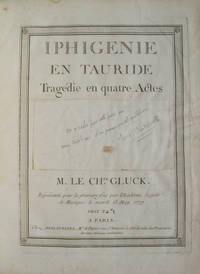
179224757Paris: Des Lauriers without PN 1792. Folio. Full contemporary green vellum with mid-tan leather label with decorative border gilt lettered "Romagnat" to upper edges colored in red. 1f. title 211 i blank pp. Engraved.<br/><br/>With blank overpaste to title with later manuscript note in pencil: "On a caché par cette . un nom . d'une personne qui a été guillotinée: Marie-Antoinette" by this overpaste a name of a guillotined person has been obscured: Marie-Antoinette. <br/><br/>Labels to verso of upper board: printed advertisement of "Husson Marchand Papier" to upper left corner; "Ex libris Georges van Parys" in the shape of a G clef to center. Bass figures entered throughout: pp. 1-31 164-70 and 174-end in pencil otherwise in ink.<br/><br/>Some moderate browning; occasional creasing and staining. Second edition first issue. Hopkinson 46A a. Wotquenne 46 pp. 215-16. Lesure p. 239. RISM G2816. <br/><br/>"Iphigénie en Tauride was given on May 18 1778 with excellent singers; Rosalie Lavasseur sang Iphigénie Larrivée Oreste Legros Pylade and Moreau Thoas . The opera had a great success immediately and even Grimm wrote of it - I do not know whether this is melody but perhaps it is something better. When I hear Iphigénie I forget I am at the opera; I seem to be listening to a Greek tragedy with music by Lekain and Mlle Clarion. It was the crowning point of Gluck's career. Guillard had provided an excellent libretto more classical than Goethe's poem less Christian and more ruthless; and Gluck had seized on the contrast between Scythians and Greeks upon the perfectly dramatic figures of Iphigenia and Orestes and had produced a work which both re-created a part of Greek tragedy and at the same time foretold a new world." Cooper: Gluck p. 258. <br/><br/>While Marie-Antoinette is not actually mentioned on the title she was the queen to whom the work is dedicated. Hopkinson describes a later issue with a new title without the dedication 46 A c.<br/><br/>Georges van Parys 1902-1971 was a French composer of operetta and film music. Des Lauriers [without PN] unknown books
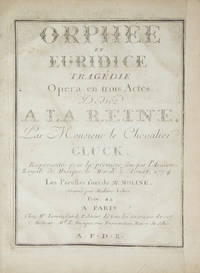
177429643Paris: Lemarchand 1774. Folio. 19th century quarter dark brown leather-backed marbled boards spine in decorative compartments gilt titling gilt. 1f. recto title verso publisher's catalogue 1f. recto dedication verso argument 217 pp. <br/><br/>With an inscription signed by the Canadian conductor Wilfrid Pelletier 1896-1982 to Italian conductor Tullio Serafin 1878-1968 dated New York 1928 to front flyleaf.<br/><br/>Bass figurings added in manuscript to pp. 10-12 Act I scene 1; final page of music signed by the publisher Lemarchand. <br/><br/>Binding worn; edges rubbed; spine split at joints and hinges; chipped at head and tail. Slightly worn and browned; title soiled with outer edge reinforced with paper tape; some minor staining; several repairs to inner margins; occasional small holes. First Edition variant issue. Hopkinson 41Af. Wotquenne 41. Lesure p. 240. RISM G2852 not distinguishing among issues. <br/><br/>"The classical orientation of Calzabigi evident in Orfeo ed Euridice from the moment the curtain rose on the almost archaeologically recreated ancient funerary ritual e.g. the threefold calling of the name of the deceased coloured the entirety of his collaboration with Gluck. Despite the ambiguous attributions of the prefaces signed by the composer it is clear that Gluck largely shared his librettist's classical enthusiasms. It is revealing that Gluck sought out subject matter from Greek tragedy independently of Calzabigi after the latter's departure from Vienna - most probably with his inner conviction mixing with a desire to exploit the goût grec then prevailing in France. Calzabigi's poetry was almost completely devoid of metaphors and similes and placed a mere three characters in a fluid context of dances and choruses or both simultaneously. The action was reduced to essentials: a demonstration of the persuasive powers of music and a cautionary tale on the dangers of curiosity with Orpheus bewailing the loss of his wife already as the curtain rose. Gluck's approach as composer was no less radical particularly in his near-complete elimination of coloratura and of opening ritornellos in the solo numbers. Above all the opera was remarkable in its emphasis on continuity which was achieved chiefly through the enchaining of harmonically open-ended sections of music and through the complete avoidance of recitativo semplice in favour of orchestrally accompanied recitatives so as to avoid sharp contrasts of texture with the set pieces. This continuity and the nearly syllabic vocal writing were calculated to prevent applause and thus also to promote the audience's absorption in the spectacle." Bruce Alan Brown and Julian Rushton in Grove Music Online. Lemarchand unknown books