24 résultats
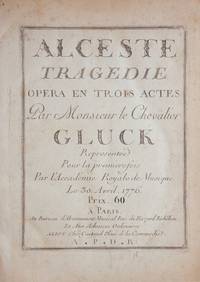
177624109Paris: Aux Adresses Ordinaires En Province Chez les Mds. de Musique 1776. Folio. Sewn. 1 title 2-5 music i blank pp. <br/><br/>Spine reinforced with paper with numerous pinholes to outer margin; several small wormholes; tears to upper outer edges; occasional additional minor tears and stains; upper portion of final leaf lacking with early paper replacement missing music completed in manuscript. Lesure p. 238. RISM G2768 one copy only of the keyboard part at the Bibliothèque nationale. Aux Adresses Ordinaires, En Province Chez les Mds. de Musique unknown books
177624109Paris: Aux Adresses Ordinaires En Province Chez les Mds. de Musique 1776. Folio. Sewn. 1 title 2-5 music i blank pp. <br /> <br /> Spine reinforced with paper with numerous pinholes to outer margin; several small wormholes; tears to upper outer edges; occasional additional minor tears and stains; upper portion of final leaf lacking with early paper replacement missing music completed in manuscript. Lesure p. 238. RISM G2768 one copy only of the keyboard part at the Bibliothèque nationale. Aux Adresses Ordinaires, En Province Chez les Mds. de Musique unknown
178734648diMünchen, Lentner, 1787. fester Pappband, etwas kl. DinA 5, Titelschild am oberen Rücken, in Holzoptik marmoriert, 343 Seiten, Einband mit Gebrauchsspuren, beschabt, berieben und bestoßen, Rücken und obere Deckel ausgeblichen und leicht verfärbt, Falzen zu den Rückenenden minimal eingerissen, Schnitt fleckig, Eintrag auf dem Vorsatzblatt, nur erste und letzte Seiten gering stockfleckig, Seiten altersbedingt leicht gewellt (kein Schaden), insgesamt gut erhalten / insgesamt guter Zustand [4 Warenabbildungen]
1755PEA3108Halle, Gebauer, 1755. [16], 80 Seiten, Vignetten, Rohbogen auf ca. 19 x 12 cm gefaltet, unaufgeschnitten, unbeschnitten. - Papier, Ränder, Schnitt teilw. gebräunt. Insgesamt guter Zustand; innen wenig stockfleckig. broschiert/ Taschenbuch/ paperback
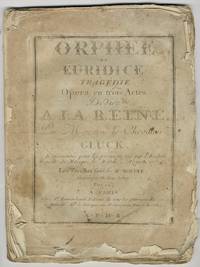
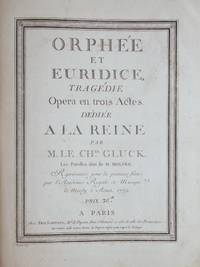
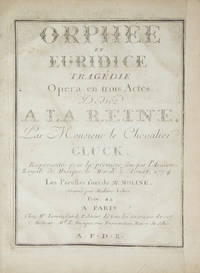
177440430Paris: Chez Mr. Lemarchand . A.P.D.R. 1774. Folio. Unbound. Sewn. 1f. recto title verso publisher's catalogue 1f. recto dedication verso "Argument" 52 pp. Engraved.<br /> <br /> Incomplete with only first act and three pages of second act present.<br /> <br /> Worn overall with occasional staining foxing and soiling throughout primarily to blank margins; title worn and heavily browned stained and soiled with paper loss to edges; corners slightly bumped and creased; signatures separated; binder's holes to blank inner margin. First Edition unrecorded variant. Wotquenne 41. Hopkinson p. 43 41A. BUC p. 386. Lesure p. 240. RISM G2582. <br /> <br /> First performed in Vienna at the Burgtheater on 5 October 1762 in Italian to a libretto by Ranieri de' Calzabigi and in Paris at the Opéra on 2 August 1774 in French to a libretto by Pierre Louis Moline after Calzabigi.<br /> <br /> "The classical orientation of Calzabigi evident in Orfeo ed Euridice from the moment the curtain rose on the almost archaeologically recreated ancient funerary ritual e.g. the threefold calling of the name of the deceased coloured the entirety of his collaboration with Gluck. Despite the ambiguous attributions of the prefaces signed by the composer it is clear that Gluck largely shared his librettist's classical enthusiasms . It is revealing that Gluck sought out subject matter from Greek tragedy independently of Calzabigi after the latter's departure from Vienna - most probably with his inner conviction mixing with a desire to exploit the goût grec then prevailing in France . Calzabigi's poetry was almost completely devoid of metaphors and similes and placed a mere three characters in a fluid context of dances and choruses or both simultaneously. The action was reduced to essentials: a demonstration of the persuasive powers of music and a cautionary tale on the dangers of curiosity with Orpheus bewailing the loss of his wife already as the curtain rose. Gluck's approach as composer was no less radical particularly in his near-complete elimination of coloratura and of opening ritornellos in the solo numbers. Above all the opera was remarkable in its emphasis on continuity which was achieved chiefly through the enchaining of harmonically open-ended sections of music and through the complete avoidance of recitativo semplice in favour of orchestrally accompanied recitatives so as to avoid sharp contrasts of texture with the set pieces. This continuity and the nearly syllabic vocal writing were calculated to prevent applause and thus also to promote the audience's absorption in the spectacle." Bruce Alan Brown and Julian Rushton in Grove Music Online. Chez Mr. Lemarchand ... A.P.D.R. unknown
1719302705Leipzig, verlegts Johann Christian Martini, 1719. 6 Blatt, 648 Seiten. Frontispiz. Lederband der Zeit mit vergoldetem Rückentitel 17 cm
179046402269A Paris, chez Boieldieu jeune, Rue de Richelieu, (vers 1790 ?) ; in-4, cartonnage bradel, papier vert marbré moderne. Titre, 293 pp., 2 ff. blancsPartition d’orchestre, gravée par Melle Lobry, de l’Alceste en français. Traduit de l’Italien par F. L. Gand Leblanc, bailli du Roulet. Ex-libris manuscrit “L. Rossignol (du Mans)” Ce dernier a rédigé une table de l’opéra (à l’encre) au verso du titre. Bel exemplaire, dans un élégant cartonnage à l’ancienne.
174910622Lucca (d. i. Venedig ?), (ohne Drucker), 1749. 16 Bll., 461 S. Kl.-8°. Pp.der Zeit mit Rückentitel (fleckig und etw. bestoßen).
177740432Paris Lyon: Au Bureau d'Abonnement Musical Rue du Hazard Richelieu et Aux Adresses Ordinaires. A Lion Chez Castaud Place de la Commedie 1777. Folio. Early dark brown morocco. 1f. recto title verso publisher's catalogue 293 pp. <br /> <br /> With "Lagny" in contemporary black ink to blank inner margin of p. 1. <br /> <br /> Binding worn rubbed and bumped. Slightly worn; title slightly browned and foxed; occasional minor foxing soiling browning and small stains; several leaves slightly trimmed at outer margin not affecting text or notation; small loss to blank lower outer corner of p. 87; light impression to lowermost system of p. 43. Lacking pp. 35/36. Second edition. Wotquenne 44. Hopkinson p. 54 44Acc. Lesure p. 236. BUC p. 385. RISM G2639. <br /> <br /> Alceste an opera in three acts with text by R. de Calzabigi and a ballet by Noverre was first performed on 26 December 1767 at the Burgtheater in Vienna. It was revised by Gluck for a performance in Paris on 23 April 1776. <br /> <br /> "Gluck himself stressed the nature of Alceste as a `reform opera' by providing in the preface dedicating the printed score to the Grand Duke Leopold a discussion that goes far beyond the conventional. .That key document at once a manifesto and a defense . is a sharp repudiation of the theory practice and conventions of the old "opera seria" represented in its final phase by Metastasio and his favourite composer Hasse." TNG Vol. 7 pp. 463 and 467. Au Bureau d'Abonnement Musical, Rue du Hazard Richelieu et Aux Adresses Ordinaires. A Lion Chez Castaud Place de la Commedie unknown
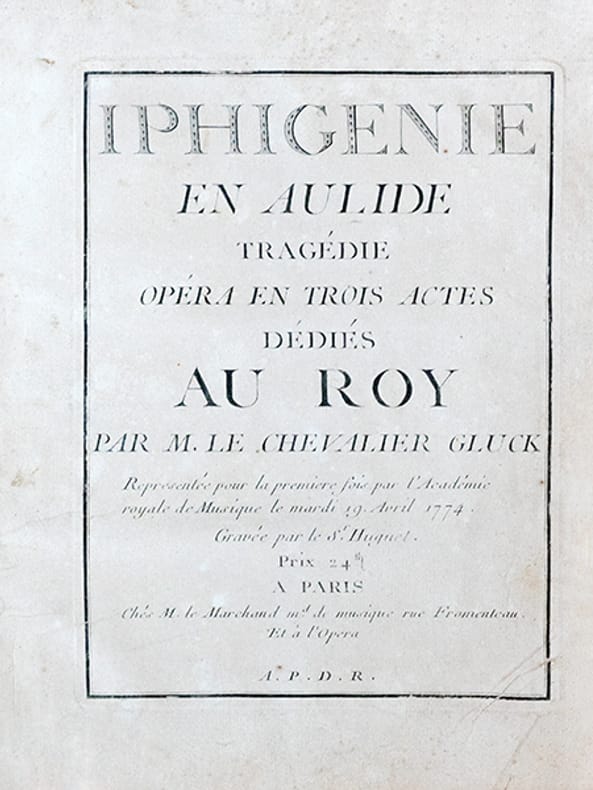
1774358091774 In-folio (330 x 255 mm), plein vélin teinté vert de l'époque, dos lisse, (1) f. de titre, (1) f. de dédicace, 298 p., (1) f. de catalogue des ouvrages de musique de l'éditeur. Paris, chez M. Le Marchand, rue Fromenteau, Et à l'Opéra, [1774].
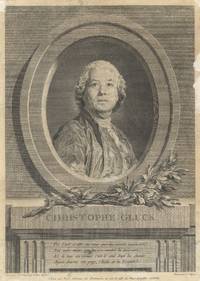
177540412Paris: chés Miger 1775. Sheet size 284 x 204 mm.<br /> <br /> The composer is depicted in a circular frame one-third length turned left with head facing forward and eyes raised. He is dressed in a pleated coat waist-length jacket shirt and cravat. The circular frame sits on a stone shelf and is adorned with a branch of laurel with lettering below as follows: CHRISTOPHE GLUCK // De l'art d'aller au coeur par des accords touchants letzter Buchstabe verdruckt / Nul autre mieux que lui n'a montré la puissance / Et de tous ses rivaux c'est le seul dont les chants / Ayent charmé son pays l'Italie et la France."<br /> <br /> Slight browning; minor abrasions primarily to margins with minor paper loss; some paper repairs. Scarce. chés Miger unknown
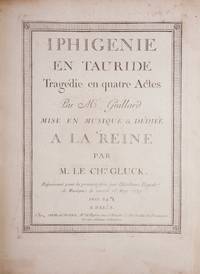
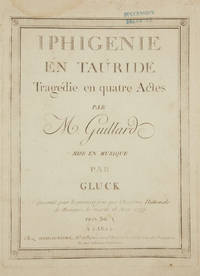
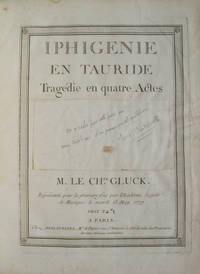
178340425Paris: Des Lauriers without PN 1783. Folio. Modern quarter dark red morocco with marbled boards black leather title label to spine gilt. i recto title verso blank i "Catalogue de Musique du fond de Des Lauriers Md. de Sapier rue St. Honoréa Paris" i dedication 211 i blank pp. Engraved throughout. <br /> <br /> With a short article from Marmontel's Mémoires laid down to blank verso of title in English translation regarding the opera's reception history. <br /> <br /> Occasional staining soiling and foxing to blank margins; small stain and hole under lowermost system of p. 65; blank upper outer margin of title through p. 7 dampstained; stain and minor loss to lower margin of pp. 18-22. In very good condition overall. Third edition unrecorded variant. Hopkinson 40A e. Wotquenne 46 pp. 215-16. Lesure p. 239 different issue. BUC p. 386. RISM G2816. <br /> <br /> "Iphigénie en Tauride was given on May 18 1778 with excellent singers; Rosalie Lavasseur sang Iphigénie Larrivée Oreste Legros Pylade and Moreau Thoas . The opera had a great success immediately and even Grimm wrote of it - I do not know whether this is melody but perhaps it is something better. When I hear Iphigénie I forget I am at the opera; I seem to be listening to a Greek tragedy with music by Lekain and Mlle Clarion. It was the crowning point of Gluck's career. Guillard had provided an excellent libretto more classical than Goethe's poem less Christian and more ruthless; and Gluck had seized on the contrast between Scythians and Greeks upon the perfectly dramatic figures of Iphigenia and Orestes and had produced a work which both re-created a part of Greek tragedy and at the same time foretold a new world." Cooper: Gluck p. 258. <br /> <br /> While Marie-Antoinette is not actually mentioned on the title she was the queen to whom the work is dedicated. Des Lauriers [without PN] unknown
1777343971777 In-folio (323 x 250 mm), plein vélin teinté vert de l'époque, dos lisse, (1) f. de titre, (1) f. "catalogue de musique Deslauriers", 279 p., entièrement gravé. Paris, Deslauriers, [1777].
179536809Paris: Des Lauriers 1795. Folio. Quarter dark green calf with green cloth boards spine in decorative compartments gilt titling gilt marbled edges. 1f. recto title verso blank 1f. recto publisher's catalogue verso blank 211 pp. Engraved. <br /> <br /> Occasional performance markings in blue pencil.<br /> <br /> Some browning foxing and soiling; light dampstaining to upper portion of leaves; final leaves slightly creased at lower outer corners; small handstamp to upper margin of title. Second Edition. Hopkinson 46 A c the present copy is presumably from an earlier issue without plate number and with fewer items in the catalogue. Loewenberg 371. Sonneck p. 56. Lesure p. 239. BUC p. 386. RISM G2816. <br /> <br /> With this opera "Gluck foreshadowed most clearly the musical achievement of Wagner. For it was not until Iphigenie en Tauride that he contrived a balance between musical and dramatic interest which was of its school a perfect one . Iphigenie en Tauride is the one indisputable masterpiece produced by Gluck the one composition which can be measured against the very highest productions in its own or any other branch of musical expression." Cooper: Gluck p. 260. Des Lauriers unknown
178340431Paris: Chez Des Lauriers Md. de Papiers Rue St. Honoré à côté de celle des Provaires 1783. Folio. Early full dark brown leather with double rule gilt to edges of boards spine in compartments gilt with titling gilt marbled endpapers. 1f. recto title verso blank 1f. recto dedication verso "Argument" 217 pp. Bound with an extra title that of Hopkinson 41Ak. 1f. recto title verso blank 1f. recto blank verso "Argument" pp. <br /> <br /> Binding quite worn rubbed and bumped with loss to spine. Occasional minor soiling to blank outer margins; paper repairs to blank inner margins of approximately fifteen leaves; small binder's holes to blank inner margin of numerous leaves; occasional staining; worming to blank inner margin of final third of volume; extra title and Argument worn and soiling with worming to blank margins. Second edition of the French version. Wotquenne 41. A variant issue of Hopkinson 41Ai but with the price of 36 instead of 24 tt. Lesure p. 240. RISM G2853. <br /> <br /> First performed in Vienna at the Burgtheater on 5 October 1762 in Italian to a libretto by Ranieri de' Calzabigi and in Paris at the Opéra on 2 August 1774 in French to a libretto by Pierre Louis Moline after Calzabigi.<br /> <br /> "More successfully than any of his contemporaries Gluck translated the widespread agitation for reform of opera and theatrical dance on the part of European intellectuals into actual works for the stage first in pantomime ballets and Italian serious operas for Vienna and then in operas of various sorts for Paris." Bruce Alan Brown and Julian Rushton in Grove Music Online<br /> <br /> "The classical orientation of Calzabigi evident in Orfeo ed Euridice from the moment the curtain rose on the almost archaeologically recreated ancient funerary ritual e.g. the threefold calling of the name of the deceased coloured the entirety of his collaboration with Gluck. Despite the ambiguous attributions of the prefaces signed by the composer it is clear that Gluck largely shared his librettist's classical enthusiasms. . It is revealing that Gluck sought out subject matter from Greek tragedy independently of Calzabigi after the latter's departure from Vienna - most probably with his inner conviction mixing with a desire to exploit the goût grec then prevailing in France. . Calzabigi's poetry was almost completely devoid of metaphors and similes and placed a mere three characters in a fluid context of dances and choruses or both simultaneously. The action was reduced to essentials: a demonstration of the persuasive powers of music and a cautionary tale on the dangers of curiosity with Orpheus bewailing the loss of his wife already as the curtain rose. Gluck's approach as composer was no less radical particularly in his near-complete elimination of coloratura and of opening ritornellos in the solo numbers. Above all the opera was remarkable in its emphasis on continuity which was achieved chiefly through the enchaining of harmonically open-ended sections of music and through the complete avoidance of recitativo semplice in favour of orchestrally accompanied recitatives so as to avoid sharp contrasts of texture with the set pieces. This continuity and the nearly syllabic vocal writing were calculated to prevent applause and thus also to promote the audience's absorption in the spectacle." Bruce Alan Brown and Julian Rushton in Grove Music Online. Chez Des Lauriers, Md. de Papiers, Rue St. Honoré à côté de celle des Provaires unknown
1800RO50056034DESLAURIERS. VERS 1800. In-Folio. Relié. Etat d'usage, Plats abîmés, Dos abîmé, Mouillures. 211 pages de partitions. Plats trés frottés et rognés à restaurer. Dos partiellement manquant. Légères mouillures sur le bas des pages, sans conséquences sur la lecture. Annotations sur la première page blanche. Représenté pour la première fois par l'Académie Nationale de musique le mardi 18 May 1779.. . . . Classification Dewey : 780.26-Partitions
1777121877P., Deslauriers, s.d. (1777), in-folio (323 x 250 mm), (1) f. de titre, 279 pp, reliure plein veau raciné, dos à 5 larges faux-nerfs soulignés de doubles filets dorés, titre doré dans un encadrement floral au 1er plat, tranches mouchetées (rel.de l'époque), coiffes arasées, pt accrocs au 2e plat, pt mque à un coin, plats lég. frottés, coins émoussés, trace de mouillure ancienne en coin, infime travail de vers en marge sup. des 10 derniers feuillets, marges des 4 premiers feuillets restaurées, 4 pages manquantes (p. 217-220) remplacées par une copie manuscrite très bien exécutée à l'époque, bon exemplaire, entièrement gravé sur cuivre, imprimé sur papier fort
1770291401Bologna: Sassi 1770. hardcover. very good. 5 librettos 12mo & small 8vo bound together in 1 volume. 72 pages. 60pp. 32pp. and 7pp. Vellum backed marbles boards. Bologna: Sassi 1770 - 1771. Very good .<br/><br/> A scarce group of opera librettos.<br/><br/> Sassi unknown books
1770291401Bologna: Sassi 1770. hardcover. very good. 5 librettos 12mo & small 8vo bound together in 1 volume. 72 pages. 60pp. 32pp. and 7pp. Vellum backed marbles boards. Bologna: Sassi 1770 - 1771. Very good .<br/> <br/> A scarce group of opera librettos.<br/> <br/> Sassi unknown
179224757Paris: Des Lauriers without PN 1792. Folio. Full contemporary green vellum with mid-tan leather label with decorative border gilt lettered "Romagnat" to upper edges colored in red. 1f. title 211 i blank pp. Engraved.<br/><br/>With blank overpaste to title with later manuscript note in pencil: "On a caché par cette . un nom . d'une personne qui a été guillotinée: Marie-Antoinette" by this overpaste a name of a guillotined person has been obscured: Marie-Antoinette. <br/><br/>Labels to verso of upper board: printed advertisement of "Husson Marchand Papier" to upper left corner; "Ex libris Georges van Parys" in the shape of a G clef to center. Bass figures entered throughout: pp. 1-31 164-70 and 174-end in pencil otherwise in ink.<br/><br/>Some moderate browning; occasional creasing and staining. Second edition first issue. Hopkinson 46A a. Wotquenne 46 pp. 215-16. Lesure p. 239. RISM G2816. <br/><br/>"Iphigénie en Tauride was given on May 18 1778 with excellent singers; Rosalie Lavasseur sang Iphigénie Larrivée Oreste Legros Pylade and Moreau Thoas . The opera had a great success immediately and even Grimm wrote of it - I do not know whether this is melody but perhaps it is something better. When I hear Iphigénie I forget I am at the opera; I seem to be listening to a Greek tragedy with music by Lekain and Mlle Clarion. It was the crowning point of Gluck's career. Guillard had provided an excellent libretto more classical than Goethe's poem less Christian and more ruthless; and Gluck had seized on the contrast between Scythians and Greeks upon the perfectly dramatic figures of Iphigenia and Orestes and had produced a work which both re-created a part of Greek tragedy and at the same time foretold a new world." Cooper: Gluck p. 258. <br/><br/>While Marie-Antoinette is not actually mentioned on the title she was the queen to whom the work is dedicated. Hopkinson describes a later issue with a new title without the dedication 46 A c.<br/><br/>Georges van Parys 1902-1971 was a French composer of operetta and film music. Des Lauriers [without PN] unknown books
177429643Paris: Lemarchand 1774. Folio. 19th century quarter dark brown leather-backed marbled boards spine in decorative compartments gilt titling gilt. 1f. recto title verso publisher's catalogue 1f. recto dedication verso argument 217 pp. <br/><br/>With an inscription signed by the Canadian conductor Wilfrid Pelletier 1896-1982 to Italian conductor Tullio Serafin 1878-1968 dated New York 1928 to front flyleaf.<br/><br/>Bass figurings added in manuscript to pp. 10-12 Act I scene 1; final page of music signed by the publisher Lemarchand. <br/><br/>Binding worn; edges rubbed; spine split at joints and hinges; chipped at head and tail. Slightly worn and browned; title soiled with outer edge reinforced with paper tape; some minor staining; several repairs to inner margins; occasional small holes. First Edition variant issue. Hopkinson 41Af. Wotquenne 41. Lesure p. 240. RISM G2852 not distinguishing among issues. <br/><br/>"The classical orientation of Calzabigi evident in Orfeo ed Euridice from the moment the curtain rose on the almost archaeologically recreated ancient funerary ritual e.g. the threefold calling of the name of the deceased coloured the entirety of his collaboration with Gluck. Despite the ambiguous attributions of the prefaces signed by the composer it is clear that Gluck largely shared his librettist's classical enthusiasms. It is revealing that Gluck sought out subject matter from Greek tragedy independently of Calzabigi after the latter's departure from Vienna - most probably with his inner conviction mixing with a desire to exploit the goût grec then prevailing in France. Calzabigi's poetry was almost completely devoid of metaphors and similes and placed a mere three characters in a fluid context of dances and choruses or both simultaneously. The action was reduced to essentials: a demonstration of the persuasive powers of music and a cautionary tale on the dangers of curiosity with Orpheus bewailing the loss of his wife already as the curtain rose. Gluck's approach as composer was no less radical particularly in his near-complete elimination of coloratura and of opening ritornellos in the solo numbers. Above all the opera was remarkable in its emphasis on continuity which was achieved chiefly through the enchaining of harmonically open-ended sections of music and through the complete avoidance of recitativo semplice in favour of orchestrally accompanied recitatives so as to avoid sharp contrasts of texture with the set pieces. This continuity and the nearly syllabic vocal writing were calculated to prevent applause and thus also to promote the audience's absorption in the spectacle." Bruce Alan Brown and Julian Rushton in Grove Music Online. Lemarchand unknown books
177429643Paris: Lemarchand 1774. Folio. 19th century quarter dark brown leather-backed marbled boards spine in decorative compartments gilt titling gilt. 1f. recto title verso publisher's catalogue 1f. recto dedication verso argument 217 pp. <br /> <br /> With an inscription signed by the Canadian conductor Wilfrid Pelletier 1896-1982 to Italian conductor Tullio Serafin 1878-1968 dated New York 1928 to front flyleaf.<br /> <br /> Bass figurings added in manuscript to pp. 10-12 Act I scene 1; final page of music signed by the publisher Lemarchand. <br /> <br /> Binding worn; edges rubbed; spine split at joints and hinges; chipped at head and tail. Slightly worn and browned; title soiled with outer edge reinforced with paper tape; some minor staining; several repairs to inner margins; occasional small holes. First Edition variant issue. Hopkinson 41Af. Wotquenne 41. Lesure p. 240. RISM G2852 not distinguishing among issues. <br /> <br /> First performed in Vienna at the Burgtheater on 5 October 1762 in Italian to a libretto by Ranieri de' Calzabigi and in Paris at the Opéra on 2 August 1774 in French to a libretto by Pierre Louis Moline after Calzabigi.<br /> <br /> "The classical orientation of Calzabigi evident in Orfeo ed Euridice from the moment the curtain rose on the almost archaeologically recreated ancient funerary ritual e.g. the threefold calling of the name of the deceased coloured the entirety of his collaboration with Gluck. Despite the ambiguous attributions of the prefaces signed by the composer it is clear that Gluck largely shared his librettist's classical enthusiasms . It is revealing that Gluck sought out subject matter from Greek tragedy independently of Calzabigi after the latter's departure from Vienna - most probably with his inner conviction mixing with a desire to exploit the goût grec then prevailing in France . Calzabigi's poetry was almost completely devoid of metaphors and similes and placed a mere three characters in a fluid context of dances and choruses or both simultaneously. The action was reduced to essentials: a demonstration of the persuasive powers of music and a cautionary tale on the dangers of curiosity with Orpheus bewailing the loss of his wife already as the curtain rose. Gluck's approach as composer was no less radical particularly in his near-complete elimination of coloratura and of opening ritornellos in the solo numbers. Above all the opera was remarkable in its emphasis on continuity which was achieved chiefly through the enchaining of harmonically open-ended sections of music and through the complete avoidance of recitativo semplice in favour of orchestrally accompanied recitatives so as to avoid sharp contrasts of texture with the set pieces. This continuity and the nearly syllabic vocal writing were calculated to prevent applause and thus also to promote the audience's absorption in the spectacle." Bruce Alan Brown and Julian Rushton in Grove Music Online. Lemarchand unknown
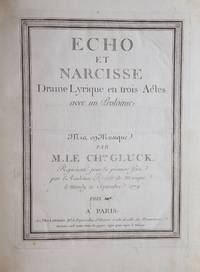
177940424Paris: Chez des Lauriers Md. de Papiers Rue St. Honoré à côté de celle des Prouvaires Ou trouve aussi toutes sortes de papiers réglés pour copier la Musique 1779. Folio. Contemporary quarter dark brown calf with marbled boards spine in decorative compartments gilt with titling gilt to spine. 1f. recto title verso blank 256 pp. <br /> <br /> With blank overpaste to title obscuring the words "Par M. Le Baron de T." <br /> <br /> Signature "L. Wessén" in ink to front pastedown and "A. Benzinger" to free front endpaper. <br /> <br /> Binding worn rubbed and bumped; lower portion of upper joint partially split. Occasional small stains foxing browning tears and light dampstaining; minor loss to blank outer margin of pp. 139 and 149; several small holes to p. 237. Quite a good copy overall on quality paper. First Edition variant issue. Hopkinson p. 63 with attributes of 47Ac except here there is no plate number and the price "40" appears in manuscript and 47Ae as "Royale" has been erased here in pencil. Wotquenne 47. BUC p. 386. RISM G2739<br /> <br /> First performed in Paris at the Opéra on 24 September 1779. <br /> <br /> "Echo et Narcisse was a failure at its early performances largely because the audiences and critics expected high drama along the lines of Alceste Armide and Iphigénie en Tauride. But Echo et Narcisse is a different type of work; it belongs to the pastoral tradition still popular at this date and a genre to which Gluck frequently returned. Comparisons were and are still made with Gluck's more popular dramas because Echo et Narcisse contains numbers and scenes similar to those that had made greater impressions before. It is not a weak opera and there is much fine music in it ." Jeremy Hayes in Grove Music Online<br /> <br /> Gluck was a "Bohemian-Austrian composer of Italian and French opera a leading figure in opera of the second half of the 18th century and the person chiefly credited with the 'reform' of opera after the age of Metastasian opera seria. . Force of circumstance may have led Gluck to Paris to complete his operatic career but in artistic terms Paris can be seen as his inevitable final destination. His years of grounding in opéra comique and the ballet and via Traetta his response to the French tragédie lyrique tradition had already provided the impetus for his overhaul of the opera seria; now it was time to confront that tradition on its own territory. On more than one occasion indeed Gluck explicitly owned the French influence and its particular effect on his preparation for Paris. Between them the eight operas that he produced for the Académie Royale de Musique in Paris - the two Iphigénie operas; the radical revisions for Paris of the Vienna 'reform' operas Orfeo and Alceste; the similar revisions of the Vienna opéras comiques Cythère assiégée and L'arbre enchanté; Armide a new opera on a libretto that Quinault had written for Lully more than 90 years earlier; and the last opera Echo et Narcisse - are all different attempts at the confrontation and revival of that lyric tradition." Jeremy Hayes Bruce Alan Brown Max Loppert and Winton Dean in Grove Music Online. Chez des Lauriers Md. de Papiers, Rue St. Honoré à côté de celle des Prouvaires Ou trouve aussi toutes sortes de papiers ré unknown
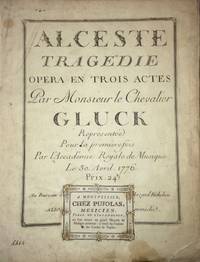
17761634Paris; Lion Lyon: Au Bureau d’Abonnement Musical Rue du Hazard Richelieu Et Aux Adresses Ordinaires; Chez Castaud Place de la Commedie 1776. First edition. In contemporary green vellum with red title vignettes on spine and front panel. Tinted edges. Contemporary bookseller’s vignette on title page Chez Pujolas Montpellier. Cover rubbed at extremities stained damaged at corners. Title page torn at lower corner with no effect to text. Old shelf mark in ink on the title page. Bookblock somewhat loose. Pages lightly brown. Occasional stains. A brown stain to the lower edge of the fists few leaves and to the side edge of the last leaves. Overall in very good condition. First edition. In contemporary green vellum with red title vignettes on spine and front panel. Tinted edges. Contemporary bookseller’s vignette on title page Chez Pujolas Montpellier. 2 305 1 p. <p><br /> First edition of the full score of the French revised version of Gluck’s Alceste. <br /> <p><p><br /> "The first edition consisting of 305 numbered pages - of which only two copies have been found by me - exists in two states." Hopkinson. <br /> <p><p><br /> A scarce true first edition of the full score of Christoph Willibald Gluck’s 1714–1784 opera finished in 1767 and recomposed for the Paris performances in 1776. The present edition consisting of 305 numbered pages with the printed price on the title page “Prix 24 Fr†and with the “Catalogue†on the verso of the title page.<br /> <p><p><br /> RISM G 2638; Hopkinson 44A; Wotquenne 44<br /> <p>. Au Bureau d’Abonnement Musical, Rue du Hazard Richelieu, Et Aux Adresses Ordinaires; Chez Castaud Place de la Commedie unknown