11 856 résultats
19982111902160102219Institute of Ocean Technology Publishing Department 1998. Soft Cover. Fine. Volume: 1 Institute of Ocean Technology Publishing Department paperback
19721327<p>Trade paperback edition. First edition. Faint creasing to spine; light soiling and wear to wraps; minor creasing to bottom edge of front cover; light bumping to edges and corners; text is clean and unmarked. Scarce. Good. </p> E. P. Dutton paperback

199260366Irvine CA: Consolidated Placer Dredging Co. 1992. 8vo. xix 1 315 1 pp. With photo plates text illustrations photo illustrations diagrams charts graphs throughout. Brown cloth gilt lettering front cover spine minor bumping at foot of spine w/ d.j. wraparound photo cover art of dredge working in a river delta minor shelfwear still NF/NF copy inscribed by author on ffep. from the library of Columbia Steel Casting Co. First edition stated & signed of the first complete text on placer mining issued for miners and mining operators since the Great Depression. He details how to explore new prospects methods of evaluation necessary equipment feasibility studies dredging or other equipment for placer mining mineral jigs and his work against the massive damage caused by illegal miners working placer deposits in South America Africa and Southeast Asia. Consolidated Placer Dredging Co., hardcover
1972S11345Mexico City:: Sociedad Mexicana de Historia de la Ciencia y de la Tecnologia 1972-79. 1972. 3 volumes nos. 3 4 & 5; Vols. 4-5 stated one of 1000 copies. 8vo. iv 352; iv 348; iv 147 pp. Original printed wrappers; lightly smudged and rubbed rear cover Vol. 4 with small closed hole. Burndy Library bookplates. Very good. Featuring an entire volume dedicated to the memory of Izquierdo a prolific Mexican doctor and historian of science who specialized in physiology. Sociedad Mexicana de Historia de la Ciencia y de la Tecnologia, 1972-79. unknown
192560077Cleveland OH: The Superior Die Casting Co. The Heiser Co. Commercial Photographers; Rebman Photo Service ca. 1925-1944. Twelve items; 1st - Oblong 4to. 12.5 x 9 in. With 41 linen-backed silver gelatin photographs sized 9.5 x 7.5 in. mounted on linen hinges at gutter margin most with typescript inscriptions on linen versos most dated 2 images of promotional articles bound as folding double-page panoramic photo. Contemporary ribbed flexible calf post-binder gilt lettering stamped on front cover Company logo of SuperCast in lower left corner margin some chipping to head & foot of spine edgewear scuffing minor soiling to rear pastedown still a VG copy; 2nd - Folio. 12.5 x 14 in. Two parts in one vol. Left hand half features 32 pp unpaginated. w/ mylar sleeves each w/ colour-tinted printed mylar film cell recto & verso of each comprising an additional 64 leaves overlaying the 32 silver gelatin product images sized 8.5 x 11 in. revealed below carefully identifying the cast parts; 34 pp unpaginated. mylar sleeves holding 22 black & white silver gelatin photos sized 8.5 x 11 in. on glossy photo stock photographer’s imprint stamped on verso along with printed text & sales figures tables for Superior Die Casting Co. Contemporary flexible pebbled cafl facing 22-ring binders at gutter fore-edges khaki-coloured zipper around fore-edges gilt stamping & logo on front cover minor scuffing edgewear some curling to mylar cell overlays still a VG exemplar; 3rd-14th - 4to. 4; 4; 4; 2; 2; 2; 2; 2; 4 including three SuperCast product catalogues from the 1920’s a Better Methods catalogue; Die Casting Adler Bag linen bag leaf w/ 8 Superior Die Casting Co. business cards dated in MS from 1925-1927 camera-ready add copies envelopes and even loose leaves touting the newly completed factory to be opened in 1928. These salesman sample photo albums and ancillary ephemera vividly document the die cast alloy products churned out by the fast growing Superior Die Casting Co. founded in 1919 following World War I by two intrepid Jewish-American engineers. The first album composed entirely of linen-backed photographs open with images of the newly opened SuperCast Die Cast factory and reproductions of trade magazines touting the company’s new ally with 50000 lbs. of tensile strength with 25% greater permanency when subjected to extreme heat and steam as well as greater strengths when subjected to sub-zero testing in 1930. The myriad of inventive and eye-catching product photographs depict oil pump bodies Motometer mounts partition castings piston and crank assemblies fans rotors pulls speedometer drives rumble seat arm rests auto pedals oil gauge parts auto door panel glass holders and more. Of particular interest are the photographs depicting the vast nearly surrealist collage product exhibits created for the 8th National Exposition of Power & Mechanical Engineering in Grand Central Palace New York 1929; the 1929 Cleveland Automobile Show at the Public Auditorium or the 1927 Cleveland Industrial Exposition. The second sales album featuring 54 silver gelatin photographs and 32 of them designed with a nearly avante-garde creativity with ingeniously arranged product collages augmented with colour-tinted overlays. The SuperCast castings display a wide range of Wartime products including gun sight components computer cams for targeting gun turrets flight instruments Army Air Force automatic pilot and bomb sight parts and more. In addition a myriad of ticket marking machines metering instruments auto heaters refrigerator parts vending machine frames hair dryers T.V. antenna rotators pump impellers railroad speed recorders and much more spill across the large photos. This sales album focuses on the SuperCast zinc alloy die castings some with electro-plating along with machined aluminum alloy castings. A few of the Wartime Homefront factory photographs show a significant number of women working to aid the War effort in the packing and shipping department and the factory production floor. Harry Weiss 1882-1975 and Adrian Weiss 1894-1964 were both machinists and engineers with Adrian serving as engineer in the AEF in Europe from 1917-Dec. 1919 while Harry Weiss arranged financing and began producing the initial products of iron and steel castings sheet metal steel wire and steel products. From the 1920’s until after World War II the company produced die castings for automobiles electric motors appliances engines phonographs calculating machines mechanical toys motion picture projectors and more. Heiser 1881-1938 was art and commercial photographer in Cleveland OH who maintained a large staff of photographers and engravers. He frequently taught classes in and around Cleveland along with W.H. Bass of Indianapolis on how to build successful commercial photography businesses and detailing how to prepare product photos. Rebman 1910-1962 formed his commercial studio during World War II after leaving his job working as pressman and photographer for the Cleveland Plain Dealer and his commercial Rebman Photo Service expanded and continued operating as a family business following his death. Family tradition would be continued later by his nephew Mort Tucker who had enhanced the business of Rebman Photo by focusing more on department store and fashion photography as well as architects financial institutions and more. This cataloguer could find almost no remaining historical reference or physical presence of any photographs related to the company and in fact the sole portfolio of undated company trade literature under SuperCast Die Castings is held by Cleveland State. The Superior Die Casting Co., The Heiser Co., Commercial Photographers; Rebman Photo Service, unknown
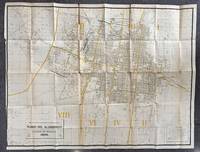
19046209Mexico 1904. Good. Map 31 x 41 inches. Old folds; slight loss and wear at some folds wear and chipping at edges. Lightly toned at folds minor soiling. A large and wonderful map depicting the streetlight illumination of Mexico City. The map puts the Alameda Central at the center of the sheet with eight outlined districts divided around it. A key provides a series of varying red dots which denote streetlights at various bulb levels as well as those planned for an increase. Green lines show electric lines both planned and in place. Various railroads snake throughout the city with the central train yard featured in the upper left center. The area with the most illumination left to do is the eighth district centered on the Paseo de la Reforma. Though the Paseo does have a series of lamps in place most of the rest of the area around it does not as it is still under development. We find no copies of this map in OCLC though with maps that is not uncommon. A fascinating look at the modernization and electrification of Mexico City at the turn of the 20th century. unknown
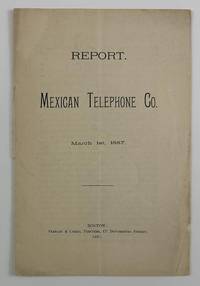
18874321Boston: Stanley & Usher Printers 1887. Very good. 12pp. Original printed self wrappers sewn. Minor dust-soiling and edge wear. Soft vertical crease throughout. Internally clean. Very good. with: Annual Report of the Mexican Telephone Company. 1890-1891. Boston: E.W.S. Jones Stationer and Printer 1891. 11pp. Original printed wrappers stapled. Wrappers somewhat toned small chip at each corner short vertical closed tear and some discoloration to front wrapper. Soft vertical crease throughout. Internally clean. An informative pair of rare and early reports from the Mexican Telephone Company a subsidiary of American Bell Telephone Company that sought to establish a national telephone network across Mexico during the 1880s. The Mexican Telephone Company began operations in 1882 using equipment from Western Electric and other supplies harvested from local Mexican markets specifically Mexican trees for telephone poles. At first the company met with success but over the course of the next two decades the company's work was eroded by a combination of increasing competition unsound workmanship the volatility of the Mexican financial markets and the restructuring and merging of telephone companies around the turn of the century. By 1905 the Mexican Telephone Company was sold or transferred to the Boston Telephone Company. Renamed the Mexican Telephone and Telegraph Company the branch continued to operate in Mexico contributing to the construction of an underground cable network.<br /> <br /> The present pamphlets provide interesting insight into the early years of the company's operations in Mexico. The first pamphlet opens with a letter to stockholders from J.D. Sargent the company's president. Sargent informs the investors of recent mismanagement of funds by the company's treasurer with which the company is dealing. He also reports on the company's takeover of the Puebla Telephone and Telegraph Company the infringement of the company's territorial rights by rival companies the hopeful outlook for completion of a railroad to Guadalajara which will likely result in "a decided improvement in business there for the future" and other news vital to the company's operations in Mexico. The following four pages are comprised of a detailed financial report to Sargent and the company directors by the general manager of the company M.L. Guiraud. Rounding out the first work is a two-page Treasurer's Report by the Treasurer pro tem. A.E. Denison.<br /> <br /> The later report indicates some volatility in the company's ranks as the opening letter from the president of the company is delivered by a new president Robert Colgate. Early in his letter Colgate mentions that he has been head of the company for two years and was part of a new regime put in place to curtail expenses liquidate outstanding obligations and "settle all outstanding claims with the view of putting the Company on a strong financial basis." Much of the remainder of Colgate's letter addresses lawsuits claims and other business which have now brought the health of the company to a "very satisfactory condition." The remainder of this annual report is a Treasurer's Report from yet another new treasurer W. French Smith. <br /> <br /> OCLC reports just a single copy of the later report at the University of Michigan. There are no holdings reported for the earlier report from 1887. Stanley & Usher, Printers unknown
2000ABE-278067314New York: Harry N. Abrams Inc. 2000. 2000. 4to. pp. 176. 200 illus. 140 colour. biblio. bds. dw. Exhib. Cat. Hardcover. New York: Harry N. Abrams , Inc., 2000. Hardcover
1894S2318Berlin:: Julius Springer 1894 1895 1900. 1894. Three volumes. 310 x 240 mm. 4to. Numerous tables and figs. Later black cloth gilt spines. Ex library blind stamps of the Carnegie Institution Mount Wilson Observatory. Fine. FIRST EDITION. Technical articles most of which refer to technical thermometry but includes others on optics electricity properties of metals and more. Julius Springer, 1894, 1895, 1900. hardcover
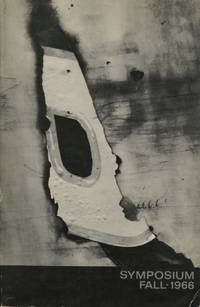
196653922Rochester: Rochester Institute of Technology 1966. First edition. 8vo. 40 pp largely illustrated from b&w photographs. Glossy photo-illustrated stapled wrappers. Moderate rubbing with a bent lower tip. Very good. A student publication of Rochester Institute of Technology: Editorial G. Gary Metz; Production Scott Goewey John Moore; Graphic Design William Phelan. The photographs are by: Michael Becotte William Sesto Larry McPherson Christian Delbert William Morris Quentin Kardos Gary Metz Gary Calderwood C. Kenneth Davis Gary Graham Diane Kay A. Uptis David Moog. Poetry by: Scott Goeway Kathleen Morris W.T. Ranney Mary Littlefield et al. No copies listed on WorldCat. Rochester Institute of Technology unknown
193264022St. Charles MO & Chicago IL: American Car & Foundry Engineering Dept. Chicago Rock Island & Pacific Railway; St. Louis & San Francisco Railroad 1932-1940. Oblong folio. 15.5 x 11.25 in. 112 pp unpaginated. thick black paper stock. With 151 silver gelatin photographs mounted within sized from 7 x 9 in. up to 10.5 x 13.5 in. a few long narrow 6 x 13.5 in. nearly all w/ typed captions w/in negative at lower fore-edges some w/ minor chipping at corners others w/ minor rippling from mounting. Contemporary faux textured flexible black calf post-binder nickel-plated screwposts at gutter margin wraparound spine black cloth w/ white lettering for title “Air. Condt. Equip.†on spine in manuscript some bumping to corners a few leaves w/ cracking in center from weight of images a few reinforced at gutter margin w/ black cloth tape still a VG exemplar. This exceptional in-house factory album visually details the American Car & Foundry’s research & development testing laboratory facilities as they raced to compete with the Pullman Company to introduce the latest innovation in rail technology -- air conditioning. This one technology was not only essential for fast streamlined trains as prior to their introduction passenger railcars were largely cooled by opening windows but also for their standard railcars as well. However all steel cars with the emphasis on less wind resistance allowed all railroad car sets to travel at higher speeds -- streamliners up to 100 miles per hour. Ralph Budd the president of Chicago Burlington & Quincy Railroad was the innovator who combined the all steel cars first developed in 1907 by Alexander Cassatt with stainless steel air-conditioning equipment and powerful diesel engines. This album opens with equipment for the Chicago Rock Island & Pacific Railway diner cars along with mechanical air-conditioning systems for the Wabash RR Chair Cars; together with the mechanical systems motors belts fan systems compressor coils air-conditioning ice boxes for transporting perishable foods and so much more. Of additional interest are the portable temporary rolling air-conditioning units which would be hooked up to diner and passenger coach cars when in the depot allowing comfort while the cars were not powered by diesel locomotive engines and their power plants so as to not drain the batteries. American Car & Foundry systems proved so successful that many of these photos show their large “Thermo-Gravity Air Conditioning System†units for overseas railways. No similar albums or technological records for American Car & Foundry are located in Worldcat; See: Air Conditioning: The Essential Technology Streamliner Memories August 1 2013. American Car & Foundry, Engineering Dept., Chicago, Rock Island & Pacific Railway; St. Louis & San Francisco Railroad, hardcover
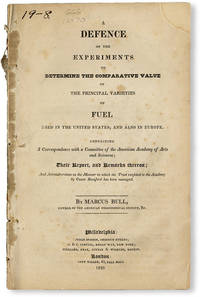
182850246Philadelphia / London: Judah Dobson / John Miller 1828. Octavo 21cm.; removed; 51pp.; illus. in text. Some foxing to textblock small damp spot at top fore-edge corner of first few leaves else Very Good and sound. First edition for a British readership. Missed by Sabin. Judah Dobson / John Miller unknown
188549879Boston: Geo. H. Ellis 1885. First Edition. Slim octavo 23cm.; publisher's tan printed wrappers; 28pp. Upper cover separated but present with a few small losses to extremities some toning and light dust-soil else Good internally sound. Inscribed and signed at head of upper cover "Dr. Bowditch with the regards of G.L. Vose." Possibly inscribed to the physician and abolitionist Henry Ingersoll Bowditch 1808-1892 son of Nathaniel Bowditch. Geo. H. Ellis unknown
181549862New-York: David Longworth 1815. First Edition. Octavo 20.5cm.; removed; 148pp. Top third of first few leaves quite darkened title page serving as upper cover somewhat chipped with a few tiny losses none approaching text else Good to Very Good overall. From the DAB: ".considered a lucid account of the current state of American scientific research." The discourse pp. 3-38 is followed by more than one hundred pages of notes and citations. SABIN 13715; SHAW & SHOEMAKER 34371. David Longworth unknown
188748930La Salle IL: Democrat-Press Print 1887. First Edition. 24mo 13cm.; publisher's tan printed stitched wrappers; 16pp. Light soil to upper cover extensive but fairly inoffensive contemporary scribbles to rear cover else Very Good or better. Apparently unrecorded we find no separately catalogued copies in OCLC as of April 2020. Democrat-Press Print unknown
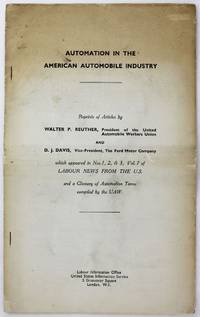
19554891London England: Labour Information Office / United States Information Service 1955. Very good. 29pp. Folio. Original printed wrappers stapled. Noticeable toning and spotting to wrappers minor edge wear. Light toning to first text leaf. A rare collection of offprints of three articles which first appeared in the English publication Labour News from the U.S. in 1955 on the subject of automation in the American car industry along with a glossary of terms compiled by the United Auto Workers UAW. Two of the articles were authored by Walter P. Reuther president of the UAW and the third was written by D.J. Davis vice president of the Ford Motor Company. The articles were presented by the authors to a special joint subcommittee of the United States Congress. Reuther reports from the labor perspective writing that automation is welcomed by labor unions but he also points out the many problems of the practice. He also discusses the impending effects of electronic computers on society the responsibilities of employers the productivity of capital the need for growth in consumer markets the need for small business aid and more. Reuther suggests policies such as a more equitable distribution of the tax burden adequate unemployment compensation improved social security a higher minimum wage and other improvements that will satisfy the labor market in the advent of more automation. Davis's article provides the Ford Motor Company's perspective on the issue their definition of automation as well as its economics and effects. The glossary comes from a pamphlet printed by the UAW the same year and provides definitions of a range of terms such as automation servomechanism cybernetics and robot among others. We locate no other copies of this collection of offprints on automation from 1955 providing early information on the effects of computers and perhaps foretelling the advent of artificial intelligence on American industry. Labour Information Office / United States Information Service unknown
191356323Detroit & New York: The American Light and Traction Company May 1913. 4to. 9.5 x 11 in. 140 pp unpaginated. With 55 linen-backed silver gelatin photographs sized 8 x 10 in. nearly all w/ identifying text w/in negative at lower fore-edge many w/ dittoed labels on versos photographer’s marks on versos and nearly all mounted on linen hinges at gutter margins; 1 cyanotype chart. Contemporary black cloth post-binder brass screw posts at gutter margin rear cover repaired wear & bumping to corners occasional fraying & wear to fore-edges of text leaves still a VG copy w/ nearly all photos having bright strong contrast. First edition of this exceedingly scarce product photo album touting the industries and products produced and powered by the American Light & Traction Co. utility consortium providing an essential visual survey of United States power use and applications prior to World War I. The striking photographs depict the often gritty working conditions the presence of women in some industries such as the chocolate dipping factory and the myriad of industrial processes in the opening decades of the 20th Century. These industries and machines powered by the AL&T Co. include asphalt melting ovens annealing furnaces barrel drying beer production commercial bakeries smelting of brass and aluminum candy furnaces china the testing of Lozier automobile engines and the operation of Nash and International Harvester gas engines. Of particular interest are the expansive sections on converting commercial kitchens in Milwaukee WI hotels and restaurants to run on gas ice machines in Cleveland rivet heating factories in Milwaukee and the massive tire and wheel factories in Milwaukee & Detroit. Founded originally in 1900 for consolidating many small utilities and power suppliers such as Detroit City Gas Co. Milwaukee Gas Light Co. Southern Light and Traction Co. Muskegon Traction & Lighting Co. and others the company quickly expanded gaining control over 40 gas producing plants electric light and streetcar companies as well as manufacturing plants. McMillin 1844-1922 was an Ohio financier and banker who controlled the company until his death which subsequently came under fire as a monopoly utility from such strident critics as Gifford Pinchot and in 1935 was broken up by the enactment of the Public Utility Holding Act eventually emerging as Michigan Consolidated Gas and eventually merged with DTE Energy. Benham 1883-1964 worked as a photographer before World War I with his own studio before becoming an inspector with the Lincoln Auto Co. and then reestablishing his commercial photography studio until his death. He is perhaps best rememebered for his photo taken in 1901 of Henry Ford’s only automobile race against Alexander Winton in 1901. No copies located in Worldcat; See: Cyphers The National Civic Federation and the Making of a New Liberalism 1900-1915 pp. 142-143; Gifford Pinchot The Power Monopoly Its Make-Up and its Menace 1928; Debunking Henry Ford’s “Faster Horse†Quote Observations & Inspirations ZinZin by Jay Nov. 28 2012. The American Light and Traction Company, hardcover
187755847London & New York: George Routledge and Sons 1877. Thick 8vo. xii 594 pp. plus 2 pp. publisher’s ads. Woodcut engraved frontisp. 7 woodcut-engraved plates 1 chromolithograph plate of light spectra all w/ tissue guards 357 woodcut text engravings. Pictorial red publisher’s cloth illustration and decorative lettering in red black & gilt on front cover & spine cover art photo of iron naval ship spine of a Franklin stove minor rubbing edgewear to fore-edges corners still VG copy. Revised & expanded edition of this lavishly illustrated work documenting the wonders of the Victorian Age including steam engines railways breech-loading rifles explosive bullets torpedoes letterpress printing optics the electric telegraph aquariums rubber and so much more. George Routledge and Sons, hardcover
189952423New York: Munn & Co 1899. Early reprint. 12mo 18cm. Publisher's blue cloth board title decoratively stamped in silver on front board; viii9-140pp; illus; 4pp publisher's ads. Trace of rubbing at spine ends and board corners; text clean tight and unmarked; Very Good or better. A highly technical treatise and possibly the first manual of its kind. First published in 1891 OCLC notes reprints as late as 1921. Munn & Co unknown
193739320Berlin: Deutsche Reichspost 1937. Near fine. Trilingual booklet produced to accompany the Deutsche Reichspost's videophone service exhibited and displayed in the German Pavilion at the 1937 Paris Exposition. Illustrated with black and white photographs this work produced under the Nazi regime shows an operator seated in the "cabin of the television-telephone" equipped with handset and view-screen: "For the talky transmission a highly qualified apparatus made by Telefunken is used a telecine scanner fitted with a Cinema-projector with a constant film transport and optical picture balance works together with an iconoscope in such a way that this scanning apparatus with another iconoscope can be easily interchanged." An uncommonly early work in the development of television and the electronic transmission of visual imagery melding German nationalism with futurism. 8" x 5.75" Saddle-stapled color pictorial wraps. 21 pages. Minor edgewear; faint touches of soil to back cover. Deutsche Reichspost unknown
19817966Newtown CT: Taunton Press 1981-1995. First edition. Original Wraps. Very Good. Large Octavo pp. approx. 130 per issue profusely illustrated w/ color and b/w photographs. Issue list - 1981: 1 2 4; 1982: 7 8 11; 1983: 14; 1984: 19; 1992: 74 75 76 77; 1993: 78 79 81 82 83 84; 1994: 85 86 87 88 91; 1995: 92 93 94. Very attractive and highly regarded magazine with nitty-gritty articles on building. A nice set. including Issue No. 1 and other early issues. Taunton Press paperback
192255371Granite City IL & St. Louis MO: John H. Wedig Sun Motors Corporation; William L. Schreiber Commercial Photographer 1922. Two vols. 1st - 4 leaves Five plates & diagrams. Steel-engraved printed softcovers typed form on front cover with US seal awarding Patent No. 1421632 to John H. Wedig and Sun Motors punch-sewn at gutter margin w/ blue ribbon minor dustsoiling edgewear w/ TLS from Ralph Kalish addressed to John H. Wedig; 2nd -- Oblong 4to. 12 x 9.25 in. With 39 linen-backed silver gelatin photographs including 4 images 35 of blueprints & diagrams many hand-coloured on images all mounted on linen hinges at gutter margin stamped on versos w/ photographer’s studio stamp. Contemporary Acco-folder post-binder bound w/ nickel-plated sliding Acco fastener at gutter margin minor edgewear rubbing still VG exemplar. A fascinating patent model album and patent award for a rotary “internal-combustion engine†developed by Wedig a Granite City IL physician and inventor. Rotary engines had first been developed by Millet and Hargrave by 1889 with applications to motorcycles and operating large flywheels. By 1900 Adams-Farwell automobiles had developed and introduced rotary engines into their motor cars. Prior to World War I there was a flurry of activity surrounding the development of rotary engines for aircraft as their power-to-weight ratios gave them an advantage over in-line engines being developed at the time. Dr. Wedig 1885-1934 an Illinois physician and inventor believed that he had made enough improvements to claim a U.S. patent including the piston sequences camshaft issues oil distribution and cooling problems. He filed in April 1918 just months after the U.S. had entered World War I and formed the Sun Motors Corporation to develop a lighter weight and more efficient rotary engine apparently not only for aircraft but also other uses. However his patent was not awarded until July 1922 and by that time high fuel consumption and oil lubrication issues would doom the rotary engine within a very short time and Sun Motors Corporation disappeared. Air-cooled radial engines notably produced by Jaguar and Bristol Jupiter replaced rotaries in aircraft and rotary engines before the Wankel rotary engine were largely confined to small and short-lived automobile companies such as Adams-Farwell Bailey Intrepid and others. Wedig had previously invented and patented a double-chamber syringe and known to have worked on other technological and medical devices. Schreiber 1879-1947 was a lithographer who became a successful commercial photographer whose business flourished until the Great Depression and then he disappears from street and commercial directory listings and is registered as unemployed for the World War II draft in 1942. John H. Wedig, Sun Motors Corporation; William L. Schreiber, Commercial Photographer, paperback
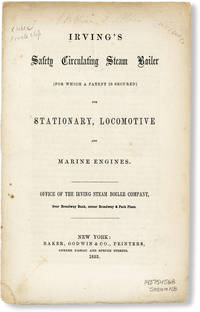
185348954New York: Baker Godwin & Co 1853. First Edition. Octavo 23.5cm.; side-stitched self-wrappers; 8pp. Faint vertical fold some light toning and wear to extremities bottom half of spine split 20th century private library rubberstamp to title page verso else Good or better overall. Errata slip laid in. Apparently unrecorded advertising pamphlet for Irving's boiler mentioned in an article in "Scientific American" in the same year: "Those who want cheap steam in the growing scarcity and advancing price of fuel would do well to give this boiler a serious examination." Not catalogued in OCLC as of April 2020. Baker, Godwin & Co unknown
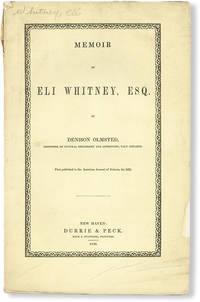
184649661New Haven: Durrie & Peck 1846. First Separate Edition. Octavo 23cm.; original pale yellow wrappers printed within decorative border; 80pp.; engraved portrait frontispiece and one additional plate pink tissue guards. Wrapper extremities a bit chipped and worn with shallow loss at spine crown general dust-soil else Very Good internally fine. Lengthy biographical article first published in the "American Journal of Science" 1832. Missed by Sabin. Durrie & Peck unknown
19497232Copenhagen: Olaf Moller 1949. Second edition. Half-Leather. Very Good. Octavo pp. 564 plus foldout charts many engine diagrams some b/w photographs of engines. Very scarce Danish volume on internal combustion engines w/ diagrams charts and equations. Olaf Moller hardcover