Livre Rare Book
44 résultats
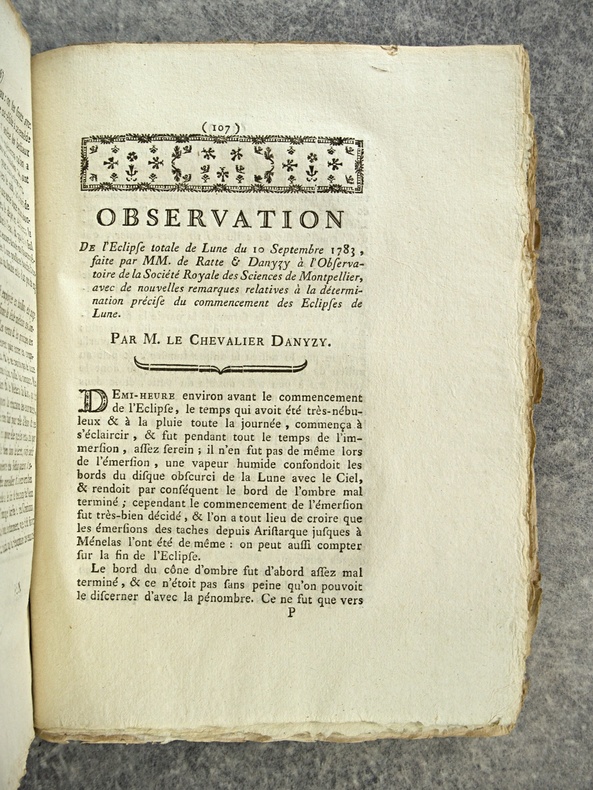
17842647A MONTPELLIER. DE L'IMPRIMERIE DE JEAN MARTEL AINE, IMPRIMEUR ORDINAIRE DU ROI, DES ETATS DE LA PROVINCE DE LANGUEDOC, & DE LA SOCIETE ROYALE DES SCIENCES. 1784. IN-4 BROCHE (20,5 X 25,5 X 1,5 CENTIMETRES ENVIRON) DE 118 + (3) PAGES, COUVERTURE PAPIER MARBRE D'ORIGINE. TITRE ILLUSTRE D'UNE VIGNETTE DE TITRE AUX ARMES ROYALES. CONTIENT:- ELOGE DE M. GARIPUY.- TOUCHY. MEMOIRE SUR LA VOIX DES OISEAUX.- BERTHOLON (ABBE). DES AVANTAGES QUE LA PHYSIQUE ET LES ARTS QUI EN DEPENDENT, PEUVENT RETIRER DES GLOBES AEROSTATIQUES. - CHAPTAL. OBSERVATIONS GENERALES SUR L’HISTOIRE NATURELLE DES DIOCESES D’ALAIS & D’UZES. BON EXEMPLAIRE, «DANS SON JUS», TEL QUE PARU, AVEC ENVOI AUTOGRAPHE: «POUR MR AUBARET ».
173546590(Paris, L'Imprimerie Royale, 1735). 4to. Without wrappers. Extracted from ""Mémoires de l'Academie des Sciences. Année 1733"". Pp. 23-39, pp. 73-84, pp. 233-254 a. 1 engraved plate, pp. 457-476. With titlepage to the volume (1733/1735). Margins of titlepage with a few brownspots.
175344319Paris, Freres Guerin, 1753. Small 8vo. Cont. full mottled calf. Top of spine with wear. Raised bands, richly gilt spine. Some wear to titlelabels. Small tear to hinges at upper compartment (hinges not loosening).. Spine a little rubbed. Small loss of leather at at lower right corner of frontcover. XXIII,444 pp. and 8 large folded engraved plates (showing apparatus and experiments with electricity). Internally clean, printed on good paper. From the library of le Comte de Caumia Baillenx, ""en son Chateau d'Andrain"" and with his mongram, blindtooled on both covers.
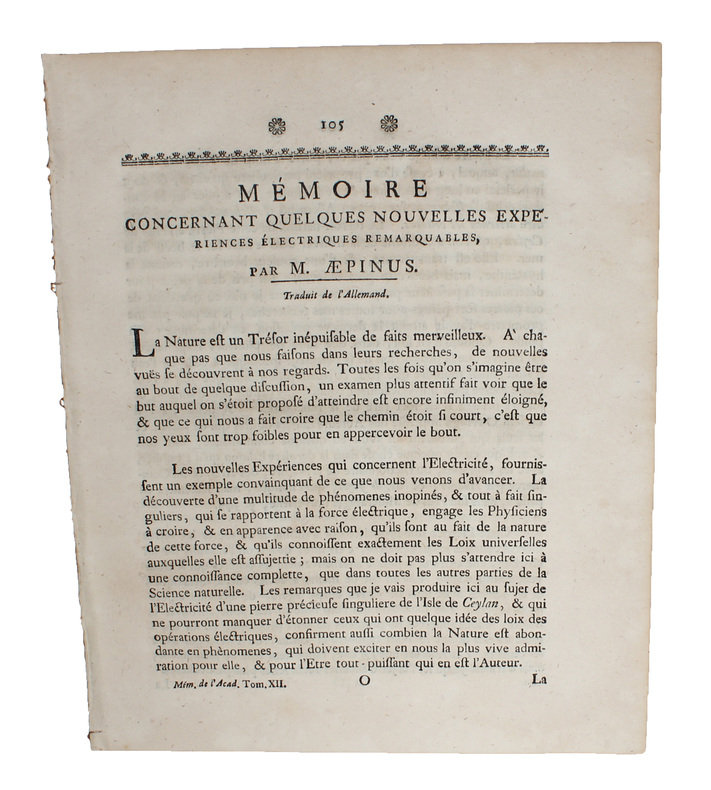
175846557Berlin, Haude et Spener, 1758. 4to. No wrappers, as issued in ""Mémoires de l'Academie Royale des Sciences et Belles-Lettres"", 1756, tome XII. Pp. 105-121. With titlepage to the volume, printed in red/blac and with engraved titlevignette. Also having the parttitlepage. Titlepage with 2 small wormtracts.
174753510Verona: Giannalberto Tumermani 1747. First edition. Engraved title vignette and headpiece. 8 189 7 pp. 1 vols. 4to. Original boards uncut. Some early but faint dampstaining throughout -- otherwise a fine wide-margined copy. First edition. Engraved title vignette and headpiece. 8 189 7 pp. 1 vols. 4to. Collection of fifteen letters on the origins of lightning by the enlightened polymath Maffei 1675-1755 "said by Grimelli Storia to contain all the anterior letters on Lightning published by him i.e. all before 1746 the date of the censorship." - Ronalds<br /> <br /> The book is rare in institutions -- OCLC gives only one location. Ronalds p. 314; Gartrell p. 334; OCLC: 23628231 one location: U. of Michigan; Mottelay p. 321; Baaken Library p. 83; not in Wheeler; not in RLIN Giannalberto Tumermani unknown
17610055561761 Paris, Le Mercier, 1761. Deux volumes in-12 (171 X 104 mm) basane fauve marbrée, dos à nerfs orné, pièces de titre et de tomaison maroquin rouge et vert, tranches rouges (Reliure de l'époque). Tome 1 : (7) ff. (faux-titre, titre, avertissement, approbation, privilège), 330 pages - Tome 2 : (4) ff., 454 pages. Petit manque de cuir dans un caisson du tome 2, un coin émoussé.
1751338701751 Du N°1, Tome 75, Janvier 1966 au N°6, Tome 75, Juin 1966, soit 6 numéros reliés en un fort volume in 4°, demi-basane rouge, dos lisse orné de doubles filets, dorés, 880 pages ; nombreuses figures ; 3 planches dépliantes en couleurs.
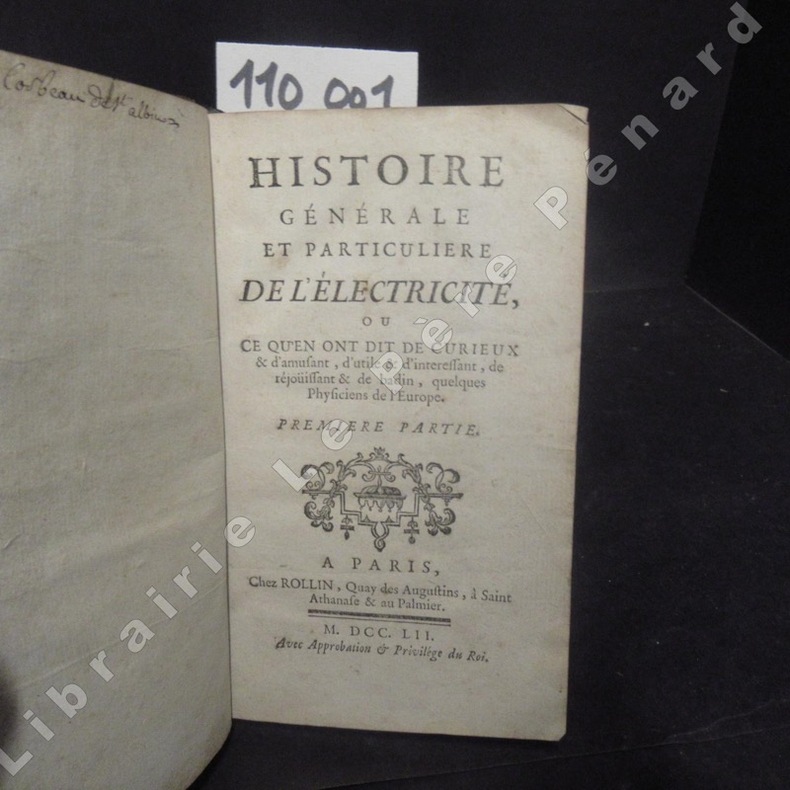
17521100011752 A Paris, Chez Rollin, Quay des Augustins, à Saint Athanase & au Palmier - M. DCC. LII. 1752 - Avec Approbation & Privilége du Roi - In-12 (9,,5 x 16,5cm environ), reliure pleine peau brune, 5 nerfs, fleurons dorés et pièce de titre au dos - Tranches rouges et signet - x, 197 pages - Rares bandeaux et lettrines
175846557Berlin Haude et Spener 1758. 4to. No wrappers as issued in "Mémoires de l'Academie Royale des Sciences et Belles-Lettres" 1756 tome XII. Pp. 105-121. With titlepage to the volume printed in red/blac and with engraved titlevignette. Also having the parttitlepage. Titlepage with 2 small wormtracts. <br/><br/><em>First appearance of a milestone paper in the history of electricity as Aepinus here found that a heated tourmaline attracted and repelled light bodies. He decided that the effect was electrical and that its ends was carrying charges of opposite sign much as soft iron is magnetized by a lodestone. This paper is a forerunner of his "Tentamen Theoriae electricitatis et magnetismi" - published 1759 and one of the most original and important books in the history of electricity. It is the first reasoned fruitful exposition of electrical phenomena based on action-at-a-distance."Aepinus’ first reseraches on the thermoelectric properties of this stone Tourmalin which was then of extreme rarity were fundamental. He recognized the electrical nature of the attractive power of a warmed tourmaline and attempted not altogether successfully to reduce its apparent capriciousness to rule. He was particularly struck by the formal similarity between the tourmaline and the magnet in regard to polarity which inspired him to reconsider the possibility then occasionally discussed that electricity and magnetism were basically analogous. This thought became the This thought became the theme for his masterwork Tentamen theoriae electricitatis et magnetismi 1759."DSB."Aepinus is known in the history of electricity for his attempt to develop the one fluid theory of Franklin. His theory was for a while generally adopted but was gradually displaced by the two fluid theory in consequence chiefly of the necessity of ascribing to uncharged matter repulsions of the same force as those which were ascribed to electrical charges. His theory exhibits interesting similarities to the present theory of the constitution of matter"Magie "A Source Book in Physics" pp.406-8.Ronalds p. 4. </em> unknown
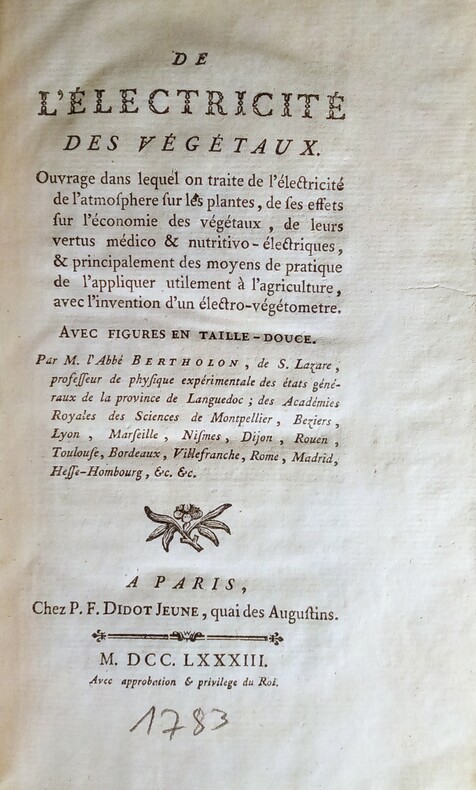
1783WOC-1999Ouvrage dans lequel on traite de l'électricité de l'atmosphère sur les plantes, de ses effets sur l'économie des végétaux, de leurs vertus médico & nutritivo-électriques, & principalement des moyens de pratique de l'appliquer utilement à l'agriculture, avec l'invention d'un électro-végétometre. Avec figures en taille-douce, un tableau et 3 planches dépliantes. Paris, Chez P. F. Didot Jeune, 1783. In-8 (20x3,5x13cm) relié plein veau raciné, dos à nerfs orné de fleurons, tranches marbrées.XVI,468pp + 2ff de Privilège du Roi. 1ère édition.
17861308168Stuttgart, J. B. Metzler, 1784 u. 1786. 76 (von 80) S., 6 gefaltete Kupfertafeln. Interims-Broschur d. Zeit (fleckig, Rücken lädiert, innen teils etwas braunfleckig, es fehlen 4 Anzeigen-Seiten (S. 77-80)).
178263380CBLeipzig, Verlag Weidmanns Erben und Reich, 1782. Klein-8°. 20,5 x 12,5 cm. VI, 84 Seiten. Pappband der Zeit mit rotem Sprengschnitt. [6 Warenabbildungen]
173546590Paris L'Imprimerie Royale 1735. 4to. Without wrappers. Extracted from "Mémoires de l'Academie des Sciences. Année 1733". Pp. 23-39 pp. 73-84 pp. 233-254 a. 1 engraved plate pp. 457-476. With titlepage to the volume 1733/1735. Margins of titlepage with a few brownspots. <br/><br/><em>First appearance of these milestone papers in the histroy of electricity in which Dufay explains his discovery of two kinds of electricity and the relation between them attraction and repulsion shocks and sparking and the full recognition of electrostatic repulsion. He formulates the two-fluid theory of electricity. He further showed that "not all bodies can become electrified themselves" by friction and went on to show "that they can all acquire a considerable electrical virtue when the tube of rubbed glass wood metals or liquids are brought near them" provided only that they are insulated by beiing stood on "a support of glass or of sealing-wax".Dufay "TRANSFORMED A COLLECTION OF MISCELLANEOUS WEEDS INTO THE FIRST GARDEN OF EUROPE" Heilbron"Dufay's substantive discoveries - ACR the two electricities shocks and sparking - are but one aspect and perhaps not the most significant of his achievement. His insistence on the impiortence of the subject on the universal character of electricity on the necessity of organizing digesting and regulariizing known facts before grasping new ones all helped to introduce order and professionel standards into the study of electricity at precisely the moment when the accumulation of data began to require them. He foundthe subject a record of often capricious disconnected phenomena the domain of the polymaths textbook writers and prfesional lecturers and left a body of knowledge that invited and rewarded prolonged scrutinity from serious physicists." Heilbron "Electricity in the 17 & 18 Centuries" p. 260.Parkinson "Breakthroughs" 1734 P - Ronalds Library p. 145. - Not in Wheeler Gift Cat. </em> unknown
1727181281727 relié avec jaquette - 17x27 - 112pp - collection découverte de la scence - éditions cercle du biblophile - 1964 - illustration
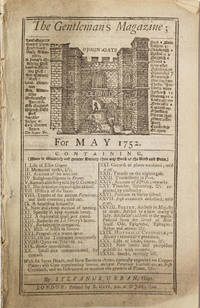
1757314545London 1757. May 1750 p 208; May 1752 pp 227-229; and January 1757 pp 22-23 respectively. 3 vols. 8vo. Disbound. Very good. May 1750 p 208; May 1752 pp 227-229; and January 1757 pp 22-23 respectively. 3 vols. 8vo. Franklin on Electrity. Three articles by Franklin relating to his experiments in electricity published in the Gentleman's Magazine. unknown books
174753510Verona: Giannalberto Tumermani 1747. First edition. Engraved title vignette and headpiece. 8 189 7 pp. 1 vols. 4to. Original boards uncut. Some early but faint dampstaining throughout -- otherwise a fine wide-margined copy. First edition. Engraved title vignette and headpiece. 8 189 7 pp. 1 vols. 4to. Maffei On the Formation of Lightning 1747. Collection of fifteen letters on the origins of lightning by the enlightened polymath Maffei 1675-1755 "said by Grimelli Storia to contain all the anterior letters on Lightning published by him i.e. all before 1746 the date of the censorship." - Ronalds<br/><br/>The book is rare in institutions -- OCLC gives only one location. Ronalds p. 314; Gartrell p. 334; OCLC: 23628231 one location: U. of Michigan; Mottelay p. 321; Baaken Library p. 83; not in Wheeler; not in RLIN Giannalberto Tumermani unknown books
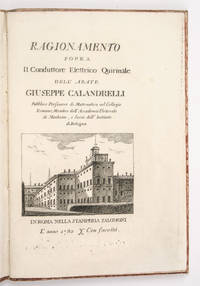
17893582Rome:: nella stamperia Salomoni 1789. FIRST EDITION. Octavo:. 20.5 x 140 cm. 2 xxxvi p. This is a beautiful copy in contemporary red pasteboard with gold floral impressions and decorative paste-paper pastedowns. The text printed on thick paper is in excellent condition. A very fresh copy. The engraved title-page has a vignette of the Quirinale palace in Rome with the lightning conductor installed on its roof. Rare. 5 copies in North America: Burndy Harvard Huntington Smithsonian American Philosophical Association. First edition of this rare publication dealing with the construction of the lightning conductor installed on the Quirinal Palace in Rome in order to prevent further damage from lightning strikes. Calandrelli discusses the electrical experiments of other well-known scientists such as Priestley Toaldo Landriani De Saussure Reccaria Lord Malion and above all those of Benjamin Franklin including Franklin's iconic kite experiment of June 1752. The kite experiment is described on pages 2-3. On pages 4 and 5 credit is given to Franklin who understood that electricity prefers metal to all other materials as a conductor for the invention of the lightning rod "to protect buildings from fatal lightning strikes". This invention Calandrelli asserts should be of interest to all but especially to those who live in North America "where storms are more frequent and more severe." Franklin's observations of the lightning rods erected by William Maine in South Carolina and of William West in Philadelphia are also included in Calandrelli's account. Wheeler Gift 554 nella stamperia Salomoni, unknown books
177919279Firenze Florence: Per Gaetano Cambiai Stamp. Granducale 1779. First edition in Italian of Cavallo's first book. Front hinge separated but cords are holding; some edge wear and rubbing to the boards; a good sound copy. 8vo contemporary decorated paper boards backed with contrasting block-printed paper and an autograph spine label xx 511 1 pages untrimmed. From this Italian-born English physicist the Italian translation of a work first published in London in 1777 as A Complete Treatise of Electricity in Theory and Practice; Cavallo includes suggestions to his translator in his prefatory note suggesting he was involved in the translation and revision of the work. This edition also includes a new dedication from the translator to the English Florentine expatriate George Clavering-Cowper dated 26 March 1779. Includes mention of Franklin and his lightning rods accounts of experiments conducted by Cavallo with Leiden jars and other apparatuses and experiments with medical treatment with electricity. With a folding table of experimental data bound after page 468 and three folding engravings of various pieces of electrical equipment bound in the rear. Per Gaetano Cambiai Stamp. Granducale, unknown books
177312556Paris, Quillau, Esprit, et l'auteur, 1773. 2 tomes en 1 vol. in-4 de [6]-XXII-[2]-338p.; [4]-XIII-[3]-318-[2]p. plein veau marbré, dos à nerfs orné d'encadrements et fleurons dorés, pièce de titre bordeaux. Reliure légèrement frottée, rares rousseurs.
1771AMO-3382Traité de l’électricité dans lequel on expose, et on démontre par expérience, toutes les découvertes électriques, faites jusqu'à ce jour, pour servir de suite aux Leçons de Physique du même auteur. Par M. Sigaud de La Fond, professeur de Mathématiques, Démonstrateur de Physique Expérimentale, de la Société Royale des Sciences de Montpellier, des Académies des Sciences et Belles-Lettres d'Angers, Electorale de Bavière, etc. A Paris, chez Des Ventes de la Doué, 1771 1 volume in-12 (18,5 x 11 cm) de (2)-XXX-413-(3) pages + 12 planches dépliantes reliées à la fin. Cartonnage d'attente plein papier brut, trace de titre à l'encre au dos, ficelles apparentes. Non rogné. Cartonnage fragile par nature resté en très bon état. Ficelles intérieures un peu lâches en tête du volume. Edition originale. On trouve dans cet ouvrage les chapitres suivants : De la manière d'électriser les corps. Des globes de verre. Des machines de rotation. De la manière d'électriser les corps an-électriques. Du feu électrique. Des aigrettes électriques. L'intensité de la vertu électrique. De l'expérience de Leyde. De l'imperméabilité du verre à la matière électrique. De l'analogie avec le tonnerre, avec la matière magnétique. Des effets de l'électricité dans le vide, sur différents substances, sur l'économie animale, etc. Les protocoles des différentes expériences sont très détaillés. Les planches hors-texte montrent les différents instruments ayant servi à réaliser les différentes expériences. Une seconde édition a paru en 1776. Joseph-Aignan Sigaud de Lafond est né le 5 janvier 1730 et mort le 26 janvier 1810 à Bourges. Il fut un physicien et enseignant français qui a été, avec son maître l'abbé Nollet, l'un des promoteurs de la physique expérimentale et de son enseignement, notamment en créant les premiers « cabinets de physique ». Son père était horloger. Son Traité de l'électricité publié en 1771 est une référence dans ce domaine de la science. A partir de 1773, Sigaud délègue ses cours du collège à son neveu, Rouland. Il a alors tout le loisir de se consacrer à son cabinet de physique sans pour autant abandonner totalement l’enseignement puisque, comme le signale plusieurs publicités. Il continue d’écrire pour présenter ses travaux. En 1775, sont publiés les deux volumes de la Description et Usage d’un cabinet de physique expérimentale. Ils seront réédités en 1784 et complétés par les Éléments de physique théorique et expérimentale en 1777. Très réalistes, les splendides gravures de Sigaud de La Fond sont déjà moins théâtralisées que celles de l'abbé Nollet et augurent ce que seront le dessin industriel et l'appareil de laboratoire du XIXème siècle. Plus encore, l'œuvre de Sigaud a profondément révolutionné les sciences physiques et leur enseignement, les faisant devenir science et discipline à part entière, en même temps que l'expérience gagnait définitivement ses lettres de noblesse. Ce sont là les prémisses de la science "moderne". Très bon exemplaire conservé à toutes marges dans son fragile cartonnage de l'époque.
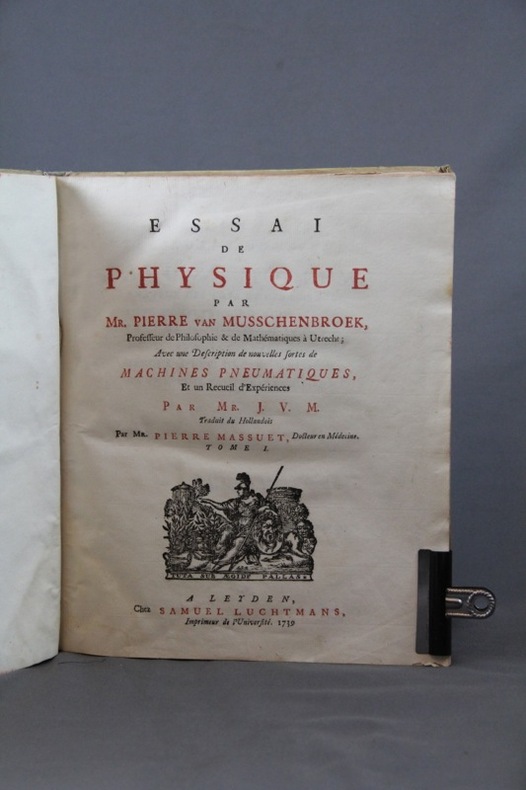
17396044Leyden, Samuel Luchtmans, 1739. 2 volumes in-4 de XXV-[3]-502-8p. ; [2]-de 503 à 914-[2]p. pour l'explication de la pl. 29 - [28]p. de table - [2]p. d'errata - 63p. pour la description des machines pneumatiques par Jan van Musschenbroek, plein vélin ivoire à (petit) recouvrement, titre doré au dos (reliure du temps).
175087787Paris, chez les Frères Guérin 1750 In-16. Reliure plein veau havane, dos à nerfs encadrés de fers dorés, roulettes dorées sur les coupes, XXIII-272 pp., frontispice, 4 planches repliées. Coiffes légèrement usées, sinon bon exemplaire.
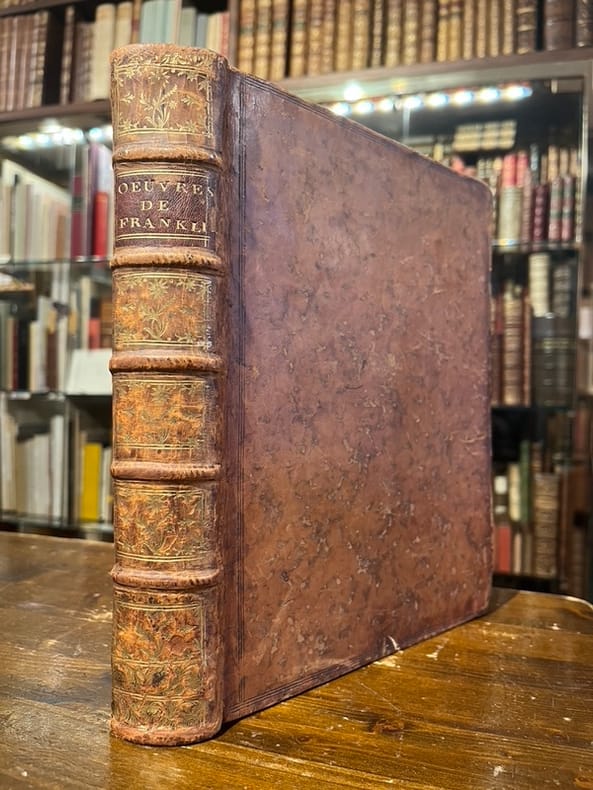
17545531754 Paris, H.L. Guérin et L.F. Delatour, 1754. Un volume petit in-8 plein veau d'époque, dos à nerfs orné, pièce de titre en maroquin brun, xxxvi et 444 pp., complet de ses 8 planches. Coiffes arasées, charnière du plat supérieure fendue, rares rousseurs.
175499671754 Paris, H.L. Guérin et L.F. Delatour, 1754. Un volume petit in-8 plein veau d'époque, dos à nerfs orné, pièce de titre en maroquin brun, xxxvi et 444 pp., complet de ses 8 planches. Coiffes arasées, charnières fendues, petit manque de cuir à un coin du plat supérieur, tâche d'encre à la tranche de queue, rares rousseurs.
175344319Paris Freres Guerin 1753. Small 8vo. Cont. full mottled calf. Top of spine with wear. Raised bands richly gilt spine. Some wear to titlelabels. Small tear to hinges at upper compartment hinges not loosening. Spine a little rubbed. Small loss of leather at at lower right corner of frontcover. XXIII444 pp. and 8 large folded engraved plates showing apparatus and experiments with electricity. Internally clean printed on good paper. From the library of le Comte de Caumia Baillenx "en son Chateau d'Andrain" and with his mongram blindtooled on both covers. <br/><br/><em>In this work Nollet the discoverer of the theory of double flux describes among other experiments the famous experiments with the Leyden jar. "The author lay down a theory according to which the cause of electrical phenomena is the effluence and affluence of a subtile fluid which is everywhere present. Some interesting experiments are described with vacuum tubes also on the influence of electric charges on the growth of plants." Wheeler 355 but not listing this edition. - Poggendorff II:296."Nollet's system effluence and affluence was much superior to earlier theories of double flux. such as Moliere's or Hauksbee's. A cheif difficulty with them as with the theory of pulsating atmospheres had been to explain why attraction occurs first.follwed by contact and then repulsion. Nollet answered that the effluent and affluent flows differ not only in direction but in velocity and spatial distribution as well.The effluent stream consists of many jets each of which spreads out into a cone with apex at one of the scattered exit pores. The affluent current being a hodgepodge of differently directed effluent streams is approximately isotropic."Heilbron p. 284 </em> hardcover