221 résultats
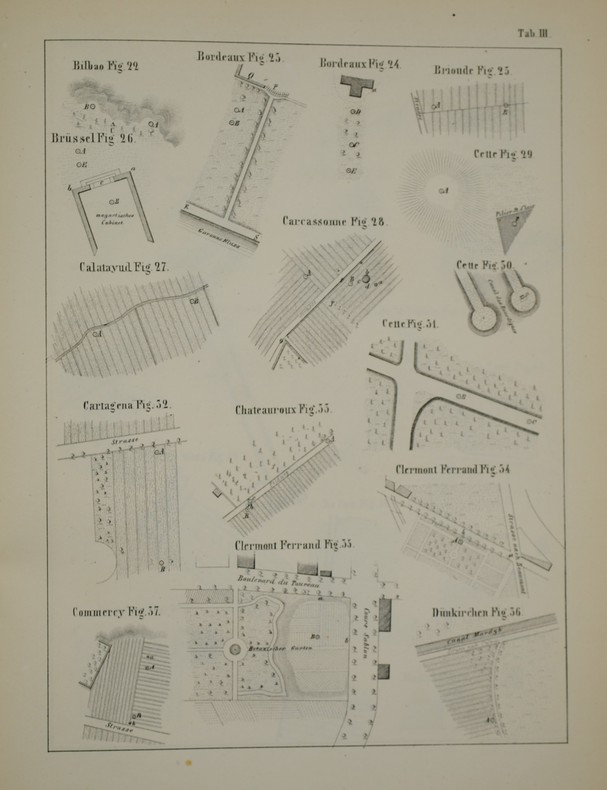
18761103679Berlin, R. Friedländer u. Sohn, 1876. 8, 174 S. u. 15 Taf. Hlwd (Rücken verblichen, die ersten vier S. m. Feuchtigkeitsspur).
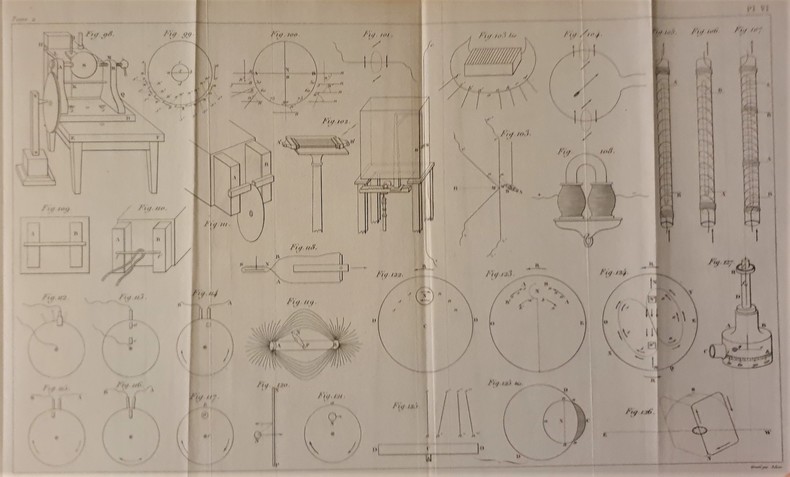
18957050EBBerlin, Verlag von Julius Springer, 1895. 4°. 26 cm. 392 Seiten. Original-Halbleinenband.
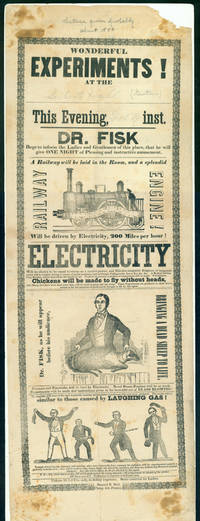
1850408771850. <p>Rare 19th Century American Electricity Broadside</p> <p>Electricity Wonderful experiments! At the Liberty Hall Groton this evening Feb. 19 inst. Dr. Fisk begs to inform the ladies and gentlemen of this place that he will give one night of pleasing and instructive amusement . . . Broadside. Woodcut illustrations. N.p.: Samuel B. Hall n.d. ca. 1850. 627 x 225 mm. Small portion of one corner torn not affecting text some creasing minor stains but very good.</p> <p>Rare nineteenth-century American broadside advertising Dr. Fisk's traveling show offering a "pleasing and instructive" demonstration of the many and varied uses of electricity. Among the marvels promised were "a splendid railway engine . . . driven by electricity 200 miles per hour" "electro-magnetic engines of immense power . . . driving a variety of useful machines" and "cannons and fireworks . . . fired by electricity." The broadside also proclaims that "a medical galvanizing machine will be at work for the benefit of all" which Dr. Fisk whom we have not been able to identify would use to make "chickens . . . fly without heads" and "sheep that have been dead some time . . . jump and run about." The broadside has blank spaces for inserting the place and date of Dr. Fisk's performance which have been filled in with the words "Liberty Hall Groton Connecticut" and "Feb. 19" in pencil in a nineteenth-century hand. </p> . unknown books
187476605Couverture souple. Brochure 24 pages. Certains chiffres ont été modifiés à la plume.
18351020101835 La T.S.F. Moderne, Paris. Sans date (début du XXe siècle). 1 plaquette in-8, brochée. 35 pages. Nombreuses figures dans le texte
1894158279Leipzig, J. A. Barth, 1894. M. 40 Abb. 8 S., 1 Bl., 295, (1) S. Hlwdbd d. Zt. Vorderdeckel m. Schabstelle. Hinterdeckel etwas fl. Vors. m. kleinem St. Innen gering gebräunt u. etwas braunfl. (Gesammelte Werke 2).
189743448Leipzig Johann Ambrosius Barth 1897. No wrappers. In "Annalen der Physik und Chemie Neue Folge" Bd. 60 No 3. Pp. 401-576 textillustr. and 2 folded plates. the entire issue offered "Heft 3". Braun's paper: pp. 552-559 a. 6 textillustrations showing the Braun tube and its operations. Clean and fine. <br/><br/><em>First printing of this groundbreaking paper being the first description of the principles governing the "BRAUN TUBE" which moves the elctron beams of alternating voltage the principle on which ALL TELEVISON TUBES operate. - Braun shared the Nobel Prize for 1909 with Marconi "in recognition of their contributions to the development of wireless telegraphy"."Cold cathode tube with side anode annular diaphragm to control spot size and built-in fluorescent screen. Beam deflection by one external coil with the trace viewed indirectly in a rotating mirror or by two coils at right angles for direct viewing. Excitation by hand-drive influence machine friction generator or by an induction coil. This "indicator tube" which enabled Braun to demonstrate how a variety of periodic and transient electrical phenomena could be visually examined is the ancestor of electric oscilloscopes televison picture tubes and other electron-beam display devices." Shiers & Shiers "Early Televison. A Bibliography to 1940" No. 263."The first oscilloscope or Braun tube was introduced in 1897. In order to study high-frequency alternating currents Braun used the alternating voltageto move the electron beam within the cathode tube. The trace on the face of the cathode tube represented the amplitude and frequency of the alternating-current voltage. He then produced a graph of this trace by use of a rotating mirror. The Braun tube was a valuable laboratory instrument and modifications of it are a basic devise in electronic testing and research. The principle of the Braun tube moving a electron beam by means of alternating voltage is the principle on which all televison operate."DSB II pp. 427-428.In 1909 he shared the Nobel Prize for physics with Guglielmo Marconi for their development of wireless telegraphy. </em> unknown
185143324Leipzig Johann Ambrosius Barth 1851. Without wrappers as issued in "Annalen der Physik und Chemie. Hrsg.von Poggendorff" Bd. 83 Viertes Stück.= Heft No. 8 of 1851. The entire issue offered Heft 2 of vol. 83 with titlepage to vol. 83. Pp.469-600 a. 2 engraved plates. Helmholtz's paper: pp. 505-540. Clean and fine. <br/><br/><em>First appearance of this paper in which Helmholtz for the first time measures and gives the mathematical formula for the duration of induced electrical currents and thus distinguished with mathematical accuracy from those due to nerve-action."In the offered paper he begins by stating a mathematical law which he had verified by a long and difficult series of experiments. By means of this law F. neumann was enabled to solve the problem he had previously laid aside as to the distribution of current in a copper disk rotating below the two poles of a magnet.After Helmholtz had extended this exponiential law mathematically to divided circuits he tested it experimentally by means of a new type of galvanic contact-key which madeit possible to vary the interval between the opening and closing of any current as required."Koenigsberger "Hermann von helmholtz" pp. 79-80. </em> unknown
185745075Leipzig Johann Ambrosius Barth 1857. Without wrappers. In "Annalen der Physik und Chemie. Hrsg. von J.C. Poggendorff" Bd. 100 No 2 . Pp. 177-252 a. 1 plate. Entire issue offered. Kirchhoff's paper: pp. 193-217. With titlepage to volume 100. <br/><br/><em>First printing of an importent papers on the theory of electricity in conductors telegraph-cables etc. determining the velocity of the electrical propagation. He found that the propagation velocity of electricity to be "very close to the velocity of light in empty space"."The work of Thomson on signalling along cables was followed in 1857 the paper offered by a celebrated investigation by Kirchhoff's on the propagation of electrical disturbance along a telegraph wire of circular cross-section. Whittaker "A History of the Theories of Aether and Electricity" pp. 230 ff."The field was still open the nature of the electric current when Kirchhoff entered it in 1857 with his own general theory of the motion of electricity in conductors. His first paper in which he treated linear conductors from the same premises as Weber turned out to coincide in all essentials with an investigation carried out by Weber shortly before but delayed in publication. Both physicists noticed a remarkable implication of their theory: in a perfectly conducting circuit oscillating currents could be propagated with a constant velocity independent of the nature of the conductors and numerically equal to the velocity of light. Both Kirchhoff and Weber however pointing to the extreme character of the condition of infinite conductivity dismissed this result as a mere accidental coincidence."DSB </em> unknown
180243637Halle Rengerschen Buchhandlung 1802-1803. Without wrappers as published in "Annalen der Physik. Herausgegeben von Ludwig Wilhelm Gilbert" Bd. 10 Viertes Stück. The entire issue offered = Stück 4. Titlepage to vol. 10. Pp. 389-512 a. 1 engraved plate. Extract from Ergänzungsheft zum Jahre 1802. =Zweite Abhandlung. Volta's papers: pp. 421-449 a. pp. 497-520. Very light browning to 2. Abhandlung. <br/><br/><em>First appearance in German of Volta's importent paper in which he describes the electrical forces that acts between the metal-plates in the Voltaic Pile. The German publication was printed in the same year as the Italian original "Sull' identita del Fluido Elettrico col Fluide Galvanico" 1802."A long memoir by Volta in two parts.reports that by measuring the electrometer deflections with different pairs of metals he found that the forces which drive the electric fluid.from the first metal to the second are: silver/copper 1 copper/iron 2 iron/thin 3 lead/tin 1 lead/zinc 5. Then the force for silver/zinc in immidiate contact is 12 12315 copper/tin 5 = 32 iron/zinc 9 513 etc. Thus 'the force or impulsion with which two metals act on the electric fluid is equal to the sum of the forces of the series of metals which stands between them and.the electric force is the same as that which arises when the two extreme metals have no effect on the force of the latter'. This is the first statement of what Maxwell called 'Volta'slaw of contact electricity'."Partington IV p.15. </em> unknown
185143324Leipzig, Johann Ambrosius Barth, 1851. Without wrappers as issued in ""Annalen der Physik und Chemie. Hrsg.von Poggendorff"", Bd. 83, Viertes Stück.(= Heft No. 8 of 1851). (The entire issue offered (Heft 2 of vol. 83 with titlepage to vol. 83). Pp.469-600 a. 2 engraved plates. Helmholtz's paper: pp. 505-540. Clean and fine.
185745075Leipzig, Johann Ambrosius Barth, 1857. Without wrappers. In ""Annalen der Physik und Chemie. Hrsg. von J.C. Poggendorff"", Bd. 100, No 2 . Pp. 177-252 a. 1 plate. (Entire issue offered). Kirchhoff's paper: pp. 193-217. With titlepage to volume 100.
180243637Halle, Rengerschen Buchhandlung, 1802-(1803). Without wrappers as published in ""Annalen der Physik. Herausgegeben von Ludwig Wilhelm Gilbert"", Bd. 10, Viertes Stück. (The entire issue offered (= Stück 4). Titlepage to vol. 10. Pp. 389-512 a. 1 engraved plate. + Extract from Ergänzungsheft zum Jahre 1802. (=Zweite Abhandlung). Volta's papers: pp. 421-449 a. pp. 497-520. Very light browning to 2. Abhandlung.
189743448Leipzig, Johann Ambrosius Barth, 1897. No wrappers. In ""Annalen der Physik und Chemie, Neue Folge"", Bd. 60, No 3. Pp. 401-576, textillustr. and 2 folded plates. (the entire issue offered, ""Heft 3""). Braun's paper: pp. 552-559 a. 6 textillustrations (showing the Braun tube and its operations). Clean and fine.
18981537DBBerlin, W & S. Loewenthal, (1898). 8°. VIII, 259 S. Mit mehreren Textillustr. Halblederbd. d. Zt. mit goldgepr. Rückentitel + Wichtig: Für unsere Kunden in der EU erfolgt der Versand alle 14 Tage verzollt ab Deutschland / Postbank-Konto in Deutschland vorhanden + (berieben u. bestossen).
1834PHO-927 TOMES ET 1 ATLAS EDITION ORIGINALE
1886RO80004785BAUDRY & Cie. 2ème édition. 1886. In-12. Cartonné. Etat passable, Plats abîmés, Dos abîmé, Rousseurs. 583 pages. Nombreuses illustrations en noir et blanc dans le texte. Manque le dos et le papier sur les plats de couverture. Traces d'humidité.. . . . Classification Dewey : 537-Electricité
1881RO20162966GAUTHIER - VILLARS.. 1881. In-8. Relié plein cuir. Etat d'usage, Couv. convenable, Dos frotté, Intérieur frais. VI + 311 pages - nombreuses gravures en noir et blanc dans et hors texte - plats et contre-plats jaspés - auteur, filet et titre dorés au dos.. . . . Classification Dewey : 537-Electricité
1881yd1131Paris, Gauthier-Villars, Imprimeur-Libraire du bureau des longitudes, de l'école polytechnique, quai des Augustins, 55 Relié 1881 In-8 (14 x 22 cm), reliure demi-peau, dos lisse orné de filets dorés, 311 pages, figures en noir dans le texte ; coins frottés, quelques rousseurs à l'intérieur par ailleurs frais, bon état. Livraison a domicile (La Poste) ou en Mondial Relay sur simple demande.
1885DEZ-6179Paris, Gauthier-Villars, 1885. In-12, demi chagrin époque, dos lisse orné de filets et de fleurons dorés, titre doré. XII, 204 pp. Ouvrage illustré de nombreuses figures in-texte. Un nombre écrit au stylo sur la page de titre, tampon de la manufacture d'armes de Chatellerault sur 1 feuillet.
1896ys3827Baudry et Cie Relié 1896 Trois fascicules reliés en deux volumes in-8 (16,5 x 24,5 cm), demi-chagrin, dos à 5 nerfs, Volume 1 (806 pp.) : Fasc. 1 : Electricité statique et magnétisme. Electrométrie. Magnétométrie (1896) ; Fasc. 2 : Electro-cinétique. Electro-magnétisme. Electro-dynamique. Induction électro-magnétisme (1898) // Volume 2 : Electrométrie (1900) ; frottements aux dos, plats et coupes, par ailleurs assez bon état. Livraison a domicile (La Poste) ou en Mondial Relay sur simple demande.
18077069Paris Victor Masson 1807 In-12 Forts 595+604 pp, tome I : avec 280 figures dans le texte, tome II : avec 168 figures dans le texte. Dos à 4 nerfs, ornés de filets, roulettes et caissons dorés mosaïqués ; plats estampés à froid. Plats, coupes, nerfs et mors frottés, coins émoussés, épidermures aux coiffes et sur quelques uns des nerfs. Rousseurs, corps d'ouvrage faibles.
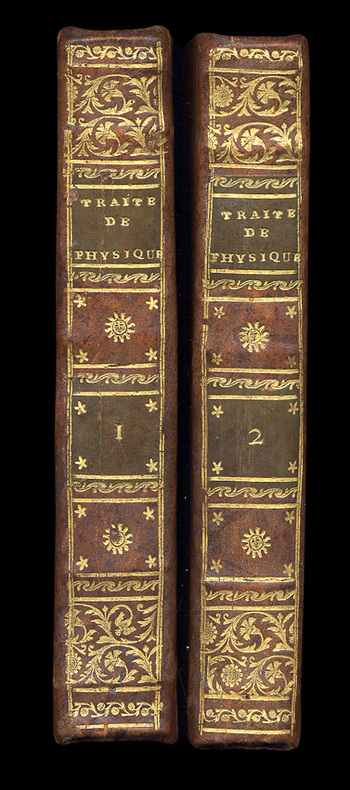
180315508Paris, Imprimerie Delonce et Lesueur, an XII, 1803 ; 2 tomes in-8 ; plein veau marbré havane glacé, dos à faux-nerfs torsadés dorés, dos décorés d'un entrelacs de feuillage, fleurons au soleil, étoiles, etc., pièces de titre et de tomaison bronze, tranches mouchetées de rouge (reliure de l'époque) ; (6), XXXIV, 426 ; (4), III, (1 bl.), 447 pp., et en tout 24 planches dépliantes gravées, représentant 157 figures.
189175779G. Masson éditeur à Paris Malicorne sur Sarthe, 72, Pays de la Loire, France 1891 Book condition, Etat : Très Bon relié, demi-toile verte à la bradelle, pièce de titres cerise au dos In-8 1 vol. - 551 pages