506 résultats
7639P., Bernard, 1807/1817, 3 VOLUMES in 8 reliés en pleine basane racinée, dos ornés de fers et filets dorés, étiquettes de titres et de tomaisons rouge, tranches jaspées (reliures de l'époque), (cachets de la bibliothèque de la société de Jésus dans la marge des pages de titres dont le fonds scientifique fut vendu à l'hotel Drouot en 1984), T.1 : (2), 4pp., 382pp., 1 TABLEAU DEPLIANT, 1 PLANCHE DEPLIANTE, T.2 : 3 feuillets non chiffrés, pp. 6/498, 1 TABLEAU DEPLIANT, 2 PLANCHES, T.3 : 6pp., (1), 618pp., 1 TABLEAU DEPLIANT
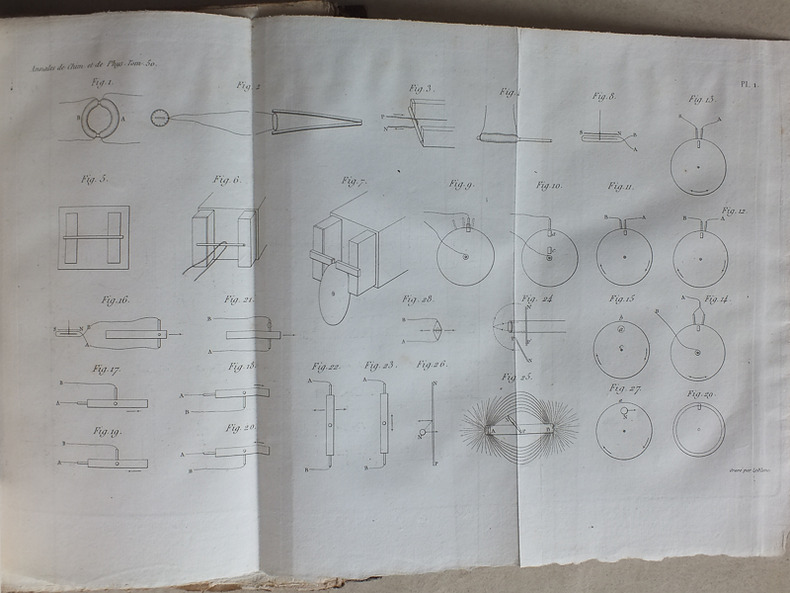
182022536Paris: Chez Crochard 1820. First Edition. Boards. Very Good. First Edition. 448 pages plus 5 plates 1 folding. 8vo. Contemporary quarter calf over marbled boards with black spine labels. Early label Coquard a Epinal on front pastedown. The entire volume of "Annales de Chimie et de Physique" Vol. Quinzieme XV 15 offered. Surface wear/damage to the leather finish resulting in minor loss to gilding and top label and minor fraying to the head/tail spine panel. Small spot of worming inside lower rear board at the gutter. Text generally bright and clean. <br /> <br /> This volume contains the original journal appearance of the separately issued "Memoires sur l'Action Mutuelle de Deux Courans Electriques" in three sections over two articles pp. 59-76 & 170-218. Section 1: "De l'Action mutuelle de deux courans electriques" pages 59-76 continued as "Suite Du Memoire sur l'Action mutuelle entre deux courans electriques entre un courant electrque et un aimant ou le globe terrestre et entre deux aimans" on pages 170-188. Section 2: "Direction des courans electriques par l'action du globe terrestre" on pages 188-196. Section 3: "De l'Action mutuelle entre un conducteur electrique et un aimant" pages 196-218. Plus plate number 4 in the rear which illustrates the articles. Boards. Ampere is today celebrated for his fundamental work in the new field of electrodynamics. The three part paper offered here established “the relationship between electric current-flow and magnetism and established the new science of electrodynamics.†Norman <br /> <br /> “In a four page circular dated Copenhagen July 21st 1820 H.C. Orsted communicated his great discovery that a closed voltaic circuit exerts forces on an adjacent magnetic needle. In more modern language: a current-carrying electric circuit gives rise to magnetic forces in its surroundings. Orsted had found the long sought affinity between electricity and magnetism. The letter reached Arago … who at the next meeting of Academie des Sciences on Sept. 11th 1820 with Ampere in attendance presented the letter and Orsted's experiment. It was indeed a memorable meeting. Already at the next weekly meeting on Sept. 18th Ampere delivered an explanation of Orsted's experiment and supported it with new experiments of his own. At every weekly meeting in the following months Ampere produced new results.†Ekelof<br /> <br /> 'In this first paper Sept. 18 he explains the law determining the position of the magnetic needle in relation to the electric current and he also makes known his intended experiments with spiral of helical wires which he predicts will acquire and retain the properties of magnets so long as the electrical current flows through them He constructed his spirals and helices and to the astonishment of all he produced magnets formed only of spools of copper wire traversed by electric currents.' Mottelay<br /> <br /> The Honeyman sale #82 notes that the paper offered here is "The first appearance of the first of a series of important papers reporting Ampere's discoveries on the electric current." Honeyman also had #83 the first separate appearance of these journal articles published as "Memoires sur l'Action mutuelle de deux courans electriques." which we believe had additional information not present in this journal appearance and hence is not a traditional "offprint" but a later state of the work. Norman notes that Ampere developed the science of electrodynamics over the next seven years publishing in a "bewildering array of journal articles offprints and revisions of earlier works.further noting some 'reprints' of Ampere's articles appear in as many as five different versions."<br /> <br /> This is an opportunity to own the original first printed appearance of Ampere's fundamentally important work in Electrodynamics. It would be an interesting collection to build the variations of Ampere's work over those seven years to see how his thought evolved. As far as we are aware there is no standard bibliographic reference for Ampere's work.<br /> <br /> LITERATURE<br /> Dibner Heralds of Science 62 first separate edition<br /> Honeyman Sale 82 original journal appearance<br /> Mottelay Bibliographical History of Electricity and Magnetism p. 472<br /> Norman 43 first separate edition. <br /> Ekelof Catalogue of Books and Papers in Electricity and Magnetism pp 284-286<br /> Sparrow Milestones of Science p33 first separate edition. Chez Crochard unknown
2309P., Pichon & Didier, 1828, 2 VOLUMES in 8 reliés en demi-basane de l'époque, dos ornés de filets dorés, étiquettes rouges et noir, (quelques rousseurs) ; TOME 1 : Leçons 1 à 20 : (2), 19 pp., 30pp., 24pp., 30pp., 28pp., 27pp., 24pp., 16pp., 30pp., 27pp., 23pp., 23pp., 32pp., 28pp., 24pp., 31pp., 27pp., 28pp., 32pp., 24pp., 31pp. -- TOME 2 : Leçons 21 à 33, (2), 28pp., 35pp., 34pp., 31pp., 32pp., 34pp., 32pp., 35pp., 36pp., 36pp., 43pp., 35pp., 43pp., 56pp.
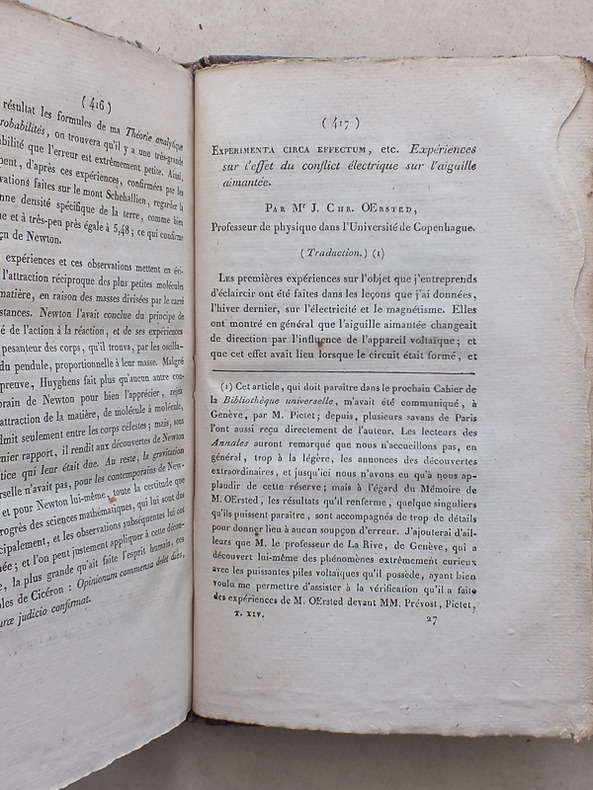
1820346261 vol. in-8 cartonnage marbré de l'époque, Chez Crochard, Paris, 1820, 448 pp. avec 3 planches dépliantes et 2 pp. (catalogue Crochard). Contient notamment : Sur la limité inférieure des neiges perpétuelles dans les montagnes de l'Himalaya et les régions équatoriales (Alex. de Humboldt) ; Mémoire sur la Communication des mouvemens vibratoires entre les corps solides (Félix Savart) ; Experimenta circa effectum, etc. Expériences sur l'effet du conflit électrique sur l'aiguille aimantée (J. Chr. Oersted) ; Examen de quelques composés qui dépendent d'affinités très faibles (Berzelius) ; etc..
181469738Paris, Chez M. Desmarais, 1814-1835, in-8, [4]-XVIII-[2]-396 pp. ; diverses pièces imprimées et manuscrites, paginées à l'encre 397 à 666. ; 7 pl. dépl. et rehaussées à la main, dont 3 dessinées à la plume, demi-veau tabac, dos lisse, Ex-dono manuscrit, non signé, de Laurent Chaudet : "Offert à l'auteur à M. E. Onfraye", au titre de la première pièce. A la suite de L'art de l'essayeur, diverses pièces ont été numérotées à l'encre 397 à 666 pp. : de 397 à 546 figurent des pièces imprimées ; les pages 547 à 595 sont manuscrites, 596-642 vierges, 643-657 imprimées, et 659-666 manuscrites. Ces pièces, extraites de recueils, touchent à la certification des métaux et aux travaux du Laboratoire des essais de monnaie. Ces documents sont particulièrement intéressants pour l'histoire des techniques proto-industrielles, à la croisée des chemins avec la science académique. Le compilateur et transcripteur, anonyme, y a fait figurer des mémoires de Chaudet, d'Arcet, Gay-Lussac et Puymartin, reliés dans l'ordre suivant : - CHAUDET, Mémoire contenant quelques expériences sur l'emploi du bismuth dans la détermination du titre des matières d'or et d'argent. Tirage à part, extrait des Annales de chimie et de physique. 24 pp. - CHAUDET, Mémoire sur quelques expériences tendantes [sic] à déterminer, par la coupellation et le départ seulement, le titre exact d'un lingot contenant de l'or, du platine, de l'argent et du cuivre. 24 pp. (Tirage à part, extrait des Annales de chimie et de physique, t. II, 1816.) - CHAUDET, Note contenant quelques expériences relatives à l'action de l'acide hydrochlorique sur les alliages d'étain et d'antimoine. 11 pages. (Tirage à part, extrait des Annales de chimie et de physique, t. III, 1816.) - CHAUDET, Note sur la fabrication des médailles coulées. 12 pages. (Tirage à part, extrait des Annales de chimie et de physique, t. VI, 1817.) - PUYMARTIN, Mémoire sur les procédés les plus convenables pour remplacer le cuivre par le bronze dans la fabrication des médailles. Paris, A. Égron, 1823. 58 pages. - [MANUSCRIT] D'ARCET, Mémoire sur la détermination des quantités de plomb nécessaires pour passer à la coupelle les essais d'argent à différens titres. (Retranscrit à partir des Annales de chimie et de physique, t. I, 1816.) - [MANUSCRIT] D'ARCET, Note sur les alliages de platine et d'argent, et sur l'application que l'on peut faire de ce procédé à l'exploitation des mines d'argent contenant du platine. (Retranscrit à partir des Annales de chimie, ou recueil de mémoires concernant la chimie et les arts qui en dépendent, t. 89, 1814). - [MANUSCRIT] CHAUDET, Note sur l'essai d'or fin (or à 1000 millième). (Retranscrit à partir des Annales de chimie et de physique, t. IV, 1817.) - [MANUSCRIT] GAY-LUSSAC, Observation sur l'essai des matières d'argent par la voie humide. (Retranscrit à partir des Annales de Chimie et de Physique, tome LVIII, 1835.) - CHAUDET, Description du laboratoire des essais des monnaies. (Tirage à part, extrait des Annales de l'Industrie française et étrangère, Août 1830.) Ex-libris Henri Vieillard et cachet annulé de la bibliothèque catholique de Paris. Étiquette en pied du dos. Charnières frottées, rousseurs. Couverture rigide
180243078Paris, Chez Fuchs, An X, (1802). Contemp. hcalf. Spine gilt. Top of spine with wear. A few scratches to binding. In: ""Annales de Chimie, ou Recueil de Mémoires concernant la Chemie"" Tome 43. 332,(4) pp., 2 engraved plates (the entire volume offered). Gay-Lussac's paper: pp. 137-175. The first 20 leaves a bit brownspotted, otherwise with a few marginal brownspots. 1 leaf (pp. 197-98) torn with loss of some letters. Gay-Lussac's paper fine and clean.
180243078Paris Chez Fuchs An X 1802. Contemp. hcalf. Spine gilt. Top of spine with wear. A few scratches to binding. In: "Annales de Chimie ou Recueil de Mémoires concernant la Chemie" Tome 43. 3324 pp. 2 engraved plates the entire volume offered. Gay-Lussac's paper: pp. 137-175. The first 20 leaves a bit brownspotted otherwise with a few marginal brownspots. 1 leaf pp. 197-98 torn with loss of some letters. Gay-Lussac's paper fine and clean. <br/><br/><em>First printing of this extremely important discovery in which Gay-Lussac first formulated the law Gay-Lussac's Law stating that if the mass and pressure of a gas are held constant then gas volume increases linearly as the temperature rises. This is sometimes written as V = k T where k is a constant dependent on the type mass and pressure of the gas and T is temperature on an absolute scale. In terms of the ideal gas law k = n R / P."In 1802 he Gay-Lussac showed that different gases all expanded by equal amounts with rise in temperature. Charles had made the same discovery some years earlier but had not published it; the credit therefore belongs to Gay-Lussac at least as much and probably more. This was an extremely importent discovery which Avogadro was to use within the decade to formulate hid long-neglected hypothesis that equal volumes of different gases at equal temperatures contained equal numbers of particles."Asimov.Magie "A Source Book in Physics" p.165-172 - Leicester & Klickstein "A Source Book of Chemistry" p. 374-379. - Parkinson "Breakthroughs" 1802 C.The volume contains other importent papers in chemistry by Humphrey Davy first French translation of his announcement of the finding of "Laughing Gas" Nitrous Oxide Parmentier Vauquelin Clement et Desormes Thenard Guyton Chenivix </em> unknown
1825346411 vol. in-8 cartonnage marbré de l'époque, Chez Crochard, Paris, 1825, 448 pp. avec 3 planches dépliantes. Contient notamment : Mémoire sur une nouvelle Expérience électro-dynamique, sur son application à la formule qui représente l'action mutuelle de deux élémens de conducteurs voltaïques, et sur de nouvelles conséquences déduites de cette formule (Ampère) ; Lettre de M. Ampère à M. Gerhardi sur divers phénomènes électro-dynamiques ; Extrait d'un Rapport fait à l'Académie par M. Ampère sur les Piles sèches de M. Zamboni ; Examen de quelques minéraux du genre grenat (Vachmester) ; Note sur la Répulsion que des corps échauffés exercent les uns sur les autres à des distances sensibles (Fresnel) ; Note sur l'existence de l'iode dans le règne minéral (Vauquelin) ; Analyse des Séléniures du Harz oriental (Rose) ; Sur la séparation de l'acide titanique de l'oxide de fer (Henri Rose) ; Analyse d'un Alliage d'or avec du rhodium, de la maison du Départ de Mexico (André del Rio) ; De l'action des poisons sur le règne végétal (Marcet) ; Examen du Platine trouvé en Russie (Laugier) ; Nouvelles Recherches sur les Vibrations de l'air (Félix Savart), etc...
180544123Halle, Rengerschen Buchhandlung, 1805. Without wrappers. In ""Annalen der Physik. Herausgegeben von Ludwig Wilhelm Gilbert"", Bd. 20, Fünftes Stück. (The entire issue offered). Titlepage to vol. 20. Pp. 1-128. Biot's paper: pp. 1-18. - Gay-Lussac: pp. 19-37 - Humboldt & Gay-Lussac: pp. 38-92. - Sacharow: pp. 107-124.
180544123Halle Rengerschen Buchhandlung 1805. Without wrappers. In "Annalen der Physik. Herausgegeben von Ludwig Wilhelm Gilbert" Bd. 20 Fünftes Stück. The entire issue offered. Titlepage to vol. 20. Pp. 1-128. Biot's paper: pp. 1-18. - Gay-Lussac: pp. 19-37 - Humboldt & Gay-Lussac: pp. 38-92. - Sacharow: pp. 107-124. <br/><br/><em>These 4 accounts of the earliest scientific ascents with balloons had the same purposes namely to make observations on the composition of the air pressure and the earth's magnetic force. Brockett "Bibliography of Aeronautics" Nos 1856 a 6303 a a. 10654 a. </em> unknown
181543079Paris Chez Crochard 1815 Contemp. hcalf. Spine gilt. Top of spine with wear. A few scratches to binding. In: "Annales de Chimie ou Recueil de Mémoires concernant la Chemie" Tome 95. - 336 pp. the entire volume offered. Gay-Lussac's paper: pp. 136-231. Some scattered brownspots throughout. <br/><br/><em>First appearance of this milestone paper in organic chemistry in which Gay-Lussac describes the preparation the chemical reactions and the determination of the physical properties of prussic acid."One of the most importent contributions of Gay-Lussac was his work on hydro-cyanid acid and its compounds. In the course of his investigations on the combining volumes of gases he had prepared gaseous hydrogen cyanide. This led him to the study of related compounds and in 1815 he published a paper "Recherches sur l'acide prussique" the paper offered wherein he announced the discovery of cyanogen and chlor-cyanogen and the composition of hydrocyanic acid. His demonstartion that hydrogen cyanide contains no oxygen added another oxygen-free acid to those already known hydrogen halides and sulfide and contributed to the overthrow of Lavoisier's oxygen theory of acids. Gay-Lussac found that the cyano radicalthe first orgianic radical clearly recognized could act as an element analogous to chlorine passing unchanged through various reactions. This concept of an organic radical was importent to organic chemistry."Leicester & Klickstein "A Source Book of Chemistry" p. 293. - Partington IV p.85 a. p. 253. - Roy G. Neville p. 505. - Parkinson "Breakthroughs" 1815 C. </em> unknown
181543079Paris, Chez Crochard, 1815 Contemp. hcalf. Spine gilt. Top of spine with wear. A few scratches to binding. In: ""Annales de Chimie, ou Recueil de Mémoires concernant la Chemie"" Tome 95. - 336 pp. (the entire volume offered). Gay-Lussac's paper: pp. 136-231. Some scattered brownspots throughout.
2313P., Deterville, 1811, 2 volumes in 8 reliés en pleine basane, toutes tranches dorées, fers dorés sur les plats (reliures de l'époque), (plats épidermés et frottés avec petits manques de peau en bordure du premier plat au tome 2), T.1 : 15pp., 405pp., T.2 : (2), 443pp., (1pp.), 6 planches dépliantes numérotées 1 à 6
41158Paris, Pichon et Didier, 1828. 2 volumes in-8°, xix-56 (tables); 30; 24; 30; 28; 27; 24; 16; 30; 27; 23; 23; 32; 28; 24; 31; 27; 28; 32 pages / 24; 31: 28; 35; 34; 31; 32; 34; 32; 35; 36; 36; 43; 35; 43 pages. Reliures demi-veau d'époque.
1825346421 vol. in-8 cartonnage marbré de l'époque, Chez Crochard, Paris, 1825, 448 pp. avec 2 planches dépliantes. Contient notamment : Suite du Mémoire de M. Ampère sur une nouvelle Expérience électro-dynamique, sur son application à la formule qui représente l'action mutuelle de deux élémens de conducteurs voltaïques, et sur de nouvelles conséquences déduites de cette formule (Ampère) ; Mémoire sur la Voix humaine (Félix Savart) ; Recherches relatives à l'Influence de la température sur les forces magnétiques (A.-F. Kupffer) ; Mémoire sur les Roues verticales à palettes courbes mues par dessous, suivi d'expériences sur les effets mécaniques de ces roues (Poncelet) ; Lettre de M. Marcel de Serres à M. Gay-Lussac sur les Cavernes à ossemens ; De l'Influence exercée par divers milieux sur le nombre de vibrations des corps solides (Félix Savart) ; etc...
1824346381 vol. in-8 cartonnage marbré de l'époque, Chez Crochard, Paris, 1824, 448 pp. avec 7 planches dont 6 planches dépliantes hors texte, Contient notamment : Extrait d'un Mémoire sur les Phénomènes électro-dynamiques (Ampère) - Sur la chaleur rayonnante - Note relative au Mémoire sur la Chaleur rayonnante (Poisson) - Développemens relatifs aux Effets électriques observés dans les actions chimiques ; et de la Distribution de l'électricité dans la pile de Volta, en tenant compte des actions électro-motrices des liquides sur les métaux (Becquerel) - Description d'un appareil électro-dynamique (Ampère). Recherches sur les usages de la membrane du tympan et de l'oreille externe (Savart) ; Instruction sur les Paratonnerrres (Gay-Lussac) ; Sur la corrosion du cuivre qui forme le doublage des vaisseaux (Davy) ; Observations sur la température de la terre à Paramatta (Nouvelle-Galles du Sud par Sir Brisbane) ; Instruction sur l'Essai du Chlorure de Chaux (Gay-Lussac) ; Extrait d'un mémoire sur les mortiers hydrauliques (Treussart) ; Examen chimique d'un fragment d'une masse saline considérable rejetée par le Vésuve dans l'éruption qui a eu lieu en 1822 (Laugier) ; etc...
1832346621 vol. in-8 cartonnage marbré de l'époque, Chez Crochard, Paris, 1832, 448 pp. avec 3 planches dont 2 planches dépliantes. Contient notamment : Recherches expérimentales sur l'Electricité (M. Faraday) ; Recherches expérimentales sur l'Electricité. Seconde Série (M. Faraday) ; Nouvelles expériences magnéto-électriques (Nobili et Antinori) ; Nouvelle construction d'une Machine électro-magnétique ; Sur la Force magnétique ; De l'Action de l'Acide hyponitrique sur les Huiles, et des produits qui en résultent (Félix Boudet) ; etc...
1824EBS100401Annales de Chimie et de Physique 1824. 1st Edition. Hardcover. Very Good/No Jacket. VOLUME WITH FIRST PAPER TO DISCUSS GLOBAL WARNING AND FIRST PAPER TO IDENTIFY ISOMERISM. This volume contains "the first paper on global warming" by Fourier pp. 136-167 Fourier didn't yet know what molecular mechanisms were trapping the heat. But in this 1824 paper he surmised that over a long period of time the amount of heat held in by the atmosphere could change altered by both the Earth's natural evolution and human activity. "Wöhler's analysis of cyanates appeared in 1824 the paper offered shortly after Liebig's analysis of fulminates. Gay-Lussac then editor of the 'Annales de Chimie' noted that the analysis of cyanic and fulminic acid were identical - the first case of isomerism. This incident brought Wöhler and Liebig together and there followed many years of collaboration in which the two studied the chemistry of benzaldehyde and numerous other compounds." Klickstein "A Source in Chemistry." p. 309. 8vo 448 pp one folding plate at end; ¼ cont. leather over green marbled boards black spine labels label of bookseller. FULL VOLUME OF JOURNAL RATHER THAN EXTRACTED PAPERS. Overall VG. From Arthur C. Greenberg History of Chemistry Collection. Annales de Chimie et de Physique hardcover
181443080Paris, Chez Crochard, 1814. Contemp. hcalf. Spine gilt. Top of spine with wear. A few scratches to binding. In: ""Annales de Chimie, ou Recueil de Mémoires concernant la Chemie"" Tome 91. - 336 pp. a. 1 engraved plate.(the entire volume offered). Gay-Lussac's paper: pp. 5-160. Some scattered brownspots.
181443080Paris Chez Crochard 1814. Contemp. hcalf. Spine gilt. Top of spine with wear. A few scratches to binding. In: "Annales de Chimie ou Recueil de Mémoires concernant la Chemie" Tome 91. - 336 pp. a. 1 engraved plate.the entire volume offered. Gay-Lussac's paper: pp. 5-160. Some scattered brownspots. <br/><br/><em>First printing of Gay-Lussac's classic paper on Iodine discovered 1811 by J.C. Courtois in which he showed that the new substance was an element analogous of chlorine and in which he named the substance Iode from the Greek ioeides meaning "violet colored".Gay-Lussac's and Davy's rechearches on iodine were carried out simultaneously which makes it difficult to assaign priority. Gay-Lussac was annoyed at Davy's introsion. His work however is considered as a model of experimental research. Leicester & Klickstein "A Source Book of Chemistry" p. 293."Gay-Lussac's major publication on iodine was not ready to be read to the Institute until August 1814 by which time not only Davy but Vaquelin had explored the subject fairly extensively. Gay-Lussac however deserves full credit for his detailled study of hydrogen iodide which he found to have a 50 percent hydrogen content by volume. He contrasted its thermal decomposition with the stability of hydrogen chloride. By the action of chlorine and iodine he pepared independently of Davy and at about the same time iodine monochloride and trichloride. After further carefull study of the properties of iodine he prepared and examined a number of iodides and iodates. He prepared for the first time ethyl iodide by distilling together concentrated hydriodic acid with absolute alcohol. The close analogy that he emphasized between chlorine and iodine led him to further investigation of the former and he discovered chloric acid by the action of sulfuric acid on a solution of barium chlorate."DSB V pp. 322-23. - Parkinson "Breakthroughs" 1814 C. - Duveen p. 237.The volume contains other importent chemical papers A. Séguin: "Premier-Second Mémoire sur le Quinquina" pp.273-284 a. 304-317 and 3 other papers by him one together with Lavoisier by Guyton-Morveau Payssé Colin etc. </em> unknown
1820ZB1182545Paris: Crochard 1820. 448 pp. 3 folding plates; original printed paper wrappers covers chipped spine and margins darkened old paper label to the base of the spine library markings to the verso & recto of the half-title page else internally clean and tight. - If you are reading this this item is actually physically in our stock and ready for shipment once ordered. We are not bookjackers. Buyer is responsible for any additional duties taxes or fees required by recipient's country. Photos available upon request. Paris: Crochard unknown
182449142Paris, Chez Crochard, 1824. Later full cloth. Gilt lettering to spine. In: Annales de Chimie et de Physique, Par MM. Gay-Lussac et Arago."", Tome 25. 448 pp. and 5 folded engraved plates. (Entire volume offered). Liebig & Gay-Lussac's paper: pp. 285-311. Titlepage with browning and marginal repairs. Stamp to verso of titlepage. A few scattered brownspots, mostly to plates. The paper clean.
182449142Paris Chez Crochard 1824. Later full cloth. Gilt lettering to spine. In: Annales de Chimie et de Physique Par MM. Gay-Lussac et Arago." Tome 25. 448 pp. and 5 folded engraved plates. Entire volume offered. Liebig & Gay-Lussac's paper: pp. 285-311. Titlepage with browning and marginal repairs. Stamp to verso of titlepage. A few scattered brownspots mostly to plates. The paper clean. <br/><br/><em>First printing of a classical paper in chemistry helping to establish "Isomerism" stating that some chemical substances have the same composition but different properties."One of Wöhler's earliest researches was made on the cyanates the same group of compounds which led to the syntheis of urea. The silver salt of cyanic acid was carefully analyzed and reported in the litterature - 77.23 per cent silver oxide 22.77 per cent cyanic acid. At about the same time Justus von Liebig working in Gay-Lussac's laboratory completed analyzing silver fulminate - 77.53 per cent silver oxide 22.47 per cent cyanic acid. The analyses indicated an identity but the compounds clearly differed in properties. Liebig certain that Wöhler analyses was wron apparently confirmed this by preparing and analzing silver cyanate it contained 71 per cent of silver oxide. The two chemists were faced with the dilemma of having two compounds but drastically different properties. brzelius took notice of the fact that the composition of cyanates and fulminates was apparently identical but was unable to arrive at an explanation. Gay-Lussac convinced of the correctness of the analyses attributed the difference in properties to variation in the way the elements were combined." Ihre "The development of Modern Chemistry" p. 171.The volume contains other notable papers by Humphrey Davy Poisson Felix Savart Humboldt Wollaston etc. </em> hardcover
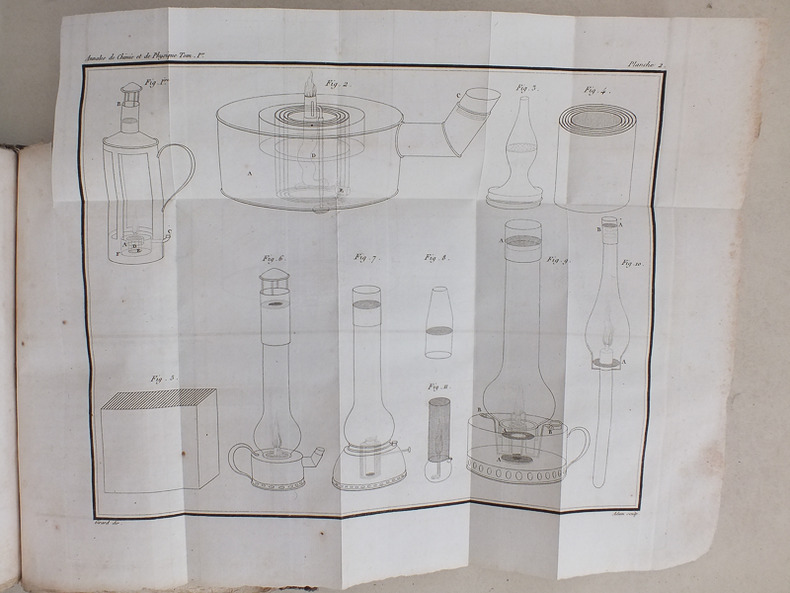
1816346131 vol. in-8 cartonnage d'origine, Chez Crochard, Paris, 1816, 452 pp. avec 3 planches dépliantes hors texte . Contient notamment : Sur les Puissances réfractives et dispersives de certains liquides et des vapeurs qu'ils forment (Arago et Petit) ; Note sur le Principe colorant du sang des Animaux (Vauquelin) ; Expériences sur la combustion du Diamant et d'autres substances carbonacées (Humphry Davy) ; Observations sur l'oxidation de quelques métaux (Gay-Lussac) ; Relation de la chute d'une pierre météorique tombée dans les environs de Langres (Virey) ; Sur la hauteur relative des Niveaux de la mer Noire et de la mer Caspienne (Maurice d'Engelhardt et François Parrot) ; Tables des dilatations linéaires qu'éprouvent différentes substances depuis le terme de la congélation de l'eau jusqu'à celui de son ébullition d'après les expériences de MM. de Laplace, Lavoisier, Smeaton, Roy ; Description d'un nouveau Baromètre portatif (Gay-Lussac) ; Mémoire sur l'air inflammable des mines de charbon (Humphry Davy) ; Observations sur l'influence que le vent apporte dans la propagation du son (Delaroche) ; Note sur un phénomène remarquable qui s'observe dans la diffraction de la lumière (Arago) ; Sur les lois que l'on observe dans la distribution des formes végétales (Alex. de Humboldt) ; Mémoire sur la Diffraction de la lumière, où l'on examine particulièrement le phénomène des franges colorées que présentent les ombres des corps éclairés par un point lumineux (Fresnel) ; Essai d'une classification naturelle pour les Corps Simples (Ampère) ; Suite de l'Essai (Ampère) ; Sur les lampes de sûreté de Sir Humphry Davy ; Justification de la Théorie de M. Dalton, sur l'absorption des Gaz par l'eau, contre les conclusions de M. de Saussuren par M. John Dalton ; Sur les combinaisons de l'Azote avec l'Oxigène (Gay-Lussac) ; Sur la vertu électrique de quelques minéraux (M. Haüy)
180543298Paris, Chez Bernard, An XIII (1805). Contemp. hcalf., gilt spine. Top of spine with wear. In: ""Annales de Chimie"" Vol. 52. 358 pp. (The entire volume offered). Gay-Lussac's paper: pp. 75-94 a. large foldet ""Tableau des Observations"". Internally clean, printed on good paper.