GAS, Jeanne Louise BertrandLivre Rare Book
6 résultats
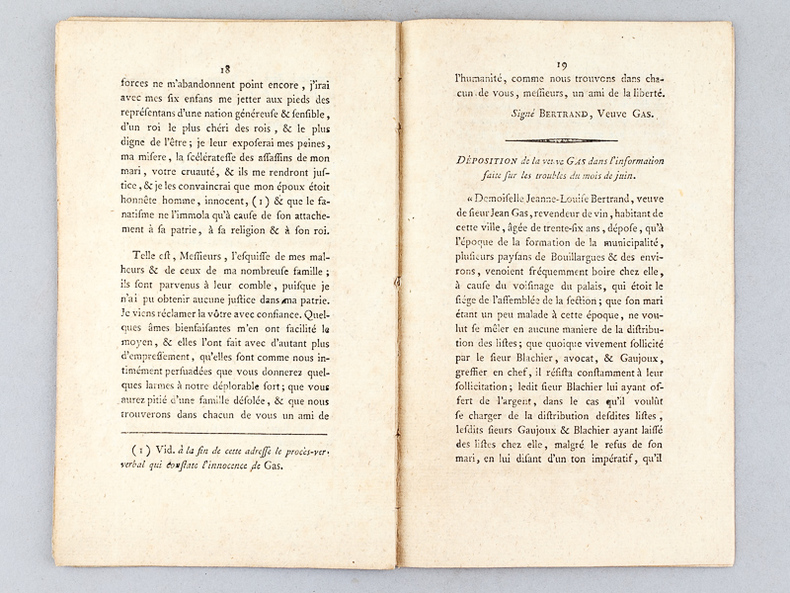
1790567111 brochure in-8, Se Vend à Paris au profit de la veuve & de sa famille, et chez Gattey, 1790, 23 pp.
179744128(Paris, Chez Fuchs, Guillaume, An VI (1797)). Without wrappers. In: ""Annales de Chimie et de Physique, Par MM. Gay-Lussac et Arago."" , tome 23, Cahier 1. Pp. 1-112 (entire issue offered). Say's paper: pp. 1-27 a. 1 folded plate depicting the stereometer.
179744128Paris Chez Fuchs Guillaume An VI 1797. Without wrappers. In: "Annales de Chimie et de Physique Par MM. Gay-Lussac et Arago." tome 23 Cahier 1. Pp. 1-112 entire issue offered. Say's paper: pp. 1-27 a. 1 folded plate depicting the stereometer. <br/><br/><em>First appearance of Say's description of his invention of the Gas Pychnometer which he himself called Stereometer. It is a simple apparatus for determining the density and volume of solids without water. - Darmstaedter 1797 Say. </em> unknown
179944095Halle, Rengerschen Buchhandlung, 1799, 1800. Without wrappers extracted from ""Annalen der Physik. Herausgegeben von Ludwig Wilhelm Gilbert"", Bd. 2. p. 483 (one page). and Bd. 6, pp. 105-115. Some scattered brownspots.
179944095Halle Rengerschen Buchhandlung 1799 1800. Without wrappers extracted from "Annalen der Physik. Herausgegeben von Ludwig Wilhelm Gilbert" Bd. 2. p. 483 one page. and Bd. 6 pp. 105-115. Some scattered brownspots. <br/><br/><em>First German translation of Davy's announcement the announcement on 1 page of his discovery of the unusual anaesthetic effects of nitrous oxide which on being inhaled gave rise to a giddy intoxicated feeling. On announcing his discovery he says that he will publish a paper discribing the experiments with the gas later. This is the paper offered here also in the first German version. Both the announcement and the paper were issued in the "Annalen" the same year as they appeared in Nicholson's Journal.The gas was first synthesized by English natural philosopher and chemist Joseph Priestley in 1772 who called it phlogisticated nitrous air."Following Priestley's discovery Humphry Davy of the Pneumatic Institute in Bristol England experimented with the physiological properties of the gas such as its effects upon respiration. He even administered the gas to visitors to the institute and after watching the amusing effects on people who inhaled it coined the term 'laughing gas'! Davy even noted the anaesthetic effects of the gas: "As nitrous oxide in its extensive operation appears capable of destroying physical pain it may probably be used with advantage during surgical operations in which no great effusion of blood takes place".Wikipedia."Davy discovered the anaesthetic properties of nitrous oxide and suggested its use during surgiical operations a suggestion which was not turned to useful account until 1844."Garrison & Morton 5646 not mentioning the announcing of its discovery in 1799. </em> unknown
17359457Paris, Debure l'Ainé (Imprimerie Jacques Vincent), 1735 ; in-4 ; plein veau moucheté havane, dos à nerfs décoré et doré, pièce de titre grenat, roulette dorée sur les coupes, tranches rouges (reliure de l'époque) ; XVIII, (8) (table et errata), 408, (2) pp., 20 planches en 10 feuilles dépliantes.
