37 résultats
18921024509Breslau, W. G. Korn, 1892. 10, 316 S., 8 Bl. Faks. Neuer Lwdbd (Titelei fleckig).
18973350232Berlin, Mosse, 1897. 194 S. Ppbd (Stempel auf Vorsatz).
18933486366Porto, 1893. 140 S. Lwd (Stempel auf Titel).
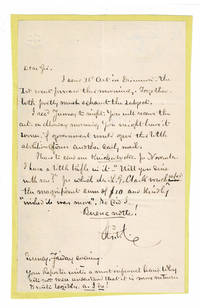
1860100131<p>Oct. 1860. Oct. 1860. Very good. - Over 115 words penned on 8 inch high by 4-7/8 inch wide creamy white paper with an embossed mark at top left. The abolitionist journalist C.T. Congdon writes that "I send the IIe Act in Disunion - the Ist went forward this morning. Together both pretty much exhaust the subject". He goes on to bemoan the delay "you might have it sooner if government would give this little abolition town another daily mail." He asks the recipient to please send him the "Knickerbocker for November. I have a little trifle in it - 'Will you dine with me'." Closing with the wishes "Buena notte!" Congdon signs himself with an abbreviated signature which one can only guess is "ChTC" and concludes with a postcript about the illegibility of another reporter's handwriting. The letter is mounted with glue from the verso onto a 8-1/4 inch high by 5-1/4 inch wide yellow paper. It is identified in an unknown hand on the verso: "C. T. Congdon / Oct 1860". Very good.</p><p>The journalist poet and abolitionist Charles Taber Congdon 1821-1891 started his career by cleaning floors and delivering newspapers for the New Bedford Courrier. He went on to work as a reporter for the Daily Register and an editor at Daily Bulletin and the Daily Mercury before Horace Greeley personally invited him to come work at the New York Tribune in 1857. He came to be known as "Greeley's right hand man" and was listed by Louis Star as one of the Tribune reporters who "lived to destroy slavery root and branch". While working at the Tribune Congdon also published articles in "Vanity Fair" the "North American Review" and the "Knickerbocker Magazine". Congdon published recollections as well as poetry including "The Warning of War" in 1862.</p><p>RARE.</p> [Oct. 1860].
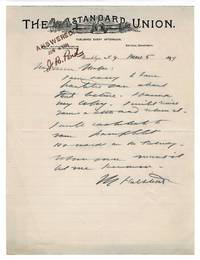
1894101010<p>Brooklyn NY June 5 1894. 1894. Very good. - Over 40 words in pencil on 10-1/2 inch high by 8 inch wide "The Standard Union" newspaper stationery. Apologizing about a lecture the American newspaper editor and war correspondent Murat Halstead offers to contribute an essay to the American impressario and lecture manager James B. Pond's pamphlet "I will contribute to your pamphlet 100 words on McKelway. When you receive it let me know." Signed "M. Halstead". Folded for mailing with minor creases and slight darkening along the bottom edge. Very good.</p><p>The American newspaper editor and magazine writer Murat Halstead 1829-1908 was a war correspondent during 3 wars. He started his career writing for "The Hamilton Intelligencer" and "The Roseville Democrat" at 18 years of age and went on to contribute to several other newspapers. He bought interest in the paper while working as a local reporter for Cincinnati's "Commercial". Halstead reported on several battles during the Civil War and was a war correspondent during the Franco-Prussian War. He took over controlling interest in the "Commercial" and became president of the company when the "Cincinnati Gazette" merged with his paper. Moving to Brooklyn in 1890 he edited the "Standard Union". He went to the Philippines as a war correspondent at the start of the Spanish-American War.</p><p>The article which Halstead mentions in his letter is about St. Clair McKelway the editor of "The Brooklyn Daily Eagle". Halstead's own paper the "Standard Union" was also in Brooklyn.</p> Brooklyn, NY, June 5, 1894.
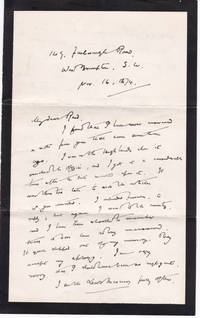
187435633London: November 16 1874. 1874. Very good. - Letter penned in black ink & filling both sides of a sheet of black-bordered 7 inch high by 4-3/8 inch wide cream paper. Signed "James Macdonell". Folded twice for mailing. Very good. <p>Macdonell writes to Thomas Wemyss Reid editor of the Leeds Mercury. He apologizes at length for not having answered a note from Reid which arrived while Macdonell was away in the Highlands. He goes on to describe his current busy life as a journalist mentioning "I am also gathering the material for a big book" probably his book on France. "But I have almost abandoned the hope of being able to write anything of that kind until I shall have freed myself from the shackles of my journalism."<p>Scottish journalist James Macdonell 1841-1879 began by writing for the Aberdeen Free Press in his native city and at the age of 22 became editor of the Northern Daily Express. He moved to London in 1865 to take up a staff position at the Daily Telegraph which he held until 1875 serving as special correspondent in France in 1870 and 1871. He became a leader writer on the Times of London in 1873. His posthumous "France since the First Empire" was incomplete at his death but yielded insights into the French politics of his time. [London]: November 16, 1874. unknown
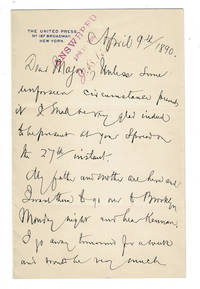
1890100212<p>New York April 9th 1890. 1890. Very good. - Two pages consisting of over 80 words penned on 2 faces of 8-1/8 inch high by 5-1/4 inch wide "The United Press" stationery with an integral attached leaf. In his letter addressed to American impressario and lecture manager Major James B. Pond Phillips informs him that "unless some unforeseen circumstance presents it I shall be very glad indeed to be present at your spread on the 27th instant." He writes that his mother and father are visiting and that he wants "them to go over to Brooklyn Monday night and hear Kennan" and asks Pond for the particulars regarding where "Kennan is to hold forth". Signed with his rapidly scribbled signature. Folded for mailing Pond has stamped that he has answered at the top left of the first page. Very good.</p><p>The American journalist telegrapher and inventor Walter P. Phillips 1846-1920 expanded telegraph codes with his Phillips Code which allowed for brevity by making use of such abbreviations as POTUS and SCOTUS. He was managing editor of the Providence Morning Herald and subsequently editor of the Providence Morning Star before becoming the head of The United Press.</p><p>George Kennan 1845-1924 to whose lecture Phillips refers was an American explorer noted for his travels in the Kamchatka and Caucasus regions of the Russian Empire.</p> New York, April 9th, 1890.
185935713New York: January 15 1859. 1859. Very good. - 34 words penned in black ink on a cream sheet of 9-3/4 inch high by 7-5/8 inch wide sheet of Times Office letterhead with a handsome engraving of the Times building at top left. Signed "W. J. Raymond". The bottom edge of the letter is slightly darkened with some light creasing. Once mounted into an album with paper remnants adhering to the corners of an integral attached blank leaf. A couple of small chips are torn from the corners of the blank. Folded 3 times for mailing. Very good. <p>Raymond writes agreeing to an exchange with another publication: "We shall be very happy to send you our semi-weekly Edition in Exchange for the W. & R. We would send the Daily but for the fact that our Exchange list is already inconveniently large."<p>Henry Jarvis Raymond 1820-1869 was an American journalist and politician and co-founder of the New York Times. Between 1841 and 1851 he worked as a journalist and associate editor for various newspapers including Horace Greeley's New York Tribune and James Watson Webb's Courier and Enquirer. In 1851 Raymond convinced George Jones who had also worked at the Tribune to become his partner and publish a new paper that would report the news in a neutral manner. They co-founded the New York Times and Raymond edited the paper until his death. Raymond was a member of the New York State Assembly in 1850 and 1851 and was elected Speaker in 1851. A member of the Whig party's northern radical anti-slavery wing he was nominated for Lieutenant Governor of New York in 1854 over Horace Greeley. He was elected and served from 1855 to 1856. Raymond has sometimes been called "the godfather of the Republican Party". He played a prominent role in the party's formation and drafted the Address to the People adopted by the Republican organizing convention in 1856. New York: January 15, 1859. unknown
18411317390Breslau, Verlags-Comtoir, 1841. Gr.-8vo. 412 (statt: 416) S. in zweispaltigem Druck. Ppbd d. Zeit m. goldgeprägtem Rückenschild (beschabt, durchgehend braunfleckig, S. 321f. u. 325f. fehlen).
1837454069Paris, Delamotte, 1837. 100 S. Hlwd im Stil der Zeit. 4to.
1883453617Paris, Durand et Pedone-Lauriel, 1883. 269 S. Halbleder (mit eingebundener OBroschur) (Rücken fehlt, Stempel auf Titel).
1876453647Paris, Marescq, 1876. IV, 115, 6 S. Hlwd (Stempel auf Titel, Exlibris, Rücken leicht lädiert, vorderes Gelenk gelockert, Bibliotheks-Rückenschild).
1887454780Paris, Marchal et Billard, 1887-95. 8, 395; 586; 187 S. Halbleinen (2) u. Halbleder (1, Rücken fehlt) d. Zeit.
1894453663Paris, Chevalier-Marescq, 1894. 207 S. Halbleder (Stempel auf Titel, Rücken fehlt).
188831348Hamburg, Hermann Grüning, 1888. 888. 78 S. OBrosch.
1894453752Paris, Marchal et Billard, 1894. 414 S. Halbleder (mit eingebundener OBroschur) (Stempel auf Titel, Rücken fehlt).
1884454072Paris, Larose et Forcel, 1884. 272 S. Halbleder. 4to. (Stempel auf Titel, Rücken fehlt).
18421245812Hamburg, (Druck:) Gottfried, (ab Nr. 20:) Halberstadt), 1842. 4to. Zus. 32 S. in zweispaltigem Druck (angestaubt, teils wasserfleckig, Stempel a. Titeln, m. Randläs. ohne Textverlust).
18721319607Tübingen, H. Laupp, 1872. 2 Bl., 383 S. (Bibliothek des Litterarischen Vereins 111). Neuerer Lwdbd (teils etwas braunfleckig, Exlibris auf Titelrückseite).
1895453559Genf, 1895. 239 S. Ppbd (mit eingebundener OBroschur) (Stempel auf Titel, Bibliotheks-Rückenschild).
18581302020Venedig, G. Antonelli, 1846 (auf d. Einbd: 1847) - 1854 (auf d. Einbd: 1858). Zus. über 3250 Sp. m. zahlr. Abb. Bedruckte OPpbde (Einbde bestoßen, beschabt u. fleckig, Bd 1 u. 2: Rücken stärker lädiert u. m. Fehlstellen; Bd 2 u. 3: obere Ecke durchgehend etwas feuchtwellig u. -fleckig; Bd 5: Fehlstelle am Kopf).
1842621715Emden, Woortman, 1842-44. 4to. Zusammen 232 zweispaltige S. Interimspappband d. Zeit (etwas berieben, Rückenbezug brüchig u. mit Fehlstellen). [2 Warenabbildungen]
19001189948Oldenburg, Schulzesche Hof-Buchhdlg, 1900. 12, 265, (7) S. Hlwd.
18693490226Paris, 1869. 216 S. Ppbd der Zeit (Stempel auf Titel, Bibliotheks-Rückenschild).
1868453667Paris, Degorce-Cadot, 1868. 143 S. Hlwd (mit eingebundener OBroschur) (Stempel auf Titelrückseite, Bibliotheks-Rückenschild).