68 résultats
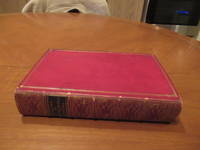
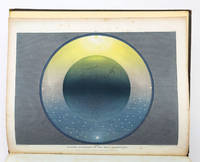
1846ST19286London: Printed by Catchpool & Trent for Simpkin Marshall & Co 1846. FIRST EDITION. 320 x 255 mm. 12 1/2 x 10". xiii 3 96 pp. <br/> Publisher's original blind-decorated dun-colored cloth gilt titling to upper cover smooth spine newer endpapers. WITH 11 COLOR ENGRAVINGS after Frost by W. P. Chubb & Son printed in oil colors by George Baxter all with original tissue guards. Front free endpaper with small ink signature of John Hill. See: Francis Reid "Isaac Frost's 'Two Systems of Astronomy' 1846: Plebeian Resistance and Scriptural Astronomy" in "The British Journal for the History of Science" Vol. 38 No. 2 Jun. 2005 pp. 161-177. Cloth rather spotted corners bumped but the binding solid with no wear to joints or hinges. A few spots of foxing to title page half of the tissue guards with overall very faint foxing/browning the illustrations with minor foxing at edges and in margins but the images themselves clean and bright and all in all a really excellent copy the text wide-margined and quite clean and fresh and the plates with rich coloring.<br/> <br/> Illustrated with beautiful color plates this anti-Newtonian work promotes a view of the universe based on the backward-looking beliefs professed by a Protestant sect known as the Muggletonians. Named after co-founder Lodowicke Muggleton the Muggletonians emerged in London in 1651 based on the claims of two tailors who professed to be the "Last Witnesses" described in the Book of Revelation. Rejecting the new directions in philosophical reason Muggletonians believed in a purely scriptural interpretation of the universe. According to E. P. Thompson's 1994 "Witness Against the Beast" the Muggletonians had curious notions quite contrary to other Protestant denominations: they believed that the soul is mortal that Jesus and God are one and the same that Heaven was left without divine supervision from Jesus' death until the day of judgment that Heaven resides six miles above the Earth that God stands between five and six feet tall and other unconventional things. Although the sect initially avoided both worship and evangelizing during the 19th century some followers became more outspoken about their beliefs and even published books appealing to the general public. Our author Isaac Frost 1793-1858 was a prominent Muggletonian and successful owner of a brass foundry who along with his brother Joseph invested large sums to promote their belief system--the present work being an especially notable example. Divided into two main sections the text first describes the Newtonian system of heliocentric astronomy and then turns to Frost's scriptural interpretation and geocentric views. As Reid tells us "According to Frost Scripture clearly states that the Sun the Moon and the Stars are embedded in a firmament made of congealed water and revolve around the Earth that Heaven has a physical reality above and beyond the stars and that the planets and the Moon do not reflect the Sun's rays but are themselves independent sources of light. Our book was apparently written as a reaction against the lecturers who expressed Newtonian astronomy--which was often for them and their audiences simply shorthand for heliocentrism." The 11 plates that illustrate these extraordinary ideas are the work of George Baxter a pioneering printer who revolutionized color printing techniques by combining metal engravings with woodblock printing using oil-based inks to produce high-quality affordable prints. The plates here are appropriately ethereal and otherworldly utilizing a beautiful palette with subtle gradations and esoteric figures to create memorable pseudo-scientific imagery. Although this work appears at auction with some regularity it is almost always incomplete no doubt because the attractiveness of its plates encourages harvesting. Useful price comparisons include a complete copy said to be in fine condition selling for £7500 in 2016 and six loose prints from the book fetching £6875 in 2015. [Printed by Catchpool & Trent for] Simpkin, Marshall, & Co unknown
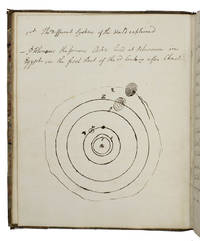
1820ABC_45977England 1820. Late 18th-century half calf marbled sides. 4to. Manuscript volume of notes on practical astronomy and mathematics in English written in ink on Dutch paper with a Maid of Dordrecht watermark without countermark. The leaves are numbered from the front 101 and 26 leaves of text and diagrams 39 blank leaves in the middle last 26 leaves in reverse order illustrated with several astronomical and mathematical diagrams including one of a solar system. A fascinating manual of astronomy written in English particularly as it relates to the form of the motions of the heavens dating from the period 1780-1825 probably from the beginning of that range. It is written in a single hand with the exception of one page though with some variations indicating that different parts of the MS were written at different times. The MS could have been prepared for personal use or as part of public tuition probably the former. The writer summarizes the subject matter of the manual on the first leaf: Astronomy is that part of Natural Philosophy which treats of the Phenomena of the heavenly Bodies. It is divided into 2 Parts Physical and Plain: by the latter we discover their Motions from the Apparent Motions; by the former the Causes of these real Motions. The manuscript comprises three parts with distinct subject matter. The first part covers the motion of the earth around the sun and its rotation about its axis with the consequences for the apparent motions of the sun and the heavens; with the moon and its phases and motion; and with lunar and solar eclipses. There are several references to John Keills An introduction to the true astronomy London 1721 or later editions. The second part principally discusses section 11 of Newtons Principia 1713 or later editions in particular as it relates to the motion of the moon. This part ends with a short section on algebra particularly polynomials which seems to have been composed more haphazardly than the remainder of the text. The third part which runs backwards starting from the end of the notebook gives demonstrations of various results in Book I of Principia notably the theorem that the orbits of the bodies in the solar system do not precess if and only if the central attractive force operating on them is exactly inverse-square. This is an important result not only for Newtons system of universal gravitation but also for the observational astronomy of the solar system which is discussed in the opening section of the book. Between the end of the second part and that of the third there are a few blank leaves and others have been torn out but the text appears to be complete.The manuscript appears to work through at least two different texts beginning with Keills on astronomy. There is a section devoted to what is called the precession of the equinoxes the westward drift of the points where the ecliptic and equator intersect due to the precession of the earths axis - the author notes that Sir Isaac Newton has demonstrated that it arises from the broad spheroidal figure of the earth. The author then turns to sunspots and the arguments for and against their being on the surface of the sun. Then comes a long discussion of the planets: the planes and periods of their orbits phases conjunctions retrograde motions apparent brightness and their distances from the sun. The second and third parts are notably more mathematical in nature than the first.The third part of the manuscript consists of a reading of various sections of Newtons Principia 1713 or later editions. Again it appears to work through and in some cases repeat Newtons proofs rather than representing a translation or paraphrase. It is not based on Mottes translation nor does it correspond with Thorps partial translation and edition. It does not appear to be based on any other intermediary between Newton and the writer such as Pemberton but to rely on Newtons Latin original here rendered in places pretty exactly into English. It renders propositions 43 to 59 of section 9 of book 1 of the Principia which concern the motion of bodies in moveable orbits and the motion of the apsides. This topic remains of considerable interest to astronomers and historians of astronomy. The manuscript hand remains fairly constant throughout the book: some variations more likely indicate the same writer at a different times or with a different pen than a different writer. The manuscript hand and paper together date the manuscript fairly securely to the period 1750-1825. If our hypothesis that the author used Thorps edition of Principia is correct that would date the manuscript no earlier than 1777. The section on the planets in the first part does not mention Uranus Georgium sidus discovered by William Herschel in 1781. Since the anonymous author seems to have followed astronomical discoveries closely this suggests a date no later than 1781. We therefore tentatively date the composition ca. 1777/81.We are indebted to Scott Mandelbrote for his assistance with the description of this notebook.Binding slightly rubbed. A couple pages have a tear at the foot and others are stained. Otherwise in very good condition. unknown
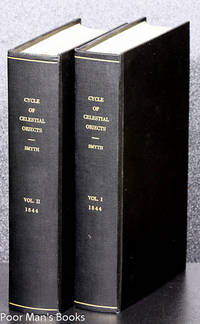
184433052London: John W. Parker. Very Good with no dust jacket. 1844. First English Edition. Hardcover. B&W Illustrations; 8vo 8" - 9" tall; viiii45164pp. ads; xx560 pages; Numerous text illustrations. Half-titles; publisher's 4-page catalogue at end of Volume 2. 2 volumes. 8vo modern gilt-lettered black cloth; old institutional stamps on titles. First edition of a classic guide to amateur astronomy. The first volume is a general introduction to the subject; the second known as the Bedford Catalogue records 850 objects seen from the author's private observatory at Bedford. A career naval officer Smyth 1788-1865 devoted his attention to astronomy from 1830 onward. One of his sons was Charles Piazzi Smyth 1819-1900 astronomer royal for Scotland. BEA page 1070. Illustrated with a large number of textural engravings and drawings. . John W. Parker hardcover
1882039051Washington: Bureau Of Navigation Navy Department. 1882. 1st Edition 1st Printing. Hardcover. Near Fine. Xiv 487 Pp. Clean Pages Slightly Aged In A Modern Sturdy Blue Cloth Binding Spine Gilt By Tassinari Bros. Of Indian Orchard Ma. Light Wear. Two New Hampshire Institutional Stamps. Simon Newcomb 1835 -1909 Was A Canadian-American Astronomer Applied Mathematician And Autodidactic Polymath. Newcomb Visited Paris France In 1870 Already Aware That The Table Of Lunar Positions Calculated By Peter Andreas Hansen Was In Error. While In Paris He Realized That In Addition To The Data From 1750 To 1838 That Hansen Had Used There Was Further Data Stretching As Far Back As 1672 And Newcomb Used The "New" Data To Revise Hansen's Tables. In 1878 Newcomb Started Planning For A New And Precise Measurement Of The Speed Of Light Using A Refinement Of The Method Of Léon Foucault. A Letter From Albert Abraham Michelson Began A Long Collaboration And Friendship. In 1880 Michelson Assisted At Newcomb's Initial Measurement But Michelson Left To Start His Own Project. Miichelson Published His First Measurement In 1880 Reprinted Here But Newcomb's Measurement Was Substantially Different And In 1883 Michelson Revised His Measurement To A Value Closer To Newcomb's. In 1881 Newcomb Discovered The Statistical Principle Now Known As Benford's Law Formulating The Principle That In Any List Of Numbers Taken From An Arbitrary Set Of Data More Numbers Will Tend To Begin With "1" Than With Any Other Digit. In 1891 Within Months Of Seth Carlo Chandler's Discovery Of The 14-Month Variation Of Latitude Now Referred To As The Chandler Wobble Newcomb Explained The Apparent Conflict Between The Observed Motion And Predicted Period Of The Wobble As Due To Elasticiity; He Used The Variation Of Latitude Observations To Estimate The Elasticity Of Earth Finding It To Be Slightly More Rigid Than Steel. He Wrote On Economics And His Principles Of Political Economy 1885 Was Described By John Maynard Keynes As "One Of Those Original Works Which A Fresh Scientific Mind Not Perverted By Having Read Too Much Of The Orthodox Stuff Is Able To Produce From Time To Time In A Half-Formed Subject Like Economics." He Was Credited By Irving Fisher With The First-Known Enunciation Of The Equation Of Exchange Between Money And Goods Used In The Quantity Theory Of Money. His Reputation Suffers From His Hostility To C. S. Pierce And Also From Newcomb's Disbelief In The Possibility Of Manned Flight. Source: Wikipedia. Albert A. Michelson 1852-1931 Performed Early Measurements Of The Velocity Of Light With Amazing Delicacy And In 1881 He Invented His Interferometer For The Purpose Of Discovering The Effect Of The Earth's Motion On The Observed Velocity. In Cooperation With Professor E.W. Morley And Using The Interferometer It Was Shown That Light Travels At A Constant Speed In All Inertial Systems Of Reference. The Instrument Also Enabled Distances To Be Measured With Greater Accuracy By Means Of The Length Of Light-Waves. At The Request Of The International Committee Of Weights And Measures Michelson Measured The Standard Metre In Terms Of Wavelength Of Cadmium Light. He Invented The Echelon Spectroscope And During His Wartime Service In The Navy He Performed Research Work On Devices For Naval Use - He Developed A Rangefinder Which Was Adapted As Part Of U.S. Navy Equipment. On His Return To Civilian Life Michelson Became More Interested In Astronomy And In 1920 Using Light Interference And A Highly Developed Version Of His Earlier Instrument He Measured The Diameter Of The Star Betelgeuse: This Was The First Determination Of The Size Of A Star That Could Be Regarded As Accurate. He Was The First American To Receive The Nobel Priize For Physics. Nobel Lectures Physics 1901-1921 Elsevier Publishing Company Amsterdam 1967. With 1985 Purchase Receipt Of Space Scientist Richard E. Bateman From Astronomy Book Dealer Paul Luther. <br/> <br/> Bureau Of Navigation, Navy Department. hardcover
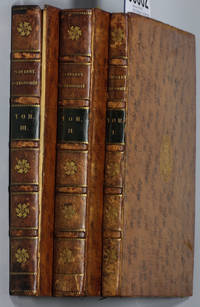
182235002St Petersbourg Russia: L'Academie Imp. Des Sciences. Good with no dust jacket. 1822. First Edition. Hardcover. Quite beautiful full calf leather. 10 folding engraved plates. 8 xvi 286; 4 x 568; 4 viii 524 pages including half-titles. 3 volumes. 4to 256x214 mm contemporary calf gilt with Signet Library arms on covers Volume 3 front cover detached others covers starting; minor foxing on Volume 1 opening leaves. St. Petersburg: Imprimerie de l'Académie Impériale des Sciences 1822. First edition in French of Schubert's 1798 Theoretische Astronomie. Houzeau & Lancaster 11811. Paper stamps inside front covers Libraire Alain Brieux withdrawn. According to Google this was a bookstore of Science and medicine. Printed in Russian Empire under the rule of Alexander I Tsar of Russia 18011825 who ruled during the chaotic time of the Napoleonic Wars. He died without issue and the Decembrist revolt of liberal army officers resulted in his brother Nicholas I being crowned. From the GUTZWILLER ASTRONOMY &SCIENCE BOOKS collection. . L'Academie Imp. Des Sciences hardcover
1842SZEPEBKS007872IToledo: J. de Cea 1842. Hardcover. Near Fine. 16mo. - 4782 pp. - Contemporary full leather spine with 3 bands and title in gilt on leather label. - Marbled endpapers. - With "Fe de algunas erratas mas principales" on last page. - With engraved bookplate in red and black of Armando Colarelo Valledor. - Very fine. - The Spanish astronomer and mathematician Jose REGUERO ARGUELLES 1803-1853 of Asturias established his fame with the present work and later he also published a three-volume "Astronomia fisca" 1850-51. - Armando Colarelo Valledor 1879-1850 was a prolific Spanish playwright and literary critic. - Very rare: WorldCat gives only two locations Biblioteca Nacional de Espana Madrid and Red de LecturaPublica de Euskadi. Vitoria -gazteiz <br/> <br/> J. de Cea hardcover
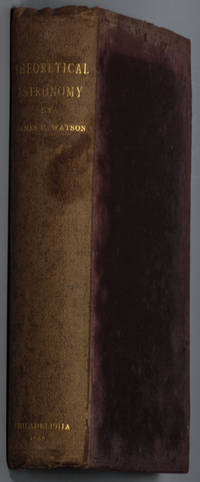
186835004N Y: Lippincott. Very Good with no dust jacket. 1868. First Edition. Hardcover. 662 pages. 8vo 255x165 mm original cloth spine faded and stained peripheral discoloration on covers; scattered minor spotting. Small loss tocloth covering towards bottom of front hinge. Hinges binding and text block quite solid. First edition of the author's major work. 'It established Watson as one of the leading American experts in celestial mechanics and orbital theory' ANB. BEA pages 1198-99; Houzeau & Lancaster 11822. PROVENANCE-Astronomy and Science Books from the Collection of Martin C. Gutzwiller. . Lippincott hardcover
187197507New Haven: Printed by Tuttle Morehouse & Taylor 1871. 1871. Good. THE FIRST APPEARANCE OF THE ESSAY "ON JUPITER AND ITS SATELLITES" BY THE FIRST FEMALE ASTRONOMER IN THE U.S.A. - Octavo 8-1/2 inches high by 5-3/8 inches wide. The contemporary brown calf and marbled boards are detached but present and the spine has perished and is thus lacking. The text block is intact and tight. 978 pages in all with the pagination as follows: Volume I: pages i-viii & 1-484; and Volume II: pages i-viii & 1-480. Pages 327/328 are skipped in numbering as published which collates with the copy at the Peter H. Raven Library at the Missouri Botanical Garden. The volume is illustrated with 3 plates including one folding as well as several textual illustrations. Although the title page to the second volume indicates the presence of a map intended to illustrate E.W. Hilgard's article "On the Geological History of the Gulf of Mexico" page 391 the map is not here present if it ever was included. The endpapers are foxed and there is some light soiling to the title page of the first volume. The edges of the first few leaves are lightly darkened with a tiny spot of dampstaining to the top edge of those leaves. A very good tight copy which would be well worth rebinding. <p>Most noteworthy is the first publication of Maria Mitchell's essay "On Jupiter and its Satellites" illustrated with a plate volume I pages 393-395.<p>The first American scientist to discover a comet Maria Mitchell 1818-1889 was the first female astronomer in the United States. Working as the librarian of the Nantuckett Atheneum Maria Mitchell read through the day and spent her nights with her father at the observatory he built atop the Pacific Bank. Her discovery in 1847 of the comet which came to be named "Miss Mitchell's Comet" brought her international acclaim. She was awarded a gold medal by King Frederick of Denmark and elected as the first woman to join the American Academy of Arts and Sciences the following year. Mitchell traveled throughout Europe after leaving the Atheneum in 1856 meeting with astronomers the world over. She became involved and active in the anti-slavery movement and the suffrage movement and was subsequently instrumental in the formation of the American Association for the Advancement of Women. After the Civil War Mitchell was recruited to join the faculty at Vassar College where with a 12 inch telescope then the third largest in the US she specialized in studying the surfaces of Jupiter and Saturn. She made waves by encouraging her female students to come out at night for classes and celestial observations and brought in noted feminists including Julia Ward Howe to speak on political issues. Continuously championing the advancement of women she gave an important speech entitled "The Need for Women in Science" during the 1876 centennial. Mitchell was one of only 3 women to be elected to the Hall of Fame of Great Americans in 1905. She was also inducted into the National Woman's Hall of Fame in Seneca Falls New York. A lunar crater on the moon was named in her honor.<p>Also worth noting is Professor L. Respighi's essay "On the Solar Protuberances" illustrated with a folding plate volume I pages 283-287.<p>The Italian astronomer Lorenzo Respighi 1824-1889 was appointed appointed professor of mechanics and hydraulics at the University of Bologna. In that context his first works were mathematical and included a well-known memoir on the principles of differential calculus. Captivated by astronomy he succeeded Calandrelli as director of the astronomical observatory at the University of Bologna in 1855. After making observations on comets Respighi became director of the Campidoglio observatory in Rome where he devoted his attention to studying solar phenomena. His studies of the spectra of sunspots were particularly important as he observed the splitting of the absorption lines later described by Hale as the result of the Zeeman effect.<p>Henry James Clark's essay "The American Spongilla a Craspedote Flagellate Infusorian" illustrated with a plate is here published on pages 426 through 436 of volume II.<p>The American naturalist Henry James Clark 1826-1873 was a pupil of Asa Gray at the Cambridge botanical garden. He became an assistant to Louis Agassiz after graduating from Harvard and was professor of Zoology and of Natural History at numerous colleges and universities. From 1872 until his death in 1873 Clark was Professor of Veterinary Science at the Massachusetts Agricultural College in Amherst Massachusetts. He contributed to a number of periodicals and authored "Mind in Nature" 1863 and "Mode of Development of Animals" 1865. New Haven: Printed by Tuttle, Morehouse & Taylor, 1871. hardcover
1803046362Philadelphia: Published by Jacob Johnson 1803. First American Edition . Hardcover. Good. 16mo - over 5¾ - 6¾" tall. 16mo. 137 3 pages. Hardcover bound in original full brown leather. The binding shows wear and bumping but is sound with rubbed but secure hinges. Headcap of the spine is chipped. Small wormhole near the foot of the spine. Complete with endpapers and illustrated with 5 full-page copperplate engravings collates complete as well as several smaller text woodcuts. Early owner's signature on the recto of the frontis reads "Solomon Mordecai / Warrenton North Carolina Jan.y. 1st 1804." Another early signature for "Jos. Mordecai" is at the top of the title page. The Mordecai family was an important Jewish family in eastern North Carolina in the late 18th and early 19th centuries. Jacob Mordecai founded the Warrenton Female Academy in 1809 and was assisted by his son Solomon and several daughters. This title was first published in 1761 by John Newbery in England thought to have actually be written by Oliver Goldsmith under the pseudonym of Tom Telescope. It was a science book written for youth. This is the First American edition. The Second American edition of 1808 is much more common. The "Teacher of Philadelphia" referred to on the title page is believed to have been Robert Patterson Professor of Mathematics at the University of Pennsylvania. This is a decent sturdy copy of a rare and important edition. <br/> <br/> Published by Jacob Johnson hardcover
180542389London W. Bulmer and Co. 1805. 4to. No wrappers as extracted from "Philosophical Transactions" 1805 - Part I. Pp. 31-64 and 1 engraved plate. Clean and fine. <br/><br/><em>First appearance of an importent paper founding the metric of interstellar space.It was the contemporous discoveries of the first minor planets ceres in 1801 Pallas in 1802 and Juno in 1803 that prompted Herschel to investigate the origin of the spurious diameters of stars. "Were their apparent diameters as real as those of planets or spurious as for stars To address this question Herschel conducted an extensive series of experiments in his garden in Slough examining through his telescope small globules of differing sizes and materials placed in a tree some 800 ft ca. 244 m away Herschel 1805. His observations showed that for the smallest globules the diameters were all spurious and all of the same size. Furthermore he found that if just the inner part of the aperture of the telescope were used the spurious diameters whether of globules or of stars were larger. If the whole aperture was employed the diameters were smaller and if only an outer annular aperture was used the diameters were smaller still. This experimental discovery that unfilled apertures can be used to obtain high angular resolution remains today the essential basis for interferometric imaging in astronomy in particular Aperture Masking Interferometry. The theoretical justification of this result came with Airy's analysis of the diffraction pattern of a circular aperture 30 years later Airy 1835 and it took a further 30 years before the idea of using multiple apertures was developed. In an early study the Reverend W. R. Dawes noted that he had `frequently found great advantage from the use of a perforated whole aperture' and that when observing Venus this produced `a central image of the planet perfectly colourless and very sharply dened' Dawes 1866. But it was left to Fizeau in his submission to the Commission for the Prix Bordin the following year to remark on `une relation remarquable et n´ecessaire entre la dimension des franges et celle de la source lumineuse' and suggest that by using an interferometric combination of light from two separated slits `il deviendra possible d'obtenir quelques donn´ees nouvelles sur les diametres angulaires de ces astres' Fizeau 1868." </em> unknown
180545883London W. Bulmer and Co. 1805. 4to. No wrappers as extracted from "Philosophical Transactions" 1805 - Part I. Pp. 31-64 and 1 engraved plate. Clean and fine. <br/><br/><em>First appearance of an importent paper founding the metric of interstellar space.It was the contemporous discoveries of the first minor planets ceres in 1801 Pallas in 1802 and Juno in 1803 that prompted Herschel to investigate the origin of the spurious diameters of stars. "Were their apparent diameters as real as those of planets or spurious as for stars To address this question Herschel conducted an extensive series of experiments in his garden in Slough examining through his telescope small globules of differing sizes and materials placed in a tree some 800 ft ca. 244 m away Herschel 1805. His observations showed that for the smallest globules the diameters were all spurious and all of the same size. Furthermore he found that if just the inner part of the aperture of the telescope were used the spurious diameters whether of globules or of stars were larger. If the whole aperture was employed the diameters were smaller and if only an outer annular aperture was used the diameters were smaller still. This experimental discovery that unfilled apertures can be used to obtain high angular resolution remains today the essential basis for interferometric imaging in astronomy in particular Aperture Masking Interferometry. The theoretical justification of this result came with Airy's analysis of the diffraction pattern of a circular aperture 30 years later Airy 1835 and it took a further 30 years before the idea of using multiple apertures was developed. In an early study the Reverend W. R. Dawes noted that he had `frequently found great advantage from the use of a perforated whole aperture' and that when observing Venus this produced `a central image of the planet perfectly colourless and very sharply dened' Dawes 1866. But it was left to Fizeau in his submission to the Commission for the Prix Bordin the following year to remark on `une relation remarquable et n´ecessaire entre la dimension des franges et celle de la source lumineuse' and suggest that by using an interferometric combination of light from two separated slits `il deviendra possible d'obtenir quelques donn´ees nouvelles sur les diametres angulaires de ces astres' Fizeau 1868." </em> unknown
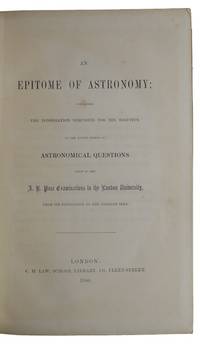
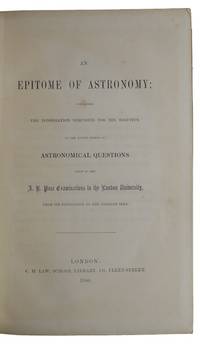
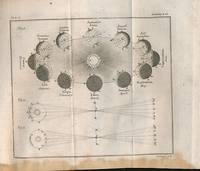
1853TA4<p>8vo. 6 9-58pp complete despite this apparent pagination jump which is found in all copies. With ten lithographed plates lettered A-D and numbered I-VI. Original publisher's blind-stamped blue cloth. Slightly rubbed to extremities offsetting to glassine interleaving else a crisp copy. Inscribed 'To Fred Bone with the donor's best wishes. Percy House Christmas 1864' to FFEP.</p><p>A rare and fabulously illustrated series of answers designed for students of the A.B. Pass examinations in the early years of the London University founded as a secular alternative to Oxford and Cambridge in 1835. The authorship not explicitly stated is inferred from the preface - which is signed Grove School York where the schoolmaster and popular text-book writer John Tabor taught - notes the work is excerpted and extended from 'An Outline of the London University Course of Mathematics containing the Questions Solutions" &c'. Moreover the plates lettered A-D are captioned 'From a Series of Drawings by J. Tabor Grove School York'.</p><p>The thoroughly detailed model answers include significant reference to the planets of our solar system including the then recent discovery of Neptune 'justly considered one of the greatest achievements of mathematical science. Its existence was simultaneously inferred by Adams and Le Verrier from some irregularities which were noticed in the motion of Uranus'.</p><p>COPAC and OCLC together locate copies at just four British institutions BL Cambridge Oxford and NLS and none elsewhere.</p> C.H. Law, School Library. hardcover
1853AQ26197London: C.H. Law School Library 1853. 6 9-58pp complete despite this apparent pagination jump which is found in all copies. With ten lithographed plates lettered A-D and numbered I-VI. Original publisher's blind-stamped blue cloth. Slightly rubbed to extremities offsetting to glassine interleaving else a crisp copy. Inscribed 'To Fred Bone with the donor's best wishes. Percy House Christmas 1864' to FFEP. A rare and fabulously illustrated series of answers designed for students of the A.B. Pass examinations in the early years of the London University founded as a secular alternative to Oxford and Cambridge in 1835. The authorship not explicitly stated is inferred from the preface - which is signed Grove School York where the schoolmaster and popular text-book writer John Tabor taught - notes the work is excerpted and extended from 'An Outline of the London University Course of Mathematics containing the Questions Solutions" &c'. Moreover the plates lettered A-D are captioned 'From a Series of Drawings by J. Tabor Grove School York'. The thoroughly detailed model answers include significant reference to the planets of our solar system including the then recent discovery of Neptune 'justly considered one of the greatest achievements of mathematical science. Its existence was simultaneously inferred by Adams and Le Verrier from some irregularities which were noticed in the motion of Uranus'. COPAC and OCLC together locate copies at just four British institutions BL Cambridge Oxford and NLS and none elsewhere. . First edition. 8vo. C.H. Law, School Library hardcover
1883035730London: Macmillan And Co. 1883. 1st Edition 1st Printing. Hardcover. Near Fine. Plates. Xx 111 Pp. Salmon Cloth Gilt; Black Endpapers. First Printing. Lightly Used No Fraying Gilt Bright Hinges Very Tight Pages Crisp. Presentation Inscription From The Author To The Duke Of Bedford With An Additional Letter Of 23 April 1883 From Siemens To The Duke Francis Charles Hastings Russell 9Th Duke Of Bedford Kg 1819 -1891 The Dedication Is Dated April 4 1883 2 Pp. An Early British Essay On The Dynamics Of Solar Radiation With Reprinting Of Many Scientific Comments Thereupon. Per Wikipedia Charles William Siemens 1823- Received His Education At The Gymnasium Of Lubeck The Art School Of Madgeburg And The University Of Gottingen. In 1843 He Visited England And Again Came To England To Patent An Invention Becoming Naturalized Subject In 1859. In 1851 Mr. Siemens Introduced His Water-Meter. Between The Years 1856 And 1861 Mr. Siemens In Conjunction With His Brother Frederick Worked Out The Regenerative Gas Furnace. Siemens Became Interested In Telegraph Engineering And In 1858 He Established With His Brother Werner Siemens Mr. Halske Of Berlin And His Brother Carl Siemens The Firm Siemens Halske And Co. With Telegraph Works In London Laying Cable Throughout The World. Siemens Presented Many Scientific Papers To British Societies. His First Paper Was Presented To The Institution Of Civil Engineers On The 17Th Of May 1853 And Was Entitled "On The Conversion Of Heat Into Mechanical Effect." It Was The First Paper Published In Great Britain Which Considered The Subject Of Heat Engines From The Point Of View Of The Mechanical Theory Of Heat And Although A Quarter Of A Century Has Nearly Elapsed Since It Was Read It May Be To-Day Taken As A Guide To The Subjects To Which It Has Reference. Between This Period And 186O He Described His Governor Steam Engine And Water-Meters In Papers To The Institution Of Mechanical Engineers. On The 14Th February 1867 Was Read His Paper "On The Conversion Of Dynamical Into Electrical Force Without The Aid Of Permanent Magnetism" Which Is Peculiarly Interesting As Being The First Scientific Enunciation In The Uk Of The Dynamo-Electric Principle Upon Which The Most Powerful Light Producing Machines Depended. Another Scientific Paper Presented By Him To The Same Society In 1871 "On Electrical Resistance" Was Made The Bakerian Lecture For That Year. It Treats Of A Method Of Measuring Variation Of Temperature By Variation Of Electrical Resistance; And The New Instruments Described In This Paper The Electrical Resistance Thermometer And Pyrometer In Connection With The Differential Voltameter Became Appreciated As Valuable Auxiliaries In Thermometry And In Metallurgical Research. The Society Of Arts Presented Him With Its Gold Medal For His Regenerative Condenser In The Year 1850 And The Institution Of Civil Engineers In The Session 1852-53 With Its Telford Medal For The Paper Already Referred To. In 1851 And 1862 Dr. Siemens Received Prize Medals Of The London Exhibition And In 1867 Was Awarded A Grand Prix At The Universal Exhibition Of Paris For His Regenerative Gas Furnace And Steel Process. In 1869 The Degree Of Doctor Of Civil Law Honoris Causd Was Conferred Upon Him By The University Of Oxford And In 1874 He Received The Royal Albert Medal For His Researches On Heat And For His Metallurgical Processes. In 1875 He Received The Bessemer Medal Of The Iron And Steel Institute "In Recognition Of The Valuable Services He Has Rendered To The Iron And Steel Trades By His Important Inventions And Investigations." <br/> <br/> Macmillan And Co. hardcover
183126848Berlin: Akademische Druckerei. Very Good. 1831. First Edition. Original Wraps. An attractive first edition of Hansen's first major work incl. Addendum Nachschrift on pp 316 - 326 in original blue wrappers; many leaves still unopened. Some very minor spotting on a few leaves; The study of the mutual perturbations of Jupiter and Saturn by professor and theoretical astronomer Peter Andreas Hansen 1795-1874 director of Ernestinische Sternwarte in Seeberg prized by the Royal Academy of Sciences in Berlin July 8 1930; 4to; xvi 326 2 pages; DSB VI p. 103. § DSB VI p. 103; Poggendorff I 1013; Cat. Of Crawford Library p. 220; not in Houzeau-Lancaster. . Akademische Druckerei paperback
181155122London: Printed for J. Johnson and co. St. Paul’s Churchyard 1811. 8vo. viii 384 pp. Copper-engraved frontisp. 19 copper-engraved plates most folding. Black half-calf over marbled boards gilt lettering on spine rebacked minor wear to corners rubbing occasional light foxing still VG copy from the library of Charles Douglas Halford 1793-1865 attended Cambridge and finished MA by 1826 East Bergholt Suffolk squire. Sixth revised & expanded edition of Bonnycastle’s 1751-1821 informative work astronomy and astronomical instruments. His astronomy textbook first issued in 1786 was designed for students without a mathematical background and proved so popular it continued to be used until the 1820s. Printed for J. Johnson and co., St. Paul’s Churchyard, hardcover
1810d1090bLondon: Dudley Adams. G : in Good condition without dust jacket. Cover rubbed scuffed and stained. Heavy marginal staining in early pages. Some foxing. Marginal staining to some plates. 1810. 30th Edition. Brown hardback half-leather cover with marbled boards. 210mm x 130mm 8" x 5". xxiv 242pp. 14 b/w plates some folding. . Dudley Adams hardcover
1856D16855Boston: Little Brown and Company 1856. First Edition. Paperback. Good. 8vo. Original tan printed wrappers; rear wrapper detached. 50pp. First Edition. Inscribed by the author to John Pendleton Kennedy American writer and friend of E. A. Poe. Everett was a U.S. Senator and a great orator. It was his address on the field of Gettysburg that preceded the most famous address in U.S. history by Lincoln. In the present oration Everett discusses Charles Babbages newly developed Calculating Engine wherein he mentions asking Babbage if the device could ever be made small enough to one day to fit in ones own pocket. <br/><br/> Little, Brown and Company paperback
185395440London: John Weale 1853. 1853. Fair. FROM THE LIBRARY OF THE SCOTTISH-AMERICAN ASTRONOMER WILLIAM HARKNESS SIGNED BY HIM - Octavo 7-3/8 inches high by 4-1/2 inches wide. Three-quarter black leather & marbled boards titled in gilt with raised bands on the spine. The covers are rubbed and the leather is scuffed. The rear cover is detached. 279 pages illustrated with textual diagrams. There is offsetting to the endpapers and pastedowns with minor chipping to the edges of the endpapers. The edges of the title page are darkened and the pages are toned. A complete copy of the rare first edition well worth rebinding. <p>First edition.<p>A wonderful association copy from the library of the Scottish-born American astronomer William Harkness with his name and the date "April 26th 1858" signed in pencil on the front pastedown. 1858 was the year he graduated from the University of Rochester.<p>The Scottish-born American astronomer William Harkness 1837-1903 studied at LaFayette College and the University of Rochester before pursuing further studies in medicine in New York City. A surgeon in the Union armies during the Civil War he also served as an aid in astronomy at the United States Naval Observatory and subsequently on the USS Monadnock. He discovered the coronal line K1474 while observing the August 1869 solar eclipse. As a member of the Transit of Venus Commission he was in charge of the group at Hobart Tasmania in 1879 and subsequently of that in Washington in 1882. Harkness contributed to the construction and improvement of telescopes and invented several astronomical instruments including the spherometer caliper. He went on to serve as astronomical director of the Naval Observatory from 1894 through 1899 and director of the Nautical Almanac from 1897 through 99 and was president of the American Association for the Advancement of Science. His published works include "The Solar Parallax and its Related Constants" 1891. London: John Weale, 1853. hardcover
1865036982London: Longmans Green & Co. 1865. 5th or later Edition . Hardcover. Near Fine. Plates. Xiv 731 Pp. 9 Plates. Eighth Edition The Last Issued In Herschel's Lifetime. Full Red Morocco 5 Raised Bands Black Morocco Spine Label Full Gilt In Other Compartments Covers With Gilt And Blindstamped Rules At Borders With Gilt Devices At Corners All Edges Of Boards Gilt Marbled Endpapers And Matching Marbled Edges Of Page Block. Binding Bright And Clean Hinges Tight Small Professionally Repaired Fray At Lower Rear Tip And Tiny Repairs At Other 3 Tips. Contents Immaculate. No Names Or Marks Or Bookplates. <br/> <br/> Longmans, Green & Co. hardcover
1843025510Leipzig: Weidmann'sche Buchhandlung 1843. First Edition . Quarter Cloth. Very Good. 8 3/4" Tall. Xx 315 I Errata 2 Double Page Folding Charts At End. Original Brown Cloth Spine Printed In Gilt Brown Marbled Paper Covered Boards Cloth Tips. Worn Along Top And Bottom Of Spine With A Little Loss A Few Small Losses Of Paper Along Edges Of Boards Covers Clean Contents Clean Small Stamped Seal Of P. Andries Astronomer And Name Stamp Of Later American Author Both On Front Endpaper No Other Names Or Marks Pages Clean With Just A Little Faint Foxing. <br/> <br/> Weidmann'sche Buchhandlung hardcover
1867039052Cambridge / Washington: Welch Bigelow And Company 1860 / Washington Observations For 1865 1867 1867. 1st Edition 1st Printing. Hardcover. Very Good . Pp 123-1520; 29Pp. The First Paper Is An Offprint Of An Article In The Memoirs Of The American Academy New Series Vol V 1860 Preserving The Prited Cover With Title Etc.; The Second Paper Is Extracted From Washington Obervations For 1865 1867. The Two Papers Were Bound Together As Part Of A Larger Compilation. Simon Newcomb 1835 -1909 Was A Canadian-American Astronomer Applied Mathematician And Autodidactic Polymath. Newcomb Visited Paris France In 1870 Already Aware That The Table Of Lunar Positions Calculated By Peter Andreas Hansen Was In Error. While In Paris He Realized That In Addition To The Data From 1750 To 1838 That Hansen Had Used There Was Further Data Stretching As Far Back As 1672 And Newcomb Used The "New" Data To Revise Hansen's Tables. In 1878 Newcomb Started Planning For A New And Precise Measurement Of The Speed Of Light Starting Development A Refinement Of The Method Of Léon Foucault. A Letter From Albert Abraham Michelson Began A Long Collaboration And Friendship. In 1880 Michelson Assisted At Newcomb's Initial Measurement But Michelson Left To Start His Own Project. Miichelson Published His First Measurement In 1880 But Newcomb's Measurement Was Substantially Different And In 1883 Michelson Revised His Measurement To A Value Closer To Newcomb's. In 1881 Newcomb Discovered The Statistical Principle Now Known As Benford's Law Formulating The Principle That In Any List Of Numbers Taken From An Arbitrary Set Of Data More Numbers Will Tend To Begin With "1" Than With Any Other Digit.I N 1891 Within Months Of Seth Carlo Chandler's Discovery Of The 14-Month Variation Of Latitude Now Referred To As The Chandler Wobble Newcomb Explained The Apparent Conflict Between The Observed Motion And Predicted Period Of The Wobble As Due To Elasticiity; He Used The Variation Of Latitude Observations To Estimate The Elasticity Of Earth Finding It To Be Slightly More Rigid Than Steel. He Wrote On Economics And His Principles Of Political Economy 1885 Was Described By John Maynard Keynes As "One Of Those Original Works Which A Fresh Scientific Mind Not Perverted By Having Read Too Much Of The Orthodox Stuff Is Able To Produce From Time To Time In A Half-Formed Subject Like Economics." He Was Credited By Irving Fisher With The First-Known Enunciation Of The Equation Of Exchange Between Money And Goods Used In The Quantity Theory Of Money. His Reputation Suffers From His Hostility To C. S. Pierce And Also From Newcomb's Disbelief In The Possibility Of Manned Flight. Source: Wikipedia. <br/> <br/> Welch, Bigelow, And Company (1860) / Washington Observations For 1865 (1867) hardcover
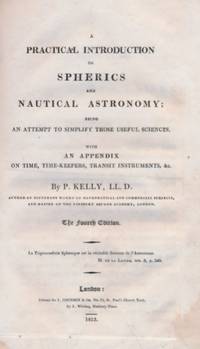
18130678aLondon: J Johnson. G : in Good condition without dust jacket. Cover rubbed with 1" split at top of front hinge. Occasional light foxing. 1813. Fourth Edition. Brown hardback leather cover. 240mm x 150mm 9" x 6". pp. 232 xvi plates. 20 b/w plates - 8 fold-out. Dedicated to Nevil Maskelyne. Includes a section on time. . J Johnson hardcover
1883056279Nedw York Ny: Henry Holt 1883. 3rd Edition 1st Printing. Hardcover. Near Fine. X 338 Pp. Green Cloth Spine Gilt Cover Lettered In Blind Brown Endpapers. A Revision Of "Astronomy" Of The American Dcience Series Leaving Out Some Material About The Techniques Of Astronomy. 1883 Date On Title Page And Copyright ;Page Apparently The Third And Last Revised Edition But No Copy Shown By Worldcat. Near Fine Pencil Ownership Name And Class List. In Jacksonville. <br/> <br/> Henry Holt hardcover
18561620Albany: Charles van Benthuysens Print 1856. First Edition. Engraved Portrait after a photograph by Mathew Brady. 1 vols. 8vo. Later 3/4 brown morocco over marbled boards spine gilt with raised bands bound by Stikeman. Extremities slightly rubbed; a Very Good copy. First Edition. Engraved Portrait after a photograph by Mathew Brady. 1 vols. 8vo. In addition to the "Discourse" by Everett this book issued in honor of the dedication of the Dudley Observatory at Albany contains various speeches and a long poem dedicated to the American Association for the Advancement of Science by Alfred B. Street. The speeches include a eulogy by Washington Hunt and remarks by A. B. Gould Benjamin Pierce and A.D. Bache. The Observatory had not as yet been built when this book was published. This was simply it seems a celebration of sorts given in honor of the donors of funds to build it. Mr. Dudley's widow to whom the discourse is dedicated was the most generous of donors pledging the then enormous sum of $12000. Although other editions of the "Discourse" with condensations of the events appear in NUC there seems to be no copy of this edition located. Charles van Benthuysens Print unknown